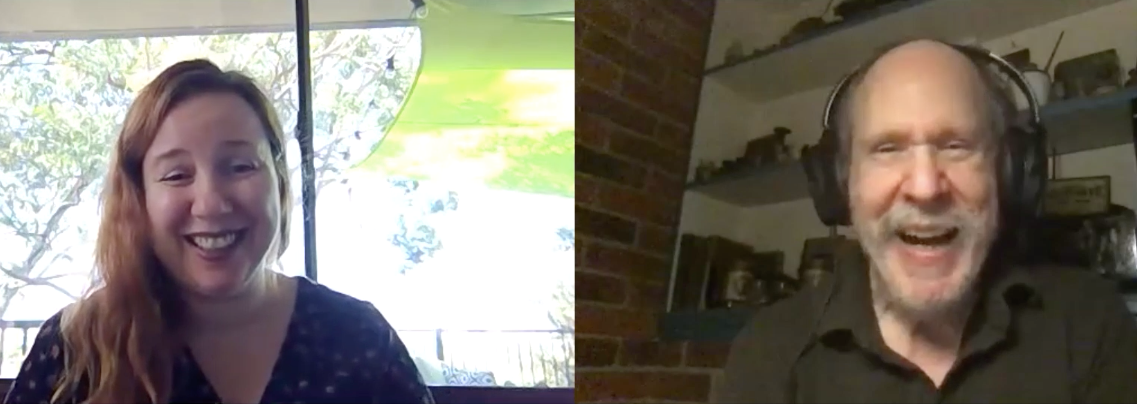
Chuck Todd interviews me about alternate histories
Showing posts with label Robert Christgau. Show all posts

Saturday, February 28, 2026

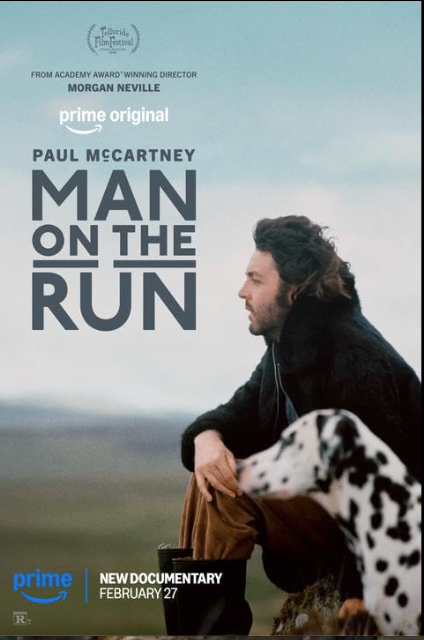
Man on the Run: The Rocky Flight of Wings


My wife and I saw Man on the Run, a nearly 2-hour documentary on Amazon Prime, about Wings, Paul McCartney's group that flew around the world from shortly after The Beatles broke up in early 1970 to shortly after John Lennon was murdered at the end of 1980, making a Beatles reunion forever impossible.

Let me say that I've always thought Wings at their best -- "Let Me Roll It," "Band on the Run," "Jet," "Mull of Kintyre," and "Live and Let Die"-- was every bit as good as The Beatles at their best, which is actually a huge lot better than good.  And like all the recent Beatles documentaries, the sound in this documentary was great, and an outright pleasure to hear.

The story, though, was no pleasure to see.  A sadness hung over the movie, and not just because we knew it would conclude close after Lennon's assassination.   But we see Paul McCartney's struggle, beginning with his attempt to get the world to see, back then, and continuing now, that Lennon had announced to the band much earlier than McCartney did to the world that The Beatles were over.  In part, McCartney's problem was the way in which he made that announcement, in an interview he conducted with himself, in which he even took a shot at poor Ringo, proclaiming McCartney wouldn't miss him.

The result was a lot of people -- fans and critics -- listened to McCartney's efforts, before he created Wings, with a lot less than a kindly ear.  The myopic critic Robert Christgau was especially harsh, missing completely the affectionate brilliance of Uncle Albert/Admiral Halsey, and many of McCartney's other solo efforts, literally solo in that he played all the instruments and sung all of the parts either by himself or with Linda.   I've been complaining about Christgau for decades, but I guess I should thank him, because The Village Voice published my response to Christgau's article, which I sent to the weekly newspaper as a letter to the editor, and they published as an article -- my first published article -- for which they paid me $65.

McCartney created Wings in large part in response to such criticisms, and the group succeeded splendidly.  They started out playing to small audiences, but in a few years played to sell-out crowds teeming with shouting fans with a great line-up that consisted of Paul, Linda, Denny Lane, and an evolving variety of musicians.  McCartney was happy about that, but continued to be plagued by public misunderstandings.  I recall how I felt, when I heard McCartney's response to Lennon's murder -- "it's a drag" -- thinking that Paul must've been in shock when he gave that seemingly shallow reply to a journalist's question, but one of my students (I was teaching then at Fairleigh Dickinson University) came up to me after, in sheer disbelief that McCartney had said this.   It was good in the documentary to hear that Paul had said a lot more than the drag line in his response to that question -- the media as they often do just broadcast the most provocative line -- and heartening and soothing to hear Sean Lennon say recently in the documentary that he always understood how much his father and Paul had loved one another.

My wife and I continue to love The Beatles, and Paul and his music.  One way I tried to deal with how much I miss them was the novel I wrote, It's Real Life: An Alternate History of The Beatles.  Seeing Man  on the Run didn't have too much of a healing effect, but I guess that's the problem with reality.
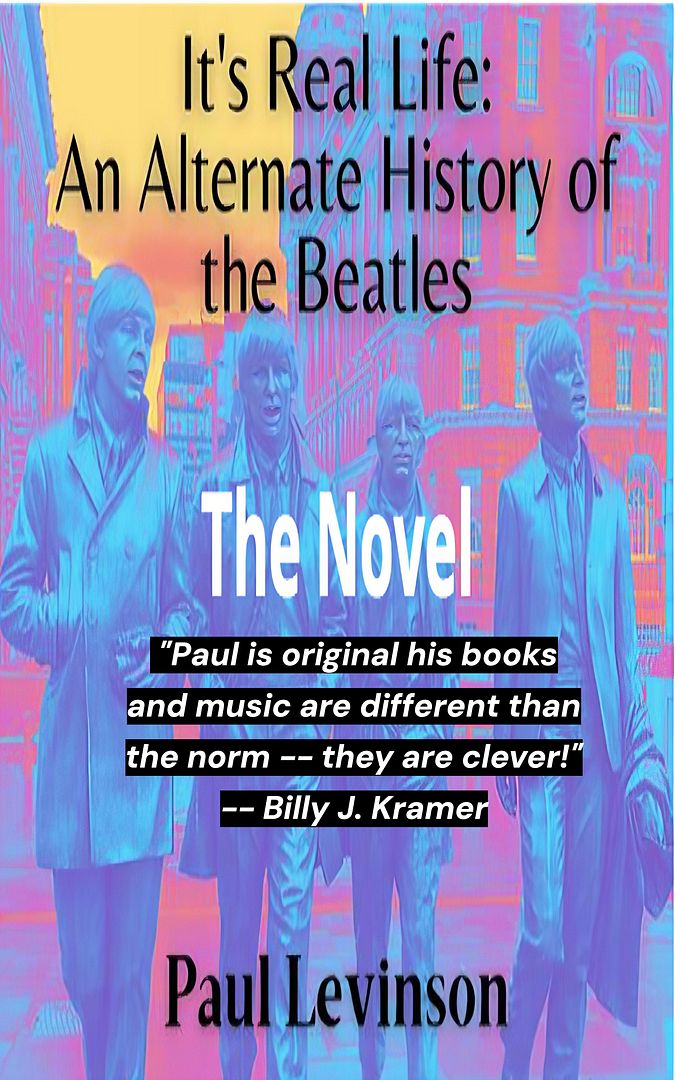


more about the novel here

Tuesday, March 15, 2022

Christine Feldman-Barrett interviewed by Paul Levinson about A Women's History of the Beatles


Welcome to Light On Light Through, Episode 262, in which I interview Dr. Christine Feldman-Barrett about her book, A Women's History of the Beatles.


Check out this episode!

Tuesday, July 20, 2021

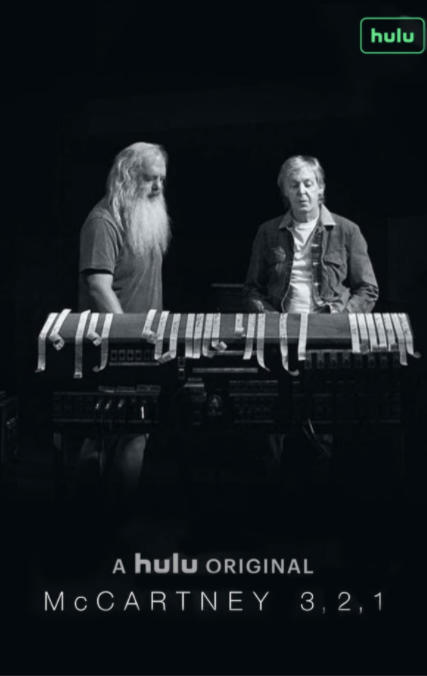
McCartney 3, 2, 1: Guide to Eternity


The first thing I want to tell you about McCartney 3, 2, 1 -- Rick Rubin's incandescent black-and-white three-hour six-episode interview with McCartney on Hulu -- is that in addition to being mind blowing and musically joyful, it made me very sad.

Not just because John and George should by all rights still be with us.  But because Paul says at some point that since the Beatles are finished, their work now complete, he's become a fan of the Beatles, and much better able to appreciate their music which includes his songs, his voice, his bass, his ideas for arrangements, and much more.

And I don't want the Beatles to be finished.  I want them to go on forever making that uniquely wonderful and always evolving music.  And though I know that's impossible, I don't care.  The pleasure that the Beatles brought to me and so many millions and millions of people was and is magical.  Including "Free As A Bird" and "It's Real Love," recorded after Lennon was gone, and which weren't in this documentary and I missed.  But if magic is involved, anything is possible, isn't it?

The conversation, though, was one for the ages, and my guess is it will be watched and listened to and carefully analyzed for thousands of years.  A lot of it I already knew, like how McCartney arrived at Lennon's house with an essentially complete "Here, There, and Everywhere," which may be McCartney's favorite Beatles song.  And a lot of it I didn't, like how Lennon really liked "Here, There, and Everywhere," and how pleased McCartney was when Lennon told him so.

Just hearing the tracks of the songs that Rubin played and played with, as a beckoning of McCartney's remembrances and explanations, were of deepest pleasure to the ear, the heart, and soul.  As some of you may know, ever since The Village Voice published my "A Vote for McCartney" in 1971 -- my defense of McCartney's solo albums, after he left the Beatles, in the face of the Voice's dyspeptic critic Robert Christgau's attack -- McCartney has managed to be more to me than a member of the Beatles.  That essay, after all, was my first published article.  But seeing McCartney 3, 2, 1 brings home just how much this genius contributed to the Beatles, and how he strove to do that.   I used to tell people in the 1970s that I thought the Beatles' music would live as long as Shakespeare's plays.  I'd add now that Rubin's movie will be an important accompaniment to that body of music, more magnificent than ever.


Wednesday, October 10, 2018

Farewell Elton John at Nassau Coliseum


Tina and I just got back from Elton John's fabulous Farewell Yellow Brick Road Concert at the Nassau Coliseum.  This is the third retiring tour concert we've been to in the past few weeks - Paul Simon and Joan Baez were the previous - and each was superb and special in its own way.

Elton John's music has played a surprisingly significant role throughout my professional life - surprising not because his songs (with lyrics by Bernie Taupin) have been wonderful, numerous, and memorable, but because they've had such diverse impact on my own creative work.


Most recently, my novelette, Marilyn and Monet, maybe in the earliest stages of being made into a movie, begins with Marilyn hearing "Candle in the Wind" as she walks off the set of The Misfits with Montgomery Clift in 1961 (hey, it's a science fantasy story).

Back when I began my life as a published writer, the fourth article I wrote for The Village Voice was inspired by "Goodbye Yellow Brick Road" - an assessment of how the Wizard of Oz figured in rock music in its first decades.  Never read that article?  Not surprising.  The Village Voice - or rather its then new music editor, dyspeptic critic Robert Christgau, declined to publish it, after his predecessor Diane Fischer had published my first three articles ever published, all about music.  (I tell more of that story here.)

And Elton John's "Rocket Man" has had more long range influence on my work.  One of the few rock songs that were science fiction, it epitomized my passion as a writer for both rock music and science fiction.  And, indeed, I'll soon be recording a brand new album of my songs with science fiction themes for Old Bear Records in Batavia, New York.


Elton John sang all of these and 21 more at his concert tonight.   He hit most of the notes beautifully, and his back-up band was tight as a drum.  I've admired Ray Cooper even since I saw the way he played the tambourine in the George Harrison Memorial Concert.  It was a real treat seeing him in person, singing "pow, pow, pow" as he beat the bejesus out of the drums and anything percussive he could hit.

Elton's repartee was clever, but, more important, he comes across as one decent, sincere human being.  The graphics on the screen behind him were a tour de force.   I'm glad I had a chance to see him in person.  I know I'll continue singing his songs in my head, and who knows what big things that may lead to.


Sunday, September 2, 2018

The Village Voice Goes Silent


Last night brought the news that The Village Voice, once the hottest, coolest, in synch weekly newspaper in town, was ceasing publication.   This was the last act in a decline which saw the Voice being given away for free on the streets of New York (in an attempt to boost circulation to staunch declining ad revenue) to going completely online just last year.  Though I've long read much more online than on paper, I hate to see any newspaper go under.   And the Voice's passing has special meaning for me, since it was the first place to publish anything that I'd written.  Actually, my first three publications were in The Village Voice.

In September 1971, I was putting the finishing touches on my LP Twice Upon A Rhyme in Mario Rossi's recording studio at the end of Brooklyn.   Ed Fox, Peter Rosenthal, and I lived in the Bronx, and on the clacking train ride out to Brooklyn, a copy of the Voice, then in just its 16th year of publication, was usually close at hand.   One night, I read a typically tone-deaf, dyspeptic review by Robert Christgau in the Voice of Paul McCartney's second solo album, Ram.  I was sufficiently infuriated that, next day, I pounded out a lengthy Letter to the Editor on my electric portable Smith Corona, stained with coffee and orange juice but still working, and I sent it off to The Village Voice.  I doubt I even made a copy, and pretty much forgot about it.   I didn't really expect to see it published there in the Letters column.

My expectations were right.   I eagerly grabbed a copy of the Voice the next week.  The first page I turned to was the Letters page.  Nothing whatsoever there by me, or about McCartney.  But a few days later, early in October, I found a letter from the Voice in my mailbox - a letter and a check.  I looked at the check, first.  $65.00.  I looked at the letter.  It was from Diane Fischer, one of the Voice's main editors.  She said she assumed it would be ok with me if the Voice published my letter as an opinion piece, in its "Taking Issue," section, and paid me $65.00 for it, for which a check was enclosed.

I was thrilled.   The release of Twice Upon a Rhyme on HappySad Records (a record company created by Ed Fox and me, after two or three major labels turned our album down, and we were not interested in shopping it around, for what could have been years) was still a year away, and I still thought of myself as a singer and songwriter, not an essay writer.   But in retrospect, the publication of my letter as "A Vote for McCartney" in The Village Voice on October 21, 1971 was a turning point in my life.  I'd imagined that Paul McCartney would contact me after reading the article, and maybe get me signed to Apple Records.  That didn't happen.  But what did is I began getting far more recognition as a Voice "columnist" - on the strength of that one publication - than I'd received, or would receiving be in ensuing years, as a singer and songwriter.

My second essay in The Village Voice, "Murray the K in the Nostalgia's Noose" was published a little over a year later to the day, in the October 26, 1972 issue.   I'd sent that one in as an essay, not letter, to Diane, after Tina and I had heard and loved Murray the K's return to New York's airwaves on the July 4th 1972 weekend.   Diane (or someone at the Voice) had taken that title from a line in my generally very flattering essay, which said Murray needs to be careful that "nostalgia doesn't become a noose around his neck".  Murray managed to track down my phone number - no doubt the Voice gave it to him - and I received a call from him the very evening that that issue of the Voice hit the streets.  He told me how much he appreciated my essay and offered me a job as a producer on his new NBC radio show.  I took it, and even wrote and recorded a song, "Murray the K's Back in Town" which he played on his show.

By the time my third and final article was published in The Village Voice - in its July 4, 1974 issue - I was already back at school, completing my BA in Journalism at New York University after a long break from the classroom.  My article about Murray the K had brought me to NBC where, after Murray left, I began working as a producer for Wolfman Jack.  After he left, I wrote an essay about his departure from New York, and Diane not only published it, but kept my title, "Wolfman Hits the Road, Jack".

I'd go on, academically, to walk up the street to the New School after getting my BA from NYU.  At the New School, I earned an MA and began reading everything I could by and about Marshall McLuhan.  I went back down the street to NYU's Media Ecology program for my PhD, which I earned before the end of the decade.  And the rest, as they say, is (my) history.

I did have two more significant interactions with Christgau in that decade.  One came in the mid-1970s, when he rejected an article I'd submitted about the evolution of "The Wizard of Oz" in rock music, then culminating in Elton John's "Yellow Brick Road".  Christgau had been put in charge of all the music pieces in the Voice, and I received a letter from him saying that my essay was very well written but said nothing of any importance.  No check was included.  Undaunted, I sent the article to The Soho Weekly News, a more local kind of Voice, focusing more on popular culture than politics, just down the street.  They accepted the article, sent me a pen-and-ink drawing to go with the article, but before they'd had a chance to publish and pay me for the article, I received a letter from - believe it or not, Christgau - explaining that he also was a consultant or something for the Weekly News, and was advising them not to publish my article.  So it goes.

The Soho Weekly News was gone by the early 1980s.  But Christgau continued at the Voice, which I continued to read, despite his caustic reviews of music that I loved.  But the Voice also had Nat Hentoff, as passionate a champion of the First Amendment as ever there was, and Ron Rosenbaum, who could write a riveting, lengthy essay that you couldn't put down, about Mayor Abe Beame, who took boring to a whole new level.

I consider myself privileged to have been in the pages of this remarkable publication which captured the times we were in, fanned and extended them, and made me even prouder than I was to be a New Yorker.


Friday, January 26, 2018

Review of Rob Sheffield's Dreaming the Beatles 21 of X: Resistance

It's been nearly a month since I posted a review of a chapter or two of Rob Sheffield's superb Dreaming the Beatles because, as I've said before, I don't want this book to end.  I want it to last forever, as I do its subject, The Beatles.  And I'm sure they - the book and The Beatles - will.

We're now into the sad and sadder part of the book.  And amidst the gathering ruins of The Beatles, no longer recording together, soon to experience far worse events, Sheffield manages to ingenuously pull together strands that no one else would or could connect, and weave into a riveting now close to heartbreaking chapter.

This time it's a comparison of John Lennon's "Revolution" (of course recorded with the Beatles) and Paul McCartney's "Silly Love Songs" (of course recorded after the Beatles disbanded).  No one but Sheffield could possibly see and convincingly argue that these two songs are really about the same thing, and show that despite the many differences between Lennon and McCartney, they nonetheless were in many ways almost the same person, or brothers.

Both songs, Sheffield explains, are about the The Beatles' resistance to authority.  Lennon's "Revolution" is about not being dictated to by trendy political truth-tellers, of which we now in 2018 obviously have a myriad, on any screen you see.  McCartney's "Silly Love Songs" is about not being told what to do - what to sing about - by self-appointed pop-cultural gurus (of which Robert Christgau was a prime example back then, and which we all suffer a myriad of advice from, nowadays as well).  And like I once read somewhere about Immanuel Kant, a philosopher much harder to understand than is Sheffield, once you consider his hypothesis about these songs, you realize instantly that he is right.

Sheffield couples and discusses other Lennon and McCartney solo recordings, such as Lennon's "Whatever Gets You Through the Night" and McCartney's "What the Man Said".  Here I'll say that I've always liked pop more than (I think) Sheffield does - "Afternoon Delight," for example, by the Starland Vocal Band in 1976, was and always will be one of my favorite recordings.  And I don't know if Lennon's "Whatever Gets You Through the Night" is pop.  How could it be, with a line like "Don't need a watch to waste your time" (my favorite line in the song)  which sounds like it could have come out Dylan's "My Back Pages"?

Sheffield also says that "Whatever Gets You Through the Night" isn't played on radio anymore, because of it's "Don't need a gun to blow you mind" line, but I just heard it on The Beatles Channel on Sirius XM Radio.  The times they are a-changing, including an evolution in our understanding and appreciation of The Beatles, of which The Beatles Channel and Dreaming the Beatles are essential parts.

See also Review of Rob Sheffield's Dreaming the Beatles 1 of X: The Love Affair ... 2 of X: The Heroine with a Thousand Faces ... 3 of X: Dear Beatles ... 4 of X: Paradox George ... 5 of X: The Power of Yeah ... 6 of X: The Case for Ringo ... 7 of X: Anatomy of a Ride ... 8 of X: Rubber Soul on July 4 ... 9 of X: Covers ... 10 of X: I. A. Richards ... 11 of X: Underrated Revolver ... 12 of X: Sgt. Pepper ... 13 of X: Beatles vs. Stones ... 14 of X: Unending 60s ... 15 of x: Voting for McCartney, Again ... 16 of x: "I'm in Love, with Marsha Cup" ... 17 of X: The Split ... 18 of X: "Absolute Elsewhere" ... 19 of X: (Unnecessary but Brilliant) Defense of McCartney ... 20 of X: "All Things Must Pass" ... 22: The 70s Till the End ... 23: Near the Science Fiction Shop ... 24 of 24: The Last Two

And here's "It's Real Life" -- free alternate history short story about The Beatles, made into a radio play and audiobook and winner of The Mary Shelley Award 2023


lots of Beatles in this time travel 

Monday, October 16, 2017

Review of Rob Sheffield's Dreaming the Beatles 17 of X: The Split

We arrive in Rob Sheffield's documentary/docudrama in print - i.e., vividly told book, Dreaming the Beatles - at a sad juncture.  Not the saddest, to be sure. That still awaits.  But sad enough, and the lowest ebb we've encountered so far:  which is the Beatles' final album, and whither (not wither, I'd insist, but we'll get to that) Paul McCartney.

The question of the final album is Abby Road vs. Let It Be, the former recorded after but released before the latter (I think I have that right).  Sheffield sees pros and cons to both albums being final, and goes with Abby Road, assuming the we don't take Let It Be to be an album.  It's certainly not a purely Beatles album, for sure, having been mutilated with the worst overdubbing of Phil Spector's career.  Now, I've always loved much of Phil Spector's work, from the Teddybears to "Black Pearl," but what he did to Let It Be just ain't it.   So whether it's an album or not, since it's not just something The Beatles recorded - it's much more than that, and for the worse - the prize of final goes to Abby Road.  I don't blame Paul McCartney and in fact admire him for releasing the album in the 21st century stripped of Spector's sounds.   (I should add: my group The Other Voices was co-produced by Ellie Greenwich, and she loved Phil, and she's gone now, so sincere apologies to Ellie's spirit.)

But this brings us to McCartney - the album as well as the man.  As I've told you now in these reviews a bunch of times, my very first published article was "A Vote for McCartney," sent into The Village Voice as a Letter to the Editor but selected by editor Diane Fischer as an article, for which I was paid $65 in 1971.   This started me, for better or worse, on my career as a writer.

The letter turned article was a defense of the album and the man - and its follow-up, Ram - from a snooty, vicious attack by Voice critic Robert Christgau, who at some point was appointed by someone as the "Dean" of rock criticism.  You can read my full article here (if you missed the link above), but, to make a long story short, I consider "That Would Be Something" and "Every Night" to be superb (along with "Maybe I'm Amazed," which Sheffield acknowledges is excellent) from McCartney, and "Too Many People," "Uncle Albert/Admiral Halsey," and "Heart of the Country" to be masterpieces or close to, which would fit well on Abby Road as Beatles songs.  But the Paul McCartney overdubs make everything on these albums breakthroughs in music production, which go beyond the Beatles insofar as they were pretty much done by one person.

As I've also noted in these reviews before, Sheffield admires Christgau, and doesn't share quite my high opinion of McCartney, certainly not in these years.  But that's ok.  Certainly Sheffield is right that the combination of these albums and the way he left the Beatles - with the infamous Q & A that said he wouldn't even miss poor Ringo - marked McCartney the man with a reputation as the wheeling-and-dealing Beatle, who played at business and egoboo in a way that supposedly hurt the music.  Or, at least Sheffield is right that that's what many regularly published critics started saying back then and some are still saying to some extent.

As for me, most  of what I publish is not rock criticism, but I suspect my view of McCartney as great in his solo years (as were Lennon and Harrison) - different, of course, from the Beatles, but still unsurpassed -  is shared by millions of fans to this very day.

More reviews of this outstanding book soon.

See also Review of Rob Sheffield's Dreaming the Beatles 1 of X: The Love Affair ... 2 of X: The Heroine with a Thousand Faces ... 3 of X: Dear Beatles ... 4 of X: Paradox George ... 5 of X: The Power of Yeah ... 6 of X: The Case for Ringo ... 7 of X: Anatomy of a Ride ... 8 of X: Rubber Soul on July 4 ... 9 of X: Covers ... 10 of X: I. A. Richards ... 11 of X: Underrated Revolver ... 12 of X: Sgt. Pepper ... 13 of X: Beatles vs. Stones ... 14 of X: Unending 60s ... 15 of x: Voting for McCartney, Again ... 16 of x: "I'm in Love, with Marsha Cup" ... 18 of X: "Absolute Elsewhere" ... 19 of X: (Unnecessary but Brilliant) Defense of McCartney ... 20 of X: "All Things Must Pass" ... 21 of X: Resistance ... 22: The 70s Till the End ... 23: Near the Science Fiction Shop ... 24 of 24: The Last Two

And here's "It's Real Life" -- free alternate history short story about The Beatles, made into a radio play and audiobook and winner of The Mary Shelley Award 2023


It started in the hot summer of 1960, when Marilyn Monroe walked off the set of The Misfits and began to hear a haunting song in her head, "Goodbye Norma Jean" ...

Saturday, September 23, 2017

Review of Rob Sheffield's Dreaming the Beatles 15 of X: Voting for McCartney, Again

It's been a while - too long - since I posted a review of a chapter or more of Rob Sheffield's Dreaming the Beatles.  Lots of reasons, including end of summer, but the most significant is I want this wonderful book to last as long as possible - or reading the book, to be more precise.  With the Beatles channel on Sirius XM, that I listen to daily, every time I'm alone in the car, I'm almost believing that the Beatles are still with is - as indeed they are, or at least their timeless music.

Also, my wife and I are seeing Paul in his final performance in New York this week - at the Nassau Coliseum.  We've wanted to do this for years, but being inveterate cheapskates held us back.  We didn't way to pay enough for decent seats.  But we finally did (and I'll be back here with a full review later this week).  And I credit Rob Sheffield's book and the Beatles Channel - not just the music there, but Peter Asher's show "From Me To You," Dennis Elsas's "Fab Fourum," and Laura Cantrell's "Dark Horse Radio" (even though it's mostly about George) as mostly to blame.  Thanks :)

So I decided to read the next chapter in Sheffield's book, and, lo and behold, it's about Paul.  Not only that, it's a George vs. Paul chapter - "Something" vs. "My Love" - and the part about Paul is a full-court put-down of "My Love" ("the worst song any of the Beatles had anything to with").  Sheffield acknowledges that there are worse songs lurking on some of the solo albums, but scores "My Love" because it got so much trumpeted attention.

So here I am defending Paul again (like he needs my or anyone's defense), like I did all those years ago in my first published article, A Vote McCartney, that appeared in the Village Voice in 1971 after I'd sent in a letter responding to a particularly nasty attack on McCartney's solo album by dyspeptic critic Robert Christgau.  (The editors took my letter, published it as an article, and paid me for it - teaching me something that guides me to this very day - writing is the easiest most enjoyable way for me to earn money.)  To be clear, I don't think "My Love" is in the first, second, or even third tier of great McCartney compositions and performances.  I think "Hope for Deliverance," for example, is vastly better.

But nor is "My Love" anywhere near as atrocious as Sheffield indicates.  "Till There Was You" from the Beatles is garbage in comparison to "My Love," a complete waste of a track on a Beatles album. Even "Hi, Hi, Hi" from McCartney's Wings era is worse than "My Love".   And "Silly Love Songs" is probably a little worse, too.   "My Love," despite its excesses, has a passion.  You can hear Paul singing about Linda in that song, and that makes it real.

But what is it that engenders such anger at Paul McCartney?  Sheffield has already said that he admires Christgau, but, in my view, Sheffield's a far better and more sensitive critic than Christgau. But what is it that evokes such dislike of a below-average, but certainly not so horrendous, Paul song?

Who knows?  I'm looking forward to more fresh evidence to hurl against McCartney's critics at his concert this week.

Note added a few days later: And here indeed is my review of McCartney's splendid three-hour concert.

See also Review of Rob Sheffield's Dreaming the Beatles 1 of X: The Love Affair ... 2 of X: The Heroine with a Thousand Faces ... 3 of X: Dear Beatles ... 4 of X: Paradox George ... 5 of X: The Power of Yeah ... 6 of X: The Case for Ringo ... 7 of X: Anatomy of a Ride ... 8 of X: Rubber Soul on July 4 ... 9 of X: Covers ... 10 of X: I. A. Richards ... 11 of X: Underrated Revolver ... 12 of X: Sgt. Pepper ... 13 of X: Beatles vs. Stones ... 14 of X: Unending 60s ... 16 of X: "I'm A Loser" ... 17 of X: The Split ... 18 of X: "Absolute Elsewhere" ... 19 of X: (Unnecessary but Brilliant) Defense of McCartney ... 20 of X: "All Things Must Pass" ... 21 of X: Resistance ... 22: The 70s Till the End ... 23: Near the Science Fiction Shop ... 24 of 24: The Last Two

And here's "It's Real Life" -- free alternate history short story about The Beatles, made into a radio play and audiobook and winner of The Mary Shelley Award 2023


lots of Beatles in this time travel

Monday, June 5, 2017

Review of Rob Sheffield's Dreaming The Beatles 6 of X: The Case for Ringo

Rob Sheffield makes the case for Ringo in the next chapter of his stellar Dreaming the Beatles, putting the question regarding Ringo as whether he was an all-time genius drummer who made the Beatles possible, or "a clod who got lucky, the biggest fool who ever hit the big time".  Sheffield puts his chips on the genius.

So ... let me first say that, as a self-professed expert in time travel (that is, I write it in fiction, and about it in nonfiction, and can't, alas, do it), I readily acknowledge that every event major or minuscule that ever took place might not have happened if even one exceedingly minor ingredient had not come before, and therefore the Beatles might well not have amounted to much if Pete Best had remained their drummer, and not in fact been replaced by Ringo.

But there's a big difference between being a necessary ingredient and a quintessentially great drummer, and Sheffield wants to shoot for both for Ringo.   Towards that goal, he presents two arguments: One, that Ringo's infectious presence inspired the other Beatles.  And two, that Ringo did incredibly good drum work in various songs like "Rain" (one of the my all-time favorites - I like the song and rain itself so much that I often include "Rain, I don't mind" in lists of my favorite quotes) and the cowbell for "Drive My Car" (which as I mentioned in an earlier review, is also one of my favorite songs).

The great drum and percussion work in specified songs is of course easier to prove than Ringo being an inspiration, and Sheffield does a pretty good job of the first.   But for Ringo to be as great in his own right as, say, drummers Phil Collins and Don Henley, I would've wanted to see Ringo do equivalent work on his own, which I don't think he did.   And if he didn't manage to do that on his own, I think this makes Sheffield's claim that Ringo did such great work for the Beatles a little harder to demonstrate. So Sheffield's convinced me only partially, at most, though I much enjoyed his chapter.

Three last little points -
  • Sheffield cites Robert Christgau in support of Ringo's importance.  While I don't disagree with Christgau's assessment - that Ringo was like a member of the audience, one of us, being in the band - I can't let a mention of him go by without objecting to Christgau's peevish attack on McCartney (Paul's first solo album) once again.
  • Sheffield mentions Paul's famous kazoo solo in Ringo's "Sixteen" - but Wikipedia cites someone who says Paul is really singing the part, making his voice sound like a kazoo, even though the liner notes credit Paul with playing the kazoo.  I'm just wondering who is right?
  • And speaking of Paul and Ringo, I just want to say that there once was a time, when the White Album first came out, that a lot of people were saying that the voice on "Good Night" was Paul doing his Ringo voice - I assume this has now been settled as the voice actually being Ringo.
And I'll be back soon with another review, writing as best I can in my own voice.

See also Review of Rob Sheffield's Dreaming the Beatles 1 of X: The Love Affair ... 2 of X: The Heroine with a Thousand Faces ... 3 of X: Dear Beatles ... 4 of X: Paradox George ... 5 of X: The Power of Yeah ...  7 of X: Anatomy of a Ride .. 8 of X: Rubber Soul on July 4 ... 9 of X: Covers ... 10 of X: I. A. Richards ... 11 of X: Underrated Revolver ... 12 of X: Sgt. Pepper ... 13 of X: Beatles vs. Stones ... 14 of X: Unending 60s ... 15 of X: Voting for McCartney ... 16 of X: "I'm A Loser" ... 17 of X: The Split ... 18 of X: "Absolute Elsewhere" ... 19 of X: (Unnecessary but Brilliant) Defense of McCartney ... 20 of X: "All Things Must Pass" ... 21 of X: Resistance ... 22: The 70s Till the End ... 23: Near the Science Fiction Shop ... 24 of 24: The Last Two

And here's "It's Real Life" -- free alternate history short story about The Beatles, made into a radio play and audiobook and winner of The Mary Shelley Award 2023


lots of Beatles in this time travel


Tuesday, May 23, 2017

Review of Rob Sheffield's Dreaming the Beatles 1 of X: The Love Affair

I've always loved The Beatles.  First as a fan, always as a fan.  How much as a fan? Well, I was delighted to find a subscription to Sirius/XM  Radio in my new car, early this month, and I promptly tuned it to MSNBC. Until The Beatles channel checked in on May 18, and that's what I listen to when I'm driving now.  Even when I'm not driving - I just came in from my driveway, because I wanted to hear the end of "Baby You Can Drive My Car".  I'd probably still be there, if the urge to write this review had not been so strong.

Yeah, writing soon blended into my love of The Beatles.  First as a singer and songwriter, in the early 1960s through the early 1970s (produced at one point by Ellie Greenwich), and then as a writer of nonfiction and about two decades later of science fiction.  My first published article - "A Vote for McCartney" in The Village Voice in 1971 - took on the Voice's dyspeptic, tone-deaf critic Robert Christgau. who had savaged Paul's debut solo album, McCartney.  (Christgau had a habit of missing the forest - at some point, he also lashed out at Phil Ochs, a lyricist second only to Dylan, for his guitar playing).   My Loose Ends Saga - arguably my best-known science fiction (arguable in the sense that many people deny it) - has a time traveler faced with the choice of either saving John Lennon or stopping September 11.

So, I was primed to read Rob Sheffield's Dreaming the Beatles: The Love Story of One Band and the Whole World since 1963, but my son Simon, who edited at Rolling Stone and knows Sheffield, pushed me over the top this weekend when I was raving about The Beatles station.   My wife had already purchased the hardcover and the audiobook, and I knew I would love it - a perfect accompaniment to my own continuing love story with The Beatles.

Sheffield is a masterful writer on all kinds of levels.  He has a knack for spot-on record reviews in less than a sentence - noting "the brash aggression of 'And Your Bird Can Sing'" and "the hair-curling harmonies of 'I Don't Wanna Spoil the Party'".  He has an assumption that The Beatles were and are in a class by themselves, which, though it may seem obvious to true-believers, Sheffield turns into a galvanizing and even surprising organizing principle.  He has a photographic, watercolor eye, describing how Ringo's wife Maureen was  "freezing her ass off" on the roof in the Get Back concert in a way that makes you want to grab your coat and get your hat on a hot Spring day.

There's so much in this book, in fact, that I decided after reading just the first 11 pages, that it warranted more than a single review.  After all, The Beatles were and are about songs, which is a short form, but even if not, who says a book has to be reviewed all at once, in one big review?   So consider what you've been reading here as an introductory review, of just the Prelude and part of the next chapter of the book, and I'll be back with more, soon.   I'll likely have the whole book reviewed in the next weeks, maybe the next months.  It probably won't take years, but you never know.  (See my series of reviews of The Perversity of Things as an example of another series of reviews in progress.)

And that's it for now.  Get the book. (I'm sure I'll disagree with some of Sheffield's views but I disagree with some of everyone's except mine, and even I change my mind.)  I'm going to watch a little of MSNBC, and then get back in the car.

See also Dreaming the Beatles 2 of X: The Heroine with a Thousand Faces ... 3 of X: Dear Beatles ... 4 of X: Paradox George ... 5 of X: The Power of Yeah ... 6 of X: The Case for Ringo ... 7 of X: Anatomy of a Ride ... 8 of X: Rubber Soul on July 4 ... 9 of X: Covers ... 10 of X: I. A. Richards ... 11 of X: Underrated Revolver ... 12 of X: Sgt. Pepper ... 13 of X: Beatles vs. Stones ... 14 of X: Unending 60s ... 15 of X: Voting for McCartney, Again ... 16 of X: "I'm A Loser" ... 17 of X: The Split ... 18 of X: "Absolute Elsewhere" ... 19 of X: (Unnecessary but Brilliant) Defense of McCartney ... 20 of X: "All Things Must Pass" ... 21 of X: Resistance .. 22: The 70s Till the End ... 23: Near the Science Fiction Shop ... 24 of 24: The Last Two

And here's "It's Real Life" -- free alternate history short story about The Beatles, made into a radio play and audiobook and winner of The Mary Shelley Award 2023


InfiniteRegress.tv