reviewing Black Doves; Dark Matter; Dept. Q; Detective Hole; Dexter: Resurrection; Fauda; For All Mankind; Foundation; Hijack; Memory of a Killer; MobLand; Outlander; Paradise; Presumed Innocent; Severance; Silo; Slow Horses; Smoke; Star City; Star Trek: Strange New Worlds; Tehran;The: Day of the Jackal, Diplomat, Night Agent; Your Friends & Neighbors +books, films, music, podcasts, politics
George Santayana had irrational faith in reason - I have irrational faith in TV.
Chuck Todd interviews me about alternate histories
Showing posts with label Lord of the Rings. Show all posts
Showing posts with label Lord of the Rings. Show all posts
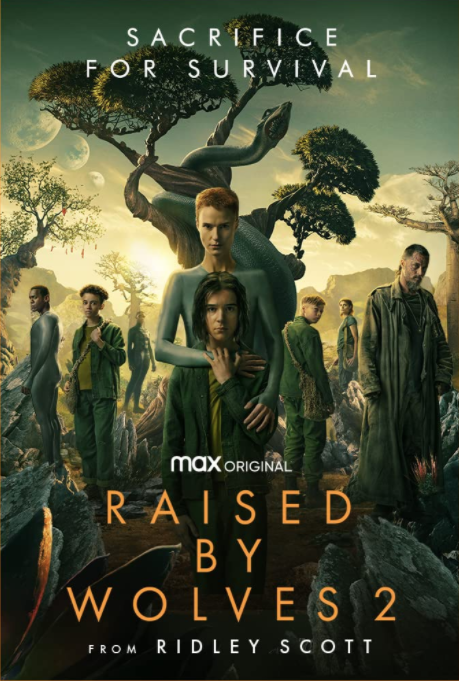
Raised by Wolves 2.6 -- the 6th of 8 episodes of this second season -- was easily the most and least science fictional of any of the episodes in the first and second seasons so far. Which is saying a lot, since the whole series has been pushing the limits of science fiction into fantasy, from the beginning.
[Spoilers ahead ... ]
Three major interludes which stretched the boundaries of the story tonight:
1. First, Sue turns into a tree. Really. The last time I saw a tree have such importance in a science fiction story were the Ents, in Lord of the Rings, which is generally regarded not as science fiction but fantasy. I will say that science in our off-screen real world here on Earth is uncovering all kinds of sentient-like qualities of trees -- see, for example, Beronda L. Montgomery's article -- so maybe what we saw in Raised by Wolves 2.6 is not too much of a stretch.
2. Next, Tempest's baby taken by that sea humanoid creature. The birthing scene itself was powerful, incredible. But real. And then ... to have that horror-show of a creature take the baby from Tempest -- that, in itself, was one of the most horror-story scenes in this science fiction series. The last time I saw a monster like that was in Creature from the Black Lagoon (1954).
3. The further development of the Mother-like android now dubbed grandmother was a good step forward in the android anthropology which is the heart of the series. Of course Father loves her -- there's too much of Mother in her for Father not to. The big question now is to what extent does this new android have a mind of her own? Clearly, Mother and Father do, vis-a-vis each other. So ... we'll just have to see. And, presumably we'll also find out when in human history the android was brought to this planet, if indeed she was brought there.
A conversation for the ages between Jon and Daenerys on Game of Thrones 7.3 tonight, with each not giving an inch, dignified and persuasive, and in the end, Daenerys agreeing more or less to help in the fight against the dead in the North.
Daenerys is not doing well in her other fight, against the Lanisters in red. Jaime faked out the Unsullied, had them attack a place where the bulk of the Lanister army was not, and in the process sent Olenna Tyrell to her just desert, too - just insofar as she horribly murdered Jaime's son Joffrey, who more than deserved to die, though not from Jaime's point of view - at least, not completely.
In this episode, every word in every conversation, every second, counts - much more so than in previous seasons. So it was also powerful to see Bran come home after all of these years, and it was good to see Mormont saved - especially good because the agent of the save was Sam.
A few more words about that. There was something truly mythical about that saving, in the sense that Lord of the Rings and King Arthur and the Knights of the Roundtable are the stuff of myth. Not only that, but as I mentioned in a previous review, something Asimovian too, with Sam toiling in the Game of Thrones of equivalent of the Library of Trantor.
So what will Mormont now do with his second life? No doubt something crucial on behalf of his beloved Daenerys. And to return to the beginning of this reflection, she'll certainly need it. Though her dragons and their fire are no doubt the best weapon against the frozen hordes of the North, they're not invincible, not even against Lannister cunning and preparation.
And here's a Spanish article in Semana, the leading news magazine in Colombia, in which I'm quoted about explicit sex on television, including on Game of Thrones.
And what a Game of Thrones 4.9 it was - an entire episode devoted to the battle for Castle Black, with scenes as sweeping and intense as those in The Two Towers Lord of the Rings movie of 2002. An impressive accomplishment indeed for HBO.
To get right down to the story, I wasn't all that upset to see Ygritte die. Chances are she would have killed Jon Snow - which would have been a far more grievous loss to the series - and even if not, her lethal arrows might well have won the battle on this night for the deadly hordes. True, she did hesitate for a moment to let loose her arrow on Snow, and that in retrospect saved his life, but her side was out to destroy what's left of civilization to the south, which is something I don't want to see.
Meanwhile, we were also treated to the best scene with Maester Aemon in the series so far, in a conversation with Samwell, who also had a sterling episode, including that long kiss. It's refreshing and satisfying seeing an entire episode devoted to one thread of this complex tapestry, which makes me think that maybe Game of Thrones should do this more often.
On the other hand, we're still left not knowing Tyrion's fate, and we saw nothing of Daenerys, Arya, Bran, Brienne, and other notables this episode. With just one more hour to this season, it's a safe bet that most of those stories won't be wrapped up, and maybe none of them at all.
And there's still the story of Jon Snow. It was a good move having Snow go out on his own to find Mance - he's right that that's the only way the South can possibly avoid a devastating conquest - but it's hard to see what Snow can do to convince the implacable Mance from pulling back his attack, which means all that this might result in is Snow's death, after all.
This has been my favorite season of Game of Thrones - the last few episodes in particular have been really outstanding - and I'm looking forward to next week.
And here's a Spanish article in Semana, the leading news magazine in Colombia, in which I'm quoted about explicit sex on television, including on Game of Thrones.
Finally had a chance to see The Hobbit, Peter Jackson's beautifully rendered prequel to his Lord of the Rings masterpiece trilogy.
And I mean beautiful. The Shire never looked more verdant and shimmering. Rivendell and its falling rivers was just breathtaking - you could practically feel the spray in the theater. The mountainous passes took your breath away, including a great battle, not just on the mountains, but of the mountains, or at least two mountainous outcroppings.
The characters were well drawn, too. Bilbo Baggins, at this stage, in this movie, carries none of the weight that his later self and Frodo must bear. So Bilbo, though older than Frodo, is much more like Merry and Pippin than Frodo in lightness of bearing - much like any Hobbit not beset by the burden of the ring.
The movie, much more a prequel to the Lord of the Rings movie trilogy than a treatment of the original novel, treats to us a delight of characters from the trilogy, including a cameo of Frodo and old Bilbo at the beginning (before the quest in Lord of the Rings begins), Elron (Hugh Weaving is one of my favorite all-time actors), Galadriel, Saruman, of course Gandalf and Gollum, and even that scowling old woman Hobbit in the Shire. There are also some good characters we haven't encountered before, including a trippin brown Wizard and his team of superfast rabbits, and all manner of Dwarves and Orcs.
Don't expect the profundity of Lord of the Rings, but the movie's a real pleasure to see.
Well, I've been saying all along - see my reviews of Fringe this season, beginning with 4.14 and back, listed below - that Peter was really back in the original Fringe reality, transformed by his erasure to have no memory of his existence (that is, no memory after he "drowned" in the lake, which was the locus of his erasure), and what Walter and Olivia were experiencing now were the real memories of Peter, that is, Peter as we saw him in our reality in the first three seasons of Fringe. And, sure enough, in tonight's episode 4.15, that is exactly what turns out to be the case. A little sad that Peter needed September to tell him what he in his heart already knew, but at least Olivia came to this conclusion on her own, and I think Walter did too.
Lots of questions still be to be answered. September did not die after all, and does this mean that the Eterrnal Bald Observers (as I've been calling them) are truly eternal - timeless to the point of being invulnerable to any kind of death? Thus would put them in a category even more eternal than the Elves of Lord of the Rings, which would be eternal indeed.
And what of September's statement to Olivia that he could not prevent her death? And what of the alternate reality with Fauxlivia and real Petter's real baby? And there's still David Robert Jones, who seems at war with everyone (but I'm thinking may be in league with other the Bald Observers, who are now out to get September).
But I'll take this 3/4 season happy ending anyway - they're few and far between on television, and they make whatever threat Olivia still faces all the more trenchant.
Hey, check out my essay The Return of 1950s Science Fiction in Fringe in this new anthology
"Sierra Waters is sexy as hell" - curled up with a good book
Enjoy listening to audio books? Get a free audio book copy of The Plot to Save Socrates - or any one of 85,000 other titles - with a 14-day trial membership at Audible.com ...
Tyrion has the best line in Game of Thrones 1.4, with remark about a "tender spot in any heart for cripples, bastards, and broken things".
Jon, himself a bastard, certainly has a tender spot for the portly boy, a confessed coward, who has joined the Night Watch. Not really joined, sent there by his father, who despises him. Jon nobly makes this coward's welfare his personal business, and it's likely that the coward, if he survives, will be a coward no longer. His name, by the way, is Samwell, recalling Lord of the Rings, but that Sam was a little less portly and never a coward. This Sam, therefore, is a little less interesting and a little cliched.
Over on the continent, Daenerys's lady servant has a keen interest in dragons, as she shares a bath with Daenerys's brother Viserys. She questions him about dragons, and learns that they're all dead, though Viserys has seen their skulls in the king's hall. Dead? More likely broken, as a major force, and not beyond repair. Daenerys soon comes to realize that her brother is broken, or in no spirit to lead an army and reclaim the throne that she wants back as much as he. That's a good development for the overall story - Daenerys alongside of her husband fighting for the throne will be more formidable than Viserys trying to command the horsemen army.
Bran is crippled, but Tyrion, stopping at Winterfell on his way back south from the northern Wall, leaves Bran instructions that will enable him to ride a horse, and stand as tall there as any man. Catelyn Stark, however, now in King's Landing, remains sure that Tyrion put the assassin up to killing Bran - because the assassin was wielding Tyrion's sword. In a fine dramatic last scene, a half dozen men with a lifetime of loyalty to Catelyn and her family pull their swords simultaneously from all sides on Tyrion - he back on his way to King's Landing, Catelyn on her way to Winterfell, in the Inn at the Crossroads, in her ancestral region - with a view to bringing him back to Winterfell to face justice for twice attempting to kill Bran.
Or so Catelyn thinks. We'll see more next week. I'm not too worried for Tyrion, however - the dire wolves know the truth.
"Sierra Waters is sexy as hell" - curled up with a good book
Enjoy listening to audio books? Get a free audio book copy of The Plot to Save Socrates - or any one of 85,000 other titles - with a 14-day trial membership at Audible.com ...
A shout out or Tweet-sized review of Emon Hassan's new webseries, The Third, which premiered, appropriately enough, on the 3rd of December (yesterday), with a 3-minute episode. Lots of powerful things come in three's - Hegel's dialectic, the 3 pyramids of Giza, and Isaac Asimov's Foundation trilogy to name three (ok, I'll add in the Lord of the Rings trilogy, either Star Wars trilogy, and the Godfather trilogy, now that The Third's got me going on this).
I'm not saying that The Third has anything in common with these other behemoth triads - certainly not in length - but it does have something in the sparse, speechless, evocative 3-minutes of the premiere. I can't say just what, as yet, except it conveys a sense of murky foreboding quite clearly. Think, maybe, Primer, I don't know.
All right, this was a little longer than a Tweet. But the premiere does follow below.
About The Third
New York City holds many mysteries and its inhabitants hide many secrets. Neil (Philip Willingham) is The Third. His job is to solve them.
My wife and I just came back from Avatar in iMax-3D. I guess I'm partial to any stories about Alpha Centauri - my second novel, Borrowed Tides, is about a one-way trip there, and Pandora in Avatar is a moon thriving with life around a gas giant planet circling Alpha Centauri A - but I think Avatar sets the gold standard for sheer beauty, visual imagery, and excitement in a science fiction or fantasy movie, standards previously held by the Star Wars and Lord of the Rings sagas. The attention to botanic detail, and for that matter all the beings, sentient and nearly so on Pandora, was a breathtaking sight to behold.
Avatar's story has a lot in common with Star Wars and Lord of the Rings, too. Good people or beings, in tune with nature, beset by a cruel, military force bent on taming, and if not, destroying the gentler souls. Indeed, many of the best battle scenes in Avatar come right out of Star Wars, and the single star fighters taking on huger cruisers, and Lord of the Rings, with Frodo and allies fighting the bruisers and monsters hurled against them by the evil lords, and the good beings all rallying in the end. There are echoes of Harry Potter as well as Lord of the Rings, too, with heroes flying great winged creatures, and of Terminator, with killing machines which also recall what the Empire used to attack the Ewoks in Star Wars.
In Star Wars, humans are pretty much equally distributed between heroes and villains, and the same is true of magical beings in Lord of the Rings. In Avatar, the humans are mostly bad, and the in-tune alien Navi on Pandora are all good.
This has led some critics to characterize the movie as an attack on humanity, and, because the ugliest Marines in the movie all have American accents, as an attack on America and American values. If this is so, it would be an attack on America in the 19th century, when Americans of European descent subjugated and wiped out most of the Native Americans on behalf of our selfish commercial interests. In that sense, Avatar was in many ways more like a Western, a cowboy and Indian movie, than a science fiction story - though the two genres are closely related. But seeing as how America in the 20th and 21st centuries has for the most part only gone to war when first attacked, or in attempt to preempt an attack, rightly or wrongly foreseen, the bad guys in Avatar bear little resemblance to us, and certainly not much to our current, professed ideals.
The most original part of the story concerned humans taking alien form, itself a science fiction chestnut in many a story, novel, and Star Trek episode. In fact, the story told in Avatar seemed more like an extended Star Trek episode than any of the individual Star Wars or Lord of the Rings movies. The human dynamics were also reminiscent of Star Trek, with Jake (the human hero) disobeying orders much like Kirk, and also falling in love with an alien.
But the women in Avatar were stronger than the women in Star Trek, and the heroine reminded me of Padme in Star Wars, especially when she literally lent a hand to killing the vicious Marine colonel. Speaking of Marines, that aspect of Avatar was reminiscent of Starship Troopers, though in that movie our Marines were all good guys, fighting marauding tank-sized and bigger bugs that attacked humanity.
So, all in all, James Cameron's Avatar was a splendidly rendered, multi-derivative science fiction movie - well worth seeing, in iMax-3D if you can, if your eyes and soul delight in visual magic, and/or if you just like science fiction. And, hey, Lost fans - you'll love seeing Ana Lucia in action again.
6-min podcast review of Avatar
*Note added January 17, 2009: Delighted that Avatar just won the Golden Globe!
Another one of my vintage Locus Online columns, this one published on 23 December 2002 - the day after I saw The Two Towers... (with a 2007 note and YouTube video of my commentary on The History Channel's Evolution of Science Fiction, 28 September 2002, added at the conclusion of this column) ...
Confessions of a Science Fiction Chauvinist, as Occasioned by Seeing The Two Towers
1. Labels and categories are important in popular culture. What works for food in restaurants works for food for thought: if you find only sushi in an Italian restaurant, or just steak in a seafood place, you are right to be annoyed. The labels "science fiction" and "fantasy" would seem to work the same way — if you find only magic in science fiction, aren't you entitled to be aggravated? I always thought so. But I'm beginning to think otherwise.
2. I have read hundreds of science fiction novels, and many more science fiction stories, since the 1950s. I have read perhaps a handful of fantasy novels, and a few dozen fantasy stories. The Lord of the Rings was not among them. The few works I enjoyed — such as John Crowley's Aegypt novels — were due not to the story, but the sheer verve of the writing.
3. What I most value in science fiction is its exploration of the human impact of scientifically plausible but not yet accomplished developments, or discovery of similarly plausible truths about the real, natural universe. Yes, I know there is much in time travel that is paradoxical — that's actually why it's so much fun — and faster-than-light travel violates Einstein's proscriptions. Yet the very fact that we can talk about the relevance of Einstein's theories to science fiction seemed to make it different from fiction that relies on spells and elves.
4. My lack of interest in elves led me to forgo not only most fantasy novels, but even the lesser investment of time required for fantasy movies. I did not see The Fellowship of the Ring in any theater. I hadn't thought about renting the videotape, one way or the other, but on a rainy Thursday evening last August, with nothing else on Blockbuster's shelves of even the remotest of interest, I brought home a copy. The first part of the movie — which took place in the Shire — was barely enough to hold my attention. I think the physical resemblance between Gandalf and Jean-Luc Picard kept me interested more than anything else... But by the end of the movie, I felt very differently. I've now seen The Fellowship of the Ring, in one mode or another, perhaps a dozen times. And I just saw The Two Towers. I think they are masterpieces of movie-making, fantasy, and, as I will explain below, perhaps even of science fiction. (And, seen in the context of the unfolding story, The Shire section is now most enjoyable, too.)
5. If Hobbits were hominids, the Dwarves some kind of Neanderthals, and the Elves an early version of humanity for which we have no fossils at hand, would the story be any different? Would it be if Orcs and Uruk-hai were genetically engineered? (We are already told that the Uruk-hai were "bred" — or, in Darwin's apt term, artificially selected.) Does it make a difference whether spells or lasers cause avalanches? What if the "spell" were really the working of a tiny, powerful, ancient technology, which — like lots of work done in the Far East in perishable bamboo, in prehistoric times — did not survive the ages? For that matter, couldn't the ring itself be an extraordinary technology which, among its many powers, includes cloaking? Is the ring as a bestower of invisibility any less scientifically plausible than the formula of H.G. Wells's Invisible Man? If magic and highly unlikely science can play similar roles in stories, Wells may have more in common with Tolkien than Verne.
6. The Lord of the Rings also has much in common with another kind of science fiction, epitomized in the Foundation and Dune series. The three sagas offer exquisite examinations of power, fine siftings of morality across characters, keen reckonings of small detail in grand events — whether the driving force is spice, spell, or psychohistory. When contests are of cosmic significance, and we're interested in the human response, the specific technological basis of the events — whether magic or science — may not be very important.
7. If the invocation of magic still rankles — and I admit that it still does — here is another consolation. As Greg Bear and I noted on a recent History Channel documentary*[see YouTube videoclip at the conclusion of this column], the hot sciences in science fiction have become biology and anthropology, replacing physics and even the information science (cyberpunk) of previous years. And whatever else LotR may or may not be, it is indubitably a work of biological and anthropological fiction. Saruman's flocks of spying birds are feats of biology in the sky, whether the birds are bred, gene-spliced, commanded, or all of the above. The same is true of the Ents, though the intelligence and mobility of trees is far less plausible. But in both cases, living organisms are the vehicles of the story — birds not planes, trees not automated catapults. Lord of the Rings was an epic of biological imagining, decades before most science fiction caught up. Here, again, we see a kinship between Wells (The Island of Dr. Moreau) and Tolkien, and, a bit later, Herbert. All three were Darwin's children, in a way that Verne and Heinlein, and even Asimov, were not.
8. None of this diminishes in the slightest the joy of coming upon an idea so strikingly scientifically plausible that I am amazed it is not already an actual fact. That is indeed the unique province of science fiction, shared by Verne, Wells, and Asimov, but not Tolkien. But I do see as far less valid the famous observation of Greg Benford that fantasy is science fiction played with the net down. That is certainly not the case when the fantasy is biological and anthropological extrapolation, and the net is woven of gene-spliced realities and an archaeology which discloses hominids and what-not living on this Earth for at least a million years. And, when the universe or the world-as-universe is the object of the game, and morality and power the fields of play, it may not matter if there is a net at all.
9. I have not yet read the book. My daughter has a copy, and is devouring it. I have held it in my hand, read the prefaces and some of the appendices. I am drawn to read it... But I am determined to wait until I have seen the third movie, because I saw the first two without having read the book, and I'd like to be able to appreciate Peter Jackson's complete accomplishment from the same narrative seat in the audience, beyond the proscenium arch of knowing the end of the story... I know this is right. I even talk about it in my classes, as a professor of media theory... But, oh, the book beckons... [Note added in 2007: But, indeed, I got side-tracked and never did get beyond the opening chapters of the book.... I did read all of Harry Potter, however ...]
*Here's an excerpt of my commentary on The Evolution of Science Fiction, first aired on The History Channel, September 28, 2002, and rebroadcast many times since...



 A conversation for the ages between Jon and Daenerys on Game of Thrones 7.3 tonight, with each not giving an inch, dignified and persuasive, and in the end, Daenerys agreeing more or less to help in the fight against the dead in the North.
 And what a Game of Thrones 4.9 it was - an entire episode devoted to the battle for Castle Black, with scenes as sweeping and intense as those in The Two Towers Lord of the Rings movie of 2002. An impressive accomplishment indeed for HBO.


