Chuck Todd interviews me about alternate histories
Showing posts with label movies. Show all posts

Saturday, May 1, 2021

Tenet: A Re-View


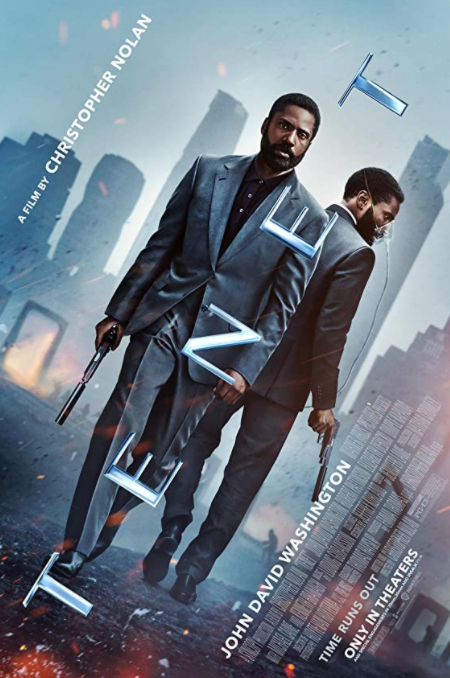
Well, I -- at last -- just saw Christopher Nolan's Tenet (on HBO).  It was an excellent, sometimes seminal, time travel movie -- in particular, time reversal -- but not without its flaws.

Let's start with a few of those:

1. Although the movie starts off with a good action scene, there's no clear time reversal I until about 50 minutes in,* when the Protagonist has a battle with at least one guy moving in reverse time. We later learn that the Protagonist was actually fighting with two guys, one traveling in normal, forward time, the other in reverse time. This is a "time-pincer" mode of combat, which is one of the hallmarks of the narrative.  All of that is very good stuff, but it took too long (50 mins) to first happen.  We also learn that Protagonist's two combatants are later versions of himself.  Also a nice touch.  And we see the same scene from the other side at about 1 hour and 50 minutes into the movie -- also fun to see.  But my first point, that this excellent sequence took too long to commence, still holds.

*There was some time reversal in the opening scene, but it happened so quickly that at the time it wasn't clear that that was what was happening.

2. The grandfather paradox is explained too curtly, as, if you travel to the past and kill your grandfather, how did you exist to travel into the past in the first place?  This leaves out the essential element of: you had to kill your grandfather before he impregnated your grandmother (who then would give birth to one of your parents), otherwise there would be no paradox.  Yeah, I'm a stickler for getting it right in discussing paradoxes, they're mind bending enough when properly stated.

3. It's mentioned that you can't run into your future or past self when you're time traveling because that could annihilate yourself or even the world.  That injunction has become a staple of the genre, and was a central principle in the 12 Monkeys TV series. But just to be clear: there's no reason that running into yourself would result in your, let alone the world's, annihilation. It might unhinge your mind, sure, with a cascade of impossible, self-referential memories, but that's not the same as annihilation.

But there were lots of thoroughly excellent parts of the movie.  I really like that the people in the future don't worry too much about accidentally annihilating themselves by messing around in the past.  After all, they exist, so they couldn't have done too much damage to their future.  This could have been a little more clear in the movie, but kudos to Tenet for at least expressing that inherently optimistic sentiment.

The backwards in time action and cinematography were outstanding, especially the cadre-level pincer movements, one going forward, the other going backward, in time, which reminded me in its own brief way of a battle scene out of Lord of the Rings.  From about 1 hour and 24 minutes into the movie and onwards, it's pure cinematic gold, with twists and turns and quickly delivered metaphysical puzzlers at every turn.

Ok, I'm going to conclude this now, and record a podcast, which should be up in an hour or less.  Look for it below.  I may or may not say something more than what I wrote above.


some talk of cleaning up "loose ends" in Tenet

Wednesday, March 10, 2021

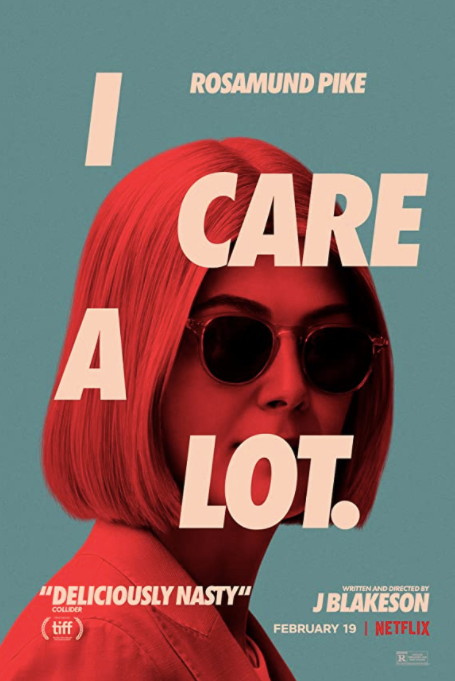
I Care A Lot: Evil vs. Evil


A here's a review of a top-notch movie with an original theme my wife and saw and much enjoyed on Netflix.  I Care A Lot is billed as "comedy, crime, thriller" on IMDb, and "black comedy" on Wikipedia.  Although there are some funny elements in this movie, it's the crime/thriller part that lifts it pretty high in the stratosphere as a movie to see.

[Spoilers below]

The best part of the story is the battle between two arch villains it sets up and portrays in appealing, escalating fashion.  Rosamund Pike plays Maria, who runs an ingenious scam in which she becomes the legal guardian of elderly people who or may not be mentally diminished, with Maria appropriates their assets for her own benefit and profit.  (I have no idea if this scam actually occurs -- I hope not, it's evilly clever.)  But Maria makes the mistake of doing this to Roman's (Peter Dinklage) mother Jennifer (Dianne Wiest) who has no real problems with her brain at all.   What Maria doesn't know at first but comes to realize with a literal vengeance is Roman is a Russian mobster -- someone as driven and sharp as Maria, and even more ruthless, along with a ready ability to use deadly force.

The battle between them is a contest to see.   And so is the twist upon twist in the end.  Maria against all odds survives Roman's attempt to kill her, she then lands Roman in a hospital but accepts his offer that they start a swindling-the-old partnership, only to be killed in the very last scene by an aggrieved son who could never see his mother -- because Maria wouldn't allow it -- and now his beloved, unfairly locked away mother has died (I told you there would be spoilers).

I felt a little bad for Maria, though she got what she deserved.  The ending -- that it's the overlooked peril that will get you -- has been a staple of everything ranging from crime to science fiction (Asimov used it in one his Foundation prequel novels in the 1980s), and it worked well in I Care A Lot.  That in itself, and the whole movie before, is something you won't even feel a little bit bad about seeing, and indeed should immensely enjoy.

 photo THECONSCIOUSNESSPLAGUE5_zps8e1b18e3.jpg


Saturday, March 6, 2021

Palm Springs: Quantum Mechanics in Addition to Romance and Comedy in this Time-Loop Movie


So I reviewed an excellent time-loop movie (on Amazon Prime Video) here a few weeks ago -- The Map of Tiny Perfect Things -- and I figured I might as well review another time-loop movie, Palm Springs, that came out almost eight months ago on Hulu, in hopes that it would be excellent, too.  It was.

Like The Map, Palm Springs is the story of not one but two people (actually, three) caught and interacting in a time-loop.   Like The Map and Groundhog Day, there's lots of romance and comedy underscored with some serious threads.   As a minor point, I also like that quantum mechanics are explicitly brought into Palm Spring, and [spoiler ahead]

Sarah applies her understanding of QM to get her and Nyles out of the loop.  The more important story is the love that the two find, as they struggle in the throes of the loop to make sense of it and their lives.  Their romance, despite the comedy, actually has a realistic basis not too often seen in any kind of movie: Nyles (Adam Samberg) loves Sarah (Christin Milioti) more than she loves him, but she does love him, and loves him enough, to make their commitment to each other and their escape from the loop work.

The third spoke in this time-looped wheel is Roy, played by none other than J. K. Simmons.   Roy's living a pretty good life in the loop, but he's more than happy that Sarah contacts him with her escape solution.  

Back to the QM: not that this crucially matters, but I generally like science fiction more than fantasy, which made Palm Spring refreshing for me, after The Map and Groundhog Day, both of which are fantasies.  So I guess the quantum mechanics is a little more than a minor point.

And I just heard that Hulu has a new time-loop movie.  I have no idea if QM plays a role, but I'll definitely be seeing and reviewing it very soon.  It should provide an opportunity to wonder if Infinite Regress -- this blog -- may be stuck in some time-loop of time-loops movies.


Tuesday, February 16, 2021

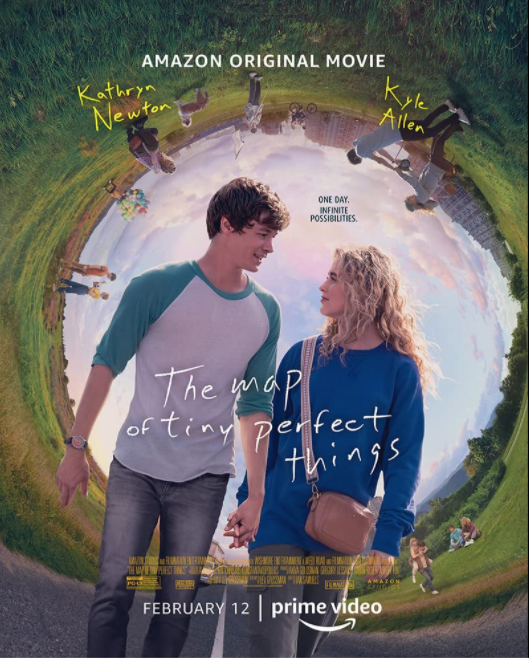
The Map of Tiny Perfect Things: Not Perfect But Close Enough


The Map of Tiny Perfect Things, from the novelette by Lev Grossman (The Magicians) and screenplay by him, debuted on Amazon Prime video a few days ago.   Its ratings on Metacritic and Rotten Tomatoes are 6-7, but I think it's much better than that, well over 9.  It's said to be a Groundhog Day (the holiday and the movie) meets Valentine's Day (just the holiday), but it's more than that, too.

The similarity with Groundhog Day, which I'd give a 10 on that scale, is Mark is reliving the same day.  He confides this to his friend Henry, who, aware of Groundhog Day, suggests that Mark might be able to break out of this time loop by getting a girlfriend.  (Note: I like movies that explicitly reference other movies.  It's not the biggest deal, but it adds a nice meta-touch.)  Mark is in the process of trying to do that at the pool, by stopping a beach ball from hitting a girlfriend candidate, but not having much luck. Until Margaret enters the picture (literally and figuratively) and everything changes.

Slowly.  Mark and Margaret are clearly having fun, and are really attracted to each other, but Margaret says no when Mark wants to kiss her.  He's a little hurt, of course, and even more so when he connects the demurral to Margaret's leaving each evening after receiving a phone call from a medical student, Jared.  The course of true love never did run smooth, especially when that course is a time loop.

And here the movie takes a crucial turn.   As Mark and Margaret pull apart, we find Margaret at the center of the story.   She's still in the time loop, but it's her time loop.  And as her story unfolds we learn that, indeed, it's more her time loop than Mark's.   Her mind or whatever created the time loop, because her mother is dying, and she didn't want to lose her mother, didn't want that day to end.  That makes perfect sense, and I actually like that raison d'etre for the time loop even better than the reason in Groundhog Day.

But the one thing Margaret didn't expect or count on was finding someone like Mark.  And, ok, I won't spill any more of the plot.   I will say that I thought the title, though well explicated in the movie, doesn't due the truest heart and soul of the movie sufficient justice.  But the acting was great, both Kyle Allen as Mark and especially Kathryn Newton as Margaret, and the music was excellent, too, especially the Bruise's closing "1992," which not only worked just right for the movie but is an apt song for the real world around us today.    (Here's another, much lesser-known song that came to mind as I was watching The Map of Tiny Perfect Things:  "I Knew You By Heart".)


Thursday, January 7, 2021

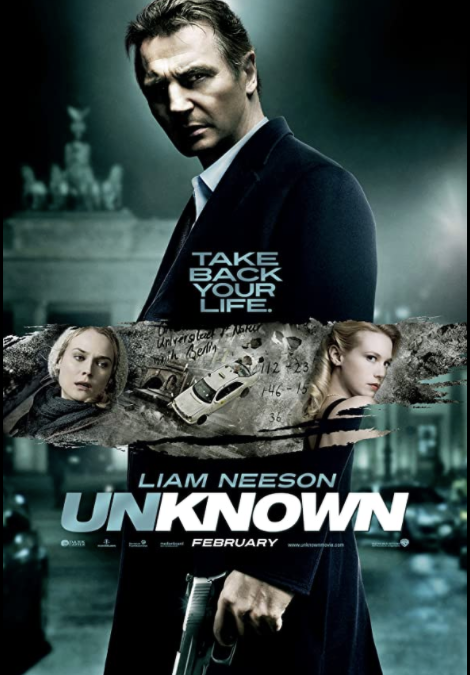
Unknown: Fast Moving and Effective


I noticed that Unknown, a 2011 movie, is on Netflix's top 10.  My wife and I saw it a few nights ago, and very much enjoyed it.

Liam Neeson plays a professor (Martin) who gets separated from his wife Elizabeth (Mad Men's January Jones) and then loses part of his memorable when he's in a car accident.  He has enough of it to know he is married and to whom, but when he meets up with his wife, he finds she's with another man, who has Martin's name, and the couple claim to have no idea who the Neeson Martin is.

That's a good set-up for an action adventure, and Unknown follows through very well.  The action takes place in Germany, and Martin, wanting to find out what's going on with his wife, stays one step ahead of being killed.  Diane Kruger plays Gina, who becomes an ally of Martin's, and the narrative is peopled with oddly memorable characters, including a hotel factotum and a former East German member of the Stasi.

[spoilers ahead]

Unknown also does a good job of sprinkling in clues which are foundations for the surprise ending.  For example, Martin seems to be a very sharp fighter and driver for a professor, and that's because ... as revealed at the end, he's a secret agent not a professor.

The action is non-stop and effective, there's no telling who will live or die, and I very much recommend Unknown.


Monday, January 4, 2021

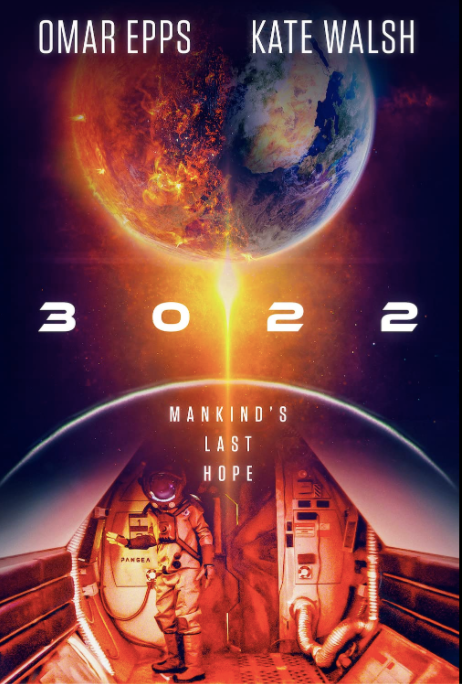
3022: Worthy Entry in a Bleak Genre


For some reason, 3022 is the second movie I've seen in as many weeks about astronauts stranded in deep space, unable to return to an unexpected dead or dying Earth. The Midnight Sky was the first, and both reprise Arch Oboler's (great name) masterful Night of the Auk from the 1950s.   I loved Oboler's play, but I'm generally not a fan of these apocalypse astronaut scenarios.   But like The Midnight Sky, 3022 gave me some reasons to like it.

First and foremost, Omar Epp's performance as John Laine, captain of one of the crews out there in the solar system, was really excellent.  So was Kate Walsh as Jackie Miller, engineer and in a romantic relationship with Laine.  Believability, dependent on actors providing the requisite range of human emotions, is essential in these kinds of life-and-death stories in outer space, and Epps and Walsh are up to the task.

Now one of the reasons I generally don't care for these end-of-the-world astronaut stories is that scant or no reason is given for why the Earth is kaput.  The Midnight Sky didn't, and neither did 3022.  Night of the Auk, by the way, did -- nuclear war.

So with the action on Earth a fait accomplis, we're left with the people in space in 3022 to tell us a captivating story.   The usual narrative, which we've seen many times, are the long-term effects life in space has on the body and mind, and even the soul.  We get a good rendition of this in 3022, with happy astronauts evolving towards falling to pieces.

I won't tell you the very end, which we get in the very last minute.  But I will recommend 3022 as a worthy entry in a bleak genre.   Good writing by Ryan Binaco, good directing by John Suits, as well as the fine acting.

first starship to Alpha Centauri ... and they only had enough fuel to get there

Wednesday, December 16, 2020

The Lie: Acting about Acting


My wife and I caught The Lie last night on Amazon Prime Video.  A scalding little movie from Blumhouse, and from the brain behind The Killing (Veena Sud), with one of its big stars ( Mireille Enos).

[spoilers follow]

First, let me say that I guessed the big shocking reveal at the end -- foresaw this about halfway through the movie.  The reason was two-fold: 1.  We didn't see Britney actually being pushed to her death.  2. Britney's body wasn't recovered.  And although the current was swift, the water didn't look particularly deep.

But this didn't spoil in the least my enjoyment of the movie, which grabs you by your collar as soon as Jay hears his daughter Kayla cry out, and keeps you there for the next ninety minutes.  Further, the acting is really impressive, with a typical brilliant performance by Enos across a simmering and wild range of emotions.

Joey King as Kayla was also noteworthy.  Her acting was, in effect, a double meta-performance.  She has to act to her parents as if she did shove Britney to her death.  And she has to pretend just the opposite to the police: that nothing untoward happened.  And then the big reveal that she and Britney were putting this whole thing on: we need to believe, after that, that Kayla was acting about everything she said before.

I believed it, and so did my wife.   If you've read this far, through the warned spoilers, you've already seen The Lie.  If somehow you haven't, it's well worth seeing.


Saturday, December 12, 2020

I'm Your Woman: This Is Your Movie


I'm Your Woman, a movie up on Amazon Prime since just yesterday, is a real treat.  A superb, different kind of take on a well-worn subject, brought to life on the screen by Rachel Brosnahan.

The set-up: Jean, played by Brosnahan, is surprised by a baby her husband Eddie brings home to her one day.  She can't have children, and he wants them to have the joy of a family.  He's some kind of mobster killer, though, and shortly disappears.  People presumably on his side show up to help  Jean and Harry the baby survive.

So, we've seen this kind of thing before, as I said, but not with the lead role and baby in Brosnahan's hands.  She starts being clueless about everything, from how to fry an egg to how to take care of a baby, let alone defend herself and him, but gradually draws on awesome instincts that get her out of all sorts of perilous situations, and learns from them and the people who want to help her.   The best part of those helpers are Cal, Teri, and Cal's father Art, who teach Jean everything from how to take care of a baby to how to shoot a gun.

I don't want to say more about the plot, because this is the kind of narrative in which a surprise will jump out and point a gun at you every couple of scenes.  I will say that not everyone survives, and not everyone escapes unscathed.  I'll also say again how good the acting is.  Arinzé Kene as Cal, Marsha Stephanie Blake (See You Yesterday) as Teri, and the ever-effective Frankie Faison as Art are just right for their savvy, homespun, ruthless when-need-be parts.  And when you consider that you last saw Brosnahan on Amazon Prime as Mrs. Maisel, about as different a character from Jean as you can imagine, you can get a good idea of what a first-class actor she is.

Well, actually, Midge Maisel and Jean do have one big thing in common.  A lot of heart.  And that's what makes both stories such a pleasure to see.

Hats off to director Julia Hart, writers Hart and Jordan Horowitz, and everyone else involved in making this movie.


Friday, December 11, 2020

Ava: Believable Assassin


Checking in with a review of Ava, a relatively new movie (September 20) about a female assassin which just went up on Netflix last week.

First of all, it has some real star power: Jessica Chastain as the assassin, John Malkovich, Common, and Colin Farrell in her supporting cast.  Now, they've been any number of atrocious movies with big stars over the years.  But Ava isn't among them.  It's a pretty good movie, lifted by the likes of just hearing Malkovich talk.

And the fight scenes are good.  I don't know, are there assassins of either gender in real life who can take on and out 20 people coming at you?  Probably not.  But Ava was convincing.

And so was the worn narrative of your own organization turning against you, because you some sort of weak spot (in Ava's case, talking to the mark about why he or she thought Ava was about to kill them).  This narrative was convincing as soon as it got to the point where you couldn't tell who was going to survive or not, and when.  This included the effective question mark at the very end.

So, if you're up for a somewhat offbeat assassin movie, with characters who manage to be believable because of acting more than the script, give Ava a shot.   And make sure no one like her gets too close to you in real life.


Friday, December 4, 2020

Archive: Androids with Twists


They've been at least three excellent, sometimes outstanding, TV series that probe the philosophic and emotional complexities of androids in the past few years, Westworld, Humans, and recently Raised by Wolves.  But I can't think of an equivalent movie.  Or couldn't think of one.  Until Archive, which has been streaming on Amazon Prime Video since the summer, but I just got around to seeing earlier tonight,

The set-up we've seen in all manner of science fiction and horror movies in the past century: a bereaved husband, who is a genius in AI or other suitable science, determined to use his genius to bring back his deceased wife.  What makes Archive worthy, even great, then, is not in this common set-up.  It's its execution.

Theo's the genius who's lost his wife Stacy in a car crash.  Fortunately, he got a bit of her self (or mind, soul, personality, take your pick), encoded in some kind of digital drive while she was well and alive --- aka the "archive".   Being the genius that he is, and the time about 20 years in our future, Theo is able to build this bit of self into a complete digital persona.  Next step is to put her into an android who looks, talks, thinks, feels like Stacy because, in a very real sense, she actually is.

The stage or story is thus set in two important dramatic ways.  Theo didn't build and therefore doesn't own the archive technology.  So we have corporate conflict.  And Theo can't build a new Stacy first crack out of the box.  On the way to Stacy, Theo builds an android with the mental age of a young child, and another with the age of a young teenager.  The sibling jealousy and rivalry between the teenaged android and the emerging Stacy, along with Theo's patermal discipline and toleration of the teenager are done just right, and would've been worth the price of admission had Archive been shown as intended in theaters.

There are, in effect, two surprises near and at the end of this fine movie.  I'll tell you some about the first but not the second, just in case you haven't seen Archive prior to reading this.  The "Stacy" that Theo is constructing has a personality at least a little different from the original.  Turns out that this new she -- the personality -- was a test-run that Theo got going to make sure the digital entity in the archive could meld well in the bio-digital android he was constructing.   But the new "she" is not exactly the same as Stacy.  So Theo's plan is to swap Stacy's mind into the android, which would mean the new "she" would cease to exist.  The ever-courteous Theo apologizes to the new "she" right before he initiates the transfer and--

Ok, that's where I'll stop in the recounting.  I will say that there is an even  bigger surprise at the very end, and that's the part I liked least in this otherwise outstanding movie (written and directed by Gavin Rothery, in his feature length debut).  Bur see it yourself, and let me know if you agree.


They're coming out into the open, for the first time in centuries ....


Saturday, October 24, 2020

Borat 2 (Borat Subsequent Moviefilm): Camera Epistemology


My wife and I just saw Borat 2 aka Borat Subsequent Moviefilm on Amazon Prime Video.  As with the first Borat movie in 2006, it was at turns and sometimes all together (and altogether) hilarious, horrifying, over the top, sobering, and vulgar.  And there's the already infamous Rudy Giuliani scene near the end.

As always, the question -- Giuliani aside -- is how much the people in the movie, other than Borat and his daughter Tutar -- knew about what was going on, i.e., that they were appearing in a movie.  The two guys who took Borat into their home and spouted dangerous conspiracy theories, the woman who genuinely tried to help Tutar, the various women and men who tried to understand Tutar and Borat, however outrageous or insane their stories, until these marks either broke or continued to work with varying degrees of discomfort inside this horror-show amusement-park universe -- were they really marks or were they part of the paid, unacknowledged, scripted acting cadre?

The people singing the at once very funny and deeply disturbing Covid-19 song were at a rally, and they most likely were real.  They wouldn't have wondered what the cameras that were recording them were doing there.  But what about the conspiracy duo -- who were also at this rally -- what did they think when Sacha Baron Cohen entered their home with not just his mustache but some kind of camera crew?  Or, again, that wonderful woman who took Tutar under her wing, and tried to give her guidance?  I sure hope she was real -- she showed there's still some hope for humanity -- but what did she make of the cameras?  Or, did both Cohen and Maria Bakalova who played his daughter have some kind of super-micro cameras tucked somewhere into their shirts?   Which brings us to Giuliani.

The good thing about Pence and Giuliani -- good, that is, as far as their roles in the movie -- is that neither would have been surprised by cameras in the contexts in which they were filmed, and of course there's no way they would have agreed to play along with Cohen, anyway.   So about Giuliani:  He consents to go into Tutar's hotel room, leering during the interview, and for some reason lies back on the bed (I'd rather not say "lay" here, and who knows exactly if that's grammatically right) and then either (a) tucks his shirt down the front of his pants or (b) you be the judge (this is Cohen's advice to viewers of his movie).  It probably doesn't really matter - Giuliani is a sleaze either way, just a worse sleaze if he's not tucking in his shirt.

Anyway, a brilliantly funny and all too instructive movie by Cohen, wonderfully acted by him and by Bakalova as his daughter.  And as for the rest of people who appear in this movie?  Brilliantly acted or real? Follow Cohen's helpful advice:  See the movie and decide.


Sunday, July 26, 2020

Code 8: Superhero Action with an Ethical Conundrum


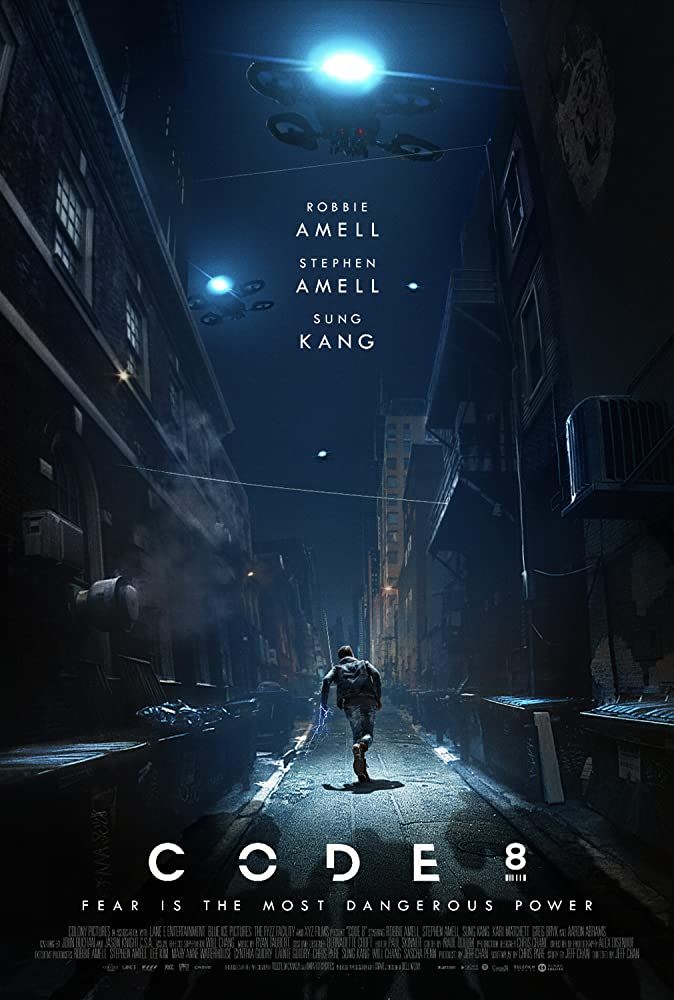
Just caught Code 8 on Netflix.  It's at once a story of people with superpowers, robot cops, human cops, and criminals.  The people with superpowers are feared by normal humans, with the result that most of the superpowered have become criminals.   None of this is particularly original, but Code 8 is lifted by a real humanity that infuses the narrative.

The humanity in the people with superpowers - different superpowers - is propelled by Mary Reed, whose superpower is freezing, and her adult son Connor, whose superpower is electrical.  Again, we've seen all of that before, in Heroes on television, and in countless movies.  But what starts to separate Code 8 from the pack is Mary is also suffering from a brain tumor, which is killing her by scrambling her control of her freezing power to the extent that she's freezing herself to death.  Connor of course is determined to save her, first by making enough money through crime to pay for Mary's operation, and then by getting Nia, whose superpower is healing, to cure his mother.  The problem, though, is that Mia heals by taking unto herself the ill that she's curing.  And that's where Code 8 shows its mettle, in the form of real heart.

Most of the movie are sequences of good shoot-em ups, displays of superpowers, and members of the superpower gang double-crossing each other as members of gangs with no superpowers are prone to do.  All of that is fun to see, but nothing close to memorable,  In contrast, the ending, where we find out just how far Connor is willing to go to save his mother, is an excellent treatment of the classic philosophic conundrum of if you see two people drowning, and can only save one, which one do you save?   Is the answer, save the one you love, by sacrificing someone you may care about, and is certainly innocent?

See Code 8 and decide what you think.   And if you enjoy this action movie charged by a fundamental ethical question, thank Jeff Chan, who wrote and directed the 2019 feature-length film, based on the 2016 short version of the movie, which Chan also directed and wrote (Chris Pare shared in the writing in both versions), which I didn't see.


Monday, June 8, 2020

The Vast of Night: Not Quite That


The Vast of Night, made in 2019, up on Amazon Prime just the end of last month, has received enthusiastic reviews in publications as intellectually (if not physically) far apart as The New York Times and The New York Post.  As usual, I don't quite agree with them.  And though my disagreement is usually I think a film or TV series is much better than the carping reviews, in this case it's somewhat the opposite: though The Vast of Night had its moments, I didn't think it was quite that much.

The story is about aliens from outer space over New Mexico in the 1950s, whom we never see.  That is, we see their ship but not them.  We're told about them through a black-and-white television show called Paradox Theater, which comes with a Rod Serling-like introduction, Twilight Zone intonation and all.  So this means that what we're seeing is not true.   Or, to be clear, all works of fiction are not true, or at least not thoroughly true, stories.  But the Paradox Theater framing of The Vast of Night makes it doubly untrue.  And not, I think, in a way that this statement, "this lie is a lie," may be true.  Or in the way that everything I say is a lie is almost paradoxical but is really just a lie.  In the case of The Vast of Night, The Paradox Theater set-up is just permission to take the story less seriously.

Which is too bad, because I actually liked the story well enough.   Fay the teenage telephone operator and Everett the teenage DJ, well played by Sierra McCormick and Jake Horowitz, are a good couple of friends or colleagues in investigation of the people in the sky.  And I liked the way both struggled to use the technologies of their day - Fay the cabled telephone switchboard, Everett the clunky reel-to-reel tape recorder, deftly listening to and replacing one tape with another as he feverishly searches for the tape recording he needs.  And the music, which is excellent, adds to the tension and fright.

But I would have preferred just the story not the story in the story.  Why dilute a scenically evocative tale with, I don't know, a tongue in cheek?  Or is the real story maybe that The Twilight Zone was a vehicle for telling us true stories disguised as fiction?  If so, that would have been daring, but should have been made much more clear.

But it's a debut film, so it's reasonable to hope for some truly pathbreaking movies from Andrew Patterson in the future.  The Vast of Night, though worth watching, isn't it.


Friday, May 29, 2020

Angel Has Fallen: Great Performances and Resemblances


So we saw Angel Has Fallen (2019) on Netflix last night.  It's the third in the "Fallen" series - Olympus Has Fallen (2013), London Has Fallen (2016) - a nonstop adrenalin saga of Agent Mike Banning overcoming traitors and what seems like hundreds of armed commandos against him to save the U. S. President, now Allan Trumbull, played by Morgan Freeman, who has moved up from Speaker of the House, to Vice President, to now President in the trilogy.  I enjoyed the first two movies a lot, but didn't review them, for who knows why.

What I liked most about Angel Has Fallen is Nick Nolte, who puts in an appearance as Clay Banning, Mike's father, a hermit with munitions savvy whom Mike aptly characterizes as one step away from the Unabomber.   But Clay plays a crucial strategic role in this story, and I'm maybe only slightly exaggerating when I say this may be Nolte's best performance and part since Rich Man, Poor Man in 1976, though I truthfully can't think of another movie or television series in which Nolte was so surprisingly effective.

Also notable in this movie is Danny Huston, who has been one my favorite villains since his Ben Diamond in the all-too brief Magic City TV series (2012-2013).  He projects a combination of intelligence, moral structure that allows him to do great evil, with an underlying adherence nonetheless to some kind of code with some trace of, if not integrity at least its style, that makes him the ideal ultimate antagonist for Mike Banning.

Freeman as Trumbull of course makes an angel to devil comparison of what's now in the White House in our off-screen reality, but there was an eerie suggestion of Trump nonetheless in Trumbull's Vice President, played by Tim Blake Nelson, who reminded me of current U. S. Secretary Steven Mnuchin.   Check out the photos below if you think I'm crazy:


Steven Mnuchin


Tuesday, May 26, 2020

Uncut Gems: Drama at the Speed of Light


I realized years ago when I saw Milton Berle in a serious dramatic role - I think in The Oscar in the 1960s - that, contrary to what you might think, comedians can make excellent dramatic actors.  Robin Williams confirmed this decades later, with a vengeance, in Insomnia.

Adam Sandler plays a serious role in Uncut Gems so frenetic that's it's almost beyond serious.  But it's certainly not comedic. at least for the most part.  Howard Ratner's a jeweler and a gambler, with a keen sense of both.  But he moves so quickly that he's almost always out on a limb, in danger of being beaten or worse, and this applies to his personal as well as professional life.

His main adversary is his brother-in-law, played by Eric Bogosian, who is dead serious as Arno, and moves at a tenth of Sandler's speed, all of the time.  Julia Fox puts in a good, even lovable performance as Howard's girlfriend Julia, and Idina Menzel has the perfect face and expressions for Howard's cheated-on wife.   There's a great seder scene, and I'm always a sucker for Yiddishkite.

Back to Howard, the thing is that he knows what he's doing, as a jeweler as well as a gambler.  He has almost limitless confidence, however, and although it's often borne out, it also leads him to make difficult and dangerous bets.   The formula leads Howard to near misses with fortune and death, and a face that looks increasingly like a punching bag.

But basketball not boxing is the sport in this fast-paced movie, and it all builds up to a crucial, complex, multi-faceted bet on a basketball game.

You can bet on it yourself if you like, but you'll never guess how the movie ends.


Monday, May 25, 2020

Joker: Fantasy and Canon


Checking in with a late review of Joker (2019), which the wife and I saw on HBO last night.

Let me stipulate several things:
  • Joaquin Phoenix was brilliant, inspired, incandescent, whatever superlatives you can find, in the title role.  He eminently deserved the Oscar he won for that.
  • I know a middling amount of Batman canon, but am no expert.
  • I thought the movie held together very well as movie, which means I disagree with, for example, the inanely critical review in the New York Times, as I often do.
I do have question about the ending, though.  And the fact that I have questions makes me think that maybe the movie would have been better ending before this ending.
Arthur Fleck, having actualized his impulses and become the Joker, is seen talking to his state-appointed shrink or social worker, but in a less dingy setting than at the beginning of the movie.  One explanation of this scene, which I'd like to think is correct, is that Fleck, after escaping the cops in what I was wish was the closing scene, is nonetheless apprehended at some time in the future, and is now in some kind of penitentiary serving a life sentence for his crimes (or is he maybe on death row?).

But there's an alternate explanation (which my wife wondered about, and now I'm thinking about it too).  We already saw, in the movie, that Fleck imagined making love and all the good things he did with his neighbor down the hall, Sophie.  This establishes that Fleck's fantasies played a major part in the narrative we see on the screen.  Is it possible that everything else we saw in the movie - Fleck's killing of De Niro's Murray Franklin (who, to me, is just as much Joe Franklin - believe it or not, I was once on his show, talking about my album, Twice Upon A Rhyme - as Murray is Johnny Carson), etc - were also just in Fleck's mind?   Or, at least more of the major sequences than just Sophie as girlfriend?

In at least one Batman movie, if memory serves, the Joker kills Bruce Wayne's parents.  In Joker, one of the myriad angry people with a clown face does the deed.   This suggests that Fleck did not make all of this up - another clown killing Bruce Wayne's parents is consistent with the historical Batman canon of his parents being killed.

In any case, I rate this movie as maybe a masterpiece, and, the more I think about it, the more I think that's right.


Thursday, May 21, 2020

Extraction: The Perfectly Ambiguous Ending and the Determining Quote


Hey, if you're up for an adrenalin rush and almost two hours of fast-paced machine-gunning action, you can't do better than Extraction on Netflix.  [spoilers follow]

Though, actually, Extraction is more than that.  It's a story of how a Rambo and the boy he's attempting to rescue against all odds form a real bond in the interstices of the non-stop action.  It's a story of betrayals and loyalties and just and unjust deserts.  A tale of irrepressible human emotion amidst all the bullets and blades.

But that's not what makes Extraction exceptional, and what I liked best about this movie.  It's the very ending.  We see Tyler, having just about brought Ovi to safety, get shot in the neck, and either fall or let himself fall off a bridge into the deep river below.   We see nothing, no one, rise up to the surface.  But eight months later, Ovi jumps into a pool, sits at the bottom, and swims back up to the surface.  He and we see a figure standing on the side of the pool.  It's not clear what Ovid sees.  But we the audience see a blurry figure who could be Tyler.   So the question is: Did Tyler really survive?  Or is what we are seeing just Ovi's imagination?  A perfectly ambiguous ending.

But where's what I think, and why.  Earlier in the movie, Ovi gives Tyler some advice.  "You know, you drown not by falling into a river.  But by staying submerged in it".  It's a quote from a book Ovi read in school.  And my guess is that's exactly what Tyler did when he jumped, badly wounded, off the bridge into the water below.  He fell into the river, but summoned all his strength to not stay submerged in it.  Why would the writer (Ande Parks), director (Sam Hargrave), or whoever it was, put this in the movie if not to provide this clue.

There's word that there will be a sequel, or maybe a prequel.  The filmmakers of course can go whichever way they choose.  But I think that in their hearts they know that Tyler survived.


Tuesday, May 19, 2020

The Goldfinch: The Burden of Immortality


My wife and I saw trailers for The Goldfinch in those bygone pre-Coronavirus days last Spring, when we went out to the movies.  But we didn't get a chance to see it in the Fall.  It therefore was a real pleasure to finally see it on Amazon Prime Video last night.  The movie is a tour-de-force, even a masterpiece, about the intersection of timeless art and the vicissitudes of human life.  "The Goldfinch" is a real Dutch Golden Age painting by Carel Fabritius, a student of Rembrandt's. The movie is based on a real novel by Donna Tartt about a series of fictitious events surrounding the painting, which I haven't read.

The narrative begins when a terrorist's bomb kills young Theodore Decker's mother during their visit to the Metropolitan Museum of Art in New York City (another place I miss even driving by in these locked-in months).  He leaves with a painting that also survived the bomb, "The Goldfinch," which an old man, another victim of the bombing, urges Theo to take.  The next decade or more of his life, and the rest of the movie, is dedicated to Theo's keeping himself and the painting alive.  He navigates, sometimes expertly, the various family members, girls, women, friends, and players in the fine art and and antique business.

Oakes Fegley as young Theo and Ansel Elgort as his older self are just superb.  My favorite character other than Theo is Jeffrey Wright as James "Hobie" Hobart, whose explanations about the enduring differences between antiques and repros, and it the difference between mortal humanity and an immortal painting, and why it is therefore so crucial that the immortal painting survive, are non-pareil, in movies or anywhere.  And Wright delivers these talks perfectly - indeed, I like his performance in The Goldfinch even more than in Westworld and various commercials,  Other memorable performances include Ashleigh Cummings as Pippa, Theo's truest love, and Stranger Things' Finn Wolfhard as young Theo's friend young Boris, who will play a game-changing role in Theo's later life.  For her part, Cummings manages to convey the deep, complex love she has for Theo, which may be immortal but doesn't always lead to happy endings.

There's a great artistic ambience in The Goldfinch, including the music of Glenn Gould (if you're interested in his virtuoso work and its continuing impact, check out Alida Altemburg's DMajor TV and her Glenn Gould page). And the New York City ambience, the restaurants and the busy streets, make me want to get out there and back there even more.   But like the painting, The Goldfinch movie transcends current catastrophes and even the pandemic, my guess it will be watched and appreciated forever.


Saturday, January 4, 2020

Rocketman: Half the Story, But Excellent


What better way to start my 2020 reviews with Rocketman - after all, Elton John and I were literally born on the same day (my Wikipedia page, Elton John's Wikipedia page).  And we both make music - though Elton John's exponentially more successful than mine.  And I remember going around to record companies in New York City in 1970 with some rough mixes of Twice Upon a Rhyme, and hearing Elton John's "Your Song" playing in one of them, with everyone in the office standing around and listening to it and loving it.  I did, too.

The movie, of course, doesn't have that scene.  But it has a lot from the first half of Elton John's life, from his rise to extraordinary and well-deserved fame, to going off the rails, to coming back to the world and his life.   I would have rather the movie continued into something closer to the present, with Elton singing at Diana's funeral, writing the music for Lion King, but, hey, that was not the movie director Dexter Fletcher and writer Lee Hall wanted to make, and they did a fine job with this one.  As did Taron Egerton as Elton John - in acting as well as singing - and everyone else in the movie.

If the story seems a little trite - and yet another star deeply unhappy, sometimes getting it back in control, sometimes not - that's because it apparently happens lots of the time.  And the cinematography was especially excellent - as is the stagecraft of Elton's in-person concerts (see my review of a concert my wife and I went to and loved in October 2018 - where he sang all of his songs).  But, speaking of concerts, I wish Rocketman had included a bit of the concert Elton did with John Lennon in 1974 at Madison Square Garden, where they sang Lennon's superb "Whatever Gets You Through the Night" - here's a not-the-greatest quality video of that performance.

But the songs that Taron as Elton sang in the movie were done with panache, and, as long as you don't expect to see and hear everything, you'll really enjoy it.


Welcome Up: Songs of Space and Time soon to be released, CDs now available

Tuesday, December 31, 2019

The Aeronauts: Science Fiction of the Past


As long as I'm reviewing good 2019 science fiction movies about traveling off of this planet - I reviewed Ad Astra here yesterday - I might as well throw in a review of The Aeronauts before the year runs out,

Part of the story is true history.  James Glaisher was a meteorologist and an "aeronaut" who traveled further off the Earth - around 9500 meters - than anyone before him, in 1862, in a balloon that lifted him.  But in real history, his co-pilot was Henry Tracey Coxwell, not even mentioned in the movie, which had as Glaisher's pilot the fictitious Amelia Rennes.

That's what makes the movie science fiction.  But there's nothing fictitious about the real emotions Felicity Jones shows us as Amelia, working through her demons born of the loss and trauma she experienced from an earlier trip to the sky.   Indeed, in her partnership in explorations above the clouds she shares with Glaisher, she is the strong one, both psychologically and even physically in some breathtaking scenes.  In real history,  Coxwell saved the day after Glaisher passed out in the high altitude, but I have no idea if those two had conversations as meaningful as between Amelia Rennes and Glaisher in the movie.

The fiction in this scientific history of a movie calls for, once again, the important proviso that should accompany all docu-dramas: they're not the same as documentaries, which are themselves not the same as real history, since a documentary only tells us the part of the story that the filmmaker wants us to see.  But docu-dramas go one big fictional step further - they make up conversations, what real-life people do, and sometimes even make up characters from whole cloth.

That's what The Aeronauts serves us, though Amelia is said to be a composite of real women who flew in balloons in those days.   As far as I'm concerned, I don't care what parts are real and what parts of the composite are fictional.  The Aernonauts is an uplifting, inspiring movie, and I highly recommend it.


                                             Welcome Up: Songs of Space and Time


                                                      Touching the Face of the Cosmos

InfiniteRegress.tv