reviewing Black Doves; Dark Matter; Dept. Q; Detective Hole; Dexter: Resurrection; Fauda; For All Mankind; Foundation; Hijack; Memory of a Killer; MobLand; Outlander; Paradise; Presumed Innocent; Reacher; Severance; Silo; Slow Horses; Smoke; Star City; Star Trek: Strange New Worlds; Tehran;The: Day of the Jackal, Diplomat, Night Agent; Your Friends & Neighbors +books, films, music, podcasts, politics
George Santayana had irrational faith in reason - I have irrational faith in TV.
Chuck Todd interviews me about alternate histories
Showing posts with label Robert F. Kennedy. Show all posts
Showing posts with label Robert F. Kennedy. Show all posts
The Who Killed JFK? podcast with Rob Reiner and Soledad O'Brien concluded today with a satisfying episode that wrapped up this enduring, searing mystery almost as good as it could have.
Reiner and O'Brien's final comments get to the point: this podcast arose from the question that has been nagging at Reiner's soul since 1963. Who killed the President? Although the podcast didn't and couldn't have provided the complete story, wrapped in a package with a bow, which we and the world could now rely on without needing answers to still-unanswered questions, the podcast provided some important signposts, and even some answers, and this is a worthy thing indeed to forward to future researchers and generations. Like Reiner, I've felt lied to about the JFK assassination all these years, angered and aggravated, and I'm glad this podcast can serve as a blueprint for the uncovering of further lies, and the wiping away of at least some of the lies that have plagued us -- all over this planet -- all these many years. We and our descendants deserve nothing less than the truth, or as much of it as we can get, about this monstrous act that stole our future and warped our relationship to the cosmos.
The biggest specific takeaway that this concluding episode gives us is that there were four shooters. I know almost nothing about ballistics and forensics, but this takeaway is convincing. And coupled with it is the fact that Lee Harvey Oswald was not one of the four shooters. As Reiner has said over and over again, why would Oswald say he was the "patsy," if he had really killed JFK? If he had thought the assassination was saving the country, wouldn't he proudly have proclaimed it, as John Wilkes Booth had done with his killing of Lincoln? Or, if Oswald had nothing whatsoever to do with the assassination, wouldn't he have repeatedly proclaimed that, as well, shouting from the rooftops to the media that he was innocent, the wrong man? Instead, the word "patsy" strongly suggests that he knew something about the assassination and how it happened, and that he realized he was the fall guy.
What Oswald knew a lot about was the CIA and how it operated. The podcast stops short of saying the CIA, the Mafia, or Cuban exiles specifically ordered the assassination. But there's ample evidence that they all participated, maybe more as individuals in some cases than formal members of their organizations like the CIA. One the one hand, the passage of time makes it increasingly difficult to identify specific culprits. On the other hand, the players in the assassination had families, maybe children, who might have heard something important, some additional key to unlocking this jagged puzzle, and this very podcast points in the right directions. Hats off to Reiner and O'Brien, to Dick Russell who did a lot of the research for the podcast, and to David Hoffman who did the writing. (I heard in the credits that some of the recording was done at CDM Studies. I've done some work with them myself, so hats off too to Charles de Montebello.)
The big question that I'd still like to see addressed, as I mentioned in my very first review of this podcast, is why JFK's brother, Robert F. Kennedy, sat still for the Warren Commission's bundle of lies about a lone shooter, etc. And RFK, of course, was then assassinated himself in 1968, likely on his way to becoming President of the United States.
Perhaps all the talented people who put together this crucially important podcast could do another podcast on Who Killed RFK?
A short but powerfully informative Episode 8 of the Who Killed JFK? podcast with Rob Reiner and Soledad O'Brien that makes a convincing case that Lee Harvey Oswald couldn't possibly have done it.
Here are the highlights:
The package that Oswald carried into the Texas Book Depository on the day of the assassination was too small to fit the rifle that killed JFK, even if disassembled, according to a witness (interviewed by Reiner in 2023) who traveled with Oswald to work that day.
More than one witness places Oswald in the cafeteria at a time too close to get back up to the 6th floor, from where at least some of the three bullets were fired.
Oswald's behavior after the assassination makes no sense from someone trying to get away.
Now these details, added to what we heard in earlier podcast episodes about why some highly placed people at the CIA, the Mafia, and Cuban exiles wanted to see JFK dead, plus the forensic evidence of at least one of three bullets coming from in front of the JFK Limo, i.e., not from the Texas Book Depository, where Oswald was, make a case that, if I were on a jury trying Oswald for this crime, I would have more than enough evidence or lack of evidence to find him not guilty.
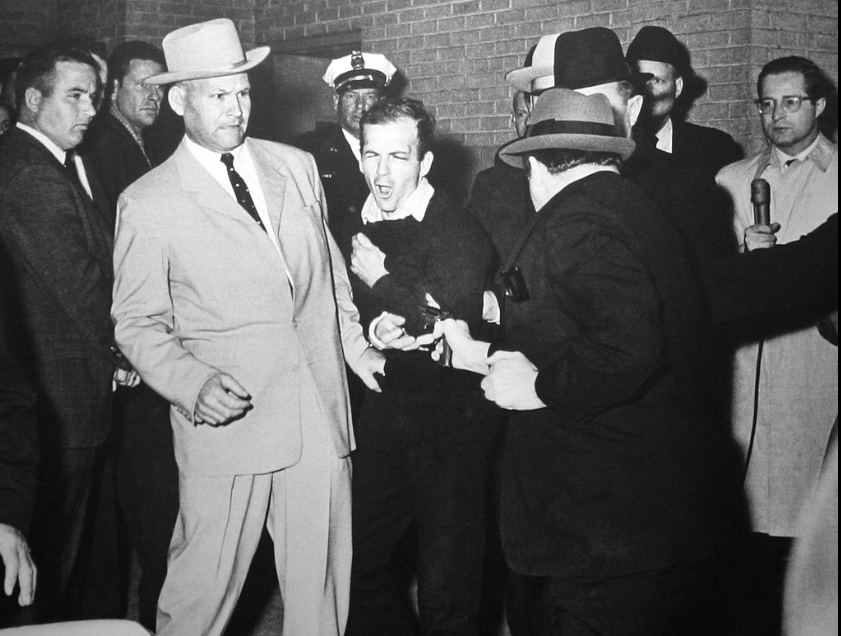
But, of course, as we know, Oswald never got to trial, because Jack Ruby killed him. So Oswald turned out not just to be just a patsy -- a troubled but innocent man blamed from the assassination of John F. Kennedy -- but a patsy who paid for that role with his life. Next week, we'll learn more about Jack Ruby's role in all of this.
And as I said before, I hope, by the end of these riveting podcast episodes, that we learn why the President's brother, Robert F. Kennedy, put up with all of this, only to be assassinated himself.
Given the depth of the pain I and everyone I know felt about the assassination of JFK in November 1963, it's hard to fathom how many different people fervently wanted it. The seventh episode of the Who Killed JFK podcast with Rob Reiner and Soledad O'Brien makes the case for three groups, in particular: the CIA, Cuban exiles, and the Mafia.
The animus that the CIA and exiles from Castro's Cuba had for JFK has already been convincingly presented in prior episodes of this pathbreaking podcast. In episode 7, the focus is on the Mafia, which had two reasons to hate JFK. First, Castro's takeover of Cuba resulted in the Mob's Caribbean Las Vegas being extinguished, which cost them untold millions of dollars. JFK's move towards peace and defacto acceptance of Castro in Cuba after the Cuban Missile Crisis thus angered the Mob almost as much as it did the Cuban exiles and the bellicose CIA. Second, Robert F. Kennedy, appointed Attorney General by his brother, pursued an escalating attack on the Mafia, giving it a reason all its own to want JFK removed from office.
As this episode amply details, members of all three groups -- the CIA, Cuban exiles, and the Mafia -- were in Dallas the day that JFK was assassinated. Are we to believe that that was just coincidence? Not likely. And one CIA operative in particular is especially notable: E. H. Hunt, who achieved infamy a decade later as one of the architects of the Watergate break-in that brought down Nixon.
As Reiner aptly has put it more than once, lots of chess pieces were being moved around in the months preceding JFK's assassination. All of which to insure that JFK was killed, and the blame placed with none of the three groups that were responsible.
The proposition that Lee Harvey Oswald was indeed the patsy that he proclaimed himself to be right after the assassination rings ever more true.
Rob Reiner and I have a lot in common regarding the assassination of John F. Kennedy on November 22, 1963 -- the awful anniversary of which is tomorrow, as I write this. Reiner first learns about the assassination, as he tells us in the podcast he's doing with Soledad O'Brien, in his high school physics class, when he was 16. I first found out about the assassination in my calculus class, which I was taking as a freshman in the City College of New York, when I too was 16. (In fact, we were both born in March 1947 in The Bronx. I was in the "SP"s, which New Yorkers might recall meant that you skipped 8th grade, which would explain why I was a year ahead of Reiner.) We both read and were very impressed by Mark Lane's Rush to Judgement, the 1966 book that attacked the Warren Commission's conclusion that one man, Lee Harvey Oswald, had been responsible for killing JFK. And most important, Reiner and I both felt and feel to this very day that the Warren Commission and the American government has been lying to us all these years about who killed JFK.
To be clear about the impact that assassination had on me, Reiner, and who knows how many more Americans and people around the world, that assassination was "the end of the innocence," to quote one of Don Henley's best songs, about the end of a true love affair. All of us 16 and younger and no doubt at least some years older found we instantly had a new view of the world, a sad, wise, and cynical view, the moment we heard Walter Cronkite or whoever it was deliver this terrible news. Cynical because, well, it's tough to see your optimism shattered, leaving you feeling naive to have had it in the first place. No amount of Beatles and landing on the Moon could change that, and the murder of John Lennon in 1980 only reinforced that horror in the soul.
Reiner seeks, if not to remedy that (it can never really be remedied), at least perhaps to reduce it, by getting at the truth of what really happened on November 22, 1963. In the first two episodes of his podcast, which O'Brien helps him deliver, Reiner explains how and why the CIA came to loathe and fear JFK. He didn't back it up to its satisfaction when it tried to wrest Cuba from Castro, and he let that attempt end in the Bay of Pigs. He started working hard to get a real peace with the Soviet Union, when he saw how close we came to destroying our civilization in the Cuban missile crisis. Reiner tells us of the note the newly widowed Jackie sent to Khrushchev. That's all in the first episode. And in the second, we learn of the various attempts, from people ranging from Geraldo Rivera and Dick Gregory, and others I hadn't heard of before, like Dick Russell, to get at the truth.
I'll be listening to every remaining episode of this important podcast. Its tone and intelligence scratch an itch that will always be there. I have no idea if Who Killed JFK? will address a question I've had since that day in Dallas when the curtain came down on my unbridled optimism about the good guys always winning. Why didn't Robert F. Kennedy, who remained Attorney General until September 1964, do everything in his power to find out what happened to his brother? Perhaps he would have, as President, if he hadn't been murdered himself in 1968.
Added 22 November 2023: Review of Episode #3
And today is the 60th anniversary of JFK's assassination. I would have thought about him and that heinous event on this day, anyway, but having listened to and reviewed the first two episodes of Rob Reiner and Soledad O'Brien's podcast last night, the assassination and the government "narrative" about it has been especially on my mind.
In the third episode, Reiner says "narrative" is a good word for what our government told us about the assassination, because so much of the government's story was fiction. Coincidentally, I've been thinking and reading a lot about alternate history recently -- and writing some of it -- and I found myself agreeing with the authors quoted in Jack Dann's Fiction Writer's Guide to Alternate History that a lot of our so-called real history is fiction.
In the third episode of Who Killed JFK?, Reiner details how the findings of what he aptly calls "the most important autopsy in American history" were not only kept from the American people, but deliberately bent to support what the government didn't want us to know -- that more than one shooter was firing at JFK in Dallas 60 years ago. We learn that Dr. James J. Humes, one of the two pathologists who performed the JFK autopsy, burned his first autopsy report, presumably because it contradicted the "single bullet" theory that our government was pushing. Reiner, O'Brien, and the experts they interview systematically explain why the single bullet theory is absurd -- way too much damage was done to Kennedy and John Connally, who was sitting in the front seat of Kennedy's limousine. We also hear convincing testimony that some of JFK's wounds came from the front, obviously impossible if Lee Harvey Oswald, firing from behind, was the only shooter.
So, today, November 22, has been and always will be a sad day for those of us who were cognizant the day that JFK was assassinated. But the Who Killed JFK? podcast is a welcome ray of hope that maybe we're finally getting close to the truth of what happened 60 years ago.
This seems to be my year -- by which I mean all of 2021 and 2022 -- for alternate history. The second season of For All Mankind in February 2021, Ronald D. Moore's masterful alternate history about the race to the Moon in the 1960s, and ensuing decades, was even better than the first. My 90-minute interview with Rufus Sewell in July 2021 about The Man in the High Castle series on Apple TV+ got me even deeper into that one-of-a-kind stunning story. And just this month, a favorite story that I've written was published -- "It's Real Life," my alternate history about The Beatles.
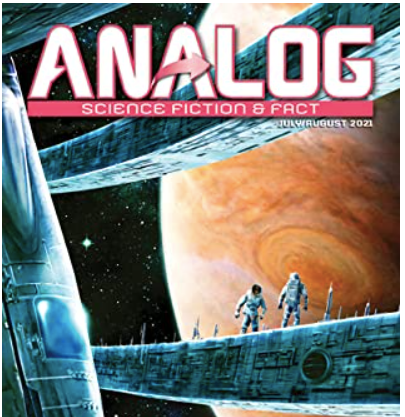
So I was well prepared to catch up in my reading with Rosemary Claire Smith's "The Next Frontier" in the July/August issue of Analog Magazine. And the novelette exceeded my high expectations, delivering a memorable mix of alternate history about our species reaching the Moon, heart-throbbing detailed astronaut action in space, keen social valence, and even a scene that brought tears to my eyes.
Here's the set-up, with just some introductory spoilers: Natalya Orlova has defected from the Soviet space program, and has joined Armstrong, Aldrin, Bean, et al as possible to likely candidates for our American missions to the Moon. Jackie Kennedy has become co-director of NASA (I just love that!), and she's far tougher than the media allowed us to see in our reality. Bobby Kennedy survived the attempted assassination in June 1968 (with just a scar on his head) -- another facet of this alternate history that I love -- and is locked in a tight race with Nixon for the U. S. Presidency.
If that doesn't tempt you to read this story, I guess alternate history is not your thing. Smith's novelette makes important statements about the role of women in getting our species off this planet (similar in that regard to For All Mankind), as well as the realpolitik of space travel. Highly recommended, to say the least, not just to read but as the best novelette for the AnLab, Nebula, and Hugo Awards this year.
It started in the hot summer of 1960, when Marilyn Monroe walked off the set of The Misfits and began to hear a haunting song in her head, "Goodbye Norma Jean" ...
It occurred to me, watching the superb Mad Men 6.7 tonight - right after Mr. Selfridge on Masterpiece Theater - that for people who weren't cognizant in the 1960s, watching Mad Men must be not much different than watching Mr. Selfridge, which takes place right before World War I. Two brilliant period pieces, two history shows, both about selling.
I did live through the 1960s, and that means I see the show through the very different lens of having been right there, been in that world, which makes the show's connection to real life history-changing events all the more potentially powerful, but I'll get to that in a minute or two.
The main themes in the office tonight were merger and margarine. The merger of the SCDP and CGC advertising firms means that some people will be let go - the new merged firm can't accommodate and won't need everyone. Burt Peterson, another perennial loser (in a different way than Pete), is unsurprisingly the first to go. No loss.
The product du jour - the first campaign - that the new combine tackles is Fleischmann's margarine. Peggy contributes the important nugget that margarine was invented back in the mid-1800s by Napoleon III in France, because it didn't turn rancid like butter so it could be used by the army. I didn't know this, and neither did the assembled ad thinkers around the table, but that was the last Peggy had to do with margarine. Don - late for the meeting - gets together with Ted a little later, gets him drunk, and comes up with a good campaign.
Don's late because he was in a hotel room with the doc's wife Sylvia, in what was one of the best set pieces in the series, repulsive yet instructive because it was so revealing of Don. Sylvia earlier called Don at the office to say how much she needed him - "I need you, and nothing else will do" - and this sets off Don making his fantasies real. Unfortunately, those fantasies entail Don treating Sylvia like a sex slave. He puts her through a ridiculous and demeaning series of requests that last into the next day - the doc's out of town on business - and Sylvia eventually ends it, telling Don she feels ashamed. Don, the ultimate cool when it comes to business and to sex when it goes his way, is stunned. And for the audience, it's both a relief to see Don's bad behavior over - for now - and a reminder of why Don is such a fascinating character. He has a unique mix of decency and indecency, reasons to admire and despise and pity him.
But these revelations into personal character were not the most profound moments in tonight's episode. Those come at the very end, when Pete's addled mother has some news for him early the next morning. Pete think she's crazy but we know it's true. And we soon see Megan and Don reacting to it.
As I said earlier, to have lived through a time depicted in an historical narrative gives the narrative special power, and also responsibility to get it right, as you remember it. The assassination of Robert F. Kennedy in June 1968 was one of the cruelest cuts of all in that decade of assassination. Not only the President but now his brother were killed, and just two months after Martin Luther King, Jr. Mad Men closed on this national tragedy tonight, and did it just right, with the news of the RFK shooting on television fading into the credits, and Friend and Lover's "Reach Out of the Darkness" playing in the background.
Friend and Lover could be a good title for Mad Men ideal but often unattained or lost relationships. For all its focus on making money, Mad Men is and always has been about something much more.