Chuck Todd interviews me about alternate histories
Showing posts with label Mike Rashkow. Show all posts

Sunday, January 12, 2025

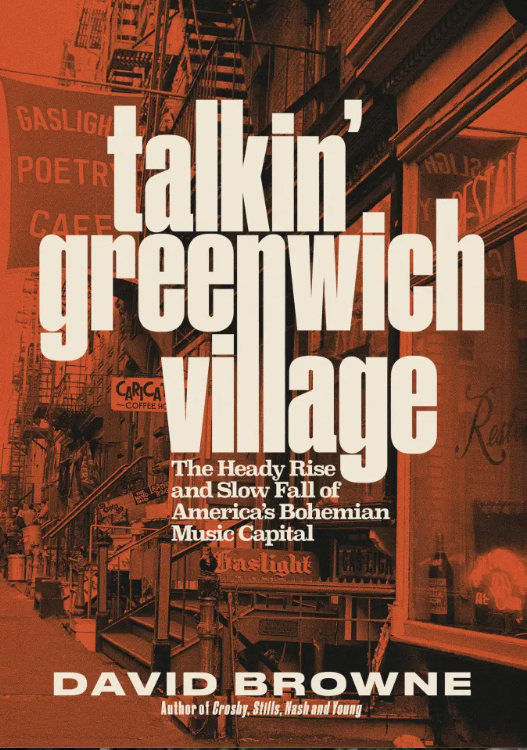
Review of David Browne's Talkin' Greenwich Village: Cornucopic Rainbow Biography


                                    more about the book here

If ever there was a time-travel ticket to a past and a place that you knew so well you could still see the sun glinting through the tree leaves, hear the din of the eateries as you walked by, and, most important, still hear the music that actually defied any given time or place, it would be David Browne's book, Talkin' Greenwich Village: The Heady Rise and Slow Fall of America's Bohemian Music Capital.  That's because Browne has a way of writing, an eye for detail, a penchant for commentary, that draws you in to fill the background you in one way or another actually experienced, or, what Marshall McLuhan called "cool".

Yeah, I sang doo-wop in Washington Square Park with my acapela group The Transits in the early 1960s, and then my folk-rock group The New Outlook a few years later (Ellie Greenwich and Mike Rashkow heard us uptown one Sunday afternoon in Central Park, and signed us to Atlantic Records, after changing our name to The Other Voices), but the way I really got to know the village was finishing up my BA in Journalism at NYU, then going a few blocks up to the New School for an M.A., then back to NYU for my PhD in the 1970s.  (I even managed to write three pieces for The Village Voice just before all that, my sum-total career as a music journalist.)

Turns out David Browne and I could have passed each other in the street -- David arrived to pursue his BA in Journalism at NYU in 1978, and I left, thankfully finished with school, in 1979 -- or bumped into each other going in and out of the diner southeast of the park.  But David stayed focused on the Village and its clubs and their music, to the present day, while I pursued music on the radio, MTV, iTunes, and anyplace I could hear it, and only came to the Village with my wife to eat in a great Italian restaurant near Houston Street, or go shopping at Balducci's.

And Talkin' Greenwich Village is one of the results of Browne's passion -- he's written more than half a dozen other books about popular music, and writes for Rolling Stone -- and delivers a cornucopia of vignettes, insights, and are what in effect mini reviews of dozens of artists.  You know, I always judge a book by how well it treats a subject I know something about.  My wife and I were/are devoted fans of Phil Ochs -- I consider his "The Crucification" right up there with the very best songs that Dylan wrote -- and Browne not only got everything right in his discussion of Ochs and his life in the Village (with an intermission in California) over the 1960s and 70s, until he took his own life the year my wife and I got married (we went to the Memorial Concert for Ochs that Browne also aptly describes), but I also learned something from his description of Ochs.  It's become hard-wired into Ochs's story that he was broken when Dylan did not include him in his Rolling Thunder tour.  But Browne provides a missing piece of the story, telling us how Ochs badgered Dylan, when Dylan was first beginning to put together the group that would tour.   Which means, it's not quite true that a callous or jealous Dylan simply didn't include Ochs on the tour.

But in addition to, I don't know, at least vignettes of 50 artists spread across 8 chapters and an Epilogue teeming with information -- Browne lists every interview he did for the book in its Bibliography -- he focuses on two artists, Dave Van Ronk, and the Roche Sisters (and, also of course, Bob Dylan), and makes them, in effect, centerpieces and guides to what Browne is telling us happened in these magical decades.  I only saw Van Ronk once (at the Phil Ochs 1976 Memorial  Concert at the Felt Forum) and the Roche Sisters only on YouTube.  But Browne's accounts of Van Ronk and of the Roches across the decades amount to mini but in-depth biographies of the two, and make Talkin' Greenwich Village irresistible reading just on their own.

But lest you think everything in this book is as serious as Ochs, or even Dylan, Browne also has a knack for the kind of detail that will make you chuckle, or even laugh out loud.  Seeking the name of a song on one of The Blues Project's just-recorded albums, the response to the person who's writing down the titles is "'What song? You mean Steve’s song?' To [Steve] Katz’s chagrin, 'Steves Song,' complete with a missing apostrophe, became the title."  Or, "when Orbison and Ronstadt huddled in his dressing room, [Jerry] Brown [then Ronstadt's boyfriend], waiting patiently outside, finally began pounding on the door: 'Let me in! I’m the governor of California!'''  Or, "the worst [performers in this Village venue] were booed or heckled. When asked if one contestant should be booted off the stage, [owner] Porco grumbled, 'No, I think we should shoot him.'”

Of course, no volume is perfect, and I'll tell you the one thing I missed in this New York Public Library of a book. I was a big fan of The Blues Project, and to this day I find myself humming or singing to myself "Cheryl's Going Home".  The song was written by Bob Lind (who wrote "Bright Elusive Butterfly of Love"), who does a pretty good job singing it.  But the Blues Project rendition, with those piercing guitar notes, and their interplay with organ, is something else.  Browne tells us almost as much about The Blues Project, Danny Kalb in particular, as he does about Van Ronk, the Roches, and Dylan.  But not a word about that elusive heart-breaker Cheryl.  I guess she was already home and out of sight.

But every page of this pulsating encyclopedia of whirling words is worth reading.  The fall of Greenwich Village and its clubs and taverns and whatever you want to call them brought tears to my eyes, because David Browne had made it seem like a beloved living organism, a mini gaia of music just several blocks long.  My only really lasting regret about this book is that it wasn't ten times longer.  As it was, it's 400 pages went by too quickly, because I just couldn't put the book down.

=========

Check back here at the end of the month for my upcoming interview with David Browne.

=========


                        in Kindle, paperback, and hardcover


Friday, January 22, 2021

Tommy James, Morris Levy, and Ellie Greenwich's Ring


Excellent article in The Guardian about Tommy James and Morris Levy (mobster owner of Roulette Records), and how Levy never paid James for his hit records ranging from "Hanky Panky" to "Crystal Blue Persuasion" (thanks guitarist Glenn Conway for bringing the article to my attention).

I found James receiving no or a negligible payment for "Hanky Panky" especially interesting, because it doesn't jibe with what Ellie Greenwich told me she received as co-writer of that song with her then husband Jeff Barry.  (Ellie and Mike Rashkow produced my group The Other Voices aka The New Outlook -- two singles -- on Atlantic Records in the late 1960s.  Here's the most successful of those two singles, May My Heart Be Cast into Stone -- Stu Nitekman is singing lead and I'm singing falsetto.)

Anyway, Ellie wore a big beautiful ring -- she called it her Hanky Panky ring, because she said when she received her multi-thousand dollar check as co-writer of "Hanky Panky," she went out and bought that ring.  I have no idea what the ring cost and how much she and Jeff received for that song.  But I don't think she was lying, and she gave the impression that the ring cost at least a couple of thousand dollars.  But even if it was cost just a couple of hundred bucks, that means she received much more for that song than Tommy James says he received as its recording artist.

Songwriters those days received royalties from two sources: the record company, which paid the writer a penny per record sold, and the performance rights organization, which paid the writer a sum of money based on how many times the song was played on the radio (in Ellie's case, the organization was BMI).  "Hanky Panky" was a huge #1 record, but did it receive enough airplay for Ellie to buy a big ring from her BMI payments, if Morris Levy paid her just a pittance, or nothing?

Who knows?  Maybe Jeff Barry threw in his BMI royalties.  Ellie died, sadly, in 2009, but Jeff is still alive and kicking.  Which come to think of it, a group by that name had a big hit record with a song called Tighter, Tighter, written by none other than Tommy James, and released on Morris Levy's Roulette Records in 1970.


Thursday, September 24, 2020

Spun Dreams on Bandcamp

Before Twice Upon A Rhyme and Welcome Up: Songs of Space and Time, there were Spun Dreams: studio and home demos, most from mid to late 60s, sunshine pop with a bit of an edge and a psychedelic flavor, especially as you get into the album. My group back then was The New Outlook, a folk-rock trio. Spun Dreams has been streaming for almost a decade on Spotify, Apple Music, and all the usual places. But now it's up on Bandcamp, with all kinds of details on songs and tracks that I haven't mentioned before. Details in the track credits about how the likes of Ellie Greenwich, Mike Rashkow, Tash Howard, and dj Murray the K figured in these songs. And check out the bonus items for at least one special photo I haven't laid eyes on since 1966.


Sunday, March 19, 2017

Late Afternoon

Usually when I'm writing and talking about my music, it's all about Twice Upon a Rhyme, the album I produced with Ed Fox in 1972, with most songs written by us (and a few others by just me, by me and Peter Rosenthal, Linda Kaplan, and others), and performed by Ed, me, Peter, Donny Frankel, Boris Midney, and lots of other musicians.

Interestingly, we never performed any of Twice Upon a Rhyme live.  In fact, the first live performance of a few songs from the album with some others was by Pete and me in Ronkonkoma, NY in August 2015 - here's the video (not the greatest sound quality, but you'll get the gist).

But before I started writing with Ed, before Twice Upon a Rhyme, I was in very different kind of group, a folk-rock group, The New Outlook.   That group consisted Stu Nitekman (usually lead vocal and strumming guitar), Ira Margolis (baritone harmony), and me (first tenor and falsetto harmony, occasionally lead, occasionally an organ I bought in Woolworth's on our home demos).

We did perform in person - almost daily, in the Alcove right outside the cafeteria on the North Campus of the City College of New York (CCNY), where we regularly sang instead of attending classes.  And when we weren't on the North Campus, we sang in a similar Alcove in Finley Hall on the South Campus, again rather than attending classes.   But we also on occasion performed at clubs in the New York area, recorded a few studio demos (recording costs paid for by this publisher or record producer or that), and lots of home demos (which is where my cheap organ came in).  I assembled 12 of those recordings, and added three of my own more recent songs, on a digital album, Spun Dreams, in 2010, available now on Spotify, Amazon, iTunes, and all the usual places.

But back to the 1960s - one sunny afternoon in 1967, The New Outlook (Stu, Ira, and I) were belting out our three-part harmonies in Central Park, when a couple walked by, stopped, and listened to at least six of our songs.  They turned out to be Ellie Greenwich (co-writer of "Da Doo Ron Ron" and tons of other songs) and Mike Rashkow (co-writer of "Mary in the Morning", recorded by Elvis), and they signed us to their production company and in turn to Atlantic Records, which released two singles by the New Outlook - renamed The Other Voices - which went nowhere.  (I co-wrote the B-side of one release, "Hung Up on Love," with Mike's wife at the time Mikie Harris).  The New Outlook shortly after left Atlantic, resumed our original name, and recorded one of our new songs, "Evening's Evergreen Morning," without Ellie and Mike.  But when it didn't get much response, either, we disbanded.  The studio demo of "Evening's Evergreen Morning" - which, by the way, features Pete Rosenthal on guitar, in his first work on what would be many of my songs - is included in Spun Dreams.

Which gets me, at last, to the title of this post.  "Late Afternoon" was not included on Spun Dreams. It was one of our favorite songs - I wrote the words, and Stu the music - and we performed it with full New Outlook harmony.  But all I had was a track with Stu singing a strong lead and strumming guitar. I had hoped to someday find a full New Outlook version - but I decided, the other day, to just add some of the harmony myself, and get this song out to the world.   It will soon be available on Spotify, Amazon, and iTunes.  But here's the song for you now (with lyrics below).   Enjoy!


Late Afternoon

Words by Paul Levinson, Music by Stu Nitekman, 1966

The shades of dusk hang over us
Our day has nearly passed
And now the Earth seems sadly hushed
As shadows wash the grass

(chorus)
Look at our love in the late afternoon
Any moment the darkness might come
Open your eyes, it's the late afternoon
Don't let our dreams set with the sun

The early warmth has cooled with time
We'll soon feel evening's frost
And in the night we'll never find
the treasure that we lost

(chorus)

You smile while twilight skies grow dim
But once the flame has died
You'll long for all that might have been
If only we had tried

(chorus)

========================================

And hey - if you'd like more of The New Outlook, here's another recently uncovered recording of all three of us singing that upbeat, peppy classic - On the Sunny Side of the Street

Wednesday, August 26, 2009

Ellie Greenwich

What a day ... Ellie Greenwich also died today. She was 68. She wrote rock classics such as "Be My Baby" with Phil Specter and her then-husband Jeff Barry. With Jeff, she discovered Neil Diamond and produced his early great records. Ellie and Jeff performed as the Raindrops, and also wrote hits for groups ranging from the Crystals ("Da Doo Ron Ron") to Manfred Mann ("Do Wah Diddy Diddy"). They even wrote "Hanky Panky" for Tommy James and the Shondells.

Jeff and Ellie split. He went on to produce the first hits for the Monkees. She joined forces with Mike Rashkow (co-writer of "Mary in the Morning"). One Sunday afternoon in the Spring of 1967, Ellie and Mike were walking in Central Park in New York City, and heard some good harmony ....

That was Stu Nitekman, Ira Margolis, and me singing. We were a folk-rock pop group called "The New Outlook". Ellie and Mike changed our name to The Other Voices and got us a contract with Atlantic Records. Two singles ensued - "May My Heart Be Cast Into Stone" and "No Olympian Height". The B-side of both singles was written by Mikie Harris (then Mike's wife) and me - "Hung Up On Love".

Mike and Ellie also put together a studio group, The Definitive Rock Chorale, which recorded one of my songs, "Picture Postcard World". You can hear it below. Listen for Ellie singing in the background.

Ellie went on to have hit Broadway play in 1985 - "Leader of the Pack".

I went on to become a professor and a writer of books instead of music and lyrics. You can hear more of my music over here. I also have a MySpace page for The New Outlook.

I spoke to Ellie maybe once every decade on the phone. She was my first brush with flickering fame. I expect her joyous music to be around for a long time.

InfiniteRegress.tv