reviewing Black Doves; Dark Matter; Dept. Q; Detective Hole; Dexter: Resurrection; For All Mankind; Foundation; Hijack; Memory of a Killer; MobLand; Outlander; Paradise; Presumed Innocent; Severance; Silo; Slow Horses; Smoke; Star City; Star Trek: Strange New Worlds; Tehran;The: Day of the Jackal, Diplomat, Last of Us, Night Agent; Your Friends & Neighbors +books, films, music, podcasts, politics
George Santayana had irrational faith in reason - I have irrational faith in TV.
Chuck Todd interviews me about alternate histories
Showing posts with label JFK assassination. Show all posts
Showing posts with label JFK assassination. Show all posts
I just saw Bob Dylan singing Ricky Nelson's "Garden Party" in San Diego (on May 15, 2025) a few hours ago on YouTube. I posted a link to it on all my social media. But I had to say more. In no order of importance (because I think all of these points are important):
Dylan's voice is outstanding. I mean, his voice was already sounding better in his 2020 Rough and Ready LP (with a standout performance in his "Murder Most Foul" lament about the assassination of JFK), but his vocal in "Garden Party" has a real depth and subtlety, hitting some notes with a fluency almost approaching that of "Lay Lady Lay".
This cover shows, again, how Dylan is a mentch. He must have greatly appreciated (1) when Ricky Nelson did a fine cover of Dylan's "She Belongs to Me" and (2) probably even more so when Dylan heard his name in "Garden Party" ("Mr. Hughes hid in Dylan's shoes"). This was, after all, certainly more appealing than what John Lennon said about Dylan explicitly in "God", and a whole lot better than Lennon's put down of Dylan (without mentioning his name) in The Beatles' "I Dig A Pony" (it was no doubt no consolation that Lennon also put down The Rolling Stones in that great song as well).
There's something very, I don't know, comforting, in reciprocal covers. It shows, at least to me, that there's something fair and good about this cultural universe we all inhabit. That's an important discovery, because the universe as we all know deals out all sorts of disappointments and betrayals (especially in show business, but more recently even more obvious in politics and its tentacles).
Dylan, when he broke through in the 1960s, was an absolute master of lyrics, at the zenith of that craft. Cole Porter previously held that position, and Lennon, McCartney, and Harrison were often close seconds, but I've always thought that Dylan held and still holds that position alone. It's good and gratifying to now see him make his mark in the increasingly important micro-genre of covers.
Just saw Martin Scorsese's Beatles '64, up today on Disney+. It's everything you would expect from a master like Scorsese and his masterful 1978 TheLast Waltz, but much more, given what the Beatles were and are to so many millions of people on this planet. As I began saying in the 1970s, that impact will last for thousands of years, right up there with Socrates and Shakespeare, even though at one point in the documentary, a young Paul scoffs at The Beatles having anything to do with "culture," preferring instead to say that what The Beatles are about are "laughs".
Here are some of the highlights of Beatles '64, made possible by some of the footage the late Albert and David Maysles brothers took of The Beatles first trip to America -- for their first appearance on the Ed Sullivan Show, concert in Washington DC, and concert back in New York in Carnegie Hall -- that had special resonance with me. I present them in more or less chronological order in the movie:
A girl fan in New York City tells about the gifts she brought for each Beatle. For Ringo, it's two "science fiction books". She doesn't say which ones, but even so, it's good to hear.
Another girl says Elvis "is old anyway". I think Elvis was great, but I get what she means.
Yet another girl, who goes to Julliard, explains that "we don't usually like rock 'n' roll ... [but] The Beatles are the greatest". See below about Leonard Bernstein and his CBS special and his daughter Jamie for more on this point.
Ronnie Spector, interviewed probably ten or so years ago, says "Murray the K was downstairs [saying] you gotta get me upstairs to meet The Beatles." My second published article was about Murray the K (in The Village Voice in 1972 -- my first was about Paul McCartney in the same weekly newspaper a year earlier in 1971), and I even wrote a song about Murray the K that he played on his WNBC-AM radio show. Beatles '64 had a lot more to say about Murray, which I'll discuss below.
I loved seeing the Ronettes hold the Phil Spector Christmas Album, which has two recordings by the Ronettes -- "I Saw Mommy Kissing Santa Claus" and "Frosty the Snowman" -- that I still play on YouTube all time.
A nasty NYPD cop tells two girls to get off the floor The Beatles were on, in their hotel, to walk down the stairs "before I throw you down the stairs". An unfortunate parallel to the London bobbies who go up to the roof to break up The Beatles last concert that we see in Peter Jackson's The Beatles: Get Back, also on Disney+, and now a perfect pair with Beatles '64.
Black teenage girls love The Beatles; black teenage boys do not, one of them saying, "I think they're [The Beatles are] disgusting." (But see Smokey Robinson, whom I'll discuss below.)
Murray the K appears throughout the movie. The Beatles tend to think he's too "loud," John mocks him in the movie, and George Harrison remarks in an interview probably conducted in the mid-1980s that Murray, in effect, just glommed on to The Beatles and their first visit to New York. I actually worked with Murray in the early 1970s -- he invited me to come work with him after he read my 1972 article about him -- and I didn't find him too loud at all. He likely had mellowed by then.
Smokey Robinson does an endearing performance of McCartney's "Yesterday" in the 1960s, and in a very recent interview explains that The Beatles had a tender, feminine way of expressing their emotions, which Smokey found very admirable. Jamie Bernstein (Leonard's daughter) and Betty Friedan echo and elaborate on this perceptive view. Clips from Leonard Bernstein's pathbreaking 1967 CBS show on The Beatles and the "rock revolution" appear throughout Scorsese's film (here's my review of Maestrowhich, amazingly, said nothing about that TV show).
Back to Murray the K: he gets George in 1964 to introduce James Ray's "Got My Mind Set on You". Unsaid in the movie is that of course George would have a big hit singing the song in 1987. Hey, Murray at least deserves credit for helping keep the song in George's head (he had first heard the song in an earlier trip to the U.S.).
Marshall McLuhan appears a lot in the second half of the movie, saying things like "JFK was the first TV President" and interviewing John and Yoko in Toronto at the end of 1969. I worked with McLuhan at the end of the following decade -- he was also the real thing, the most perceptive scholar I've ever had the chance and pleasure to work with (more on McLuhan in my just updated McLuhan in an Age of Social Media). Beatles '64 sets up The Beatles coming to America as the immediate sequence and desperately needed healing musical salve to the crushing depression caused by JFK's assassination, which indeed it was. McLuhan's breakthrough book, Understanding Media, arrived at same time. The Beatles helped heal America, McLuhan helped us understand what was happening.
Harry Benson, a now 94-year-old photographer, tells us that Lennon "used to speak, of all things, about Lee Harvey Oswald ... he was worried about violence" directed against him and The Beatles in America. That brought me to tears. (I say more about Lennon's assassination, and how it brought me to write It's Real Life: An Alternate History of The Beatles, in this interview conducted just last week.)
But on a lighter note, speaking of tears, I had to laugh when I heard that "George Harrison was near tears" when he and The Beatles were dissed at a reception for them at the British Embassy after their Washington DC concert. McCartney had a much better response.
Also on a lighter note, and putting on my media theorist hat, I was pleased to hear the word "cassette," long before there were little tape recordings, back in 1964, used to describe a place that cans of soda inhabited, when someone said, "draw it [the soda can] out of the cassette".
But the documentary returns to the assassination of JFK, which, along with the assassination of John Lennon, were the worst public events in my life. At the end of the movie, satirist and critic Joe Queenan, who appears throughout the film, tells us that his "father never recovered from Kennedy's assassination but we did". And that of course was because we had The Beatles. The "we" is my generation, and what Queenan says is all the more trenchant, since he earlier tells us that his father beat him, and also decreed that Queenan couldn't watch The Beatles on Ed Sullivan, which Queenan said was worse. But he managed to watch at his uncle's place.
I could say more about this documentary, but you get the picture, and if you loved or love The Beatles, and feel the same about Peter Jackson's The Beatles: Get Back, see this movie, Beatles '64, at least once.
The Who Killed JFK? podcast with Rob Reiner and Soledad O'Brien concluded today with a satisfying episode that wrapped up this enduring, searing mystery almost as good as it could have.
Reiner and O'Brien's final comments get to the point: this podcast arose from the question that has been nagging at Reiner's soul since 1963. Who killed the President? Although the podcast didn't and couldn't have provided the complete story, wrapped in a package with a bow, which we and the world could now rely on without needing answers to still-unanswered questions, the podcast provided some important signposts, and even some answers, and this is a worthy thing indeed to forward to future researchers and generations. Like Reiner, I've felt lied to about the JFK assassination all these years, angered and aggravated, and I'm glad this podcast can serve as a blueprint for the uncovering of further lies, and the wiping away of at least some of the lies that have plagued us -- all over this planet -- all these many years. We and our descendants deserve nothing less than the truth, or as much of it as we can get, about this monstrous act that stole our future and warped our relationship to the cosmos.
The biggest specific takeaway that this concluding episode gives us is that there were four shooters. I know almost nothing about ballistics and forensics, but this takeaway is convincing. And coupled with it is the fact that Lee Harvey Oswald was not one of the four shooters. As Reiner has said over and over again, why would Oswald say he was the "patsy," if he had really killed JFK? If he had thought the assassination was saving the country, wouldn't he proudly have proclaimed it, as John Wilkes Booth had done with his killing of Lincoln? Or, if Oswald had nothing whatsoever to do with the assassination, wouldn't he have repeatedly proclaimed that, as well, shouting from the rooftops to the media that he was innocent, the wrong man? Instead, the word "patsy" strongly suggests that he knew something about the assassination and how it happened, and that he realized he was the fall guy.
What Oswald knew a lot about was the CIA and how it operated. The podcast stops short of saying the CIA, the Mafia, or Cuban exiles specifically ordered the assassination. But there's ample evidence that they all participated, maybe more as individuals in some cases than formal members of their organizations like the CIA. One the one hand, the passage of time makes it increasingly difficult to identify specific culprits. On the other hand, the players in the assassination had families, maybe children, who might have heard something important, some additional key to unlocking this jagged puzzle, and this very podcast points in the right directions. Hats off to Reiner and O'Brien, to Dick Russell who did a lot of the research for the podcast, and to David Hoffman who did the writing. (I heard in the credits that some of the recording was done at CDM Studies. I've done some work with them myself, so hats off too to Charles de Montebello.)
The big question that I'd still like to see addressed, as I mentioned in my very first review of this podcast, is why JFK's brother, Robert F. Kennedy, sat still for the Warren Commission's bundle of lies about a lone shooter, etc. And RFK, of course, was then assassinated himself in 1968, likely on his way to becoming President of the United States.
Perhaps all the talented people who put together this crucially important podcast could do another podcast on Who Killed RFK?
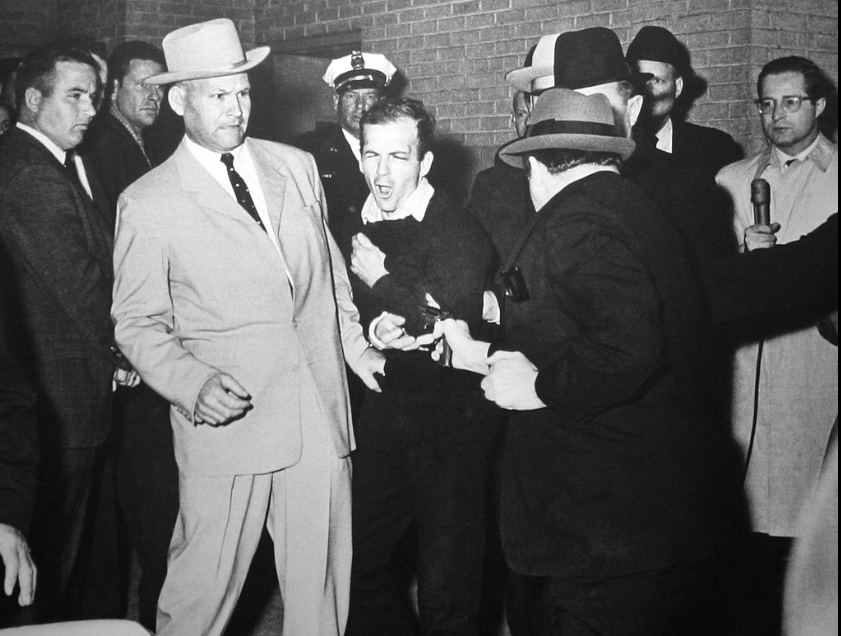
Episode 9 of the Who Killed JFK? podcast with Rob Reiner and Soledad O'Brien is devoted to Jack Ruby (born Jacob Rubenstein), the man who shot Lee Harvey Oswald on live television two days after John F. Kennedy was assassinated.
Photo by Robert H. Jackson. Originally published in the Dallas Times Herald,
November 25, 1963. Winner of the 1964 Pulitzer Prize for Photography.
I remember seeing that on television on November 24, 1963, as my 16-year-old self struggled to make sense of the horrendous assassination that had taken place two days earlier. The first thing that came into my mind as I saw Ruby lunge forward and shoot Oswald was that this meant Oswald was not the person who shot JFK, and the real killers had hired Ruby to kill Oswald to prevent a trial and the truth from coming out. I had seen enough Perry Mason, Dragnet, or whatever shows on television to know that's how it worked.
Episode 9 of the Who Killed JFK? podcast provides the details. Although Ruby famously said that he killed Oswald to spare Jackie the grief she would have endured as a witness in the trial of Oswald, we learn that Ruby also said that there was a much bigger story involving Cuba that would sooner or later come out. He never got to tell that story, because he was afraid he himself would be killed -- "I want to tell the truth, and I can't tell it here," he eventually said to Warren Commission members in Dallas in June 1964, asking that he be transferred to Washington, DC -- but his request was denied, and he died of cancer and a pulmonary embolism in January 1967, before the new trial that he had been granted could begin.
The podcast doesn't mention this, but I couldn't help wondering if the CIA heart-attack gun might have been responsible for putting Ruby, now a grave danger to the CIA, out of his misery? Even if not, the podcast raises the important question of why the Warren Commission waited so long to interview Ruby? Gerald Ford, then a Congressman on the Commission, later to become President in 1974 when Nixon resigned, might have known more about this, and I wonder if any of his children might have any more light to shed on what their father really thought about Jack Ruby and Lee Harvey Oswald?
The Who Killed JFK? podcast has already shone a light in all kinds of dark, deliberately hidden places, and I very much look forward to next week's episode.
A short but powerfully informative Episode 8 of the Who Killed JFK? podcast with Rob Reiner and Soledad O'Brien that makes a convincing case that Lee Harvey Oswald couldn't possibly have done it.
Here are the highlights:
The package that Oswald carried into the Texas Book Depository on the day of the assassination was too small to fit the rifle that killed JFK, even if disassembled, according to a witness (interviewed by Reiner in 2023) who traveled with Oswald to work that day.
More than one witness places Oswald in the cafeteria at a time too close to get back up to the 6th floor, from where at least some of the three bullets were fired.
Oswald's behavior after the assassination makes no sense from someone trying to get away.
Now these details, added to what we heard in earlier podcast episodes about why some highly placed people at the CIA, the Mafia, and Cuban exiles wanted to see JFK dead, plus the forensic evidence of at least one of three bullets coming from in front of the JFK Limo, i.e., not from the Texas Book Depository, where Oswald was, make a case that, if I were on a jury trying Oswald for this crime, I would have more than enough evidence or lack of evidence to find him not guilty.
But, of course, as we know, Oswald never got to trial, because Jack Ruby killed him. So Oswald turned out not just to be just a patsy -- a troubled but innocent man blamed from the assassination of John F. Kennedy -- but a patsy who paid for that role with his life. Next week, we'll learn more about Jack Ruby's role in all of this.
And as I said before, I hope, by the end of these riveting podcast episodes, that we learn why the President's brother, Robert F. Kennedy, put up with all of this, only to be assassinated himself.
Given the depth of the pain I and everyone I know felt about the assassination of JFK in November 1963, it's hard to fathom how many different people fervently wanted it. The seventh episode of the Who Killed JFK podcast with Rob Reiner and Soledad O'Brien makes the case for three groups, in particular: the CIA, Cuban exiles, and the Mafia.
The animus that the CIA and exiles from Castro's Cuba had for JFK has already been convincingly presented in prior episodes of this pathbreaking podcast. In episode 7, the focus is on the Mafia, which had two reasons to hate JFK. First, Castro's takeover of Cuba resulted in the Mob's Caribbean Las Vegas being extinguished, which cost them untold millions of dollars. JFK's move towards peace and defacto acceptance of Castro in Cuba after the Cuban Missile Crisis thus angered the Mob almost as much as it did the Cuban exiles and the bellicose CIA. Second, Robert F. Kennedy, appointed Attorney General by his brother, pursued an escalating attack on the Mafia, giving it a reason all its own to want JFK removed from office.
As this episode amply details, members of all three groups -- the CIA, Cuban exiles, and the Mafia -- were in Dallas the day that JFK was assassinated. Are we to believe that that was just coincidence? Not likely. And one CIA operative in particular is especially notable: E. H. Hunt, who achieved infamy a decade later as one of the architects of the Watergate break-in that brought down Nixon.
As Reiner aptly has put it more than once, lots of chess pieces were being moved around in the months preceding JFK's assassination. All of which to insure that JFK was killed, and the blame placed with none of the three groups that were responsible.
The proposition that Lee Harvey Oswald was indeed the patsy that he proclaimed himself to be right after the assassination rings ever more true.
Episode 6 of the Who Killed JFK? podcast with Rob Reiner and Soledad O'Brien really hit paydirt with an account of Richard Case Nagell, given to Dick Russell, which provides the most convincing evidence I've heard so far that Lee Harvey was indeed a patsy, set up to take the fall for the assassination of JFK on November 22, 1963.
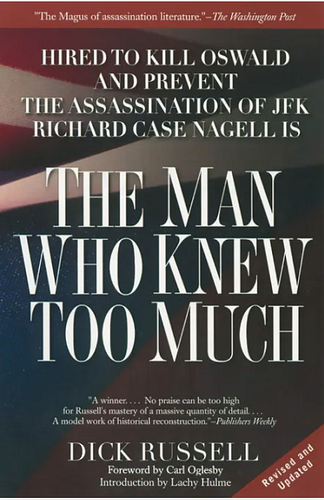
Who was Nagel? He was a CIA double agent -- same as Oswald (according to Russell and this podcast), tasked by the Soviets, whom he wasn't really working for, to kill Oswald. Why? Reiner and Russell explain that the Soviets knew of the CIA plan to kill Kennedy and blame it on them (the Soviets), as a pretext for the U. S. to then invade Cuba and once and for all get Castro out of power. Extensively interviewed by Russell over a period 20 years before Nagell's death from a "heart attack" in 1995, Russell tells us in the podcast (and in his 2003 book about Nagell, The Man Who Knew Too Much) that Nagell was ordered by the Soviets to kill Oswald to prevent the assassination of JFK. This put Nagell "between a rock and a hard place," as O'Brien aptly puts it. If he follows the Soviet orders and kills Oswald, the CIA will likely kill him. If he doesn't follow those orders, the Soviets will do the same. Nagell tries to let Oswald know he's being set up, without being too specific, because Nagell doesn't want to bring CIA down on him. Oswald shrugs him off. So in a move that seems crazy if you don't know any of this background, Nagell walks into a bank in Dallas two months before JFK's assassination, and fires a gun in the air, twice. He wants to get arrested, because he figures that prison is the safest place to be, with potentially CIA and Soviet assassins both apt to kill him.
The CIA does eventually get Nagell with a "heart attack gun" (not science fiction, check it out online) in 1995, one day after the Assassinations Records Review Board (established by Congress in the President John F. Kennedy Assassination Records Collection Act of 1992) sent Nagell a request for information. Fortunately for the truth, Nagell had already talked extensively with Russell in the preceding decades.
So where does this leave us? Well, as I said in reviews of earlier episodes of this podcast, it convinced me early on that, at very least, Lee Harvey Oswald was not the sole shooter in Dallas on November 22, 1963. I'm now convinced that Oswald was far more than not the only shooter that day: he was indeed the "patsy," as Oswald after the assassination said he was, in the murder intricately plotted and carried out by the CIA to punish JFK for his failure to provide support for the Bay of Pigs invasion, prevent him from furthering detente with the Soviet Union, and we can now add to provide a pretext for a US all-out attack on Cuba.
I'm looking forward more than ever to the next episodes in this crucially important podcast.
Wikipedia says "sheep dipping is the immersion of sheep in water containing insecticides and fungicide." On another Wiki page, we learn that sheep dipping in military idiom is"to formally, and usually temporarily, transfer military equipment or personnel to non-military ownership for the purpose of its employment in covert action with less risk of triggering armed conflict."
Guess which kind of sheep dipping Episode 5 of Who Killed JFK? tells us the CIA did to Lee Harvey Oswald, to set him up as the "patsy" in their assassination of JFK? The answer is: all that sheep have to do with this is the American people and the world were led like sheep to believe that Oswald was the sole assassin in this horrendous history-changing crime.
Rob Reiner, Soledad O'Brien, and their experts give us painstaking details of how the CIA did this, making him look like a supporter of Fidel Castro and his Soviet-allied Cuba when actually Oswald was just the opposite. And who do Reiner et al claim came up with this ingenuously devious plan? None other than James Angleton, aka the Poet Spy, the erudite, brilliant Chief of Counterintelligence at the CIA.
I have to say that this part of the incredible story the podcast is carefully telling is a bit less convincing than the forensic evidence laid out in prior episodes. The fact that at least one of the bullets came from the front not the back of JFK as he and Jackie and Connally and wife rode through Dallas that day seems unimpeachable, unless all the experts talking in podcast are blatantly lying, which seems very unlikely. And if there was more than one shooter, that means 100% that the Warren Commission was lying, and at very least there was more than one person shooting at JFK.
But the CIA piece is important, because it seeks to establish or at least further demonstrate not only its motive in killing the President (anger over the Bay of Pigs and fury at the detente JFK was pursuing with Khrushchev) but the specific way they expressed that motive, and made his assassination actually happen, and in a way that didn't implicate the CIA.
Even as I write that, it seems like one tall order. I'm not completely convinced that Angleton was smart enough and powerful to pull that off (I certainly didn't know the man personally). But the evidence is piling up in this and the previous episode, and I'm 100-percent up to being further convinced.
Episode 4 of Who Killed JFK, the podcast with Rob Reiner and Soledad O'Brien, was just put up today. It's all about Lee Harvey Oswald, prior to his day in the Texas Book Depository, or wherever he was on that day in 1963 when JFK was assassinated. It tells us of his conditioning or brainwashing by the CIA, resulting in his false defection to the Soviet Union. A lot of this reminded me of The Manchurian Candidate.
In case you haven't seen it, I highly recommend this 1962 movie, based on 1959 novel by Richard Condon of the same name. In the movie, Lawrence Harvey (Oswald's middle name, an awful coincidence?) plays a Korean War veteran who comes home to America, brainwashed by the North Koreans. He's now an assassin, programmed to kill -- in this case a nominee for U. S. President -- with no conscious knowledge of what he's doing. (Yes, this is similar to Homeland, which clearly was inspired by The Manchurian Candidate.)
Episode 4 of Who Killed JFK presents a variety of evidence that Oswald was "brainwashed" by the CIA in the late 1950s. Whatever happened to Oswald, the CIA's infamous MK-Ultra program -- which used LSD, hypnosis, sensory deprivation, and other nefarious methods to program its subjects to do whatever the CIA wanted -- is established fact. (Candy Jones, one-time model and later co-host with her husband, Long John Nebel, of their widely popular late-night radio talk show, claimed to have been given the MK-Ultra treatment in the 1950s.) Episode 4 of Who Killed JFK presents the case that Oswald was put through the program and sent to the Soviet Union as a double agent. The title of the episode, "The Patsy," comes from what Oswald himself said when he was between the time JFK was killed and Jack Ruby in turn killed Oswald. The next episode will present the further case that Oswald, still under the influence of MK-Ultra program, was set up to take the sole rap for killing JFK.
So here's where we stand at the end of 4th episode: The CIA has it in for JFK. They pressured doctors to change their reports in order to support the preposterous single-bullet theory. And they programmed Lee Harvey Oswald to do their bidding -- at this point, to pretend to defect to the Soviet Union.
I'm looking forward to learning all about the continuation of Oswald's trajectory in the fifth and subsequent episodes of Who Killed JFK? I do have one question at this point. What was the reaction in the Soviet Union of Oswald being named the sole killer of JFK? In Episode 4, we're told that maybe, likely, the Soviets were suspicious of Oswald's defection, and likely were playing their own game with Oswald, seeking to use him for their own ends. I hope Who Killed JFK -- which has become must listen-to audio for me -- tells us a little more about what Reiner at al may have learned of what the Soviets thought of Oswald being labeled as the sole assassin of JFK. Given what we found out in previous episodes about JFK and Khrushchev drawing closer after the resolution of the Cuban Missile Crisis, driven by their mutual desire to make sure that the U.S and the USSR never came so close to the precipice of nuclear Armageddon again, it makes sense that the Soviets would have been very interested in who really killed JFK, even after Khrushchev was put out of power.
Rob Reiner and I have a lot in common regarding the assassination of John F. Kennedy on November 22, 1963 -- the awful anniversary of which is tomorrow, as I write this. Reiner first learns about the assassination, as he tells us in the podcast he's doing with Soledad O'Brien, in his high school physics class, when he was 16. I first found out about the assassination in my calculus class, which I was taking as a freshman in the City College of New York, when I too was 16. (In fact, we were both born in March 1947 in The Bronx. I was in the "SP"s, which New Yorkers might recall meant that you skipped 8th grade, which would explain why I was a year ahead of Reiner.) We both read and were very impressed by Mark Lane's Rush to Judgement, the 1966 book that attacked the Warren Commission's conclusion that one man, Lee Harvey Oswald, had been responsible for killing JFK. And most important, Reiner and I both felt and feel to this very day that the Warren Commission and the American government has been lying to us all these years about who killed JFK.
To be clear about the impact that assassination had on me, Reiner, and who knows how many more Americans and people around the world, that assassination was "the end of the innocence," to quote one of Don Henley's best songs, about the end of a true love affair. All of us 16 and younger and no doubt at least some years older found we instantly had a new view of the world, a sad, wise, and cynical view, the moment we heard Walter Cronkite or whoever it was deliver this terrible news. Cynical because, well, it's tough to see your optimism shattered, leaving you feeling naive to have had it in the first place. No amount of Beatles and landing on the Moon could change that, and the murder of John Lennon in 1980 only reinforced that horror in the soul.
Reiner seeks, if not to remedy that (it can never really be remedied), at least perhaps to reduce it, by getting at the truth of what really happened on November 22, 1963. In the first two episodes of his podcast, which O'Brien helps him deliver, Reiner explains how and why the CIA came to loathe and fear JFK. He didn't back it up to its satisfaction when it tried to wrest Cuba from Castro, and he let that attempt end in the Bay of Pigs. He started working hard to get a real peace with the Soviet Union, when he saw how close we came to destroying our civilization in the Cuban missile crisis. Reiner tells us of the note the newly widowed Jackie sent to Khrushchev. That's all in the first episode. And in the second, we learn of the various attempts, from people ranging from Geraldo Rivera and Dick Gregory, and others I hadn't heard of before, like Dick Russell, to get at the truth.
I'll be listening to every remaining episode of this important podcast. Its tone and intelligence scratch an itch that will always be there. I have no idea if Who Killed JFK? will address a question I've had since that day in Dallas when the curtain came down on my unbridled optimism about the good guys always winning. Why didn't Robert F. Kennedy, who remained Attorney General until September 1964, do everything in his power to find out what happened to his brother? Perhaps he would have, as President, if he hadn't been murdered himself in 1968.
Added 22 November 2023: Review of Episode #3
And today is the 60th anniversary of JFK's assassination. I would have thought about him and that heinous event on this day, anyway, but having listened to and reviewed the first two episodes of Rob Reiner and Soledad O'Brien's podcast last night, the assassination and the government "narrative" about it has been especially on my mind.
In the third episode, Reiner says "narrative" is a good word for what our government told us about the assassination, because so much of the government's story was fiction. Coincidentally, I've been thinking and reading a lot about alternate history recently -- and writing some of it -- and I found myself agreeing with the authors quoted in Jack Dann's Fiction Writer's Guide to Alternate History that a lot of our so-called real history is fiction.
In the third episode of Who Killed JFK?, Reiner details how the findings of what he aptly calls "the most important autopsy in American history" were not only kept from the American people, but deliberately bent to support what the government didn't want us to know -- that more than one shooter was firing at JFK in Dallas 60 years ago. We learn that Dr. James J. Humes, one of the two pathologists who performed the JFK autopsy, burned his first autopsy report, presumably because it contradicted the "single bullet" theory that our government was pushing. Reiner, O'Brien, and the experts they interview systematically explain why the single bullet theory is absurd -- way too much damage was done to Kennedy and John Connally, who was sitting in the front seat of Kennedy's limousine. We also hear convincing testimony that some of JFK's wounds came from the front, obviously impossible if Lee Harvey Oswald, firing from behind, was the only shooter.
So, today, November 22, has been and always will be a sad day for those of us who were cognizant the day that JFK was assassinated. But the Who Killed JFK? podcast is a welcome ray of hope that maybe we're finally getting close to the truth of what happened 60 years ago.