Chuck Todd interviews me about alternate histories
Showing posts with label Aldous Huxley. Show all posts

Monday, August 3, 2026

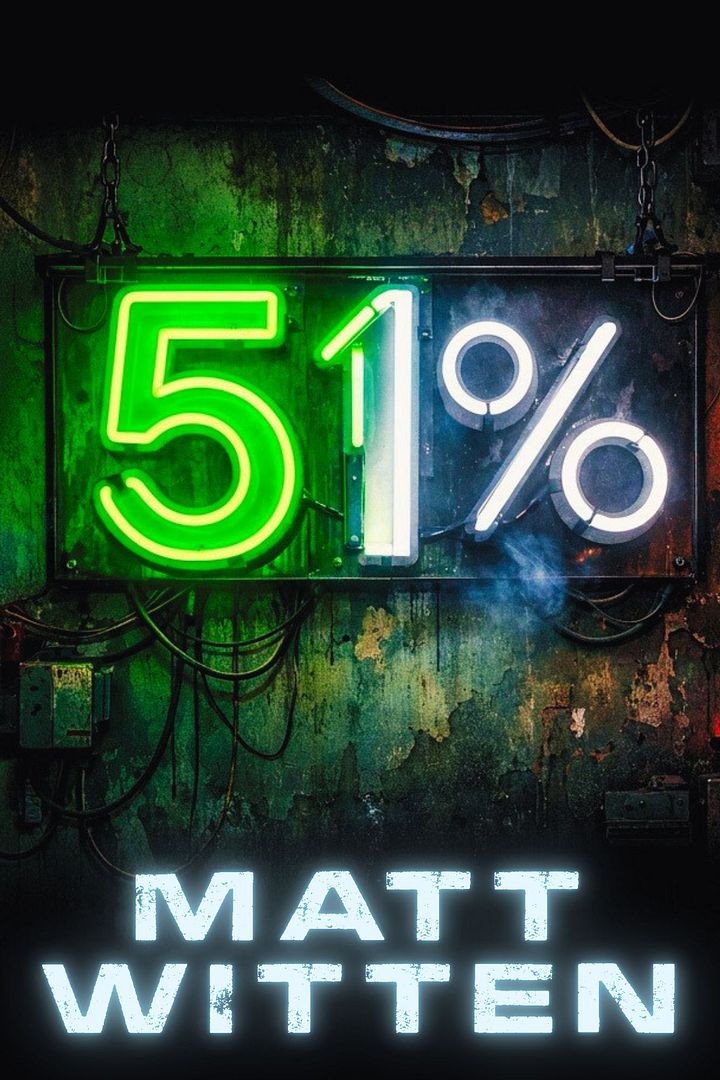
Review of Matt Witten's 51%: 100% Excellent, Relevant, Enjoyable, and Important


There couldn't be a better time to read Matt Witten's cyberpunk novel, 51%, in which Ayn Randian corporate power and philosophy controls and permeates all parts of American life, including the NYPD (New York's police), which are named NYPDInc, and in which police need payment from the people to do their work.  Apple's adaptation of William Gibson's Neuromancer will be streaming this coming January.  Even more important, Trump's hijacking of American democracy is claiming more innocent lives via ICE and other Federal police just about every week -- the most recent, Edwin Lopez-Cornejo, a 41-year-old migrant from El Salvador, died the day before yesterday at the Delaney Hall Detention Facility in Newark, NJ -- and that kind of "legal" killing requires vigorous response in all aspects of communication, including science fiction.

Witten's novel, published this past April, takes place 20 years from now.  People who are not rich pay for their medical treatment, education, and other essential needs by selling percentages of themselves to corporations.  If they sell more than 50%, they become corporate property, with where they live and work completely controlled by their owners.  To make sure that the 51%ers don't try to evade this corporate slavery, biochips are implanted in them, and their owners are alerted if anyone tries to remove them.

This is the environment in which NYPDInc Detective Luke (aka Juke) O'Keefe and his partner Halee Navarro (who carries a gun but is actually a “Crime Marketing Consultant”) must work in as they attempt to find the killer of Talia, a young immigrant 51% woman in New York City, and get drawn into a desperate, ingenious plan to break free of the corporate enslavement.  Witten has a keen sense of what the city would look like in such a corporate-glorified country, with streets renamed "Ayn Rand", "Randy Weaver", "Fountainhead", and "John Galt" -- right alongside current names like "Waverly" -- and gun models called "Hestons" and "Ruby Ridges".  Witten also knows his kittens, writing  "She started down the hall -- and tripped on a kitten, which had slipped out of the speck between her legs".  ("Speck", by way, is slang for apartment in this Big Corporate Apple, in which NYPDInc cops are called "Dincs" and the FBI cleverly called "Fincs".)

Given the ascent of AI in our world today, there of course is an AI character in 51% who, in another move that will make you smile, speaks with Margaret Thatcher's voice.  There's also use of fireflies in the story, which I'm also glad to see because they harken at least as far back in science fiction as my 1999 novel The Silk Code and Peter Watt's 2006 Blindsight, and they warrant more widespread use in our world.  And in the last third of the novel, there's almost nonstop action that will keep you glued for at least a few hours or longer, capping the memorable love story throughout.

But those are the science fiction and police fiction wheels of 51%, and the most important raison d'etre for this successor to Aldous Huxley’s Brave New World and George Orwell’s 1984, along with the enjoyment it provides, is the lesson it gives us about the likes of Trump and his allies and the damage they continue to do to our country and our world, and why we must show up at the ballot box this November and begin to get them out of office.

more about The Silk Code here


Saturday, December 28, 2019

You 2: Killer Charm


Well, it's rare that a mystery or thriller surprises me with almost all of its twists, but the second season of You, now streaming on Netflix, did just that.  And with the same wit and style that lit up the first season, maybe even more.  All of which adds up to a highly, often immensely, enjoyable second season of this literate and introspective serial killer.

Joe Goldberg worked in a bookstore in New York City in season one.  Now he's trying to establish a new identity out in LA.  He employs his time-honored way of making things happen: he locks a guy up in his basement and assumes his identity.  Just before he falls in love with Love.  Well, Joe was already in love with love, certainly obsessed with it. but this Love is Love Quinn, perfectly played by Victoria Pedretti, whom I last noticed in Once Upon a Time in Hollywood.

But she's just outstanding in You, down to that smile she gives us when she realizes that she's finally getting Joe to sleep with her.  Her character is complex, to say the least, and I actually liked her even more than Guinevere Beck in the first season, as Joe's all-consuming passion.

[big spoilers ahead]

And the plot is brilliant.  Here are some of the surprises I didn't get:  Joe letting the real Will go - the guy whose identity Joe stole.  The best surprises are well-motivated, and this one was a logical result of Joe wanting to really be a good person, as part of his love for Love.  The cop killing Forty at the end, and, for that matter, Forty figuring out that Joe killed Beck et al back in New York.  Candace's deployment was not surprising, but very well played.

The one big twist I sort of saw coming - indeed, the biggest twist in the season - was Love killing Delilah, etc.  I put her at the top of the list via process of elimination, behind Love's parents, all higher as would-be protectors of Joe than Joe himself, which have been too obvious.  And I can't say I was thrilled by the very very ending, with Joe starting to fantasize about the neighbor we don't really see.  But, hey, I liked seeing Huxley's Brave New World among her books, and that's just entree to the next season.

All of this is brought to life not only by great acting - the scenes with Joe (also perfectly acted, by Penn Badgley) and Love are nonpareil - but sparkling dialogue, mostly from Joe, often interior, as when he grumbles that "this is what I get for trying to out-tech a teenager" (Ellie) or "the robots are not our friends".  Yeah, though Joe is social media-literate enough, his true talent are words and word-play in the Victorian tradition, and thus he's often challenged by latest tech, all of which adds to his charm.

And charming might be one of the best words to describe this second killer season.


See alsoYou: Review from an Unconflicted Fan ... Spoiler-Free Review for You 3

Tuesday, January 3, 2017

The Perversity of Things: review #4 of X: Gernsback and the First Amendment

Continuing with my review (#4 of X) of The Perversity of Things: Hugo Gernsback on Media, Tinkering, and Scientifiction, edited by Grant Wythoff (University of Minnesota Press, 2016),  this time focusing on pages 26-28 of Wythoff's 59-page Introduction to the 359-page volume, because it tells us that Gernsback was a staunch opponent of government regulation of the nascent radio medium.

So I now have a third area of strong agreement with Gernsback and his work, joining science fiction and media theory: Gernsback not only understood the evolution of media, but got that we should not let the ham-handed government and its penchant for regulations get in the way of that.

Had I known that, I certainly would have mentioned Gernsback in my Flouting of the First Amendment 2005 keynote address - a central part of which is that the Federal Communications Act of 1934 and the FCC it created was a hindrance not a help to the evolution of broadcasting, and violated the First Amendment.  Wythoff again deserves credit for bringing Gernsback into this continuing controversy about how much if any government regulation of media is helpful and constitutional as we move further in the 21st century.

But Wythoff and I don't agree on everything regarding this issue.  He notes on page 27 that Gernback's "arguments against hasty legislation ... are very much reminiscent of advocates for net neutrality".   But net neutrality, though laudable as an ideal, is usually advocated as a government regulation - in other words, an example of the very kind of government meddling in the evolution of media that Gernsback was so eloquently and knowledgeably against. Wythoff is no doubt right that Gernsback the tinkerer would have been no fan at all of today's huge media corporations, but Gernback's often repeated contempt for and fear of government intervention in media development would have made him even less a fan of an FCC induced net neutrality as a way of limiting corporate power.  (My Why I Oppose Net Neutrality summarizes my opposition, pre-Gernsback and Wythoff.)

I would add here that underlying my and Gernsback's opposition to government regulation is not only an understanding of media evolution, but an optimism that this evolution by and large leads to good and better things.   This optimistic outlook, as Wythoff makes clear and I mentioned in previous reviews of The Perversity of Things, is also the basis of Gernsback's hopeful science fiction - in the tradition of Jules Verne, contradicted by the dystopian science fiction of Aldous Huxley and George Orwell, furthered in cyberpunk which was and is specifically scathing about media evolution, in the latter part of the 20th century and the present (and, being a not 100% Gersnbackian, I've occasionally written a little of, I'll admit).

Wythoff goes on to describe the McLuhanesque "global village" that Gernsbach's "new minted citizens of the ether" (Wythoff's apt term) comprised - a development which didn't quite turn out the way Gernsback intended and predicted (and not just because of government interference), which I'll look at it my next review.

See alsoThe Perversity of Things: review #1 of X: Gernsback as Philosopher of Technology ... #2 of X: Learning by Doing ... #3 of X: The Evolution of Media ... #5 of X: Amateurs vs. Corporations ... #6 of X: Thought Experiments and Toys ... #7 of X: The Invention of Invention, and the Advent of Science Fiction ... #8 of X: Definitions and Fake News


InfiniteRegress.tv