Chuck Todd interviews me about alternate histories
Showing posts with label Emily St. John Mandel. Show all posts

Thursday, January 13, 2022

Station Eleven Finale: Hope and Plaudits


What a glorious, hopeful finale to the masterful television series known as Station Eleven.  An ending so uplifting, in a story of humanity beset by a virus that kills 99% of the population, that it can serve as beacon of hope, a map to a better world, in our own world, also beset by a deadly virus, but far less lethal than the deadly flu in Station Eleven.

There were so many wonderful parts of this finale.  Kirsten and Jeevan hugging near the end.  If that wasn't satisfying to the soul on the deepest level, I don't know what is.    Tyler aka the Prophet telling his mother to join him.  Even the passing around of the book that is Station Eleven -- the illustrated book within the illustrious watercolor television series -- well, that was inspiring, too.

The performance of Hamlet was great, too, especially Tyler as Hamlet not stabbing Clark as Claudius with the knife.   That knife, of course, hadn't done Tyler any real harm when Kirsten stabbed him with it, so maybe he knew that in some sense it just was a symbolic knife not a real cutting edge at all, except that it cut to the emotional core.

The music once again, in Hamlet and throughout the episode, was just superb.  I've never heard a better performance of "Midnight Train to Georgia," even from Gladys Knight and the Pips.  Georgia, the state that has become a symbol and a beacon, to use those words again, in our own democracy in our off-screen world.

Big plaudits to Dan Romer for the music.   Accolades to the brilliant acting of Mackenzie Davis as Kirsten and Matilda Lawler as her younger self and Himesh Patel as Jeevan at all ages.  In fact, every scene was boosted to admirable heights by the performances of everyone.

Station Eleven has redefined the presentation and staging of a post-apocalyptic story .  It will take its place alongside of A Canticle for Leibowitz (I read the novel but haven't seen the adaption) as a standard-bearer of portraying humanity on and after the very brink.  Kudos to Emily St. John Mandel for writing the novel (which I haven't yet read) on which the series is based and  Patrick Somerville for bringing the series to life.


See also Station Eleven 1.1-3: "Looking Over the Damage" Well Worth Seeing ... Station Eleven 1.4-5: Shakespearean Prophet ... Station Eleven 1.6-7: Time, Blake, and Bosch ... Station Eleven 1.8-9: Before and After

Saturday, December 18, 2021

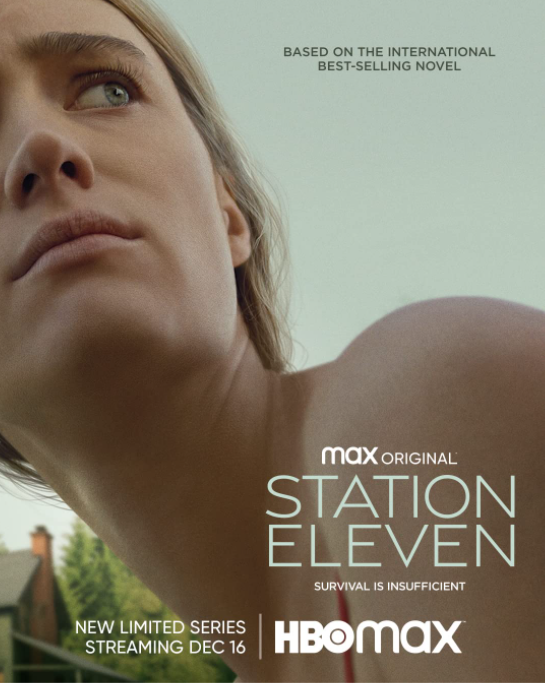
Station Eleven 1.1-1.3: "Looking Over the Damage" Well Worth Seeing


With Apple TV+'s  run of superb science fiction -- Foundation, Invasion, and Finch -- temporarily on pause, it looks like HBO Max has picked up the slack with a powerful new series, Station Eleven, a new Matrix movie up next week, and the first half of Dune this past October.  

The first three episodes of Station Eleven introduce us to a complex, perilous, beauty of a story.  It's a story about the passion and agony of creating art, about bringing a story into being.  And, oh yeah, it's a story about "the end of the world," due to a super-virulent (super-all-too-familiar) flu that kills over 99% of the population.

So, well, almost the end of the world (shows how we’ll we’ve actually done in our real, off-screen world),  and therein lies the heart of Station Eleven.  A heart within a heart, a play within a play, because Station Eleven is not only the name of this series, it's the name of a book that Miranda (outstanding performance by Danielle Deadwyler), a major character in this series, wrote.  (A much more appropriate meta than what Facebook says it's becoming, I would say.)  And the book is no mere prop for a meta-title.  It's something that "ruined my life," as said by Miranda and her husband.

The series unfolds in a mode first perfected in Lost:  now, or close to now, when the extinction-level pandemic strikes, and twenty years into the future, when we see how a small group of survivors struggles and (at this point) perhaps triumphs in a way.  When we're in the now, we see flashforwards (the plural of Rob Sawyer's excellent term); when we're in the future, we see flashbacks to the present.  This makes the story a little difficult to follow, but it's worth that price.  Station Eleven, in just three episodes, has already unfurled a rich, memorable tapestry of characters and humanity, as they "look over the damage," another one of the mantras of the series.

[Spoilers ahead ... ]

It's already left us with all kinds of questions.  Why, exactly, did Kirsten (well played by Mackenzie Davis, with great facial expressions that in themselves tell the story) try to kill that guy (Prophet?) in episode 1.2?  Because he said Kirsten and her troupe were "monsters"?  I doubt it's because she has that thin a skin. Because he told Kristen that some of her friends would start to "disappear"?  He didn't say he would make them disappear. There must be more to that stabbing, but that's good grist for the continuing narrative.  

I'll also mention that this series -- based on the novel by Emily St. John Mandel that I haven't read -- is evocatively photographed and accompanied by outstanding music, including Dylan's "Don't Think Twice."  I'm not going to think twice about continuing to watch this vivid series, and I'll be back here with reviews.


See also Station Eleven 1.4-5 : Shakespearean Prophet   ... Station Eleven 1.6-7: Time, Blake, and Bosch
InfiniteRegress.tv