Chuck Todd interviews me about alternate histories
Showing posts with label Michael Imperioli. Show all posts

Friday, April 17, 2026

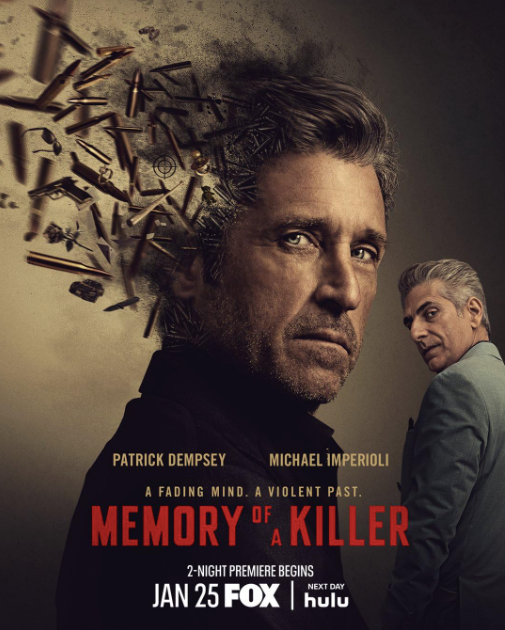
Memory of a Killer: Hit Man with a Heart


I rarely review TV series on old-fashioned broadcast television, and even more rarely on Fox. But Memory of a Killer is a worthy exception. 

Part of its power is acting. Patrick Dempsey, who established his creds on Grey’s Anatomy (my wife has been a devoted fan for its umpteen seasons) and was excellent last year in Dexter: Original Sin, was great in the lead role of Angelo Doyle, a hit man suffering from the early symptoms of Alzheimer’s. Michael Imperioli, one of the many standouts on The Sopranos, was good to see as Angelo’s boss/senior partner. And Odeya Rush, whom I probably saw on Curb Your Enthusiasm and Law & Order: SVU, was refreshing as Angelo’s pregnant daughter Maria.

The Dexter connection is especially relevant.  I've been an avid fan since the series began in 2006, and I put the series and its sequels (and one prequel) in the top 5 of all TV series ever.  The key to Dexter Morgan's appeal is that he's a serial killer of serial killers and other monstrous people who deserve to die, but our police and legal system have for some reason missed.  Angelo doesn't get quite the same pleasure from his work, but also takes pride in his victims being people who deserve to die.

[And there will be spoilers ahead ... ]

His unknowingly killing someone who did not deserve to die sets up the central thrilling tension of the series:  the victim's mother Linda Grant (well played by Gina Torres from The Matrix sequels) is an FBI agent, and she's determined to kill not only Angelo's beloved wife, which Grant makes sure happens, but his brother Mike and daughter Maria.   This turns the tables on the serial killer narrative, making the hit man's loved ones the target, and is a nice piece of storytelling,

The other leg of story, a hit man with the onset of Alzheimer’s, is also very effectively told.  Angelo's brother Mike has a much more advanced condition, which adds the heart-rending element of letting us and Angelo know where he's headed.  The series has been renewed for a second season, so we'll get to see some of that, and, optimist that I am, I'm hoping that Angelo finds a treatment that will further delay the progression of this crushing illness.

See also First Place to Dexter and Dexter: Original Sin: Activation of the Code


Saturday, October 2, 2021

The Many Saints of Newark: You'll Enjoy It Immensely


After all of these years -- 21 or 14, depending on whether you count from the beginning or the end -- The Sopranos is arguably still the best series ever on any kind of television screen.  What's beyond argument is that The Sopranos started it all, and opened the gates, paved the way, for all the great television that ensued on cable and streaming screens.

It certainly changed my life, all for the better, not only as a viewer but a media scholar thinking and writing about television.  The late David Lavery asked me to write an essay about The Sopranos just a few years into the series for an anthology he was putting together.  The result was "Naked Bodies, Three Showings a Week, No Commercials: The Sopranos as a Nuts-and-Bolts Triumph of Non-Network TV" in This Thing of Ours: Investigating The Sopranos published by Columbia University Press and Wallflower Press in 2002.   His next good idea was to organize a conference on The Sopranos, which I did at Fordham University with David and Douglas Howard's help in 2008.  Lots of important things came out of that conference, including a nice long interview with Dominic Chianese, and another anthology, The Essential Sopranos, chock full of essays, including my "The Sopranos and the Closure Junkies," published by University of Kentucky Press in 2011.  And just for good measure, I was interviewed for "Defining a Landmark," a documentary on The Sopranos included in The Sopranos: The Complete Series, brought out by HBO on blu-ray in 2014.

So now that we've got my creds out of the way, what about the movie?

Well, with The Many Saints of Newark, just up on HBO Max for the month of October, that 2014 package is no longer complete.  The two-hour movie thus had everything to lose for David Chase, if it didn't live up to the extraordinary series to which it has the temerity of being a prequel.  Anything short of loving it would have made it a disappointment.

And I just saw it, and I loved it.  For lots of reasons.

One of the great joys in seeing a prequel is getting to know the younger selves of characters you came to know and prize in their primary presentations.  Michael Gandolfini was an inspired choice to play Tony Soprano as a teenager.  Not only did he look and sound like the adult Tony played by his father James, Michael had a perfect presentation of lines, the mix of mischief and disappointment, and the beginning of that short fuse to anger that animated his father.

And Michael Gandolfini is by no means the only actor who delivered memorably recognizable performances in The Many Saints of Newark.  Among my favorites are John Magaro, whose young Silvio not only had the toupe (of course, and preceded by a comb over for his even younger self) but had the scowl and literally walked the walk as well as talked the talk.  The same for Corey Stoll as Uncle Jun, not the toupe (of course) but in every way the bespectacled uncle of Tony.  And Vera Farmiga was so convincing as Livia -- the intensity of her gaze, the angle of her head -- she was recognizable as Tony's mother before anyone spoke her name.

And there was great work in this movie as well by actors playing characters who weren't in the original series.  My favorite of these was Alessandro Nivola, who did a stand-out job as Dickie Moltisanti, Christopher's father.

Now as to the plot.  It was strong, believable, and fleshed out in classic Sopranos detail.  And there's a stunning revelation at the end, which I won't say anything about except it was thoroughly plausible given what we know of the character in later life on The Sopranos.   

I'll also mention that the movie was studded with gems of fine touches, like baby Christopher Moltisanti crying when he sees Tony as a pouty young boy (William Ludwig), and an old biddy remarking that some people think that newborns have knowledge of "the other side" (as Christopher in a narration from the grave reminds us earlier in the film, Tony killed him).  It was also a nice touch saving the iconic "Woke Up This Morning" for the closing rather than the opening of the movie, since the song was an entree to The Sopranos.

So here's my recommendation: If you've seen The Sopranos, see The Many Saints of Newark, you'll enjoy it immensely.  If you haven't seen The Sopranos, see the entire series, then see the prequel movie.  You'll enjoy it immensely.


Wednesday, February 20, 2019

Project Blue Book 1.7: The Star People


A strange, not really resolved, episode 1.7 of Project Blue Book, which features Native American legends of The Star People maybe come true, and Quinn himself under investigation for a good part of the story.

Indeed, this episode pretty much consists of two stories, barely related, and hardly tied together at the end.   We learn that Quinn's under suspicion for absconding with the peculiar artifact we saw Hynek take from the base last week.  General Harding choses to investigate Quinn by tasking him to interrogate, the hard way, the character played by Michael Imperioli - a Russian spy.  It turns out that Rizzuto (Imperioli's character) has switched back to our side, and Quinn passes the test.  Well, at least it was nice to see Imperioli again.

The Star People part is more interesting.  They figure in a Choctaw legend near Bowling Green, Ohio (which, maybe or maybe not relevant, I've long admired as a center for the study of popular culture).  Hynek, who has turned from a likely believer into a systematic debunker, discovers that extra-terrestrials had nothing to do with the lights (caused by swamp gas - the usual terrestrial explanation) and kidnapping of a scout master, who wasn't kidnapped.  But there is still room enough for real aliens here, given that the Choctaw really had petroglyphs and stories about them.

All of this adds up to a story that's hard to categorize.  Which makes sense, given that the series itself is hard to pin a label on.  Most of the time, it's deception and military jockeying masquerading as science fiction.  But enough real science fiction is thrown in - the flying saucer in the Generals' bunker, the traveler vanishing, the little edges that are not explained - that makes it worth watching.

Which I'll do when the next episode is on, next week, and be back here with a swampy report.

See also:  Project Blue Book 1.1: Science Fiction, Or? ... Project Blue 1.2: Calling Roy Thinnes ... Project Blue Book 1.3: Peggy Sue Gets Space Ship ... Project Blue Book 1.4: von Braun ... Project Blue Book 1.5: A Theory ... Project Blue Book 1.6:  The Team


here I am talking Ancient Aliens a few years ago on the History Channel


1st starship to Alpha Centauri ... Native Americans figure in here, too

Wednesday, February 13, 2019

Project Blue Book 1.6: The Team


My favorite part of Project Blue Book 1.6 last night - and also likely to have some beneficial consequences for Hynek's investigation - is his decision to bring his wife Mimi into his investigations of extra-terrestrial visitations, so the two of them are a "team".

This is a crucial decision for all kinds of reasons.  Mimi is smart and loves him.  Hynek is learning that he can't really trust anyone else - including, sadly, Quinn, who folds when the Generals apply pressure.  I'm still hopeful that he might break away sooner rather than later, and work 100% with Hynek, but this has yet to happen.

My second favorite part is Michael Imperioli in a small role (as of now) as a Soviet agent (or, at least, identified as such by those Generals).   The Soviet part of this is a good counterpart to the extra-terrestrials.  They need to be reckoned with.  The blonde's husband is brutal, and doesn't hesitate to kill anyone who he thinks knows too much, and that apparently includes just seeing him.  Mimi on the team is thus a two-edged sword: she'll no doubt be a big help to Hynek, but her friendship with Susie (the blonde) means that the Soviets could have even better entree to Hynek's work.

And the role of the priest - who seems to know a lot, or more than Hynek, about the extra-terrestrials - is also an important development.  I've been saying for more than a couple of years that religion and space explorations are natural partners - see Touching the Face of the Cosmos: On the Intersection of Space Travel and Religion - and it will be fun and significant to see where this goes.

Project Blue Book could easily be mistaken as an obvious, superficial narrative with 1950s B-movie values.  It's indeed that, but it's beginning to mine deeper elements.  Stay tuned.  I definitely will.

 See also:  Project Blue Book 1.1: Science Fiction, Or? ... Project Blue 1.2: Calling Roy Thinnes ... Project Blue Book 1.3: Peggy Sue Gets Space Ship ... Project Blue Book 1.4: von Braun ... Project Blue Book 1.5: A Theory


here I am talking Ancient Aliens a few years ago on the History Channel

Monday, December 31, 2018

Escape at Dannemora Finale: Why "At"?


Herewith some thoughts on tonight's powerful Escape at Dannemora finale:

1. Michael Imperioli did a great Andrew Cuomo.  Doesn't look all the much like him, but he got the Governor's voice and manner down perfectly.

2.  Matt was indeed a pretty good artist.  The portraits of George W. Bush and Hillary Clinton  that we saw at the end were a lot better than most.  (I like Joel Iskowitz's work better - he's done a lot of my book covers, and is doing the cover for my new album, Welcome Up.  But if JI wasn't available, I might have asked Matt, if he was still alive and not a murderer.)

3. Matt really slowed Sweat down after the escape.  He was at his best, in control and usually comfortably in charge, in prison.  He was at his worst outside of prison, in the real world.

4.  But even on his own, had Sweat made it to Canada, would he have been home free?  The Canadians won't extradite people for whom there might be a death penalty, but there wasn't one awaiting Sweat, so it seems possible, even likely, that they would have extradited him.  Of course, they first would have needed to find him.  (Especially strong work by Paul Dano as Sweat tonight.)

5. Tilly seems to have an almost unbelievable power over men.   Her husband is staying with her, and if that scene near the end, with the new prison guard (or cop) propositioning her is true ... plus the prisoners at Dannemora ... well ...

6. All in all, an unusual and excellent series.  I still don't get though, why it's "Escape at" rather than "Escape from"?   Is that because they didn't succeed in their escape?  Do the results of an escape govern our grammar?

But I enjoyed the mini-series.

this cover by Joel Iskowitz ... really

Monday, March 21, 2011

Detroit 1-8-7

Just caught the season finale of Detroit 1-8-7 - been watching and enjoying the series since it began - and the finale was superb.  A realistic, satisfying ending.

The series started off a little slowly in the Fall.  Formulaic two cases per episode, rarely intersecting.  But an outstanding Detroit locale.  Between that and new Chrysler commercials, I almost want to live there (I'm an incorrigible New Yorker).

The acting has been powerful throughout.   With Michael Imperioli and James McDaniels (Lt. from NYPD Blue), how can you miss.  And, in fact, this easily is Imperioli's best role since The Sopranos, and McDaniels may be even better here than on NYPD Blue, playing a detective close to retiring.

But the rest of the cast and characters are fine, too - even McDaniels' partner (played by Shaun Majumder), which easily could have been a throwaway role, makes a unique, memorable impression.

And with the last few episodes, the series has come into its own.  Surprising deaths and other twists, stories which get to the hearts of the characters.  Especially effective was Imperioli's son Vadim playing Imperioli's character Fitch's son - a cool, younger version of the father,  with similar body language and expressions, as well as sharp dialogue.

If you missed Detroit 1-8-7, catch it on Netflix or whatever when it's out.  And here's hoping that we get to see more of Detroit and this story in the Fall.  I'd really enjoy another weekly series of visits.


                 Special Discount Coupons for Angie's List, Avis, Budget Car, Garden.com, eMusicMozy


The Plot to Save Socrates

"challenging fun" - Entertainment Weekly

"a Da Vinci-esque thriller" - New York Daily News

"Sierra Waters is sexy as hell" - curled up with a good book


Enjoy listening to audio books? Get a free audio book copy of The Plot to Save Socrates - or any one of 85,000 other titles - with a 14-day trial membership at Audible.com ...
 

Friday, January 8, 2010

A Conversation with Dominic Chianese - The Sopranos' Uncle Junior


Here, at last, is a more or less verbatim transcript of the interview that David Lavery and I conducted with Dominic Chianese - Uncle Junior of The Sopranos - at The Sopranos: A Wake Conference at Fordham University in New York City on May 23, 2008. The conversation also includes 24 questions from the audience. Thanks to Giselle Isner for the transcription.   (April 21, 2011: Video now posted of the complete conversation - see it here.)


A Conversation with Dominic Chianese - The Sopranos' Uncle Junior
Pope Auditorium, Fordham University, Lincoln Center campus
Conference: The Sopranos: A Wake
May 23, 2008
 
Chianese:  Dominic Chianese
Levinson:  Paul Levinson
Lavery:  David Lavery
AM:  audience members
 
Levinson:  Welcome to Fordham University and our conference on “The Sopranos: A Wake.” For those of you who may not know me, my name is Paul Levinson. I’m Chair of the Department of Communication and Media Studies. In fact, I’m ending my second and final term as Chair and I can’t think of any better way to end it than doing a conference like this and in fact this very panel that you’re soon going to hear, with the two people seated at the table.

Let me introduce you to probably the lesser known person, [audience laughter] but certainly a very significant person, and actually he is someone who helped put together most of this conference. In fact he was here with me and the other people who put together this conference back in September 2002, when we had a little vest pocket conference on The Sopranos. His name is David Lavery, and he [audience applause]…He certainly deserves a round of applause. He has edited two books about The Sopranos. One of which I am especially fond of because an essay of mine is in there, but the other book is pretty good too. I would say there’s probably no one in the world who knows more about television - not just The Sopranos, but Lost, Buffy, Heroes - than David Lavery. So I am very happy that David is here with us.

And sitting next to David is someone who was born in the Bronx in 1931. Actually I was born in the Bronx too just a few years after that - not that many years after that. He may look familiar to you because in The Godfather II, you may recall that tall sinister figure, Johnny Ola [applause], but of course he’s probably far better known, in addition to that role and other distinguished roles over the years, for the part he played in The Sopranos as Uncle Junior [applause], otherwise known as Corrado Soprano.

And when I was speaking to Bob Milang the other day, when he called me and we were discussing Uncle Junior coming to this conference, I said to him I thought that that character in many ways was the heart and soul of the show. It was such a wonderful show, there were so many important characters, but there was something about the Junior character that brought out aspects of the show that no other character did. Now the actor has a name other than Uncle Junior, and his name is Dominic Chianese, so we are going to have an interview with Dominic ... well, really not so much of an interview, more a discussion in which both David and I will ask questions and I encourage Dominic to answer however he pleases, however short or long because far be it from me to ever tell Dominic what to do, but then, you know, we want to this to be a group experience as well, so we will leave a lot of time for all of you to ask questions. By the way, we do have another member of The Sopranos cast here in the audience, Katalin Pota. You may remember Lilliana [applause]... She played the housekeeper on The Sopranos, so we’re glad to have her here as well. All right, let's then go to the discussion. I am going to sit down right at that table, and I’ll ask the first question and we’ll see how it goes.
 
Why don’t we start at the end if that’s okay. One of the things that struck me with the final season of The Sopranos was the diminished role that Uncle Junior had on that show, and I was wondering if you could perhaps speak to that. How did you feel about approaching that as an actor? Were you disappointed in that? Did you think the story called for that?
 
Chianese:  You speak specifically about the ending?
 
Levinson:  Yes, we can talk specifically about the very last minutes of the show, and also the whole final season.
 
Chianese:  The final season…well I think the ending is a good indication of, I think of what David [Chase] was trying to write, in my opinion. I noticed that when we read the script, the final script, we were amazed at the quietness of the ending. However, when all the actors read the final script, there was no indication that there would be a blackout for maybe 15 or 20 seconds. We just thought they’d end up having an ice cream soda and onion rings together, and that was it. Finito, complete, you know. Even David said, “Why not?” So we were all surprised when the blackout came. My wife and I thought, of course, we had lost television. But, my daughter pointed something out to me, which I think is very interesting. David – the greater genius that he is – he may put clues sometimes, and we don’t realize it. If you remember, she told me….I haven’t checked on it, but if you go home and check on the jukebox that he was playing at the table,  it had a song in it – “Don’t Stop Believing,” or something like that. There was a “B” side to that. Does anybody know what the title of the “B” side was?
 
Audience member #1:  “Any Way You Want It”
 
Chianese:  “Any Way You Want It.” [audience laughter] I think maybe that’s David’s motive or something, his idea or his motive for putting it in, and that struck me as something David possibly would do. Any way you want it. You make the idea. A lot of teenagers come up to me and got mad at me, and said “why don’t you kill him?” What am I gonna say?  [audience laughter]
 
Lavery:  Paul started at the end. I would like to go back to start at the beginning. Could you reflect or remember anything about the casting, about how you were actually cast in the show?

Friday, October 24, 2008

Life on Mars Goes on in America 3: What Happens When a Time Traveler Runs Into His Younger Self?

I gotta say my single favorite moment in last night's episode 3 of Life on Mars in the mean streets of New York City was when The Marmalade's "Reflections of My Life" came on at the end. I haven't heard that song, maybe since 1973. "All my sorrows, sad tomorrow..." was just perfect for a man unwillingly, apparently stuck back in 1973 from 2008 ... Yeah, that music was perfect, just like about every clip of music I've heard thus far in the series.

Not perfect at all, though, is the purely cop part of the show. Michael Imperioli's Det. Ray Carling is annoying - that's the fault of the character and the writing, not the fine actor - and though I've warmed up a little to Harvey Keitel's Lieutenant Gene Hunt (he finally displayed a bit of a heart last night), he still has a way to go.

It almost feels if the series is a collaboration between a very cool and a tone-deaf writer, with the cool one writing the time travel parts, and the tone-dead writer the cop parts.

There were very good time travel touches last night - the best being when Sam sees his younger self at the end. A time traveler running into his or her younger self is one of the sweet, infinitely paradoxical moments of any time travel story ... does the older traveler instantly get a memory of that encounter? What happens when that look is exchanged between their eyes? "I'm changing, rearranging..." as The Marmalade sing.

I've played with that a lot in my Loose Ends and Plot to Save Socrates stories ... When you're writing a novel or a story, it's easy to explore and lay out some of those possibilities. But what was Sam, the older Sam, thinking we he saw his younger self, and his younger self saw Sam, last night?

I'm looking to find out...


See also Life on Mars Debuts in America ... Life on Mars 2nd Episode in America: Coma, Time Travel, Mars Rover ... Life on Mars #4: All in the Family ... Life on Mars #5 Meets the Wire ... Life on Mars #6 Meets Itself on Television ... Life on Mars #7: Is Annie Real, Or, Is Life on Mars a False Memory


The Plot to Save Socrates


"challenging fun" - Entertainment Weekly

"a Da Vinci-esque thriller" - New York Daily News

"Sierra Waters is sexy as hell" - curled up with a good book


more about The Plot to Save Socrates...

Get your own at Profile Pitstop.com


Read the first chapter of The Plot to Save Socrates
.... FREE!

And, hey, like a short, savvy, funny book about time travel? Try Frank Borzellieri's The Physics of Dark Shadows...

Sunday, May 13, 2007

The Sopranos: Sixth of Nine - Stunner!

Well, after five relatively quiet episodes, The Sopranos finally got down to serious, finale business. It was thoroughly expected, certainly warranted, but what a kick in the stomach it was.

Tony had problems with Christopher from Day One. But the killing of Adriana put their relationship in a new, far more drastic and merciless light. Christopher felt he made the ultimate sacrifice for Tony - giving up, to murder, the woman he loved. And Tony knew that Christopher held something over him - the murder of Adriana - that no one other than Silvio knew about. But since Silvio not only knew about it, but pulled the trigger, there was no way he could ever talk about it. Not so Christopher.

But Christopher never really did talk about it, except in oblique references, to Tony. And that's what made tonight so difficult. For Tony Soprano, and the viewers.

Christopher did do plenty wrong. Just last week he blew away the scriptwriter of his movie (leave it to the writers of The Sopranos to have the writer killed - their commentary, no doubt, on the way writers are treated in show business). It made Tony uncomfortable, understandably, to see any part of his story on the screen. And tonight Christopher was driving, drugged, and the car carrying him and Tony went off the road...

I doubt that Tony could ever have brought himself to gun down Christopher or order one of his guys to do it. Tonight, Tony took advantage of the situation. Spurred by the realization that Christopher's drugs could have led not only to Tony's death in the car, but Christopher's baby - whose car seat was impaled by a branch - Tony takes fate in his hands and suffocates Christopher, who was hurt so badly, he might have died, anyway.

But Tony knows full well that Christopher might not have died, either.

The rest of the show was a haze - for Tony and I bet most viewers. The death of Paulie's Ma provided some comic relief - sorry for the disrespect, Paulie - as almost no one except Tony and Carm show up at her funeral. Daniel Baldwin's appearance of Christopher's funeral reminds us of the importance of that movie to Tony.

After the funerals, Tony takes a trip and has some good sex and trips out with one of Christopher's women. A. J. continues his sorry, petty-criminal ways. And tensions rise between Tony and Phil.

R.I.P, Christopher Moltisanti. Your actor, Michael Imperioli, put in an unforgettable performance of a lifetime.

Useful links:

Naked Bodies, Three Showings a Week, No Commercials:
The Sopranos as a Nuts-and-Bolts Triumph of Non-Network TV
my 2002 article, published in David Lavery's This Thing of Ours: Investigating The Sopranos

reviews of other episodes this final season: The Sopranos: First of Nine, Second of Nine, Third of Nine, Fourth of Nine, Fifth of Nine, Seventh of Nine, Eighth of Nine, Ninth of Nine

listen to free podcast of this review, and reviews of all the other final nine episodes

InfiniteRegress.tv