Chuck Todd interviews me about alternate histories
Showing posts with label Cole Porter. Show all posts

Saturday, May 24, 2025

Dylan Debuts His Cover of Ricky Nelson's "Garden Party"


I just saw Bob Dylan singing Ricky Nelson's "Garden Party" in San Diego (on May 15, 2025) a few hours ago on YouTube.  I posted a link to it on all my social media.  But I had to say more.  In no order of importance (because I think all of these points are important):

  • Dylan's voice is outstanding.  I mean, his voice was already sounding better in his 2020 Rough and Ready LP (with a standout performance in his "Murder Most Foul" lament about the assassination of JFK), but his vocal in "Garden Party" has a real depth and subtlety, hitting some notes with a fluency almost approaching that of "Lay Lady Lay".
  • This cover shows, again, how Dylan is a mentch.  He must have greatly appreciated (1) when Ricky Nelson did a fine cover of Dylan's "She Belongs to Me" and (2) probably even more so when Dylan heard his name in "Garden Party" ("Mr. Hughes hid in Dylan's shoes").   This was, after all, certainly more appealing than what John Lennon said about Dylan explicitly in "God", and a whole lot better than Lennon's put down of Dylan (without mentioning his name) in The Beatles' "I Dig A Pony" (it was no doubt no consolation that Lennon also put down The Rolling Stones in that great song as well).
  • There's something very, I don't know, comforting, in reciprocal covers.  It shows, at least to me, that there's something fair and good about this cultural universe we all inhabit.  That's an important discovery, because the universe as we all know deals out all sorts of disappointments and betrayals (especially in show business, but more recently even more obvious in politics and its tentacles).
Dylan, when he broke through in the 1960s, was an absolute master of lyrics, at the zenith of that craft.  Cole Porter previously held that position, and Lennon, McCartney, and Harrison were often close seconds, but I've always thought that Dylan held and still holds that position alone.  It's good and gratifying to now see him make his mark in the increasingly important micro-genre of covers.


And here are Ricky Nelson's twin sons talking about Dylan's cover of their father's song (begins about 3 mins into the video):


See also It's Real Life: An Alternate History of The Beatles (chapter 8), where Ricky Nelson dies in 1996. ...


Saturday, August 5, 2023

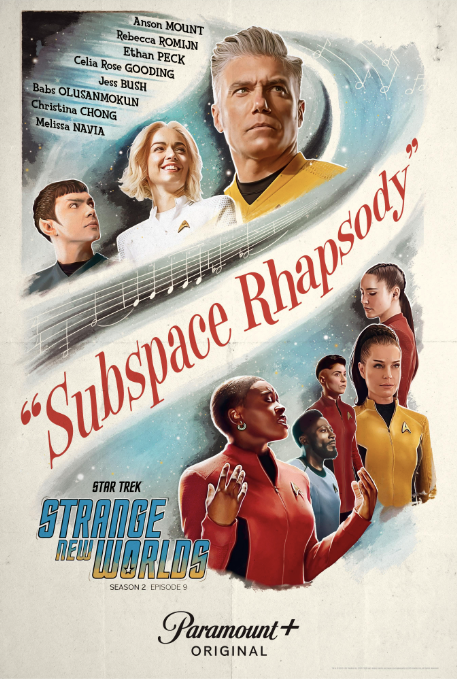
Star Trek: Strange New Worlds 2.9: The Operetta


Here's my one-line, non-spoiler review of Star Trek: Strange New Worlds 2.9, which was, literally, an operetta:  I liked a lot of it.

[Spoilers ahead ... ]

Here's more:

I thought the story was excellent, ingenious, and original: the Enterprise encounters some kind of force-field that has the effect of making the crew put into song their most personal thoughts.  The addition of the Klingons added more tension to the story, and their actual singing number was pretty good.

I'll get to the singing of our crew in a moment.  But sticking with the story, the resolution, of sorts, of the romantic attractions/relationships of La'an/James T. Kirk, and Chapel/Spock was powerful narrative, and fine writing and acting, but I would have rathered see both relationships go in a better direction.  In particular, James T. Kick didn't have to be already involved in a relationship with Carol, who is pregnant, and Chapel need not have seen her upcoming time away from the Enterprise as ending her relationship with Spock (though, I suppose, maybe it's possible that she doesn't).  As I've said before, I'm a hopeless romantic. And it seems that Strange New Worlds, encumbered by what we know of the future of these characters from the original Star Trek -- no relationship between Spock and Chapel, and James T. Kirk not being attached to Carol, La'an, or anyone -- had no choice but to put the brakes on these budding relationships on the Enterprise under Pike. Speaking of which, it was good to see his relationship still on track with Captain Marie Batel (Pike's future in the original series certainly doesn't preclude that at this point in his life). And it was great as always to see James T. Kirk on the Enterprise, in any case.

Now as to the songs.  I thought the singing and songs of Una, La'an, Spock, Chapel, and Uhura were top-notch -- not only in and of themselves, but working well in the story.  The rest were ok, but at least to my ears sounded at times like a parody of an operetta, whatever exactly that means.

I'm not the biggest fan of Gilbert & Sullivan, anyway, though I think The Who's Tommy is great, and I always regretted Paul McCartney saying no to the story he had asked Isaac Asimov to write for a musical McCartney had in mind. In Strange New Worlds 2.9, the brief Klingon performance had the best beat, and the songs of the Enterprise crew would have gone down better, in my never humble opinion, had they more in common with rock 'n' roll, rock, hip-hop, and rap, than well, Cole Porter, even though I think he was one of the best lyricists of all-time.

Speaking of Cole Porter, my friend Ken Hudson brought this to my attention: Uhura in the original Star Trek singing (privately to herself) a few lines from Porter's "Let's Do It, Let's Fall in Love" to, of all people, Spock, in an outtake from the "Who Mourns for Adonis" episode! We did see, in episode 2.9 of Strange New Worlds, Uhura looking romantically at Spock (he's seems totally unaware), and we've seen glimpses of this in earlier Strange New Worlds episodes. The outtake clip from the original series tells us that the makers of episode 2.9 of Strange New Worlds were likely inspired by this scene from the original series, and gives a nice unexpected meaning to the inclusion of Gene Roddenberry in the writing credits (though if Nichelle Nichols came up with this on her own, then she deserves a little of the writing credit for the Strange New Worlds operetta as well).

Anyway, on balance, I'm very glad I saw this episode of Strange New Worlds, and I'm looking forward to the season 2 final next week.  And hats off to all of the singing crew, who actually sang, and had fine voices!


more on the McCartney-Asimov musical that was never written, at
the end of this story .... "It's Real Life" ... an alternate history of
The Beatles ... read the story FREE here ... get the Kindle or paperback 
here... listen to the radio play FREE here ... winner of The Mary Shelley Award

Sunday, June 7, 2020

The Trial: A Different Kind of Murder Lawyer Story


Not Kafka's famous and famously important novel posthumously published nearly a hundred years ago, but a new (2019) Italian murder-mystery-lawyer television series, Il Processo, that started streaming on Netflix in April.  And no, it's of course not as good or powerful as Kafka's novel, but it's pretty good, will keep you guessing until the end, and is well worth watching if you don't mind dubbbing or subtitles.  [Spoilers follow, though I won't tell you the very ending.]

Unlike most lawyer dramas, The Trial is pretty much equidistant between prosecutor and defense, with both being flawed but attractive heroes of this story.  The prosecutor, Elena (well played by Vittoria Puccini) has the slight edge in originality of character, given that she soon discovers that the murder victim, a young pregnant woman, was her biological daughter, given up years ago for adoption.   But the defense attorney, Ruggero (also well played by Francesco Scianna) is no slouch, either.  He wants to win, yes, but he also has a stubborn devotion to the truth, and certainly doesn't want to be taken advantage of.

Also of interest to my American eyes is the nature of the Italian trial, which takes place in Mantua (which my wife reminds me figures in one of Cole Porter's great songs in Kiss Me Kate) before a panel of judges.  I have no idea if this is standard in Italy, but it certainly isn't in the United States, which makes it fun to follow.   The scenery is great, the food looks delicious, and the supporting cast is also excellent on all levels.

Bur the whodunnit narrative is the best reason to see this series.  The hallmark of a good murder mystery is that you're not sure who did the deed until the last chapter or episode, and when the culprit is revealed, it confirms what your less than fully conscious instincts were telling you all along.  The Trial has all kinds of twists and turns and red herrings along the way - are they a big fish in Italy? - and it was especially enjoyable to see, given that my wife and I haven't gone out to any of our favorite Italian restaurants in New York since the pandemic hit.  But even without the good food, The Trial is recommended.


Saturday, November 24, 2018

Dylan in Concert at Beacon: Still Recognizable as the Greatest Lyricist of All-Time


Bob Dylan sketch in Old Bear Studios

Well, Dylan tonight at the Beacon in New York City did not look all that much like the sketch above, which hangs in Old Bear Studios in Batavia, New York, where I recorded my first new album in nearly 50 years a few weeks ago (details here).   Nor did he sound all that much like he did in the early-mid sixties, either.  Not even like the Dylan who sang at George Harrison's Bangladesh concert at Madison Square Garden in 1971.  Not even like the Dylan who sang a verse of "My Back Pages" at the 30th anniversary concert in 1993, also at the Garden, with every conceivable Dylan-related singer and guitarist right there on stage with him and loving it.

The difference was that the melodies that Dylan sang of his iconic songs tonight were almost unrecognizable.  And the melodies of the songs I didn't recognize, I couldn't tell you.  But you know what?  I loved it!  (Tina, who was with me, had a somewhat different opinion.)

Of his best-known songs, I enjoyed his renditions of "Like a Rolling Stone" and "Don't Think Twice" the most, with "Blowing in the Wind" a close runner-up.  Of those I didn't know, I thought "Scarlet Town" (2012) and "Gotta Serve Somebody" (1979) were great.  And I really enjoyed lots of the other songs, unknown to me before tonight, too.

Look, Dylan doesn't talk to the audience and didn't introduce his band, which was sharp and excellent.  But he played a strong piano - no guitar - standing and sitting, and his trusty harmonica, too.  And that was enough for me, more than enough.  I've long considered him the greatest lyricist of our or any age - in rock, only John Lennon comes close to Dylan in sheer brilliance and output, but Dylan was so far ahead by the end of the 1960s, that even Lennon with his great work in the 1970s couldn't catch up (maybe if his life hadn't been taken by a lunatic and a gun it would have been different, but we'll never know).  Cole Porter in his own very different way could give Dylan a run for his money, but Porter lacked the anti-war social relevance of early Dylan and late Lennon.

I understand that in concerts some years ago, Dylan carried no tune, and just mumbled  his lyrics, not even in his trademarked cant.  Tonight, he did give us some melody.  If it wasn't the melody we heard back in the 1960s, that's fine with me.  The lyrics, those extraordinary words, were always what made Dylan an unsurpassed genius anyway.

It was all an unforgettable thrill tonight, and when I go to his next concert, and I'll know more of the songs.


Bob Dylan tonight at Beacon; photo by Tina Vozick


Tuesday, July 4, 2017

Review of Rob Sheffield's Dreaming The Beatles 8 of X: Rubber Soul on July 4

Checking in with a new review in my continuing series of reviews of Rob Sheffield's masterful Dreaming the Beatles on July 4.  This review is about Sheffield's chapter (actually two chapters) devoted to Rubber Soul.  There's no intrinsic connection between Rubber Soul and July 4, but I just read the two chapters, and they're too good not to talk about immediately, whatever the date.

Though, come to think of it, there is a slight connection, since Sheffield makes the point that he can't decide which of the two versions of the 1965 album, the British or the American, he loves most, because they're both so good.  This is just a minor example of why these chapters are such memorable discussions of Sheffield's favorite album.

There's long been a tie in my head between Rubber Soul and Sgt. Pepper (not quite Revolver, for reasons I'll get into in some subsequent review), but Rubber Soul has my heart and soul, and Sgt. Pepper my head, and I guess two out of three wins.  (My 1987 essay "Sgt. Pepper and the Presumption of Genius," reprinted in Electronic Chronicles, speaks to Sgt. Pepper, and I'll return to that in a later review).

Sheffield's chapters are just brimming with insights, my favorites being -

  • John and Paul later disputing who wrote a given song (I'll return to that general theme also in a later review)
  • John doing "slinky" harmony to blend in with Paul's lead in "You Won't See Me" (you don't often see John credited for his harmonies)
  • Ringo's essential drumming (Sheffield is slowing convincing me of Ringo's importance)
  • The Beatles worrying that Rubber Soul might not be well-received, with the lukewarm reception of the record label being no help (this is a story common to most great works in sundry creative fields, but it's still eye-opening to see the Beatles subject to it)
  • John trying to write about a love affair in "Norwegian Wood" in a way that won't tip off Cynthia (this is also a perennial problem with lyricists and all kinds of writers)
But what stands out most about these chapters, and Rubber Soul, is what it says about sophisticated love songs.  Dylan inspired the Beatles, but I'd say Rubber Soul and its superb variety of meditations on passion has as much or more in common with Cole Porter.  I've always thought that the greatest lyricists of the 20th century were equally Cole Porter, Lennon-McCartney, and Dylan - and Rubber Soul, the album and Sheffield's chapters, in effect testifies why (and why Lennon-McCartney are in retrospect the bridge) .  It may well be that Rubber Soul is the greatest album not only by the Beatles, but by anyone, because that mix of rock and folk, however brilliantly it might work for social commentary, finds its apotheosis in adventures of the human heart.

See also Review of Rob Sheffield's Dreaming the Beatles 1 of X: The Love Affair ... 2 of X: The Heroine with a Thousand Faces ... 3 of X: Dear Beatles ... 4 of X: Paradox George ... 5 of X: The Power of Yeah ... 6 of X: The Case for Ringo ... 7 of X: Anatomy of a Ride ...  9 of X: Covers ... 10 of X: I. A. Richards ... 11 of X: Underrated Revolver ... 12 of X: Sgt. Pepper ... 13 of X: Beatles vs. Stones ... 14 of X: Unending 60s ... 15 of X: Voting for McCartney ... 16 of X: "I'm A Loser" ... 17 of X: The Split ... 18 of X: "Absolute Elsewhere... 19 of X: (Unnecessary but Brilliant) Defense of McCartney ... 20 of X: "All Things Must Pass" ... 21 of X: Resistance ... 22: The 70s Till the End ... 23: Near the Science Fiction Shop ... 24 of 24: The Last Two

And here's "It's Real Life" -- free alternate history short story about The Beatles, made into a radio play and audiobook and winner of The Mary Shelley Award 2023


lots of Beatles in here

Sunday, June 18, 2017

Review of Rob Sheffield's Dreaming The Beatles 7 of X: Anatomy of a Ride

Been a bit since I posted a review of Rob Sheffield's Dreaming the Beatles (some 13 days), mostly because this is not a book to be rush-read or even normally read (whatever pace that might be), but savored, and also because I've been writing some science fiction, and there's also the lure of the cool water and soft beach of Cape Cod Bay.  But I wanted to record a few words about Sheffield's chapter on "Ticket to Ride", about as rich and satisfying an extended analysis you can find of a Beatles or any worthy song.

I recall well when "Ticket to Ride" came out in the Spring of 1965.  My friends and I - especially our group, on its way from The Transits to The New Outlook - knew immediately that "Ticket to Ride" was something different.  It had an edge, an imminence, a truth that none of the Beatles' songs quite had before.  (The B-side, "Please Don't Wear Red" aka "Yes It Is," is a masterpiece, too, and a personal favorite.  Not mentioned by Sheffield in this chapter, but it plays a crucial role in my 1997 Loose Ends.)

Back to "Ticket to Ride" - Sheffield tells us why.  It's a song about an adult relationship - Lennon is living with this woman.  It's a song pointed at a unique stage in their relationship - she wants to leave, she's bought a ticket to leave, but she hasn't left yet.  Maybe she won't leave (unlikely), maybe she'll come back (also unlikely), the only unambiguous note in this story is that she's deeply unhappy about living with John.   And as Sheffield aptly says, John is not arguing with her, trying to convince her to stay, he's just at the beginning of trying to understand this.

You just don't usually find relationships at this stage and presented at this level of complexity and ambiguity in love songs, although they are the marrow of real life.  This song also checks in on a quiet tally I've been keeping in my head for more than a half a century: can a love song be as socially significant as a song aimed at some social injustice?  Dylan's "Just Like A Woman" is one, rare example (as are some of Cole Porter's best works)  - but it came a year after "Ticket to Ride".  So the Beatles in terms of socially significant love songs got there first, and these two songs are all the evidence one needs that not all love songs are silly, or even just medium wise.

Sheffield also offers more testimony on behalf of George Martin's deft production skills, remarking on the perfect mix of McCartney's harmony on this track, so it provides resonance to Lennon's introspection without intruding on it.

And I'll be back sooner or later with another review.

See also Review of Rob Sheffield's Dreaming the Beatles 1 of X: The Love Affair ... 2 of X: The Heroine with a Thousand Faces ... 3 of X: Dear Beatles ... 4 of X: Paradox George ... 5 of X: The Power of Yeah ... 6 of X: The Case for Ringo ...  8 of X: Rubber Soul on July 4 ... 9 of X: Covers ... 10 of X: I. A. Richards ... 11 of X: Underrated Revolver ... 12 of X: Sgt. Pepper ... 13 of X: Beatles vs. Stones ... 14 of X: Unending 60s ... 15 of X: Voting for McCartney ... 16 of X: "I'm A Loser" ... 17 of X: The Split ... 18 of X: "Absolute Elsewhere... 19 of X: (Unnecessary but Brilliant) Defense of McCartney ... 20 of X: "All Things Must Pass" ... 21 of X: Resistance ... 22: The 70s Till the End ... 23: Near the Science Fiction Shop ... 24 of 24: The Last Two

And here's "It's Real Life" -- free alternate history short story about The Beatles, made into a radio play and audiobook and winner of The Mary Shelley Award 2023


lots of Beatles in here

Thursday, October 13, 2016

Why Bob Dylan Deserved the Nobel Prize for Literature

With so much wrong and out of control in this world, it was a tonic indeed to learn that Bob Dylan is being awarded the Nobel Prize for Literature for his lifetime of song writing.

Who are the other great American songwriters in the past few hundred years?  Stephen Foster wrote eternally beautiful songs, with haunting music and gossamer lyrics, in the 19th century.  Cole Porter was an unsurpassed master of wordplay in the first half of the 20th century.   Lennon & McCartney wrote a ton of incredibly catchy and some songs very profound of lyric and music a little later.

All of these songwriters occasionally reached heights that Bob Dylan attained over and over, many dozens of times, in the 1960s.  His protest songs, like "Masters of War," are just peerless.  His commentaries on the human condition, like "A Hard Rain's A-Gonna Fall," devastating and unforgettable. His love songs, like "Just Like A Woman," are right up there with the best of Romantic poetry - and for that matter, Shakespeare and the Greek poets, too.  And Dylan did this, countless times.

Someone asked me today if Dylan really deserved the award, since songs aren't books, and thus not really a form of literature.  But what is literature?  Words put together to tell a story - or exactly what Dylan did with his words in his songs.  And he molded those words, sculpted them and strung them together, mined their metaphoric depths and extended them to surprising, stunning, breathtaking places, in a way that only James Joyce in fiction, Marshall McLuhan in nonfiction, and few other soaring writers have done.

Dylan's songs would've been heard 10, 000 years from now, even without this Nobel Prize. But the Prize is a worthy recognition of this work.


Friday, February 24, 2012

Santorum's Deficient Education

Probably Rick Santorum's blanket denunciation of colleges and universities as "indoctrination mills" is the least offensive of his 18th-century regressive, repressive views publicized in the past few weeks.  But that's because his views about contraception, for example - which he opposes, even though he always says he wants to reduce teenage pregnancies - are so far gone and off the wall.

But since I know a  little something about college education, I thought I'd mention how at variance with reality Rick Santorum also is about that.

First, I should say I'm no blind advocate of higher education.  I've always found some merit in Cole Porter's "a college education I would never propose, a bachelor's degree won't even keep you in clothes".   A university degree isn't necessary for everyone.  Bill Gates, Mark Zuckerberg, and Steve Jobs all did just fine without one.

But the claim that a college education is a course in indoctrination is just nonsense.  Where I teach at Fordham University, no one ever told me or even encouraged me to present a specific political or cultural point of view.    That's what academic freedom is all about.

More important, I've never told a student what to think.  The goal, as every college professor knows, is to teach students how to think.  Or, in the Writing Workshop course I'm currently teaching, how to write, clearly and effectively, whatever your point of view.

Perhaps there are professors somewhere who teach differently.  But I've never met one.  And for those many that I have known, their emphasis has always been on teaching students how to think clearly.

Wherever Rick Santorum got his education, he obviously failed to learn that lesson.


Thursday, January 6, 2011

There But for Fortune: Gift of Phil Ochs to the Future

Tina, Simon, and I saw There But for Fortune last night at the IFC Center - formerly the Waverly Theater - in the heart of Greenwich Village in NYC.  It was the second time for Tina and Simon - they were at a a preview screening in December (Simon reviewed it for Entertainment Weekly; Tina has been one of the lead editors of Phil Ochs' Wikipedia page since 2006).   This documentary about the life and times of Phil Ochs merits repeated viewing.

If you don't know who Phil Ochs was, here's what you missed: a folk singer who wrote and sang topical songs - one of his albums was entitled "All the News that's Fit to Sing" - with a warmly evocative voice, a trenchant logic and commentary, and a zest and precision in lyrics that rivals Bob Dylan and Cole Porter.   Ochs' songs critiquing the Vietnam War ("White Boots Marching in a Yellow Land"), war in general ("I Ain't a Marchin' Anymore"), the wishy-washy "liberal" political philosophy of the 1960s (that is, Hubert Humphrey rather than Eugene McCarthy, in his song "Love Me, I'm a Liberal") and many more are still among the best "protest" - political commentary - ever written in any medium.   And when you add to this "The Crucification" (the public's thirst for the fall of heroes they create, ranging from Christ to John F. Kennedy), "The Floods of Florence" (artists struggling to communicate through own their media), "Flower Lady" (the eternal witness to cultural decline), and more like that, you get some of the best songs and cultural commentary ever written, period.

Ochs was loved and admired, but he got nothing like the recognition he deserved in his own time.  Robert Christgau, long the dyspeptic music critic of The Village Voice, complained about Ochs' guitar strumming in a concert in which Ochs' words, melodies, and voice were heart-rending and extraordinary (Tina and I were likely in that audience -  we heard Ochs at concerts and rallies at least a dozen times).  Dylan dissed Ochs, didn't include him in his Rolling Thunder tour, though the two had often performed together, including just the two of them for Broadside Magazine with Pete Seeger listening at the beginning of their careers (Pete talks about this in the movie).    In 1976, Ochs took his own life - succumbing to the pits of a manic depression that had also helped propel him to greatness.

So There But for Fortume - written and directed by Kenneth Bowser, produced by Michael Cole, Bowser, and Ochs' brother Michael - had a lot to take care of, a steep road to climb, and it did this just masterfully, with clips and photos of Ochs and friends seldom if ever seen before,  and sage and instructive interviews with people in a position to know, from Joan Baez to Abby Hoffman to Sean Penn and Christopher Hitchens.  Some of these interviews were clearly done years ago (as Kenneth Bowser and Michael Ochs discussed in their q&a after the movie - a perfect cap for a splendid night - There But for Fortune was 19 years in the making).

Among my favorite parts (in no particular order, because it was all great) was Ochs explaining why he went to orchestration rather than folk rock with his Pleasures of the Harbor album,  the revelation that Ochs saw himself as a John Wayne patriot (the Vietnam War that Ochs so implacably and aptly opposed was, after all, unconstitutional, as has been every war since World War II, the last time Congress adhered to the Constitutional requirement of a declaration of war by both houses of Congress), photos of "Bobby" Dylan at Ochs' place in the Village in the early days,  Dylan and Ochs performing at the concert on behalf of Chilean refugees in the 1970s, and much, much more.

I think everyone whose souls were captured, ratified, and lifted by Phil Ochs wanted to do something to keep his words and music alive when we learned of his death back in 1976.  I was teaching at Fairleigh Dickinson University in Teaneck, NJ, then, and did a radio show for the campus station - broadcast and heard all over the New York area - called "Seminar on the Air".  I asked the program director if I could do a special on Ochs.  He said ok, but keep it to an hour.  I invited my friend and fellow-Ochs lover Josh Meywrowitz to join me, but by the time we were finished talking about Ochs and playing his records, the clock said our taping had gone three hours.   I called the program director - he said, hey, I know it will be hard, but kindly cut the tape down to the one hour.  I had a decision to make ...  I was sending a press release about our show to the New York Times, and my hand must have "slipped" when I put in the length of the show, because it said three hours ...  On the Saturday the show was to air, I got a call from the program director early in the morning, telling me the Times had listed our show - great news - but by mistake or misprint [smile] indicated its length as three hours.  He asked me if there was any chance I still had the three-hour version of the show on hand.  Of course I did.  I went out to Teaneck, put the three hour tape in the queue, and it was indeed played in its entirety that night.  Hey, even three hours of radio doesn't do Ochs justice.  You gotta do what you can ...

But Ken Bowser, Michael Ochs, and Michael Cole have done with There But for Fortune more than any who loved Ochs could have asked for.   The documentary is a gift to the future, and I'm guessing it will finally put the works of Phil Ochs in the eternal hall of great works, right along with Dylan's, that will be listened to for centuries or longer to come.

Further listeningDennis Elsas recently interviewed Ken Bowser on WFUV-FM Radio, with fine Ochs songs as accompaniment ... One of the songs Elsas and Bowser discuss is Ochs' "Small Circle of Friends," which, as Elsas notes, "almost became a hit record".

I've long been vexed by perhaps the main reason this song did not become a hit.  Shortly after it was released in 1967, the FCC issued a warning to radio stations, that their licenses could be in jeopardy when they came up for renewal if they played songs that endorsed drug use.   "Small Circle of Friends," which is about public apathy, has a verse about "smoking marijuana" and getting high detaching people from their responsibilities as citizens and human beings.  It is obviously an attack on drug use, not an endorsement, but that distinction was lost on radio stations afraid of the FCC.   Many of them promptly dropped "Small Circle of Friends" from their play lists.  Just one of many reasons I'd like to see the FCC declared unconstitutional - put out of its miserable, censorious business - as a blatant violation of the First Amendment.

Friday, November 5, 2010

Bones 6.5: Shot and Pretty

"I'm shot, I'm pretty," Hannah tells Booth in the resumption of Bones with episode 6.5 tonight - after the World Series, and, here in New York, after greedy Cablevision and Fox finally settled their dispute which led to no Fox on our screens.   Regarding Hannah, what she tells Booth is true enough - her boss will now definitely keep her on the reportorial job in Washington given her looks plus affinity for bullets back home.

But the deeper truth of this scene is what happens when Bones enters the hospital room, with news that Hannah, who's intending on getting back on the job in the morning, has an "avulsion" fracture.   This could make Hannah not only pretty and shot but dead, because the tendon if unduly exercised could pull the fractured part of the bone way out into severing an artery.

Now this might well make some/many Bones fans happy, but Bones herself cannot be one of them, because she's after all inside the story, not watching it from the outside.   So she's happy to save Hannah's life, and so are Booth and Hannah, who both deeply appreciate that Bones has done this, and we've got almost one big happy family.

How do I feel about this?  Well, short of a menage a trois resolution,  I don't particularly like it, especially the additional bonding between Bones and Hannah that happens at the end of the episode.  I guess it makes sense on some level - Bones and Hanna both love Booth (though on very different levels of awareness) so they are already bonded.   But I'd be happier if they two were in open battle.

On a brighter note - and what gets the cake for the funniest scene tonight - we have a bronze Shakespeare who turns out to be one of those human statues.  There was an hilarious episode of Monk a few years back which featured a silvered dude standing outside of a bank (where there was a robbery), who maintained a steely silence.  The bronze on Bones does the same - but Sweets diagnoses his "dissociative disorder" - he can only converse in Shakespearean, literally.   And Sweets is then able to have a witty, useful, and satisfying interrogation of the bronze Bard.   "Brush up yer Shakespeare, start quoting him now..."

Good special effects tonight, too, with the murder victim being not even bones but an impression of bones.  And come to think of it, Bones is also able to use her knowledge of bones not just to solve a murder but save a life.   And if the life was Hannah's?   Well, there's that bone to pick, but it was still an episode that cut to the bone on many levels and, ok, I'll become one of those silent statues now.

Nah ... "Just declaim a few lines from Otella, and she'll think you're a hell of a fella ..."


See also Bones 6.1: The Linchpin ... Bones 6.2: Hannah and her Prospects ... Bones 6.3 at the Jersey Shore, Yo, and Plymouth Rock ... Bones 6.4 Sans Hannah

And see also Bones: Hilarity and Crime and Bones is Back For Season 5: What Is Love? and 5.2: Anonymous Donors and Pipes and 5.3: Bones in Amish Country and 5.4: Bones Meets Peyton Place and Desperate Housewives and Ancient Bones 5.5 and Bones 5.6: A Chicken in Every Viewer's Pot and Psychological Bones 5.7 and Bones 5.8: Booth's "Pops" and Bones 5.9 Meets Avatar and Videogamers ... Bad Santa, Heart-Warming Bones 5.10 ... Bones 5.11: Of UFOs, Bloggers, and Triangles ... Bones 5.12: A Famous Skeleton and Angela's Baby ... Love with Teeth on Bones 5.13 ... Faith vs. Science vs. Psychology in Bones 5.14 ... Page 187 in Bones 5.15 ... Bones 100: Two Deep Kisses and One Wild Relationship ... Bones 5.17: The Deadly Stars ... Bones Under Water in 5.18 ... Bones 5.19: Ergo Together ...  Bones 5.20: Ergo Together ...  Bones 5.21: The Rarity of Happy Endings ... Bones Season 5 Finale: Eye and Evolution


                 Special Discount Coupons for Angie's List, Avis, Budget Car, eHarmony, eMusic, Mozy, Zazzle


The Plot to Save Socrates


"challenging fun" - Entertainment Weekly

"a Da Vinci-esque thriller" - New York Daily News

"Sierra Waters is sexy as hell" - curled up with a good book

Monday, August 2, 2010

Mad Men 4.2: "Good Time, Bad Time?" "Yes"

The first striking line in Mad Men 4.2 is delivered by Allison, Don's secretary, as she walks into his office.   "Good time, bad time?" she asks.  Replies Don: "Yes."

This proves to prophetic for the big surprise of this episode.   Don and a blond psychologist have a little chemistry on the job.   Don - who comes home to his apartment drunk just about every night - would have been happy to have a romp with his cute next door neighbor, a nurse.  She demurs.   And this sets us up for a a scene Cole Porter would've enjoed, as the business Don gives is the business he gives his secretary.   He's left his keys in the office, Allison (well played by Alexa Alemanni) comes by to give them to Don, and after he's settled in his apartment and she's just about to leave, he pulls her into his arms and more.

They both enjoy it - at this point, apparently she more than he.   The next day at the office, she asks Don if he'd like her to close the door, after she comes in.   But Don wants to play like it didn't happen - at least, for now.

Romance of sorts was in the air for least two other couples tonight.   Peggy doesn't want to sleep with her boyfriend just yet, but she doesn't want to be alone on New Year's Eve.   She winds up sleeping with him about a week before that, against Freddy's advice (yes, he's back - good!)   (I'm assuming she didn't want to sleep with him in the first place because she doesn't want to get pregnant again, but with inscrutable Peggy you never quite know.)

And Sally has attracted the amorous attention of the boy next door - literally.   In an effort to be her hero, he trashes her house, because she's told him that she hates the house and wants to move.  Of course, if she does, then that would likely be the end his knowing her - but at that age, logic has little to do with bold actions.

Business-wise - the true business, non-Cole Porter type - the Lucky Strike exec is getting his kicks pushing Roger around.  This occasions another good line, as Roger quotes his father about the business they're in being great  - except for the clients.

This gets right at the irresistible essence of Mad Men - everyone in the organization loves the job, but hates a part of it,  and struggles to keep that part from dominating their lives.  For Don,  that part is his own true background, which he continues to work to keep out of his life, or at least at bay.  Last week it was the reporter who wanted a piece of that, tonight it was the blond shrink, as Don continues to just keep his head above water in this swirling game.

But he remains, whatever else happens, a good, loving father.  I liked the way he added the Beatles (on 45 rpm!) to his Christmas present for Sally.   And with the mention of the Beatles, Don and Mad Men have taken a big step into our current age.   Hey, I was just watching and loving PBS's presentation of Paul McCartney at the White House (from this past June) last night!  There is a continuity between the first time the Beatles were heard, right through to our very present, which makes all of that distinct from anything that happened before.

PS - The closing song with the original "I Saw Mommy Kissing Santa Claus" - I always liked the Ronettes' version better, from the Phil Spector Christmas album.  Here's a taste.

See also Mad Men 4.1: Chicken Kiev, Lethal Interview, Ham Fight

And from Season 3: Mad Men Back for 3 and 3.2: Carvel, Penn Station, and Diet Soda and 3.3: Gibbon, Blackface, and Eliot and 3.4: Caned Seats and a Multiple Choice about Sal's Patio Furniture and 3.5: Admiral TV, MLK, and a Baby Boy and 3.6: A Saving John Deere and 3.7: Brutal Edges ... August Flights in 3.8 ... Unlucky Strikes and To the Moon Don in 3.9 ... 3.10: The Faintest Ink, The Strongest Television ... Don's Day of Reckoning in Mad Men 3.11 ... Mad Men 3.12: The End of the World in Mad Men ... Mad Men Season 3 Finale: The End of the World

And from Season Two: Mad Men Returns with a Xerox and a Call Girl ... 2.2: The Advertising Devil and the Deep Blue Sea ... 2.3 Double-Barreled Power ... 2.4: Betty and Don's Son ... 2.5: Best Montage Since Hitchcock ... 2.6: Jackie, Marilyn, and Liberty Valance ... 2.7: Double Dons ... 2.8: Did Don Get What He Deserved? ... 2.9: Don and Roger ... 2.10: Between Ray Bradbury and Telstar ... 2.11: Welcome to the Hotel California ... 2.12 The Day the Earth Stood Still on Mad Men ... 2.13 Saving the Best for Last on Mad Men

And from Season One: Mad Men Debuts on AMC: Cigarette Companies and Nixon ... Mad Men 2: Smoke and Television ... Mad Men 3: Hot 1960 Kiss ... Mad Men 4 and 5: Double Mad Men ... Mad Men 6: The Medium is the Message! ... Mad Men 7: Revenge of the Mollusk ... Mad Men 8: Weed, Twist, Hobo ... Mad Man 9: Betty Grace Kelly ... Mad men 10: Life, Death, and Politics ... Mad Men 11: Heat! ... Mad Men 12: Admirable Don ... Mad 13: Double-Endings, Lascaux, and Holes

20-minute interview with Rich Sommer (Harry Crane) at Light On Light Through


                 Special Discount Coupons for Angie's List, Avis, Budget Car, eHarmony, eMusic, Mozy, Zazzle


The Plot to Save Socrates


"challenging fun" - Entertainment Weekly

"a Da Vinci-esque thriller" - New York Daily News

"Sierra Waters is sexy as hell" - curled up with a good book


And  check out Natasha Vargas-Cooper's new book ....

InfiniteRegress.tv