Chuck Todd interviews me about alternate histories
Showing posts with label James Franco. Show all posts

Monday, September 9, 2019

The Deuce 3.1: 1985


The Deuce was back tonight with its final season on HBO with another step into the future, New Year's Eve 1985, that is, the last day and evening of 1984.  The big villain, at this point, is AIDS.  Bobby's afraid he has it (he likely doesn't, at least yet).  Gene seems set up to get it.   And a lot of people, including Abby on the East Coast and Lori on the West Coast, aren't feeling too well.

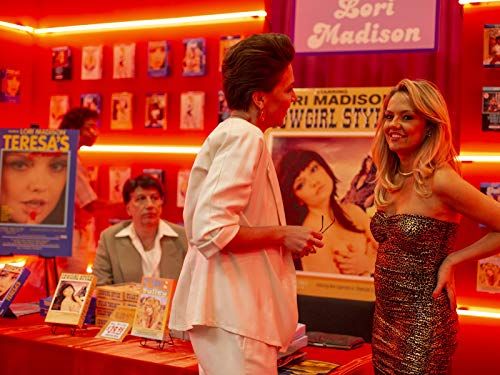
Well, Lori's just getting out of rehab, and she's soon on her way to going back, i.e., hooked on some other substance.  Candy and Harvey seem physically ok, but they're at odds, as always, on the porn business they helped bring into being the previous decade.  Harvey, always concerned about "the p and a," as he says (meaning, what? profits and ass?), wants Candy to be less arty, and she, of course, resists.

The New York City scenes, as always, are gritty and right.  The LA scenes look right, too, but I wasn't out there in the mid-80s so I don't know from first-hand experience. The acting is outstanding.  James Franco has aged his twin parts well.  David Krumholtz, now pretty much the same weight as his character Harvey, is also totally believable in that part,  And the same for Maggie Gyllenhaal as Candy.

I do miss Elvis Costello's opening music from Season 2, but otherwise I'm looking forward to seeing how our surviving characters fare in the brave new technological world of the mid-1980s.  No early Macs or IBM pcs in sight, as yet, but I'm guessing we'll see some of those as this season progresses.  Porn had not yet migrated to the Internet - that would be at least a decade away - but there was lots of book-keeping done on those early computer beasts, and book-keeping was always essential to mob and porn activities.

See you back here next week.

See also The Deuce Is Back - Still Without Cellphones, and that's a Good Thing ... The Deuce 2.2: Fairytales Can Come True ... The Deuce 2.3: The Price ... The Deuce 2.4: The Ad-Lib ... The Deuce 2.6: "Bad Bad Larry Brown" ... The Deuce 2.9: Armand, Southern Accents, and an Ending ... The Deuce Season 2 Finale: The Video Revolution

And see also The Deuce: NYC 1971 By Way of The Wire and "Working with Marshall McLuhan" ... Marilyn Monroe on the Deuce 1.7 ... The Deuce Season 1 Finale: Hitchcock and Truffaut 

  
It all starts in the hot summer of 1960, when Marilyn walks off the set
of The Misfits and begins to hear a haunting song in her head,
"Goodbye Norma Jean" ..

my story "The P & A" in this issue

Sunday, October 14, 2018

The Deuce 2.6: "Bad Bad Larry Brown"


Larry Brown had the most best scenes in The Deuce 2.6 tonight.  His acting not only animates Candy's Little Red Riding Hood feature, but he's a first-class ad-lib writer, and his being beaten by cops who mistake him for the real thing when he's chasing Lori in the streets of New York leads to Candy getting a much-needed twenty grand for her movie.  Not bad for an hour's work in The Deuce - creds to Gbenga Akinnagbe in the role - and it more than justifies Candy calling him "bad bad Larry Brown" in an homage to Leroy.  (Hey, I was too busy to review last week's episode, but I'm back now, from outer space.)

Meanwhile, Candy does some fine acting herself (and Maggie Gyllenhaal some fine acting as Candy) after she insists that Frankie fire his wife for her poor portrayal of Grandma and Candy plays the part herself. And I have to say that I was completely wrong when I said that Frankie seemed to be fading from the show a few weeks ago.  In this and last week's episode, he's had a much stronger part than Vincent.

About that, Vincent's second thoughts about his life with the pimps and parlors is a bit trite and even boring.  The Vincent we've come to know always surmounted his doubts and gets on top of the situation.   In contrast to Frankie, who makes a silk purse out a sow's ear, or something like that, Vincent seems to sinking into a morass of self-doubt and pity.  But kudos to James Franco for consistently good acting in this double role.   (And while I handing out praise, I've been meaning to say how much I like the rendition of Elvis Costello's great 1978 "This Year's Girl" that plays at the start of very episode.  The vid of Costello original singing of his song is right below.)


Still unresolved is what's going to happen with CC and Lori.  He has contempt for Larry and his acting - remarking that he's no longer a pimp - and he's putting up with Lori only because she's still giving him her earnings.  But this unstable situation can't last, and I'll be back here next and the weeks ahead to review how it all explodes, falls apart, or resolves.

See also The Deuce Is Back - Still Without Cellphones, and that's a Good Thing ... The Deuce 2.2: Fairytales Can Come True ... The Deuce 2.3: The Price ... The Deuce 2.4: The Ad-Lib

And see also The Deuce: NYC 1971 By Way of The Wire and "Working with Marshall McLuhan" ... Marilyn Monroe on the Deuce 1.7 ... The Deuce Season 1 Finale: Hitchcock and Truffaut 

  
It all starts in the hot summer of 1960, when Marilyn walks off the set
of The Misfits and begins to hear a haunting song in her head,
"Goodbye Norma Jean" ..

Tuesday, September 11, 2018

The Deuce Is Back - Still without Cellphones and that's a Good Thing


The Deuce is back on HBO for its second season.  As was the case with first season, the most enjoyable aspect of this series is its deft capturing of the New York City sleaze ambience of the 1970s.   I remember it quite well - no, not because I was a part of it - but because I walked those streets often, first as a singer/songwriter going in and out of recording studios (which resulted in Twice Upon a Rhyme), later as graduate student at The New School and NYU.

Season 2 zooms in more than half a decade after Season 1.  Koch is now Mayor - as cops debate whether or not he was a "homo," and take figurative shots at Abe Beame, admittedly the most boring Mayor in New York history.  The pimp business is now thoroughly appreciative of the monetary opportunities of porn, and a much slimmer Harvey is still making movies, while Candy continues to push their creative boundaries.

As with the first season, the centerpiece is Vincent Martino (James Franco) and his twin brother Frank (of course also played by Franco).  In a different kind of narrative, Frankie could well be an invention of Vincent's brain.   He flits in and out of scenes, and is often barely seen.   But since he is indeed seen and interacted with by characters other than his brother, chances are Frankie is real.  Certainly Abby acts as if he's real, and the decisive moment in 2.1 is the love she sees in Vincent for his brother when Vincent forgives his debt.   This fans the attraction and love she feels for Vincent, and provides a nice bed for the two of them in bed together at the end.

Something I also liked in the first season, which continues in the second, is how everyone manages to live personal lives and do whatever business with no cell phones.  The 1970s would be the last decade without even a hint of one in the streets or in a car, and the same is true for personal computers.    Given the enormous degree to which all of us in 2018 depend upon those devices, it's almost gratifying to see how well our people did without them back in the 1970s.

So I'd keep watching The Deuce, even if it wasn't about porn and all of that.  See you here next week with more.

See also The Deuce: NYC 1971 By Way of The Wire and "Working with Marshall McLuhan" ... Marilyn Monroe on the Deuce 1.7 ... The Deuce Season 1 Finale: Hitchcock and Truffaut 

  
It all starts in the hot summer of 1960, when Marilyn walks off the set
of The Misfits and begins to hear a haunting song in her head,
"Goodbye Norma Jean" ..

Thursday, September 15, 2016

Stephen King's 11.22.63 on Hulu: Three-Part Drama in Eight Episodes

I finally got around this week to streaming Stephen King's 11.22.63 on Hulu, based on his novel of the same name.  Before I say what I liked and didn't about the short TV series, here's a little context:

Although I think King is a masterful writer, the fantasy/horror/science fiction nexus of most of his work never appealed to me, either in print or on screen.  I had hopes for his CBS-TV series, Under the Dome, but they were pretty quickly dashed.

On the other hand, I consider the assassination of John F. Kennedy the defining moment of my life and our age, even given the close contention for that destructive apex by 9/11.   And time travel has been a consuming passion for me, as a reader, viewer, and author.   Indeed, my Loose Ends saga, begun as a novella published in Analog Magazine in 1997, was all about a time traveler in Dallas on November 22, 1963.   So I approached 11.22.63 with great expectations.

These were only partially rewarded, and they all came in the last episode of the series.  But they were impressive, and well worth awaiting.

Although the series consists of eight episodes, I see it as essentially a three-part drama:

The first part was an enjoyable enough, workmanlike presentation of the hero being drawn into time travel - going back for a quick jump to prove to himself that the time travel is real, figuring out how he can have money in the past, those bells and whistles are always fun to hear and see.  But we've seen and heard all of them many times before.

The second part, at its worst, had nothing to do with the JFK assassination, and dramatically brought into the story some of the literal bleeding that I like least about King's tales.  Even when this took place in or near Dallas, it was at best a distraction and at worst an ugly story that I didn't want to see.

But the final act was masterful, and, in and of itself, a masterpiece in time-travel storytelling.  In stories in which the time traveler is trying to stop a momentous event like an assassination, the options are limited and daunting to pull off with originality.  If the traveler doesn't succeed, is that because she or he unknowingly made the bad event happen?  If the traveler does succeed, does the world get better as intended, or does it get even worse due to an unintended consequence?

In a riveting, magical final hour, 11.22.63 keeps you breathless and guessing, and does this not only for the event at hand, but for the personal life of the time traveler, powerfully played by James Franco.  Although seven hours is a long time in preparation, I strongly recommend 11.22.63 for its astonishing, hard-hitting, heart-rending rollercoaster of a finale, which will stay with you for a long time.


 photo LooseEnds-series.png_zpsvr6q50f0.jpeg

Tuesday, January 6, 2015

The Interview: The Review

Well, I just saw The Interview - on Cablevision - for three reasons: 1. I said the movie was "moronic," based solely on seeing the trailer, in an interview of my own on Arise TV conducted by Francesca Maxime before Christmas (see below for video).   So I figured I had some kind of ethical obligation to see how much my trailer-based review was justified.  2.  I'll be interviewed about "The Interview" again, next week, by Bob Mann on his "Let's Consider the Source" radio show on XM/Sirius Radio, and I thought it would be good to at least know a little about what I'd be talking about.   3. I'm a Professor of Communication and Media Studies at Fordham University.  The movie will no doubt be discussed in some of my classes in the Spring term - see, again, my above point about it being a good idea to know at least something about what I'll be talking about, a credo I try to follow as much as possible as a professor.

That I felt obligated to write such a long, detailed paragraph about why I saw The Interview itself says a lot, or at least how little I thought of the movie before seeing it.  And what did I think of the movie after actually seeing it?

Though parts of it were moronic, a lot of it was not - indeed, it was funny in lots of places without slapstick - and, moreover, it has a political message, and, most important, a heart.   At its best, The Interview was like a long Saturday Night Live skit, replete with fingers bitten off and blood spurting, which were never the high points of SNL in any case.   But as geo-political humor writ large, as the CIA and potential world conflict both lampooned and taken seriously for important fleeting moments, The Interview was quite good.   I enjoyed it - much of it - and laughed out loud a bunch of times.

The worst parts of The Interview were the incessant "butt" and "poop" jokes - a little less of which would have gone a long way.   But the two wild and crazy guys banter between Skylark (James Franco) and Rapaport  (Seth Rogen) throughout the movie was funny, and the bit of caricatured James Bondian romance with Rapaport and a hot North Korean propaganda minister worked well too, with a nice political payoff for the story in the end.

In short, though The Interview is no great movie or comedy for the ages, it's much better than not half bad, and I'm glad I saw it.   Good that Sony finally did the right thing and made the movie available.


I stand by most of things I say here ...


has nothing to do with The Interview, but it does have an Asian theme
InfiniteRegress.tv