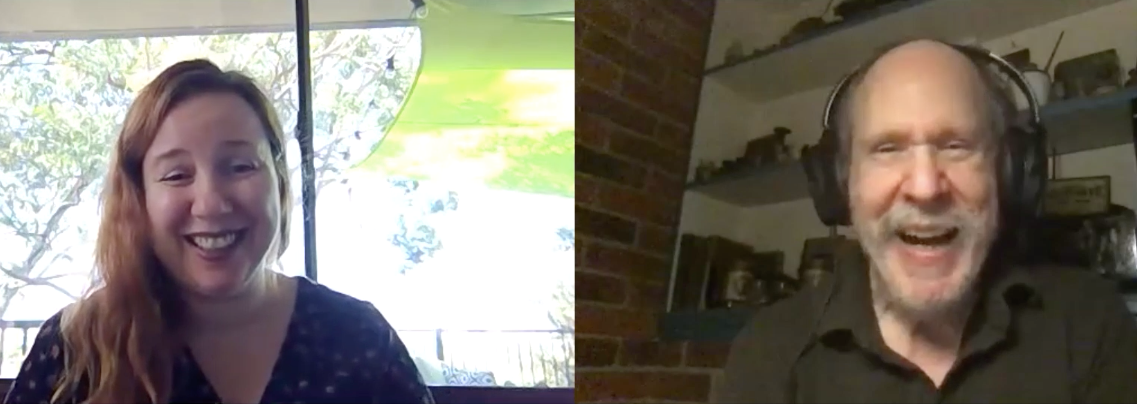
Chuck Todd interviews me about alternate histories
Showing posts with label Paul McCartney. Show all posts

Saturday, February 28, 2026

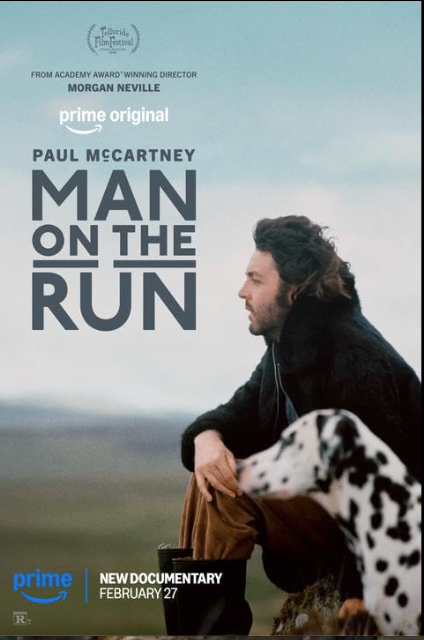
Man on the Run: The Rocky Flight of Wings


My wife and I saw Man on the Run, a nearly 2-hour documentary on Amazon Prime, about Wings, Paul McCartney's group that flew around the world from shortly after The Beatles broke up in early 1970 to shortly after John Lennon was murdered at the end of 1980, making a Beatles reunion forever impossible.

Let me say that I've always thought Wings at their best -- "Let Me Roll It," "Band on the Run," "Jet," "Mull of Kintyre," and "Live and Let Die"-- was every bit as good as The Beatles at their best, which is actually a huge lot better than good.  And like all the recent Beatles documentaries, the sound in this documentary was great, and an outright pleasure to hear.

The story, though, was no pleasure to see.  A sadness hung over the movie, and not just because we knew it would conclude close after Lennon's assassination.   But we see Paul McCartney's struggle, beginning with his attempt to get the world to see, back then, and continuing now, that Lennon had announced to the band much earlier than McCartney did to the world that The Beatles were over.  In part, McCartney's problem was the way in which he made that announcement, in an interview he conducted with himself, in which he even took a shot at poor Ringo, proclaiming McCartney wouldn't miss him.

The result was a lot of people -- fans and critics -- listened to McCartney's efforts, before he created Wings, with a lot less than a kindly ear.  The myopic critic Robert Christgau was especially harsh, missing completely the affectionate brilliance of Uncle Albert/Admiral Halsey, and many of McCartney's other solo efforts, literally solo in that he played all the instruments and sung all of the parts either by himself or with Linda.   I've been complaining about Christgau for decades, but I guess I should thank him, because The Village Voice published my response to Christgau's article, which I sent to the weekly newspaper as a letter to the editor, and they published as an article -- my first published article -- for which they paid me $65.

McCartney created Wings in large part in response to such criticisms, and the group succeeded splendidly.  They started out playing to small audiences, but in a few years played to sell-out crowds teeming with shouting fans with a great line-up that consisted of Paul, Linda, Denny Lane, and an evolving variety of musicians.  McCartney was happy about that, but continued to be plagued by public misunderstandings.  I recall how I felt, when I heard McCartney's response to Lennon's murder -- "it's a drag" -- thinking that Paul must've been in shock when he gave that seemingly shallow reply to a journalist's question, but one of my students (I was teaching then at Fairleigh Dickinson University) came up to me after, in sheer disbelief that McCartney had said this.   It was good in the documentary to hear that Paul had said a lot more than the drag line in his response to that question -- the media as they often do just broadcast the most provocative line -- and heartening and soothing to hear Sean Lennon say recently in the documentary that he always understood how much his father and Paul had loved one another.

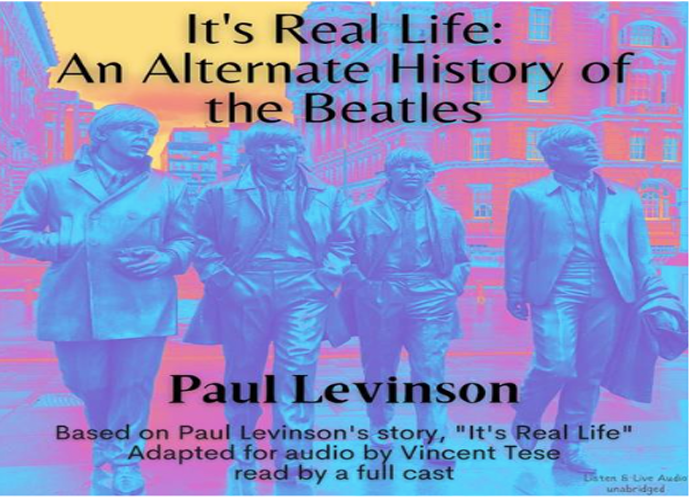
My wife and I continue to love The Beatles, and Paul and his music.  One way I tried to deal with how much I miss them was the novel I wrote, It's Real Life: An Alternate History of The Beatles.  Seeing Man  on the Run didn't have too much of a healing effect, but I guess that's the problem with reality.
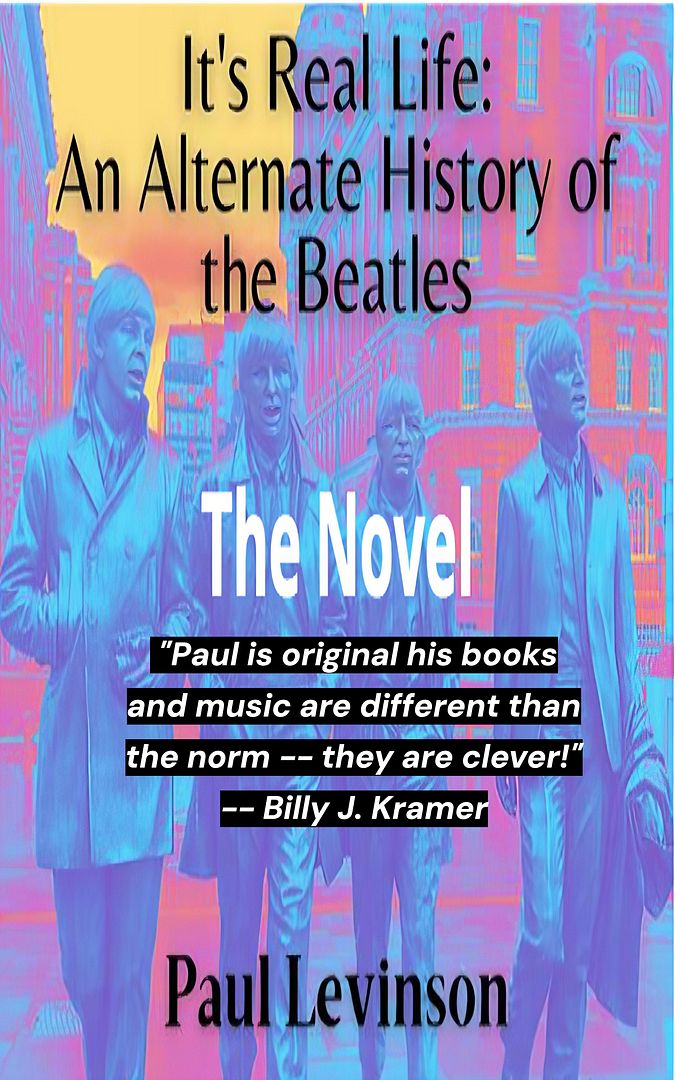


more about the novel here

Saturday, November 29, 2025

(Beatles) Anthology 2025: The Highs and the Highs (and the One Low)


My wife and I watched the renewed and expanded Beatles' Anthology on Disney+ the past three nights. I'd seen and heard bits and pieces of various lengths of the original eight episodes -- on YouTube, The Beatles Channel on Sirius XM, and everything in between -- which originally aired on ABC-TV in 1995, but we somehow had managed not to have seen that original on the unsmart TV in our family room.  It was more than wonderful to see and hear what 2025 director Oliver Murray did with the 1995 eight episodes -- uncovering/discovering new footage as well as calling upon Peter Jackson and his elves to bring to current vibrant life what was done in 1995 (just as Jackson had done so miraculously with The Beatles: Get Back in 2021) -- but the real treat for me (treat is too weak a word) was seeing the new ninth episode.

I'll go over some of highlights of the first eight episodes, and then delve into the wonders of ninth episode, and the one problem I had with it.

About the first eight episodes:

  • It was great to see Murray the K get his due (just as he had in Martin Scorsese's Beatles '64 last year).  I worked with Murray the K when he was at WNBC Radio in New York City in 1970s.  He hired me after he read my article "Murray the K in Nostalgia's Noose" in The Village Voice in 1972 (my second-ever published work -- my first was "A Vote for McCartney" a year earlier, my response to dyspeptic critic Robert Christgau's attack on Paul and his early post-Beatles work).  Murray never got the credit he deserved back then in ushering in The Beatles, and before then on WINS with Alan Freed, and after when he was on WOR-FM helping to invent the FM radio format. I had such a good time working with him on NBC, I even wrote and recorded a song about him -- "Murray the K's Back in Town" -- which he played on the air.  (The late Pete Fornatale -- protagonist of my It's Real Life: An Alternate History of The Beatles -- played that song on his Mixed Bag on WFUV Radio in the early 2010s.)
  • Great shots that I hadn't seen before of The Beatles in their 1964 Washington, DC concert!
  • There was a spectre, a foreshading, of what would happen to John at the end of 1980. George worries throughout about the exposure of The Beatles in a country in which John F. Kennedy had just been assassinated.  (The sick devotion to guns in this country is still claiming lives.)  John himself notes after the DC concert that "some bloody animal cut Ringo's hair".
  • I was reminded again what a uniquely almost  extraterrestrial person Ed Sullivan was.  I mean, no one here on Earth had his accent or his delivery.  Even in Japan, the Beatles are introduced in Japanese (of course), and the host concludes in English with "Ladies and Gentlemen, The Beatles!" -- delivered in a pretty good mimic of Ed.
  • I find it hard to believe that "Pennylane" didn't go to #1 in the UK. Beaten out by Engelbert Humperdinck's "Release Me"? Maybe if it was "Les Bicyclettes de Belsize" ...
  • John -- after The Beatles had broken up and at odds with Paul -- objects to Sgt Pepper being called a "concept" album, saying "Mr. Kite" and all the songs on the album other than the Peppers could easily have been on any other Beatles' LP.   (George also critiques Sgt Pepper.)  As far as I'm concerned, I think Sgt Pepper is indeed a concept album and what John says is also true.  There's really no contradiction here, both are true.  And I'll also say how happy I was to find the following poster in an antique shop my wife and I were in, must've been, the late 1970s.  It's hanging on a wall outside our bedroom.  Every time I walk by it, I smile.  It reminds me of Sgt Pepper.


Now, about the new ninth episode:

It was not only heartwarming (to see the three surviving Beatles still making such superb music) and heartbreaking (because now George is gone), it was chock full of fascinating and important information.  My favorite example: I had always heard, regarding the genesis of "Free As A Bird", "Real Love", and "Now and Then", that the transformation projects began when Yoko Ono gave Paul a tape with some of John's demo recordings from the 1970s.  But in episode 9 of Anthology, George tells us about a crucial preface: When Roy Orbison died, The Traveling Wilburys were thinking of taking some of Elvis's demos and bringing them to life with the inimitable Wilbury voices.  But they decided not to go in that direction, because (in George's words), it was "too gimmicky".  (George didn't say, but rumor has it that the Wilburys were thinking of inducting Del Shannon into the group, but he took his life in 1990.)

But if I had to pick my favorite moment in the ninth episode, and therefore all nine episodes of this beautifully burnished Anthology, it would be Paul and George completing their incomparable three-part Beatles harmony with John's voice in the chorus of "Real Love".  It's been one of my favorite Beatles songs since I first heard it in the mid-1990s.  The song inspired me to write It's Real Life: An Alternate History of The Beatles (the video of Anne Reburn's cover of the song follows below -- she performed this in the radio play broadcast on Killerwatt Radio, adapted from the first chapter of my novel; "Real Life", by the way, was John's title for the song before he changed it to "Real Love").  Paul and George's voices being in such synch with John's recording, the harmony snapping into place, snapping into life, is a deeply acoustic proof to me that this uniquely satisfying sound will never die.  At that instant, the former Beatles became The Beatles again, and gave evidence that The Beatles will always be with us.


Powers that be often miss the immortality of what is all around them.  After Marshall McLuhan died in December 1980 (same year and month as John: their lives were intertwined: they both hit America big in 1964), I proposed a book about him to an editor at St. Martin's Press.  He laughed and told me no one cared about McLuhan any more. That book became my Digital McLuhan, which Routledge published in 1999.  I still receive royalties checks for sales of that book every year.   In the 1970s, I told my doctoral thesis advisor Neil Postman that I thought The Beatles, like Shakespeare, would be known and enjoyed for as long as there were human beings.  He laughed too.

Which brings me to the one criticism I have about episode 9.  Paul and Ringo are still alive.  Yes,The Beatles music including their harmonies will live forever.  But not the mortals who made it.  Wouldn't it have been wonderful to have another hour, or even just a few minutes, to have Paul and Ringo look back at 1995 from their vantage point right now?  Oliver Murray of course interviewed Paul and Ringo in the short film he made, Now and Then: The Last Beatles Song, that accompanied release of the single in 2023.  I guess that could be considered a coda to Anthology 2025, but wouldn't a few additional or more words from Paul and Ringo looking back at what they accomplished in 1994 (when "Free As A Bird" was made) and 1995 (when "Real Love" was made) have been just the perfect cup of sencha tea after the marvel we just took in?

Chris Willman asks Oliver Murray in an excellent interview in Variety why there are no contemporary 2025 voices in Episode 9.   Murray replies: "I didn’t really like the idea of Ringo [and Paul] in 2025 talking about an interview that he gave in 1995 about something that happened in 1965. It was all too nebulous to do that." I'm not sure I know what "too nebulous" means, in this context. "That is, I think I disagree".


in Kindlepaperback, and hardcover

Added February 10, 2026: Check out this new episode of Rock Talk Studio

Saturday, July 26, 2025

And So It Goes: The Extraordinary Billy Joel Documentary


My wife and I saw the second part of the extraordinary Billy Joel documentary last night, after seeing the first part last week.  I've been a big fan of Billy Joel since "Piano Man".  I thought and still think "Only the Good Die Young" was a masterpiece song, same for "Say Goodbye to Hollywood," and same for "Uptown Girl" which also has a masterpiece video.  In fact, I can't really think of any Billy Joel recording I don't like, and the same only applies only to a dozen or so other artists beginning with The Beatles.

But as to his life, the person who wrote and recorded all those great songs, I never knew too much.  I knew of course he'd been married to Christie Brinkley.  I knew he'd been touring for a while with Elton John -- another piano man -- but that ended on an acrimonious note (they later reconciled).  I heard him a few times on The Beatles Channel on Sirius/XM Radio -- talking about The Beatles and playing their records -- and I knew about his recent long run in Madison Square Garden.  My wife and I were going to a lot of concerts prior to COVID, and I had in my mind that we should go so see Billy Joel, but that didn't (yet) happen.

But I didn't know much about his personal life, and how that related to his music, and And So It Goes -- directed by Susan Lacy and Jessica Levin -- does a brilliant job of telling that true story.  Here are some of my takeaways (in no order of importance, because all are important):

  • Billy Joel found writing lyrics somewhat of a burden.  Given that his lyrics were uniquely descriptive, setting scenes and telling stories that seemed to splash out as naturally as the rain, I (as a songwriter as well as a fan) found that especially interesting.
  • Billy Joel's manager, his one-time brother-in-law, robbed him of millions of dollars.  As is clear in this documentary, Joel, in addition to being incredibly talented, is also highly intelligent, so I found that surprising as well.  It's well known that doo-wop groups were regularly robbed of their royalties by record companies in the 1950s, but Joel's misfortunates happened 50 years later.
  • Billy Joel always loved classical music. (His father, who abandoned his family when Billy was a boy, was a classically trained pianist.)  I knew, of course, that Jeff Lynne and ELO did/do, but Billy Joel always seemed firmly rooted in rock 'n' roll.
  • Billy Joel has always been quick to denounce his tone-deaf critics in the media.  Good for him.
  • Billy Joel was spoken for in the documentary by a cavalcade of musical stars that lit up the screen:  Paul McCartney (who said Billy's "I Love You Just the Way You Are" was his answer when he was asked which song did he wish that he had written), Bruce Springsteen, Jackson Browne, Don Henley, Garth Brooks, Nas,  Sting, and Pink)
  • Billy Joel has been beset by demons all of his life -- which makes his extraordinary accomplishments even more impressive.
All too often, these kinds of eye-opening, definitive documentaries happen after the subject is no longer with us.  Good for Billy Joel for giving that to us now.  His active participation in And So It Goes is itself a testament to what mind-blowing talent he has.

Creds to HBO for putting this on!  As I my wife mentioned, this is the second great documentary on HBO this summer, after My Mom Jayne.


Saturday, May 24, 2025

Dylan Debuts His Cover of Ricky Nelson's "Garden Party"


I just saw Bob Dylan singing Ricky Nelson's "Garden Party" in San Diego (on May 15, 2025) a few hours ago on YouTube.  I posted a link to it on all my social media.  But I had to say more.  In no order of importance (because I think all of these points are important):

  • Dylan's voice is outstanding.  I mean, his voice was already sounding better in his 2020 Rough and Ready LP (with a standout performance in his "Murder Most Foul" lament about the assassination of JFK), but his vocal in "Garden Party" has a real depth and subtlety, hitting some notes with a fluency almost approaching that of "Lay Lady Lay".
  • This cover shows, again, how Dylan is a mentch.  He must have greatly appreciated (1) when Ricky Nelson did a fine cover of Dylan's "She Belongs to Me" and (2) probably even more so when Dylan heard his name in "Garden Party" ("Mr. Hughes hid in Dylan's shoes").   This was, after all, certainly more appealing than what John Lennon said about Dylan explicitly in "God", and a whole lot better than Lennon's put down of Dylan (without mentioning his name) in The Beatles' "I Dig A Pony" (it was no doubt no consolation that Lennon also put down The Rolling Stones in that great song as well).
  • There's something very, I don't know, comforting, in reciprocal covers.  It shows, at least to me, that there's something fair and good about this cultural universe we all inhabit.  That's an important discovery, because the universe as we all know deals out all sorts of disappointments and betrayals (especially in show business, but more recently even more obvious in politics and its tentacles).
Dylan, when he broke through in the 1960s, was an absolute master of lyrics, at the zenith of that craft.  Cole Porter previously held that position, and Lennon, McCartney, and Harrison were often close seconds, but I've always thought that Dylan held and still holds that position alone.  It's good and gratifying to now see him make his mark in the increasingly important micro-genre of covers.


And here are Ricky Nelson's twin sons talking about Dylan's cover of their father's song (begins about 3 mins into the video):


See also It's Real Life: An Alternate History of The Beatles (chapter 8), where Ricky Nelson dies in 1996. ...


Friday, November 29, 2024

Beatles '64: The Real Thing


Just saw Martin Scorsese's Beatles '64, up today on Disney+.  It's everything you would expect from a master like Scorsese and his masterful 1978 The Last Waltz, but much more, given what the Beatles were and are to so many millions of people on this planet.  As I began saying in the 1970s, that impact will last for thousands of years, right up there with Socrates and Shakespeare, even though at one point in the documentary, a young Paul scoffs at The Beatles having anything to do with "culture," preferring instead to say that what The Beatles are about are "laughs".

Here are some of the highlights of Beatles '64, made possible by some of the footage the late Albert and David Maysles brothers took of The Beatles first trip to America -- for their first appearance on the Ed Sullivan Show, concert in Washington DC, and concert back in New York in Carnegie Hall -- that had special resonance with me.  I present them in more or less chronological order in the movie:

  • A girl fan in New York City tells about the gifts she brought for each Beatle.  For Ringo, it's two "science fiction books".  She doesn't say which ones, but even so, it's good to hear.
  • Another girl says Elvis "is old anyway".  I think Elvis was great, but I get what she means.
  • Yet another girl, who goes to Julliard, explains that "we don't usually like rock 'n' roll ... [but] The Beatles are the greatest".  See below about Leonard Bernstein and his CBS special and his daughter Jamie for more on this point.
  • Ronnie Spector, interviewed probably ten or so years ago, says "Murray the K was downstairs [saying] you gotta get me upstairs to meet The Beatles." My second published article was about Murray the K (in The Village Voice in 1972 -- my first was about Paul McCartney in the same weekly newspaper a year earlier in 1971), and I even wrote a song about Murray the K that he played on his WNBC-AM radio show.  Beatles '64 had a lot more to say about Murray, which I'll discuss below.
  • I loved seeing the Ronettes hold the Phil Spector Christmas Album, which has two recordings by the Ronettes -- "I Saw Mommy Kissing Santa Claus" and "Frosty the Snowman" -- that I still play on YouTube all time.
  • A nasty NYPD cop tells two girls to get off the floor The Beatles were on, in their hotel, to walk down the stairs "before I throw you down the stairs".  An unfortunate parallel to the London bobbies who go up to the roof to break up The Beatles last concert that we see in Peter Jackson's The Beatles: Get Back, also on Disney+, and now a perfect pair with Beatles '64.
  • Black teenage girls love The Beatles; black teenage boys do not, one of them saying, "I think they're [The Beatles are] disgusting."  (But see Smokey Robinson, whom I'll discuss below.)
  • Murray the K appears throughout the movie.  The Beatles tend to think he's too "loud," John mocks him in the movie, and George Harrison remarks in an interview probably conducted in the mid-1980s that Murray, in effect, just glommed on to The Beatles and their first visit to New York. I actually worked with Murray in the early 1970s -- he invited me to come work with him after he read my 1972 article about him -- and I didn't find him too loud at all.  He likely had mellowed by then.
  • Smokey Robinson does an endearing performance of McCartney's "Yesterday" in the 1960s, and in a very recent interview explains that The Beatles had a tender, feminine way of expressing their emotions, which Smokey found very admirable.  Jamie Bernstein (Leonard's daughter) and Betty Friedan echo and elaborate on this perceptive view.  Clips from Leonard Bernstein's pathbreaking 1967 CBS show on The Beatles and the "rock revolution" appear throughout Scorsese's film (here's my review of Maestro which, amazingly, said nothing about that TV show).
  • Back to Murray the K: he gets George in 1964 to introduce James Ray's "Got My Mind Set on You".  Unsaid in the movie is that of course George would have a big hit singing the song in 1987.  Hey, Murray at least deserves credit for helping keep the song in George's head (he had first heard the song in an earlier trip to the U.S.).
  • Marshall McLuhan appears a lot in the second half of the movie, saying things like "JFK was the first TV President" and interviewing John and Yoko in Toronto at the end of 1969.  I worked with McLuhan at the end of the following decade -- he was also the real thing, the most perceptive scholar I've ever had the chance and pleasure to work with (more on McLuhan in my just updated McLuhan in an Age of Social Media). Beatles '64 sets up The Beatles coming to America as the immediate sequence and desperately needed healing musical salve to the crushing depression caused by JFK's assassination, which indeed it was.  McLuhan's breakthrough book, Understanding Media, arrived at same time.  The Beatles helped heal America, McLuhan helped us understand what was happening.
  • Harry Benson, a now 94-year-old photographer, tells us that Lennon "used to speak, of all things, about Lee Harvey Oswald ... he was worried about violence" directed against him and The Beatles in America.  That brought me to tears.  (I say more about Lennon's assassination, and how it brought me to write It's Real Life: An Alternate History of The Beatles, in this interview conducted just last week.)
  • But on a lighter note, speaking of tears, I had to laugh when I heard that "George Harrison was near tears" when he and The Beatles were dissed at a reception for them at the British Embassy after their Washington DC concert. McCartney had a much better response.
  • Also on a lighter note, and putting on my media theorist hat, I was pleased to hear the word "cassette," long before there were little tape recordings, back in 1964, used to describe a place that cans of soda inhabited, when someone said, "draw it [the soda can] out of the cassette".
  • But the documentary returns to the assassination of JFK, which, along with the assassination of John Lennon, were the worst public events in my life.  At the end of the movie, satirist and critic Joe Queenan, who appears throughout the film, tells us that his "father never recovered from Kennedy's assassination but we did".  And that of course was because we had The Beatles.  The "we" is my generation, and what Queenan says is all the more trenchant, since he earlier tells us that his father beat him, and also decreed that Queenan couldn't watch The Beatles on Ed Sullivan, which Queenan said was worse. But he managed to watch at his uncle's place.
I could say more about this documentary, but you get the picture, and if you loved or love The Beatles, and feel the same about Peter Jackson's The Beatles: Get Back, see this movie, Beatles '64, at least once.


in Kindle, paperback, and hardcover


More books about McLuhan the media at Connected Editions

Thursday, November 2, 2023

Thoughts about The Beatles Now and Then


The Beatles "Now and Then" was released today, the last of three John Lennon demos Yoko gave the Beatles after John was murdered.  The first two were "Free as a Bird" and "Real Love".  I've always loved "Real Love", and as many of you know, it inspired my short story "It's Real Life".

How does "Now and Then" compare to those two songs, brought back to life by Paul, George, and Ringo, with Jeff Lynne producing, in 1995 (released in 1996).   Well, "Now and Then" is heartbreaking beautiful --- as was "Real Love" -- but "Now and Then" is clearly in a class of its own.   As the 12-minute The Beatles - Now And Then - The Last Beatles Song (Short Film) makes clear, "Now and Then" is the product of three ages: John Lennon after The Beatles break-up, in NYC in the 1970s; Paul, George, and Ringo in Paul's studio recording "Free as a Bird" and "Real Love" in 1995 (and working on but not finishing "Now and Then"); and Paul and Ringo singing and playing "Now and Then" in 2022, and talking to us about it in 2023.  


Indeed, this crucial little film actually shows us John; and then Paul, George, and Ringo; and then Paul and Ringo, in all three times.  All three of these times in their and our lives.  And this brings home how unique -- and uniquely heartbreaking and beautiful -- "Now and Then" truly is.  This little movie is itself unique and wonderful.  Every moment in the movie tells us something profound, at the core of our being and our knowledge of history, beginning with the newsreel ambience at the start of the short film, which reminded me of the spinning newsreel segueing into "Edelweiss" at the start of The Man in the High Castle series on Amazon Prime Video.  The story of beauty then horror to the soul, which the loss of John Lennon will always be to every Beatles fan who lived through it.

So The Beatles - Now And Then - The Last Beatles Song (Short Film) is an indispensable companion to the "Now and Then" recording, which is indeed the last Beatles song.  But I've seen a lot a people saying "Now and Then" is our chance to say goodbye to the Beatles.  And that's the opposite of the way I feel.  The recording is a chance to love The Beatles again.  And in a way in which we can't exactly say we love any of the other Beatles recordings, because we know them so well.  That's a very different kind of love than loving something for the first time.

"Now and Then" opens up a new part of The Beatles universe, which was and is nearly infinite, in the way it commands our rapt attention.  The new recording does bring the pain of making us think, once again, what the world and our lives would have been like if John hadn't been murdered.  But wondering about that, well that  happens every time I hear a Beatles song, whenever it was recorded, anyway.  And the joy that "Now and Then" brings vastly outweighs the pain.

The short movie explains that the recording is a combination of Peter Jackson's advanced technology which enabled him to make The Beatles: Get Back documentary, which also changed the world for the better, and Paul McCartney's perseverance in hearing something in the murky demo that was so keenly worth making in this record.  We all and the world of music owe both of them a world of thanks.  And Ringo, too.

====


It's Real Life -- free alternate history short story about The Beatles, made into a radio play and audiobook, and Finalist for the Sidewise Award 2022, and Winner of The Mary Shelley Award 2023 ... discussed with Chuck Todd on his podcast


Saturday, August 5, 2023

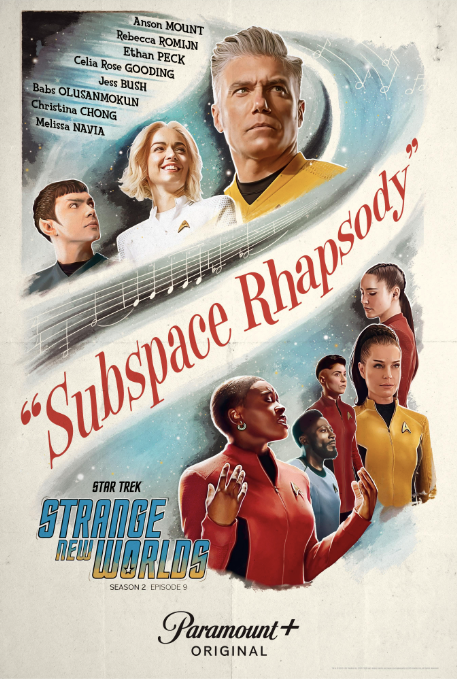
Star Trek: Strange New Worlds 2.9: The Operetta


Here's my one-line, non-spoiler review of Star Trek: Strange New Worlds 2.9, which was, literally, an operetta:  I liked a lot of it.

[Spoilers ahead ... ]

Here's more:

I thought the story was excellent, ingenious, and original: the Enterprise encounters some kind of force-field that has the effect of making the crew put into song their most personal thoughts.  The addition of the Klingons added more tension to the story, and their actual singing number was pretty good.

I'll get to the singing of our crew in a moment.  But sticking with the story, the resolution, of sorts, of the romantic attractions/relationships of La'an/James T. Kirk, and Chapel/Spock was powerful narrative, and fine writing and acting, but I would have rathered see both relationships go in a better direction.  In particular, James T. Kick didn't have to be already involved in a relationship with Carol, who is pregnant, and Chapel need not have seen her upcoming time away from the Enterprise as ending her relationship with Spock (though, I suppose, maybe it's possible that she doesn't).  As I've said before, I'm a hopeless romantic. And it seems that Strange New Worlds, encumbered by what we know of the future of these characters from the original Star Trek -- no relationship between Spock and Chapel, and James T. Kirk not being attached to Carol, La'an, or anyone -- had no choice but to put the brakes on these budding relationships on the Enterprise under Pike. Speaking of which, it was good to see his relationship still on track with Captain Marie Batel (Pike's future in the original series certainly doesn't preclude that at this point in his life). And it was great as always to see James T. Kirk on the Enterprise, in any case.

Now as to the songs.  I thought the singing and songs of Una, La'an, Spock, Chapel, and Uhura were top-notch -- not only in and of themselves, but working well in the story.  The rest were ok, but at least to my ears sounded at times like a parody of an operetta, whatever exactly that means.

I'm not the biggest fan of Gilbert & Sullivan, anyway, though I think The Who's Tommy is great, and I always regretted Paul McCartney saying no to the story he had asked Isaac Asimov to write for a musical McCartney had in mind. In Strange New Worlds 2.9, the brief Klingon performance had the best beat, and the songs of the Enterprise crew would have gone down better, in my never humble opinion, had they more in common with rock 'n' roll, rock, hip-hop, and rap, than well, Cole Porter, even though I think he was one of the best lyricists of all-time.

Speaking of Cole Porter, my friend Ken Hudson brought this to my attention: Uhura in the original Star Trek singing (privately to herself) a few lines from Porter's "Let's Do It, Let's Fall in Love" to, of all people, Spock, in an outtake from the "Who Mourns for Adonis" episode! We did see, in episode 2.9 of Strange New Worlds, Uhura looking romantically at Spock (he's seems totally unaware), and we've seen glimpses of this in earlier Strange New Worlds episodes. The outtake clip from the original series tells us that the makers of episode 2.9 of Strange New Worlds were likely inspired by this scene from the original series, and gives a nice unexpected meaning to the inclusion of Gene Roddenberry in the writing credits (though if Nichelle Nichols came up with this on her own, then she deserves a little of the writing credit for the Strange New Worlds operetta as well).

Anyway, on balance, I'm very glad I saw this episode of Strange New Worlds, and I'm looking forward to the season 2 final next week.  And hats off to all of the singing crew, who actually sang, and had fine voices!


more on the McCartney-Asimov musical that was never written, at
the end of this story .... "It's Real Life" ... an alternate history of
The Beatles ... read the story FREE here ... get the Kindle or paperback 
here... listen to the radio play FREE here ... winner of The Mary Shelley Award

Wednesday, June 14, 2023

Why the Final Beatles Record via AI Will Be Great, But Not So Revolutionary


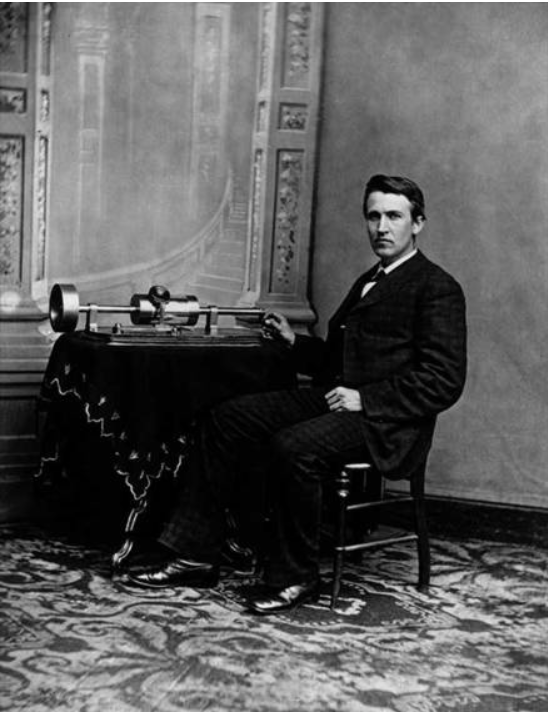
Edison and his first phonograph

Everybody's talking about Paul McCartney's comment in a BBC interview that AI was used in the creation of the "last" Beatles record, based on a demo John Lennon made in the 1970s, and already worked on by the surviving Beatles -- Paul, George, and Ringo -- in the 1990s, when The Beatles released two other Lennon demos they recrafted, "Real Love" and "Free As A Bird".   I'm really looking forward to this new record, to be released last this year, but I expect it won't be very much different in production and outcome than any other Beatles recordings released in the past few years, including the beautiful things Peter Jackson did to the Beatles recordings from their 1969 rooftop concert and a little before in Jackson's 2021 documentary, "The Beatles: Get Back."

Let's go back to the history of recording to understand why AI use in these recordings is not such a big deal.  If Frank Sinatra hit a bad note, or wanted to change anything in his studio recording of "That Old Black Magic," which would appear on his second studio album, released on Columbia Records in 1947, he would have needed to go back into the studio and record the whole song again.  By the 1960s, when The Beatles began recording, that already was not necessary.  Splices could easily be made in the recording tape, so the correct note could replace the off-key note, and by the end of the decade and the beginning of the 1970s even that was not necessary.  All splicing could be done electronically, and as the number of "tracks" that were used in a recording quickly expanded from 4 to 8 to 16 and more, doing harmony to your own voice became easy and commonplace.  None of that was called or even considered to be recordings made by AI.  The were recordings made by human beings, using ever more sophisticated technology,

By the 21st century and increasing in the past two decades, digital correction of flat notes via Autotune and production of harmonies without the singer needing to put down another track became ubiquitous in recording.  Even in the 1990s, producer Jeff Lynne did all kinds of electronic magic on Lennon's vocals to make them compatible with the new voices Paul and George were putting on "Real Love" and "Free As A Bird".  None of that was thought or said to be the least bit worrisome.  These developments were just more of the same tech advances which had been foreseen almost since the day Thomas Edison rolled out his first phonograph -- which recorded on tin foil -- back in 1877.  He'd intended that to be used as a recording device for the telephone (invented by Alexander Graham Bell a year earlier in 1876) and didn't foresee its mass adoption as a music recording player.  But the world soon did, and gave Edison the name of "The Wizard of Menlo Park" (New Jersey, where Edison invented the record player).

History is always worth consulting, and especially useful in putting new developments into perspective.  It may be exciting to be concerned about our increasing use of AI in so much that we do, but the Greek chorus of criticism that we hear about every new use of AI these days is misplaced. In reality, it's actually about things that AI does in science fiction, and is itself a kind of science fiction.

I'll sit back and listen to this new Beatles recording with no concern at all, and nothing but pleasure, grateful that Yoko sent cassette recording by John to Paul in the 1980s, and we now have the technology to make it sound fully alive.

It's Real Life

"It's Real Life" -- an alternate history about
The Beatles -- read it for FREE here


Monday, May 22, 2023

It's Real Life audiobook


 on Audible, Amazon, AppleSpotify, etc


My alternate history short story about The Beatles -- "It's Real Life" (which you can read for free here) -- has been made into a radio play, which you now obtain in an audiobook on AudibleAmazon, AppleSpotify, and all the usual places. Among the people and places you'll find in this 24-minute radio play, followed by an 18-minute interview with me: Pete Fornatale, Dennis Elsas, The Beatles, John Lennon, Paul McCartney, WFUV Radio, Barnes & Noble, with musical performances by The Bangles, Anne Reburn, and Spencer Hannabus. Enjoy! 

 "The radio play of 'It’s Real Life' is set on Paul Levinson’s home campus of Fordham University and has a fictional version of the legendary New York disk jockey, Pete Fornatale of WNEW-FM and WFUV (Fordham’s radio station), hurrying through the tunnels under the campus, which transports him to an alternate reality. Full of Beatles references and music, and the interview with Levinson at the conclusion of the play is rich with Fordham and musical history (and music) and is extremely well done — the whole package is highly recommended. Tune in and be transformed into your own alternate reality. --John F. McMullen, Poet Laureate, Town of Yorktown, NY

Wednesday, March 22, 2023

It's Real Life radio play


My alternate history short story about The Beatles -- "It's Real Life" (which you can read for free here) -- has been made into a radio play, which you can listen to for free, anytime here.  Among the people and places you'll find in this 24-minute radio play, followed by an 18-minute interview with me: Pete Fornatale, Dennis Elsas, The Beatles, John Lennon, Paul McCartney, WFUV Radio, Barnes & Noble, with musical performances by The Bangles, Anne Reburn, and Spencer Hannabus.  Enjoy!


"The radio play of 'It’s Real Life' is set on Paul Levinson’s home campus of Fordham University and has a fictional version of the legendary New York disk jockey, Pete Fornatale of WNEW-FM and WFUV (Fordham’s radio station), hurrying through the tunnels under the campus, which transports him to an alternate reality. Full of Beatles references and music, and the interview with Levinson at the conclusion of the play is rich with Fordham and musical history (and music) and is extremely well done — the whole package is highly recommended. Tune in and be transformed into your own alternate reality. --John F. McMullen, Poet Laureate, Town of Yorktown, NY

Monday, April 11, 2022

Review of a Review -- But, Hey, It's About The Beatles


I don't usually write reviews of reviews -- in fact, I'm pretty sure I never have -- but Joel McKinnon, whose views on science fiction, music, and the world at large I've found invariably worthy, strongly recommended that I read Ian Leslie's lengthy review of Peter Jackson's lengthy masterpiece The Beatles Get Back ("Knowing how much you loved Get Back I think you'll love this beautiful essay about it," Joel told me), so I did, and he was right.

In fact, from the very first line of Leslie's review -- "A friend of mine, a screenwriter in New York, believes Get Back has a catalytic effect on anyone who does creative work" -- I knew that Joel was right.  Because that's exactly what watching Jackson's eight-hour documentary did for me.  I'm always writing reviews, other nonfiction, science fiction, lyrics and music, whatever, but I've been on one thrill of a creative ride since I saw Get Back at the end of November (including writing an alternate reality story about The Beatles and WFUV Radio -- It's Real Life -- which has in turn sparked my writing all kinds of other linked stories).  And that's because Get Back is a paean to, as far I know, the greatest creative work of the words and music of songs in human history, and Leslie's review gets that, too.

Here are two other other points on which Leslie and I manifestly agree:

  • Leslie likes McCartney's "toothy, boyish, involuntary grin" which, he notes, even showed up after the British bobbies arrived on the roof.  As I noted in my review of Part 3 of The Beatles: Get Back, McCartney's response to the police on the roof was my favorite moment in the entire documentary, and there were a myriad of contenders (see the next point).
  • Leslie cites Ringo's "I would like to go up on the roof" as a pivotal moment in the true narrative that Jackson gives us.  In that same review of  Part 3, I mention that another favorite moment is Ringo making that statement.  I've been thinking on and off about that since the end of November, and I'd say that statement and its result of getting the Beatles up on the roof is sweet proof of the important role that Ringo had in the group, concomitant with his drumming.
Ok, here's a brilliant part of Leslie's review which I don't talk at all about:  Leslie approvingly paraphrases Rick Rubin's observation that "The Beatles are the single best argument for the existence of God".  I really like that -- not surprising, given that I thought Rubin's McCartney: 3,2,1 was a kind of masterpiece, too.

I could go on, but you surely get the picture.  If you love the Beatles, and loved Jackson's documentary, read Leslie's review.   It provides a really attractive fence around the magnificent garden of music that was and is The Beatles, and the astonishingly satisfying lighting that Jackson's movie has shone on it, and that's an insufficient metaphor.

But I'll end this review of a review with offering an answer to one of Leslie's minor questions:  He wonders what John meant when he says to Paul, “We’re altogether, boy".  Leslie also wonders if Paul knew.  I'd say John was referring to Paul's "All Together Now," recorded in 1967 and released in January 1969.  The timing is perfect and of course Paul knew.


Tuesday, March 15, 2022

Christine Feldman-Barrett interviewed by Paul Levinson about A Women's History of the Beatles


Welcome to Light On Light Through, Episode 262, in which I interview Dr. Christine Feldman-Barrett about her book, A Women's History of the Beatles.


Check out this episode!

Wednesday, January 12, 2022

"It's Real Life": New Alternate History Story, FREE

Here's a new story, started a while ago, finished the other day under the inspiration of Peter Jackson's splendid The Beatles: Gat Back movie.  Read it for FREE, any time: "It's Real Life" -- an alternate history tale about The Beatles.

Poets, musicians, and critics are saying ... 

  • "Just read this alternate history on the Beatles. Cool stuff. I want to check out those tunnels and find the reality where they never broke up." -- Joel McKinnon, Seldon Crisis
  • "'The question was, how could he get back to the world he knew?' By the power of creativity of course. This story reminded me of the short dark and a bit surreal stories of Edgar Allan Poe. I really enjoyed this story." -- Grzegorz Kwiatkowski, Trupa Trupa
  • "Clever and fun. Love the slide into alternity — with a deft little nod to Poe. The sense of New York comes through front and center. Love the Conrail detail. And is that a hat tip to TZ’s “Willoughby”? Why yes, I think it is." -- John McDaid
  • “Paul Levinson's fiction is always challenging, daring and imaginative. But this story…this ranks among his best. It thrills me in every way.” -- Mark Shanahan, A Sherlock Carol

And here's a video from two years and a half years ago, where I read the very beginning of "It's Real Life" at Readercon, a science fiction convention in Braintree, MA:


And if you'd like a very inexpensive copy of this story on Kindle:

It's Real Life


at 17 mins 4 seconds into this episode of Hot Media with Bob Mann, I reveal a lot about how I came to write "It's Real Life"


more of Fordham's tunnels in my science fiction

Saturday, November 27, 2021

The Beatles: Get Back, Part 3: Up On the Roof


If I had to pick the single best moments in the nearly nine hours of the superb, one-of-a-kind documentary that is Peter Jackson's The Beatles: Get Back, it would be Paul McCartney saying "whew!" smiling, doing a dance, and continuing the concert, after turning and taking note of the robotic cops  (or whatever they call them in London) intruding into the Beatles' rooftop performance.  The same cops on the ground floor had been threatening arrests and claiming they weren't making threats before they demanded to go up to the roof.  Good thing they don't carry guns like the police do here in America.

Widening the focus a bit, the whole rooftop concert was a splendid, high-octane tour-de-force, finally shown in Jackson's movie in its full extent, making the original film of the concert that we've been watching all these years seem two-dimensional in comparison.  That original movie has flashes of the energy of that rooftop performance, which takes full and gorgeous expression in Jackson's documentary. 

It may have been the Beatles' finest moment.  "I've Got a Feeling," which I always really liked, is now in my top handful of all-time favorite Beatle songs -- the energy in McCartney's voice, the oh-yeahs, the nos, Lennon's bit, the instrumentation, is all just extraordinary. 

It certainly was their final moment in a public performance.  Some of the earlier part of Part 3 tells us why:

  • Paul says to George Martin -- with Paul not sure that going on the roof the next day was the best thing, John saying it was, and George Martin saying they had to respect deadlines -- "that's why I'm talking to John not you".
  • A little later, Paul's still not sure about the roof, George Harrison says he'd rather not do it, and Ringo declares they should do the roof concert.  Ringo's opinion carries the day.  But Paul is quietly a little dismayed with Ringo's opinion, or maybe that he has to put up with it.
  • George tells John he wants to do an album of just his own songs, to see "what they all sound like together".  George winds up doing none of his songs on that roof.
But there are many beautiful moments to be treasured in the footage before the concert:

  • George Harrison comes over to Ringo to help him write his song "Octopus's Garden".  It's a wonderful, redeeming moment.
  • And then George Martin gets interested in the song.  Soon we see John on drums on the song.  In previous parts, we saw Paul and George on Ringo's drums.  In an interview conducted much more recently, Ringo lamented that every time he stepped out for a cup of tea, he'd return to find someone else in The Beatles on his drums.  But it's all endearing,
  • Great jamming with Linda's daughter Heather in the studio, and it's great to see how each of The Beatles relate to her.
  • Paul really groovin' and enjoying working on one of George's songs.
  • George Harrison telling John he took John's advice, given some ten years earlier, that when you start writing a song, you should stay up and finish it.
So there was lots of love and good energy between the Beatles, even with all the problems, and the rooftop concert was magnificent.  So why didn't they stay together?  There's clearly even more to the story than Peter Jackson showed us in his documentary.  But watching it changed my perspective on The Beatles forever, largely for the better, and I'll be forever grateful Peter Jackson made it.


And here's "It's Real Life" -- free alternate history short story about The Beatles, made into a radio play and audiobook and winner of The Mary Shelley Award 2023


Friday, November 26, 2021

The Beatles: Get Back, Part 2: Back from the Threshold


A very different kind of feeling and (true) story in Part 2 of Peter Jackson's The Beatles: Get Back documentary.  Up from the doldrums, George Harrison is back, Billy Preston joins them, and the sound and the ambience is often heady and exhilarating.

It's almost as if Twickenham, where the first part of the month of January 1969, and therefore the first part of Jackson's movie, took place, was infected by some kind of mold that put everyone on edge and made them depressed.  In the new Apple Studios, the Beatles are transformed.

Billy Preston, who joins them, is justly given at least some of the credit by the Beatles themselves.  But the four were also getting along together much better, and beginning to gel, even before Preston arrived.  Lennon blossoms with  "I Dig a Pony" and in fact every song written by him or McCartney or Harrison that he sings and plays.   Preston does add his inimitable smile and just-right keyboard.  Harrison takes an active role in arranging McCartney's "Get Back".  The performances are punctuated not by complaining but joking, mostly Lennon's, with McCartney more than willing to jump in, and Harrison appreciatively laughing.  Ringo is always in a good mood, except when he's sleeping.

All of this feels for all the world like this just happened, that what we're seeing on the screen took place just last week.  This has to be a testament to Peter Jackson and all the people and the magic he and they brought to this documentary.  It felt like a time portal, to a place where all the Beatles were alive and young.

But all's not completely well.  The disagreements that nearly tore the group apart at Twickenham are not gone, merely receded.  Early in the episode, back at Twickenham, Paul and John have an on-camera conversation.  Paul wants more planning, more organization, in their work.  John responds with lines from Beatles songs, clever in themselves, sarcastic in this context.  (To some extent, I've always thought that bands are bound to fall apart, because they violate the very egos that make the band members join the band in the first place.) Near the end of this episode, we find McCartney once again discontented.  It's not about how George isn't getting it right.  It's McCartney's wish to end this now productive time for the Beatles not with just another album, but some kind of memorable event .

The people working for and supporting and often thinking for the Beatles come up with a solution: a rooftop performance on top of their Apple Studios.   But this brings us to the door of Part 3, which I'll watch and review right here tomorrow.


And here's "It's Real Life" -- free alternate history short story about The Beatles, made into a radio play and audiobook and winner of The Mary Shelley Award 2023

See also The Beatles, Part 1: Soul Touching Anecdotes and The Beatles: Get Back, Part 3: Up on the Roof ...  my review of Rob Sheffield's Dreaming the Beatles and A Vote for McCartney (my very first published article, in The Village Voice, 1971)


The Beatles: Get Back, Part 1: Soul Touching Anecdotes


I started watching Get Back with the absolute knowledge that The Beatles were and are one of the best things in my life, and easily THE best thing musically.   For the past few years, I've listened to them about as much as to MSNBC on Sirius XM radio, which is to say, any and all the time I'm in the car driving by myself (see The Omnipotent Ear).  Their arrival in the United States in 1964 coincided with my first serious girlfriend, Barbara (we met when she came to hear my doo-wop group sing at a Y on the Grand Concourse in the Bronx).  By January 1969, the time we see the Beatles in the studio in Peter Jackson's The Beatles: Get Back, I was with Tina, who became my wife.  We're still happily married, with wonderful children and grandchildren.

So The Beatles in general, and Peter Jackson's documentary, are that central and important to my life.  Masterpiece is not quite the right word for it, because experiencing the first part of this movie was more than that, deeply personal.  But I will say that this documentary -- or, at this point, Part 1-- is brilliantly made.  The rapid history of how The Beatles got to 1969, with words on the screen in an almost silent movie kind of style, worked perfectly.  The two hours thirty something minutes flew by.  Here are some moments that especially impressed, even touched my soul:

  • George compliments Paul on his beard.  This happens at the beginning of the movie -- that is, early on in the first seven days which are the timeline of Part 1.  That's about the happiest interaction between Paul and George in this part of the movie, which is surprising, given that the movie has been billed as spotlighting the joy which was cut of out everything we saw and heard back in 1969 about The Beatles. But Paul is quietly relentless in his disparagement of George, ranging from his well-known plea to George to keep it "simple," to complaining that he can't hear himself sing with George playing, to just the expressions on Paul's face.  None of George's songs at this point in the movie are taken very seriously, with the partial exception of  "All Things Must Pass," which didn't make it into The Beatles' new album, anyway. In a word, though I'll always be a champion of Paul and his extraordinary talent, Jackson's movie makes me think that George had every right to be angry.
  • John suggests changing "wind" to "mind" in George's "All Things Must Pass" ("a mind can blow the clouds away").   By 1969, Lennon's leadership of the band had clearly given way to Paul's.  But his incisive, sparkling mind was as sharp as ever.  It looks in the movie like he's looking at the lyric sheet, when he says something along the lines of "mind" being almost the same word as "wind".  Marshall McLuhan would've loved the visual/acoustic written/verbal interplay.
  • "Get Back" (the song) semi-seriously considered to be and developed into a protest song.  There was a wave of fascistic anti-immigration fervor in England in 1968-1969 -- something we know all too well via Trump here in the United States in the past few years -- and Paul and John toy with pitching the song as a satire critique of what the right wing was calling on the Pakistanis who came to England to do.
  • Ringo, watching and hearing Paul play the piano, says he could listen to that all day.  One of sweetest, most heartwarming moments of the movie.
  • Yoko and Linda talking and laughing.  Shatters some of myths of Yoko and The Beatles, and also heartwarming.
  • The joy on Mal Evan's face every time he plays the hammer in "Maxwell's Silver Hammer" -- he's just thrilled to actually play even this smart part in a Beatles' performance. I can understand how he feels, completely.
  • The sheer abundance of Paul's contribution is just incandescent magnificent:  In addition to "Silver Hammer" and "Get Back," we get clips of "Let It Be," "Long and Winding Road," "Two of Us," even "Another Day" (which, like George's "All Things Must Pass," never made it to The Beatles album we see under preparation).

Back to George:  As I said, I don't blame him for being hurt and angry.  I can't quite say the same about his leaving The Beatles, which closes out Part 1 of this life-changing documentary. But, all right -- I'm going to post this, then do a podcast about it, then watch Part 2 of this movie, and I'll be back again.

And here's the podcast:


And here's "It's Real Life" -- free alternate history short story about The Beatles, made into a radio play and audiobook and winner of The Mary Shelley Award 2023 ... and expanded into a novel

See also The Beatles: Get Back, Part 2: Back from the Threshold and The Beatles: Get Back, Part 3: Up On the Roof and  my review of Rob Sheffield's Dreaming the Beatles and A Vote for McCartney (my very first published article, in The Village Voice, 1971)


here is one of the songs I sang with my doo-wop group, The Transits, in early 1964

Tuesday, July 20, 2021

McCartney 3, 2, 1: Guide to Eternity


The first thing I want to tell you about McCartney 3, 2, 1 -- Rick Rubin's incandescent black-and-white three-hour six-episode interview with McCartney on Hulu -- is that in addition to being mind blowing and musically joyful, it made me very sad.

Not just because John and George should by all rights still be with us.  But because Paul says at some point that since the Beatles are finished, their work now complete, he's become a fan of the Beatles, and much better able to appreciate their music which includes his songs, his voice, his bass, his ideas for arrangements, and much more.

And I don't want the Beatles to be finished.  I want them to go on forever making that uniquely wonderful and always evolving music.  And though I know that's impossible, I don't care.  The pleasure that the Beatles brought to me and so many millions and millions of people was and is magical.  Including "Free As A Bird" and "It's Real Love," recorded after Lennon was gone, and which weren't in this documentary and I missed.  But if magic is involved, anything is possible, isn't it?

The conversation, though, was one for the ages, and my guess is it will be watched and listened to and carefully analyzed for thousands of years.  A lot of it I already knew, like how McCartney arrived at Lennon's house with an essentially complete "Here, There, and Everywhere," which may be McCartney's favorite Beatles song.  And a lot of it I didn't, like how Lennon really liked "Here, There, and Everywhere," and how pleased McCartney was when Lennon told him so.

Just hearing the tracks of the songs that Rubin played and played with, as a beckoning of McCartney's remembrances and explanations, were of deepest pleasure to the ear, the heart, and soul.  As some of you may know, ever since The Village Voice published my "A Vote for McCartney" in 1971 -- my defense of McCartney's solo albums, after he left the Beatles, in the face of the Voice's dyspeptic critic Robert Christgau's attack -- McCartney has managed to be more to me than a member of the Beatles.  That essay, after all, was my first published article.  But seeing McCartney 3, 2, 1 brings home just how much this genius contributed to the Beatles, and how he strove to do that.   I used to tell people in the 1970s that I thought the Beatles' music would live as long as Shakespeare's plays.  I'd add now that Rubin's movie will be an important accompaniment to that body of music, more magnificent than ever.


InfiniteRegress.tv