
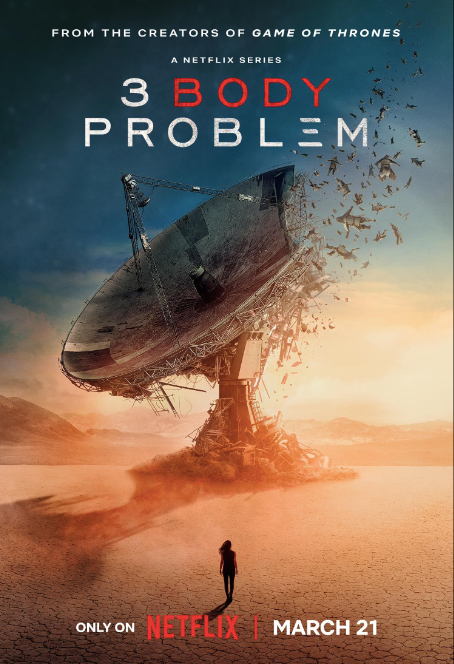
I haven't read the novel by Liu Cixin and its sequels, and I didn't read much about the series because I wanted to be surprised. I'd say the first season of 3 Body Problem was superb -- a powerful mix of thought-provoking, stunning action, and heartbreaking human stories, all in support of a story of a life-threatening interstellar intelligent species, the San-Ti, who have been in contact with our planet for more than 50 years and now are approaching us, some 400 years away from arriving, which may mean the end of our species. And there was a wise and funny joke about Einstein and God which I hadn't heard before.
But almost all of that happened in the last few episodes, and the beginning and middle of the eight-episode first season was bogged down with a computer game the interstellar beings are doling out to various people on Earth for various reasons. I've always enjoyed science fiction about computer games interacting with reality, beginning with Orson Scott Card's path-breaking and brainy Ender's Game, but its situation in 3 Body Problem was needlessly repetitive. The heart of 3 Body was closer to Arthur C. Clarke's Childhood's End and Damon Knight's "To Serve Man" (see this collection of Knight's stories), and the first season of the 3 Body television series, whatever may have been done in the novel, should have spent more time on that. (This slow start is reminiscent of another iconic novel in science fiction, Frank Herbert's Dune, that also took a long time to get going, but once it did was fabulous, and led to not just a trilogy but a whole series, exceeded in excellence only by Isaac Asimov's Foundation novels, in my opinion.)
But speaking of hearts and brains, biology was actually far more the star of the first season than was space travel. This puts 3 Body Problem in a league with Andrew Niccol's debut motion picture Gattaca. If I'm making 3 Body sound derivative, that's because it is, but that's ok, because the first season puts all of these perennial elements of science fiction together in an original, compelling way. It's not every day you see a science fiction series starting in Mao's China and its emphasis on ideology over truth (a problem unfortunately arising now in the United States and other parts of the world, off the fiction screen and for real), moving into a life-and-death James Bondian present fighting for the survival in the future of our very species.
Ironically, the unflattering depiction of intellectual life in Mao's China at the beginning of the 3 Body Problem television series contradicts the warning that five Republican US Senators sent to Netflix in 2020 that the TV series would just be spreading Chinese propaganda. Of course, those Senators and no one other than the creators of the TV series had any idea what would actually be depicted in the TV series, and thus those Senators based their concerns on the novel. The original Chinese publication of the novel indeed did not begin with the jolting scene of a physicist brutally killed in the throes of the cultural revolution -- because he believes in truth over ideology -- but that scene did appear in the middle of the original Chinese novel, and at the beginning of the English translation (Liu Cixin confirms that he wrote the novel with that scene at the beginning). Apparently those US Senators didn't take the time to read the novel before offering their ill-founded concerns about the TV series.
In any case, I don't recall seeing anything quite like this TV series at all, and I'm eagerly awaiting the second season and more. The dialog, by the way, was excellent, as was the acting. Nearly everyone was new to me, other than Game of Thrones' Liam Cunningham, and it was good to see him on the screen again. Kudos to David Benioff, D.B. Weiss, and Alexander Woo for creating the series, and kudos to me for not having to warn you about spoilers in this review, because they really aren't any, are there?


 Human Is, the third standalone episode in Philip K. Dick's Electric Dreams 10-episode anthology now streaming on Amazon Prime, and which I'm reviewing one episode at at a time (see my
