Chuck Todd interviews me about alternate histories
Showing posts with label Three Laws Lethal. Show all posts

Tuesday, June 11, 2019

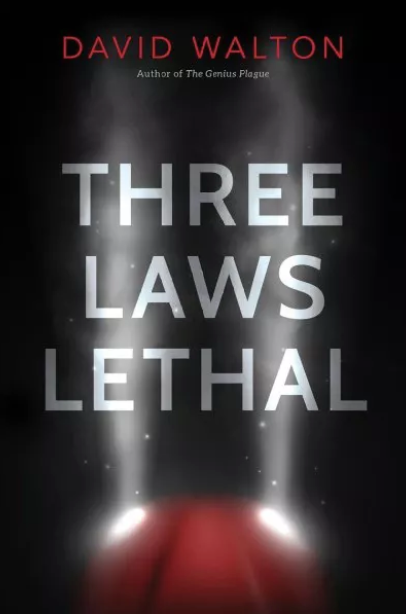
Review of David Walton's Three Laws Lethal: A Few Minutes and Decades Into the Future


David Walton's newest novel, Three Laws Lethal - title inspired by Isaac Asimov's three laws of robotics - begins with what certainly is an ethical quandary that typifies our increasingly AI-driven age, in this case, driven literally.  A mother with her children are passengers in an AI-driven automobile.  She can turn around and tell them to stop arguing, without risking an accident.  She marvels at being in the driver's seat with her hands off the wheel.  And then ...  A big tree falls in front of them.  To plow into the tree would risk the death of both mother and children.  The AI computes the deadly odds, and acts upon it, instantly swerving the car to the right to avoid the tree.  Unfortunately, there's a biker in that lane, and he's killed by the swerving car.

It's not that the AI didn't see the biker - the problem is that it did, and decided the mother and children's lives were more worth saving than the biker's.  Now, people driving in our reality make split-second decisions like this all the time.  They're maybe not quite decisions but instant gut reactions.  Would anyone for a moment think of charging a mother with vehicular homicide if she did what the AI did in the car?  Of course not.   But there's something deeply disturbing about an AI making this decision, any decision, that results in the loss of innocent human life.

This is the problem that opens David Walton's novel, just published by Pyr today.  It's a narrative that is as philosophically profound as it is breathtaking.   Asimov imagined/foresaw that all robots could and would be programmed with three laws:  1. A robot can never do harm, or allow harm to be done, to a human being.  2. A robot must follow all orders given to it by a human, except when following such an order would contradict the first law, i.e., harm or allow harm to be befall a human.  3. A robot must always act to protect itself, except when that would contradict the first or second law.  Asimov wrote great novels and stories that explored what could happen when these laws were bent or broken.  In that sense Three Laws Lethal is an extrapolation of Asimov, a meditation on how an AI programmed to protect human lives can end up taking a life - a life that threatens no one, but whose existence nonetheless must be ended to protect the people the AI serves.  The novel is also Asimovian in the sense that it is an un-put-downable read.

Exploration of driverless cars makes Three Laws Lethal not a story happening the day after tomorrow, as they used to say back in the 1950s, but maybe more like a few minutes from now.  An Uber driverless car already killed a woman in Tempe, Arizona in 2018.  This apparently was more a malfunction than a deliberate decision of the car to kill the woman (a pedestrian walking her bicycle in the street), so it didn't raise the kind of wrenching ethical dilemmas posed by Walton.   But Walton also explores, with the same panache and savvy, the corporate competition and intrigue that has characterized the digital revolution since it began in the 1980s.  In this case, we go from intrigue to outright assassinations, and self-driving cars to fleets that can work as an attack force.  Malignant AIs reminiscent of HAL (an Arthur C. Clarke not Asimov creation) also figure in this story, pitching it at least a few years and maybe decades into the future. 

All of this is played out by a memorable cast of characters all along the continuum of fundamental human decency, which at the bad end includes a willingness to do the aforementioned  murders to get desired results.   In as much Asimov's robot stories were also detective stories, this makes Three Laws Lethal an Asimovian story in yet a third, appealing sense.

Although Asimov defined the genre of sentient robots and therefore AIs, the other two titans of the golden age of science made important contributions to this crucial sub-genre.  In addition to Clarke's homicidal HAL, Robert Heinlein's self-sacrificing Mike has a permanent place in the AI pantheon.  No one can duplicate those achievements, but it's good to see that David Walton is carrying forward that tradition so well as we move to ever more AI in our cars and lives in the 21st century.


Sunday, June 9, 2019

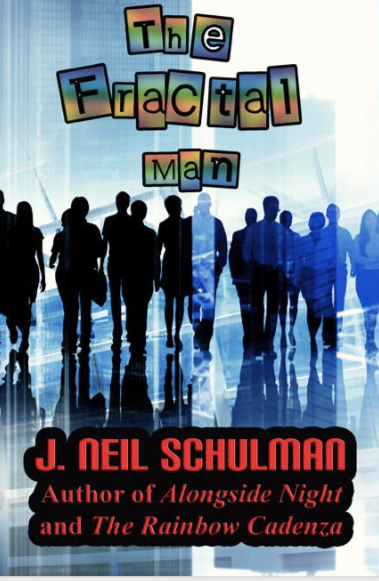
Review of J. Neil Schulman's The Fractal Man: Alternate Reality Autobiographies


Alternate realities have become something of a vogue in science fiction, especially on television with Fringe and Counterpart.  I've even tried my hand at it in a few short stories such as The Other Car.  But J. Neil Schulman has outdone all of this with his novel The Fractal Man, which for most of its 160 some odd pages - meant literally as well as a figure of speech here - is not only a masterpiece of alternate reality, but one of the best science fiction novels I've ever read, literally.

It's also a tour de force of meta-fiction and autobiography.  What do I mean by that?  Well, the main character - the narrator - is David Albaugh, a character in Schulman's 1979 novel Alongside Night, played by Schulman in the 2014 movie that Schulman wrote and directed.  In The Fractal Man, we meet Schulman - one of Albaugh's fractals, i.e., existences in an alternate reality - to the point of the character Schulman warning Albaugh about a danger that lies ahead, because, after all, Schulman wrote Albaugh's account of Albaugh's  alternate reality adventures which is the novel The Fractal Man.   I'd say I'm a sucker for that kind of science fiction, but if a I'm a sucker for delighting in that, then anyone with any appreciation for the finer tropes of science fiction, carried to their logical extents and well beyond, should be a sucker, too.

And the novel is chocked full of tidbits to delight the science fiction devotee and anyone with a taste for new ways of thinking about old things.   Distant galaxies that we see in our reality may be alternate timelines.   Arguments that a couple may have over whether an event unfolded this way or that way may reflect an alternate reality that one of the couple for some reason came from or has access to.   Everything from timeless music to time travel is woven into the undulating fabric.  It's all served up so well that I don't even mind that Schulman and most of his alternates are thorough-going libertarians, in contrast to me (I'm an absolutist only about the government keeping its hands off of all media and communication, i.e., the First Amendment). 

Schulman sprinkles in some of his real libertarian friends as greater and lesser characters in this novel.   We know each other and have worked together, but I can't hold it too much against him that I didn't make the grade, because I'm not a close friend of his, and, as I said, I'm not an across-the-board libertarian.   And he makes up for this with some derring-do espionage escapades across realities, and a galactic scope that reminds of both Asimov and Heinlein, which is no mean feat  (Schulman, at least in this reality, did an important interview with Heinlein in 1973).

What I do hold against the novel is a long play within the novel, near the end, that has lots of relevance to the novel's philosophy and was excellent in and of itself, but comes out of left field, so much so that the reader is offered the option of skipping ahead.  This doesn't exonerate the play's inclusion.

But, hey, the rest of the novel is so bright and wonderful - such an intellectually exciting and satisfying ride - that I put it up there with David S. Michaels and Daniel Brenton's Red Moon and David Walton's Three Laws Lethal (to be published in two days, look for my review) as one of the best standalone science fiction novels I've ever had the pleasure of reading.   Is it a contradiction to describe The Fractal Man and its immersion in alternate realities as a standalone novel?  There's a sequel afoot - "The Metronome Misnomer - the title comes from a fractal version of the author in The Fractal Man, who wrote a book of that title in an alternate timeline" (this quote from Schulman's biography at the end of The Fractal Man) - so you may not need to answer that.


more alternate reality - "flat-out fantastic" - Scifi and Scary
InfiniteRegress.tv