Chuck Todd interviews me about alternate histories
Showing posts with label Jeff Bezos. Show all posts

Saturday, June 18, 2022

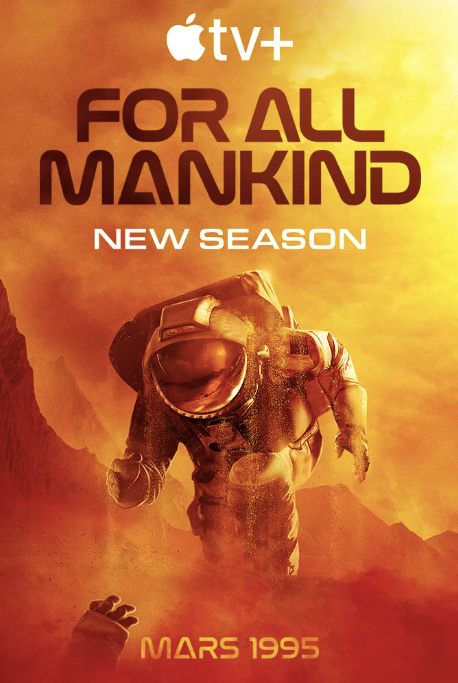
For All Mankind 3.2: Dmail


My favorite alternate history detail in For All Mankind 3.2 on Apple TV+ yesterday is "dmail" -- that's the name in 1992 for what we call email in our world.  I guess "d" comes from digital -- digital mail, just as the "e" in ours comes from electronic mail.  I like details like that.

[Now for some bigger spoilers... ]

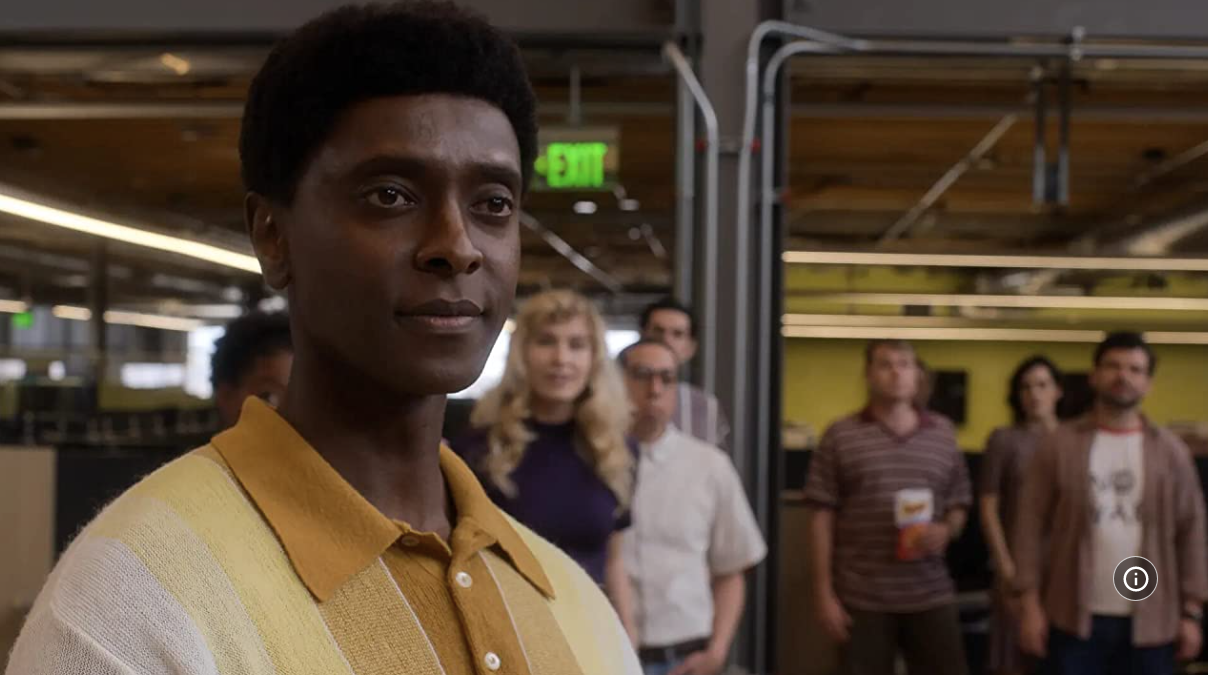
I had a feeling as soon Marge fired Molly and removed Ed from the Mars mission that he would wind up on what Dev was doing.  He's a great character.  An Elon Musk, Jeff Bezos, or Richard Branson mega-rich titan with the cosmic visionary quality of Steve Jobs.  And he's played by Edi Gathegi, who was just iconic in StartUp.

And I like the way Ed got there.  I said in my review of last week's 3.1 that I thought Sam's death was good for the narrative, freeing up Karen to maybe get back with Ed and who knows else.  In 3.2, we learn that Ed has split with his wife (good), and Karen and Ed are indeed much closer.  But, most importantly, she pitches Ed as the leader of Dev's mission (pitch is his apt word), he takes a vote of his people in the room (his company is at least this far a democracy), and Ed is commanding the mission.

This sets up a heated rivalry between Ed (Helios) and Danielle (whom Marge has chosen to lead the first Mars mission for NASA) and who knows who the Soviets might send up there.  And to up the ante, and increase the pressure, Dev is moving up the date of the mission.

It's an easy prediction that Ed and Danielle will be on Mars at the same time, and one will likely save the other.  But that's getting ahead of the story, and I'll see you back here next week with my review of 3.3.


See also For All Mankind 3.1: The Alternate Reality Progresses

And see also For All Mankind, Season 1 and Episode 2.1: Alternate Space Race Reality ... For All Mankind 2.2: The Peanut Butter Sandwich ... For All Mankind 2.3: "Guns to the Moon" ... For All Mankind 2.4: Close to Reality ... For All Mankind 2.5: Johnny and the Wrath of Kahn ... For All Mankind 2.6: Couplings ... For All Mankind 2.7: Alternate History Surges ... For All Mankind 2.8: Really Lost in Translation ... For All Mankind 2.9: Relationships ... For All Mankind 2.10: Definitely Not the End

It's Real Life

get the paperback or Kindle here

or read the story FREE here


*** Note added 27 October 2023:  Check out my review of Jack Dann's new book, The Fiction Writer's Guide to Alternate History

Wednesday, October 20, 2021

Call for Essays and Science Fiction Stories for Volume 2 of Touching the Face of the Cosmos


It’s been almost six years since we brought out Touching the Face of the Cosmos: On the Intersection of Space Travel and Religion, an anthology of essays and science fiction stories, assembled with the purpose of jumpstarting the human movement into space by connecting it to the sense of wonder, the need to know what we are doing here in the universe, that is the basis of religions and spiritual thinking.


Since 2015 and especially recently space exploration has gained momentum:, Richard Branson, Jeff Bezos, and William Shatner have gone very briefly into space. Elon Musk has sent a ship with people into orbit for three days. The United States has sent robots to Mars, and the Chinese have put a crew in Earth orbit for months.

But we as species have not lifted off this planet in the way that many foresaw when people first walked on the Moon in 1969. We are still in need of a more robust connection to that spiritual sense of wonder to lift us beyond our home planet.

We therefore think the time is right for a second volume of Touching the Face of the Cosmos. As with the first volume, we are looking for both essays and science fiction stories, 500 (five hundred) to 7000 (seven thousand) words in length (but query us if you have something that you think would be perfect for the anthology, but is shorter or longer). We would like original essays and stories, but will consider a very limited number of already-published science fiction stories.

-- Paul Levinson and Michael Waltemathe

Deadline for receipt of submissions is 1 February 2022.

Please send to:

Levinson@Fordham.edu 
and michael.waltemathe@rub.de

Sunday, October 17, 2021

Looking Back at “The Missing Orientation”: One Year Later


Abstract: Space tourism has received four literal liftoffs in the past year, and science fiction about space travel is flourishing, with new Star Trek seasons and Isaac Asimov’s Foundation series streaming this Fall. All of these both kindle and express our sense of wonder, but the pathways to space are still expensive and dangerous, and they need to be connected to the taproots of our sense of wonder In religion and science fiction, so those pathways stay open and strong.

Key words: space tourism, science fiction, religion, sense of wonder, Star Trek, Foundation, Richard Branson, Jeff Bezos, Elon Musk, Joe Biden, William Shatner

======

It’s been nearly a year since I wrote “The Missing Orientation” (Levinson, 2021), and its call for enlisting our religious or spiritual sense of wonder about our place in the universe in our continuing efforts to expand our existence off this planet and out into space.

Billionaires Richard Branson (Chang, 2021) and Jeff Bezos (Rincon, 2021) touched space in July, albeit briefly, kissing the cosmos in their spaceships and laying the equivalent of groundwork for tourism off this planet. William Shatner aka Star Trek’s Captain Kirk him went up to space in Jeff Bezos’s Blue Origin in October (Pereira, 2021; Roulette, 2021). And Elon Musk’s Space X literally brought four civilian tourists into space for three days in September (Duffy, 2021). But Branson’s Virgin Galactic apparently had a problematic re-entry (Wattles, 2021), showing how dangerous space flight still is, and seats on the Space X’s Inspiration 4 are estimated as costing some $50 million per seat, putting that flight beyond the reach of most tourists (Kelvey, 2021).

Meanwhile, the sense of wonder intrinsic in science fiction has been firing on all cylinders. Paramount+ will be streaming new seasons of Star Trek: Discovery and Picard in the months ahead, and Isaac Asimov’s Foundation series at long last found expression on the screen when Apple TV+ began streaming Foundation in September. As I mentioned in “The Missing Orientation,” it was the original Star Trek series in the 1960s that ignited my interest in space travel, and the Foundation trilogy got me thinking about humanity in galactic terms when I was a boy in the 1950s.

Star Trek always emphasized the inherently international nature of space travel and exploration. In 2021 and the years ahead, China is promising a robust space program (SCMP Editorial, 2021). And U. S. President Joe Biden’s 2022 budget request for NASA is the “2nd-best budget proposal for the space agency in 25 years,” supporting projects on the Moon, Mars, and Jupiter’s moon Europa (Dreier, 2021).

But, as the vacuum in the American space program for decades after humans walked on the Moon in 1969 and a few years after so vividly shows, budgeting for space exploration, especially in democracies, is unreliable. And space tourism needs to drastically lower its price before it becomes a part of our lives. Tourism is rooted in our sense of wonder, and as long as that sense remains strong, and connected to space via the ancient and more modern channels of religion and science fiction, our path to space will remain open and expand.

References

Chang, Kenneth (2021) “A Ride to Space on Virgin Galactic? That’ll Be $450,000, Please,” The New York Times, 5 August https://www.nytimes.com/2021/08/05/science/virgin-galactic-ticket-price.html

Dreier, Casey (2021) “Biden's 2022 NASA Budget Says Yes to Pretty Much Everything,” The Planetary Society, 4 June https://www.planetary.org/articles/nasas-fy2022-pbr-analysis

Duffy, Kate (2021) “SpaceX's all-civilian crew chatted with Elon Musk and shared photos of Earth from the spaceship's glass-dome bathroom on their first full day in space,” Insider, 17 September. https://www.businessinsider.com/spacex-civilian-inspiration4-elon-musk-spaceship-shared-photos-earth-2021-9

Kelvey, Jon (2021) “Inspiration4: How Much Does a Ticket to Space Cost?” 16 September. Inverse. https://www.inverse.com/science/inspiration-4-how-much-is-a-ticket-to-space

Levinson, Paul (2021) “The Missing Orientation,” Religions. 2021;12(1):16. https://www.mdpi.com/2077-1444/12/1/16/htm

Pereira, Ivan (2021) “How William Shatner's Blue Origin space trip can reignite passion for science,” ABC News, 12 October. https://abcnews.go.com/Entertainment/william-shatners-blue-origin-space-trip-reignite-passion/story?id=80404356

Rincon, Paul (2021) “Jeff Bezos launches to space aboard New Shepard rocket ship,” BBC News, 20 July https://www.bbc.com/news/science-environment-57849364

Roulette, Joey (2021) “In a Blue Origin Rocket, William Shatner Finally Goes to Space,” The New York Times, 13 October. https://www.nytimes.com/2021/10/13/science/william-shatner-space-blue-origin.html

SCMP Editorial (2021) “The sky is the limit for the emerging Chinese space industry,” South China Morning Post, 24 July https://www.scmp.com/comment/opinion/article/3142412/sky-limit-emerging-chinese-space-industry

Wattles, Jackie (2021) “FAA grounds Virgin Galactic, says it's investigating problems with Richard Branson's flight to edge of space,” CNN Business, 2 September. https://www.cnn.com/2021/09/02/tech/richard-branson-virgin-galactic-space-danger-scn

Tuesday, September 8, 2020

Review of Tobias Cabral's New Eyes: Newer Worlds

Tobias Cabral picked a good time to send me his 2018 novel New Eyes for review.   Mars is in the air.  Actually, it's always been in the air, or at least, at the top of the air, in the sky.  But NASA's Perseverance is on its way to Mars, with a landing date in February of next year.  Elon Musk wants to colonize the Red Planet (I'm 100% on board, here's a talk I gave at the 19th Annual International Mars Society Convention at The Catholic University in Washington, DC on 23 September 2016):

And I just saw, loved, and reviewed the first season of Away on Netflix.

Cabral's novel starts in February 2047.  Trips to Mars take just four days.  There's a space station named "Jeff Bezos," a ship named the "Elon Musk," and androids are "equipped with ‘minds’ that could not just pass but proctor the Turing Test" (italic and quotes around 'minds' in the novel).  And, at least one is capable of murder.  With the result that New Eyes is just as much in the tradition of Westworld and the new Raised by Wolves (see my reviews) as it is a descendant of The Martian Chronicles and The Martian.

But as the title suggests, the fulcrum of this narrative are eyes, in particular Gaspar's "Martian eyes".  The character's a "bio-cyberneticist," women desire his body, and his new eyes in effect make him a human on the way to becoming an android, in the time-honored Six Million Dollar Man way.

The novel also has resonance to the work of Orson Scott Card (sims play an important role, as in, you often can't tell what's really really real) and, to my eyes, at least, the novel reads a lot like Isaac Asimov (a big compliment in my book).   But as to the plot, well, Mars is "a mostly-unpopulated planet" at this point,  and this "young Martian society" is populated by humans and increasingly by androids.  Could this actually happen by 2047?  Probably not (more because of the androids than living on Mars).  But my late editor at Tor, David Hartwell, always told me that readers are willing to grant you at least one big part of a story they find unbelievable, and I'm happy to grant Cabral that.   I should also mention that Cabral throws in a bit more repartee humor than does Asimov -- someone comments that someone has a "nice assonance... that sounded naughty" -- and there's even some rapping in this story.

But that still doesn't tell you much about the nuts and bolts of the plot, does it?   You'll need to set your eyes on the novel to find that out.  Ok, I'm in a good mood.  Here's a quote from the novel: - think "alternate branches in a Many Worlds Hypothesis time travel story".  And enjoy.


first starship to Alpha Centauri leaves from Mars Vestibule ...


Saturday, August 15, 2020

Blog Post: Defending the Postal Service

It seems strange to have to write in defense of the U. S. Postal Service, but it's a measure of the depravity of the man in the White House, and how far he's willing to go in his flailing attempt to win another term in office.  Removing sorting machines, removing mailboxes, doing whatever he can to gum up the works of  a service that everyone loves and has never been more essential in this our age of the COVID-19 pandemic and the upcoming Presidential election.   An election which could well determine the fate and future of democracy in this country.  An election which the person now in office will do anything to win,

It didn't start with COVID-19 and this build-up to the election.  Trump's hatred of Jeff Bezos, who created Amazon, became a billionaire, and bought The Washington Post, one of Trump's most effective critics, led him as early as 2018 to attack the Post Office,  Its crime?  It gave Amazon a good, special rate, a smart move both for Amazon and the Postal Service.

Trump's pretext back then in 2018 was that giving Amazon such a good special rate was bad business for the Postal Service.  But like Amtrak which is also often starving for funds, the Postal Service isn't and was never intended to be a profit-making business.  It is a governmental service provided to the people.  And in the case of the Postal Service, it is a service provided for in our Constitution.

But Trump now has a better reason to starve the Postal Service.  He wants to eliminate mail-in ballots, especially necessary in these COVID times, because he thinks (and polls say) that they will be used by Democratic more than Republican voters. (If we want to entertain a maybe only slightly paranoid explanation, perhaps Trump wants to handcuff the Postal Service because the Russians have told him they haven't come up with a way to hack votes cast through the mail). But whatever his reasoning, crippling the Postal Service is one of the things Trump is doing to win an election which current polls show him badly losing. Attacking the media, lying so often that keeping count is a bad joke, are no longer enough.  The fascistic impulse dictates an escalation of tactics.  Dampen, crush the democratic expression by physical means.  Send Federal troops or whatever exactly are into the streets.  Get in the way of people exercising their right to vote.

There are things we the people can do to oppose this.  Shine a light on it.  Pressure our state governments to provide alternate, safe means of casting ballots, like collection boxes.  But also support our Postal Service in whatever ways we can.   They are not only the carriers of our mail, of birthday cards and holiday greetings that we cherish, but now more than ever are carriers of our democracy.

And some people, who like Jeff Bezos are billionaires, can do even more.  If Bezos, Bill Gates, Mark Zuckerberg, Michael Bloomberg, and Warren Buffet each donated a couple of billion dollars to the Postal Service, that could well enable it to stay whole and functioning through the election.   Fascism triumphs by undermining democratic institutions, eroding the foundations of freedom.   First the press, now the Postal Service, anything that conveys our freedom.   We have a chance to stop this, reverse this, in less than three months.  We have to do all in our power to keep that beleaguered arena for freedom open.


InfiniteRegress.tv