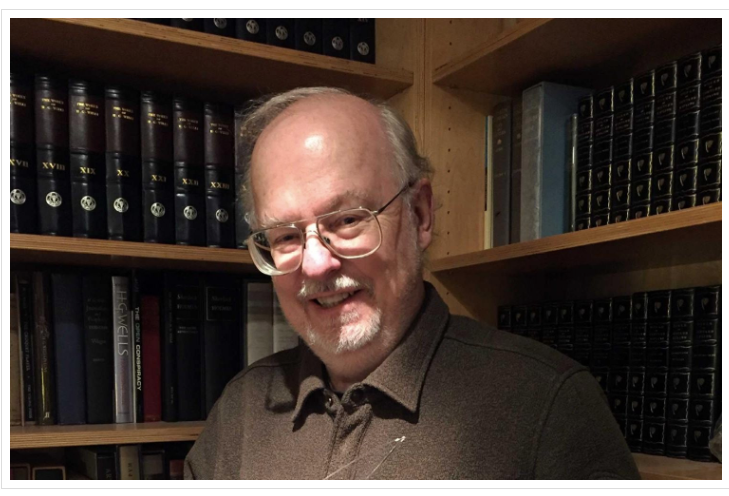
Chuck Todd interviews me about alternate histories
Showing posts with label Gregory Benford. Show all posts

Sunday, December 1, 2024

Aporia: Firing Back in Time


Readers of this blog will know that my favorite genre -- as a viewer, reader, and author -- is time travel, and its close relative alternate history.  You'll know this because I say it in just about every other post.  But you would also know this because, at least by my lights, excellent and even good examples are not easy to find (and, I'll immodestly or modestly say, as an author, to write).

But Aporia, a 2023 movie I saw last night on Hulu, is an excellent example.  The heart of its narrative is that a would-be inventor (later, inventors), of a time machine discovers that the clanky machine he's struggling to build in his home can't quite do it -- it's not powerful enough to hurtle a human back in time -- but it can send a subatomic particle back to a specific time and place (the time just a handful of years or a little bit in longer into the past), where it will cause a very minor explosion.  And the inventor realizes that if the place in the past where the subatomic particle lands is inside someone's head, well, what he the inventor has created is a gun that can reach back and kill someone in the past, by putting one of these time-travelling particles into the target's head.

[And I'll here I'll tell you that there will be spoilers ahead ... ]

So, there are three main characters in Jared Moshe's movie (which he wrote and directed): Jabir and Mal were working on the time machine in Jabir's home, when Mal was killed by a drunk driver.  This of course left his wife Sophie desolate.  Jabir is desperate to ease her pain, and restore her life, and comes up with a plan: send one of those lethal subatomic particles back in time, to land in the drunk driver's head, before he gets into the car and accidentally kills Mal.  And the plan works!

But that's when Aporia really gets riveting and ethically wrenching, as Sophie struggles with the fact that although she got her husband back, she had to take another human life to do it.  She reaches out to the drunk driver's widow.  They become friends, and so do their daughters. And here the movie excels in depicting how the people who know the original reality, and know that it has been altered, deal with the new reality they now inhabit.  (I tend to like this metaphysics of time travel -- that people who cause the changes in time are aware of the changes, even if the changes affect them -- maybe because I always employ such a narrative structure in my own works.)  As Sophie gets to know the drunk driver's family, she finds she can't bear the fact that she was responsible for killing the drunk husband and father, however much he may have deserved it ... but any attempt to change the past again by killing someone else with a time-traveling particle could have unforeseen consequences ...

Aporia resonantes in all kinds of ways.  The build-your-machine-at-home continues the tradition started by H. G. Wells' The Time Machine, and furthered more recently by Primer and just a few months ago Quantum Suicide.  The idea of sending something rather than people or living things back in time was put to good use by Gregory Benford in his 1980 award-winning novel, Timescape, in which information could be sent back in time.  And the idea of apprehending criminals, not because they committed a crime, but because you know they will commit a crime, was of course memorably developed by Philip K. Dick in his novel The Minority Report

But Aporia has a story and an ambience all its own, brought to life by really excellent acting by Judy Greer as Sophie, Edi Gathegi (who has been great in For All Mankind, and before that, StartUp) as Mal, and Payman Maadi as Jabir.  And all of this builds up to a top-notch ending, in which a smile tells us almost everything.


my interview with Jared Moshe


watch the movie on Amazon Prime Video -- read the novelette here


in Kindlepaperback, and hardcover


Sunday, November 20, 2022

Greg Bear, RIP: Three Ways In Which He Bettered My Life


                          Greg Bear -- File 770

Greg Bear, author of more than 50 science fiction books, left us yesterday at the too-young age of 71.  I'll leave it to others to detail the superb, riveting stories he told us in those books, and tell you instead about three significant ways he had a personal impact on my life.  I was always happy to run into him at a science fiction convention, but these three encounters were more than that.

1.  I wrote a review somewhere of the Foundation prequel trilogy Gregory Benford (Foundation's Fear), Greg Bear (Foundation and Chaos), and David Brin (Foundation's Triumph) -- or maybe it was just a comment on some board -- at the end of the 1990s, a few years after Isaac Asimov's death.   I said that I enjoyed all three novels, but, surprisingly, Greg Bear's was the best.  (I guess I was surprised because I expected that all three would be so good it wouldn't be so easy to rank them.) Greg and I had already been in occasional touch -- he had been President of the Science Fiction Writers of America from 1988-1990, and I was President of SFWA from 1998-2001 -- and I got a genial email response from Greg almost immediately after my review/comment was published.  "Why are you surprised?"

There was something refreshing and reassuring about those four words that immediately struck me.  I was already egotistical -- most writers are -- but Greg's response, in addition to making me laugh, showed me how right and important it was to stand up for yourself when circumstances called for that.  Modesty isn't all it's cracked up to be.

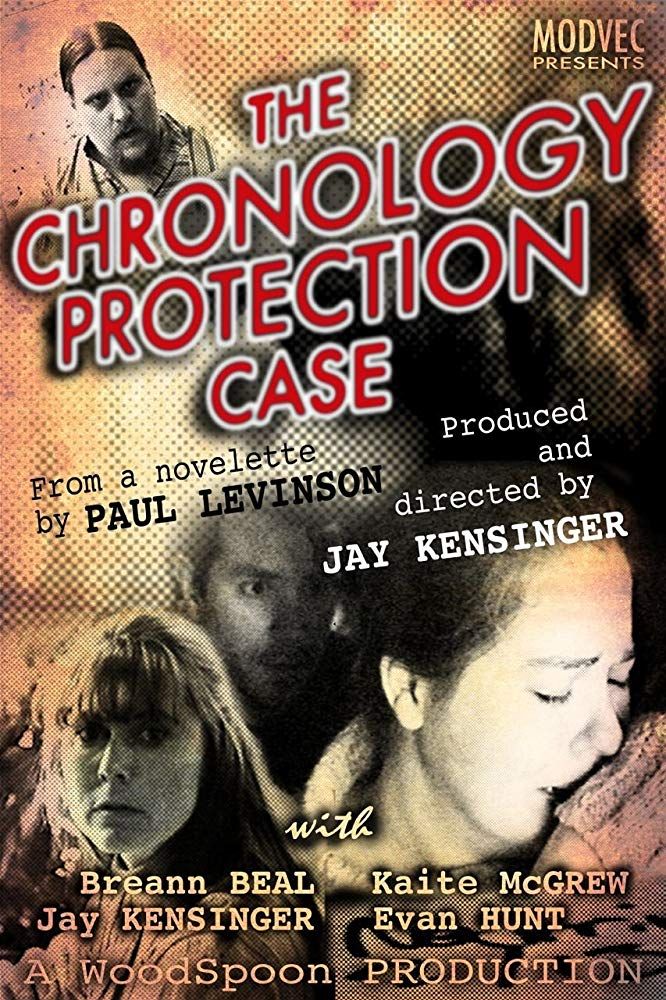
2. In February 2002, I received a package in the mail.  It contained a videotape made by Jay Kensinger, of a short movie he had made of my 1995 novelette, "The Chronology Protection Case," first published in Analog Magazine, already reprinted then in several places, and a finalist for the Nebula and Sturgeon Awards.  Jay apologized in the letter for not letting me know he was making this movie, not seeing if he needed some contract with me, etc.  He included his phone number, and when I called him, eager to talk to this guy who had made a movie from my story, he again profusely apologized and told me he had walked up to Greg Bear at a book signing, said how worried he was that I was going to be upset that he had made the movie without my permission, but he wanted to contact me and what did Greg think he should do?  He told me Greg gave him a big smiled and assured him, "I know Paul Levinson and he'll be nothing but thrilled."  Greg knew me well.  (And he knew himself  -- he had the heart and soul of a writer.)   You can watch the movie here, on Amazon Prime Video.

3. As I mentioned, Greg and I first got to know each other when I was President of SFWA, 1998-2001, and I sought his advice on a variety of issues, as a former President.  Greg and I agreed on just about everything, including that it was no fun at all being president of a writer's organization -- certainly a small fraction of the fun of being a writer.  I learned then a lesson that I learned once again when I was Chair of my Department of Communication and Media Studies at Fordham University shortly after, from 2002-2008.   Don't do it.  Administration doesn't combine well with the creative process.

There are few people in my life from whom I learned so much, and was so fortunate to have known, than Greg Bear.  Rest in peace, my friend.


Saturday, November 5, 2022

The Peripheral 1.4: Who Took Lev's Tea?


Who took Lev's tea? The disappearance of his tea in episode 1.4 of The Peripheral up on Amazon Prime Video since yesterday was an another signalic moment, just like the coffee container materializing in thin air in what now seems like a much earlier episode.  The tea gone and the coffee appearing just like that symbolize the immense forces at play in this so far delicately powerfully rendered series, which as far as I can tell so far hasn't missed a step.  (Reminder: I haven't read the book.)

Everyone, certainly in the near future, is struggling to understand what's going on.  "It's not time travel, it's data transfer," Flynne says, after Burton tells her traveling to the future caused her seizure.  But Burton is more right than his sister here, since the transfer of data from the future to the present (or past, depending on how you look at it) is indeed a kind of time travel.  (See Gregory Benford's 1980 Timescape if you don't believe it -- that's a book, by the way, that I did read.)

Also in the near future, Connor wants to know if the data visits to the future come with real bodies?  This is another key to what's really going on.  As we well know, the bodies in the future are both real and not.  As in countless science fiction stories about cyberspace, the original flesh-and-blood bodies can be seriously injured if not killed when their avatars in the future are hurt or killed.  That in itself makes those entities real enough.

Speaking of science fiction entities, I liked that android that Cherise is starting to school in the distant future, especially how he's able to moderate the percentage of sarcasm in his attitude.  That one, brief scene struck me as one of the best I've seen or read in any android story, starting with Isaac Asimov's stories back in the 1950s.

And last but not least -- last is an apt word for for this -- I thought the end of our civilization sequence was top-notch, too.  Given the deadly perils we're currently encountering -- pandemics, climate change, the resurgence of fascism in the U.S. and all over the world -- I found that very appropriate to be watching tonight, too.

Don't forget to turn your clocks back tonight if you live in the U.S.

See also The Peripheral 1.1-1.2: Cyberpunk, Time Travel, and Alternate Reality ... 1.3: John Snow


It's Real Life

alternate reality about The Beatles on Amazon, and  FREE on Vocal


Saturday, September 10, 2022

Moonfall: Bad News


Well, the Wikipedia article about Moonfall (now on HBO Max) quotes the consensus on the Rotten Tomatoes site:  "Whether Moonfall is so bad it's good or simply bad will depend on your tolerance for B-movie cheese."  I have a pretty high tolerance for grade B movies, but I have to say that I thought Moonfall was just plain and simply bad.  Very bad.

Where to start?  The intellectual hero of the movie, K.C. Houseman, pretends to have a doctorate, and promulgates a crackpot theory that the Moon is really hollow inside, powered by some alien technology, which turns out to be right!  But that theory is so ridiculous, that what message are we supposed to get from Houseman being proven correct at the end?  That crackpot theories could be right?  I have no objection to that possibility generally, but given the flood of crackpot theories about COVID (such as the one about Bill Gates embedding microchips in vaccines), a pandemic which has cost so many lives, I would say this is one of the worst times to make a movie which champions nutcase theories.

And, frankly, the storyline around that theory makes no sense, and grows like a field of mushrooms out of control.   In the end, it turns out that there's not only an alien operating system inside the Moon, which can actually be helpful, but a malignant force that has a grievance against organic life.  Science fiction author Greg Benford once distinguished science fiction from fantasy by remarking that fantasy is playing with the net down.  I always thought that was not really fair or true, given that Lord of the Rings, Harry Potter, and Game of Thrones are all excellent fantasy with very precise, logical constructs.  But if Benford's distinction were true, Moonfall is not even playing with the net down.  It's playing with no net at all in sight, or ever there.

The special effects are ok, and about the only thing worth seeing in this disaster of a disaster movie.  But they're certainly not worth paying for, and I'm not happy I wasted just time watching this on HBO Max last night.


Thursday, December 17, 2015

Touching the Face of the Cosmos just published


Click here, and then on Look Inside, to see Table of Contents


#SFWApro 


right after my interview John Glenn, appearing in the anthology


#7 on Amazon Kindle Top 100 Science and Religion a day after publication

Monday, November 29, 2010

The Event 1.10: Satellite

Well, another bit of evidence - all but irrefutable - that those folks who don't age on The Event are aliens from space.   In episode 1.10 just on the East Coast tonight,  Thomas launches a satellite.

The President and his advisors, in true 24-fashion, thought until after the launch itself that the payload was a nuclear weapon, aimed at the United States.  The fact that it was a satellite, with transmission turned out towards the universe (not back to Earth, like our telecom satellites), showed not only that it was not intended to destroy us (at least, not immediately) but it likely was also not intended to communicate just across time.

Of course, for all we know, it is some sort of tachyon communication device across time, too.   But, at very least, even if there is a time travel (or communicating across time) element, it is coupled with a transmission out into space too.   In other words, whatever else these ageless people may be, they seem to have an undeniable outer space connection.

By the way, while we're on the subject of communicating across time, we of course do that all the time.   You're reading this blog whenever - but I'm writing it now at about 10:21pm Eastern time - in other words, these words have traveled x number of minutes, hours, days, maybe years (depending upon when you're reading this) across time, in the good old natural way that started when the first humans carved or painted something upon a wall or tree.   We also do this every time look at a photograph.

That kind of time-honored travel across time of information is not what science fiction is talking about when its characters and authors and fans speak about communicating across time.   In the case of The Event, if what's going on is communication across time, what would be happening is sending information back in time or directly to the future - as in Greg Benford's Timescape - both of which are something extraordinarily difficult or even impossible, as far as know, or at least would engender mind-lacerating paradox.

Ah, I could write about this stuff all night!

Anyway, the other big news in tonight's Event is that Leila's father is alien!  Or, at least, he doesn't age.   Someone suggested this in a comment to my review of last week's Event.  Hey - maybe he/she was able to glimpse the future ...


5-min podcast review of The Event

See also The Event Debuts on NBC ... The Event 1.2: Aliens! ... The Event 1.4: 24 Back in Action! ... The Event 1.6: Not Only Aliens, Immortals! ... The Event 1.7: The Portal and its Implications  ... The Event 1.8: The "Republican" VP and the Anti-24 ... The Event 1.9: "Native Populations, Indigenous People"


                 Special Discount Coupons for Angie's List, Avis, Budget Car, eHarmony, eMusic, Mozy, Zazzle


The Plot to Save Socrates


"challenging fun" - Entertainment Weekly

"a Da Vinci-esque thriller" - New York Daily News

"Sierra Waters is sexy as hell" - curled up with a good book

Tuesday, October 16, 2007

Tachyon Telephone: A Journeyman Extra!

Back with a little focus essay on what could be a very important thread introduced in last night's Journeyman - Episode 4 - on NBC. In 2007, Dan contacts a scientist who has done some work on tachyons - the name our real-life scientists give to particles that might travel at faster-than-light speeds, were such speeds possible. Dan presumably thinks this scientist might know something about time travel (because, again in our reality, some projections of what conditions would permit time travel say it could be linked to faster-than-light travel). Dan has an inconclusive conversation with the scientist, who tells Dan he'll get back to Dan, and-

Later in the show, when Dan is back in the late 1990s, he gets a call from this scientist...

Now, conceivably, the scientist's late 1990s self might have been calling Dan for some reason. But let's assume the scientist was in 2007 when he placed the call to Dan in 1998.

How might this have happened?

Greg Benford, a physicist at University of California-Irvine, and a science fiction writer (and a friend, so I know he's real), published an award-winning novel in 1980 entitled Timescape. In this novel, scientists from the future communicate with scientists in the past via tachyons.

Was that what was happening with Dan in Journeyman last night?

Well, in order for that to have occurred , here's would have been required in the telephone technology. Our telephones and cellphones and iPhones today work by encoding sound into electronic signals - electrons - and sending them through wires, or whatever carrier waves in the air, to receivers, which in turn decode the electronic patterns back into sounds that we can hear. Since electrons and the carrying signals travel at the speed of light, we can talk to anyone anywhere on the Earth just about instantly. Of course, if we try to do this with someone near the Moon, there will be a little delay (the Moon is 240,000 miles from Earth - light travels at 186,000 miles per second).

A tachyon telephone would work the same way - except, rather than the sound being encoded into electrons it would need to be encoded into tachyons (or, if it was encoded into electrons, those electrons would need to be hitched to a tachyon carrier wave).

Presumably our tachyon-knowledgeable scientist in Journeyman would understand this, and might have access to or even constructed a tachyon telephone.

But how about Dan? He would need to have a tachyon telephone in order to receive a call from a scientist in the future (the scientist in 2007, Dan in 1998) and have a conversation with him. Dan is seen using a late-1990s cell phone in last night's episode - his old phone, that he dug out in 2007 (hey, I have one just like it, buried somewhere in my desk!) - but there is no reason to think that it came tachyon enabled.

But Livia, Dan's former lover, also travels around in time, and she might have gotten to Dan's phone at some point, and given it a tachyon chip... a tachyon hack!

Interesting possibilities here, and I'm eager to see how Journeyman develops this.

In the meantime, you might enjoy the following:

Greg Benford's Timescape

my time-travel novel, The Plot to Save Socrates

20-minute podcast: Time Travel in Fact and Fiction


5 minute podcast of this tachyon analysis


The Plot to Save Socrates


"challenging fun" - Entertainment Weekly

"a Da Vinci-esque thriller" - New York Daily News

"Sierra Waters is sexy as hell" - curled up with a good book
InfiniteRegress.tv