Chuck Todd interviews me about alternate histories
Showing posts with label Tom Hanks. Show all posts

Sunday, November 7, 2021

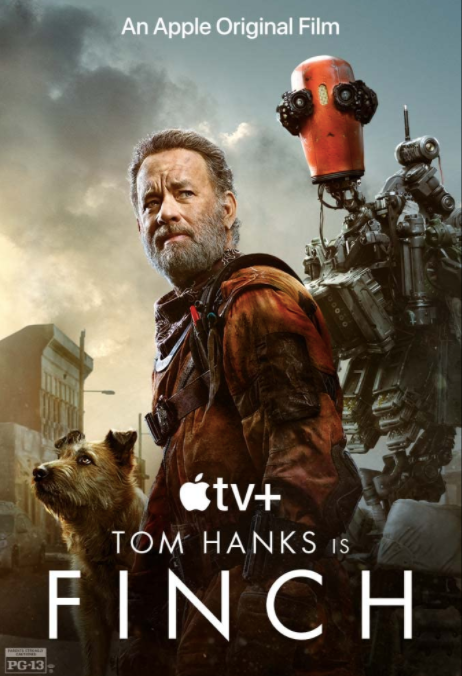
Finch: Heartwarming, Even Reassuring, About a Robot


Just saw Finch on Apple TV+, at once a small scale infinitude of a movie, a quiet triumph of a story that may be the best robot AI film I've ever seen.

The bare bones are Finch is a genius inventor in a post-apocalyptic America who builds Jeff, a gangly robot, to take care of Finch's dog Goodyear, after Finch is gone, which won't be long.  He's dying from over-exposure to UV radiation, due to the solar flare that wiped who knows how much of the world.  But the apocalypse is the least important part of the story, a means to an end, which depicts how Jeff learns to be human.

As such, Finch (the movie and the character) builds on Asimov's three laws of robotics -- (1) a robot cannot harm a human, or by inaction allow such harm to occur, (2) a robot must follow every command it receives from a human, except commands in conflict with the First Law, and (3) a robot must act to protect itself, except when such a protection conflicts with the first two laws.  So, for example, in Asimov's schema, a robot would have no choice but to destroy itself if so ordered by a human, unless it was needed to protect a human.  Asimov's later promulgated a "zeroth" law, that a robot must act to save the many rather than the few, but not every Asimovian purist has accepted that John Stuart Millian utilitarian principle.

Finch (brilliantly played by Tom Hanks) expands the three laws by adding a fourth -- Jeff must protect Goodyear the dog, but that's just shorthand for the rich tableau, sometimes funny, sometimes heartrending, in which Jeff (deftly played by Caleb Landry Jones), growing into his intelligence, seeks to protect both Finch and Goodyear.  Jeff makes mistakes, has its/his feelings hurt, but learns the importance of mastering such mundane but essential tasks -- essential to Goodyear's wellbeing -- as playing throw and fetch the ball with the lovable pooch.

There have been many a depiction of robots, with or without Asimov's laws as a guide, on television and movie screens.  Demerzel, more properly an android than a robot, began existence as R. Daneel Olivaw in Asimov's robot novels, and became Demerzel is Asimov's Foundation prequel decades later.  He became she in the Foundation series also on Apple TV+ these days, and I've found myself irritated at her character, in contrast to the Foundation series as a whole, which I think is top notch.  Having just seen Finch, I now understand why.

Jeff in Finch is somehow more than just a character, a cog in the machine of the motion picture.  The movie manages to make us believe that he is human in the end, and not because he looks good in a hoodie jacket.    That evolution makes the movie heart-warming, even reassuring, despite the apocalypse and its effects, and one I'll always treasure seeing.


Sunday, January 6, 2019

The Post: More Timely Than Ever


Just saw The Post again on HBO, and figured it was long since time to post a brief review.  Since the movie first came out at end of 2017, the need for a brave press to stand up to an autocratic, paranoid President has become even more acute.  The story of how Katherine Graham, Ben Bradlee, and Ben Bagdikian defied legal counsel, an at first badly misguided Federal Judge in New York (Murray Gurfein, who issued a restraining order on The New York Times for one day, then refused to grant the government's demand for a permanent injunction), and lots of strong advice from the Post's inner circle, could not be more timely today.

And the acting, especially for those three heroes of the press and democracy, couldn't have been more vivid.  Meryl Streep portrays Graham with just the right mixture of concern about the consequences and devotion to a free press.   Tom Hanks' Bradlee led the punch for publication, smiling but tough as steel, and also felt compelled to warn Graham that they both could be held in contempt of court and sent to prison.  Bob Odenkirk's Bagdikian made a commitment to Daniel Ellsberg to publish, and was just right as one-hundred-and-ten-percent advocate of publication.

In some ways, the America we live in today is in even more dire straits regarding freedom of the press than it was with Nixon in office.   Trump and his minions daily denounce the press as fake new news.  CNN reporter Jim Acousta had his White House press credentials invoked (they were shortly after reinstated).   The one advantage we have in 2019 over 1971 is that we have so many sources of news, on cable and the Internet, as well as printed papers and network television, that it's harder to suppress the truth.

But The Post provides a jolting reminder of how close Nixon came to muzzling the Washington Post and The New York Times.   With Trump still in the White House, how much further have we really come since then?


Sunday, February 9, 2014

Black Sails 1.3: John Milton and Marcus Aurelius

As I noted last week, Black Sails turns out to be an astonishingly literate series, literally.   Previously, the erudite Captain Flint cited Homer to good effect.   Last night, he brings Miranda - with whom he has a long term stable relationship - a copy of a book by John Milton.  Later, Miranda in turn recommends a tract by the stoic philosopher and Roman emperor Marcus Aurelius.

It's tempting to suppose Flint's gift to Miranda was Paradise Lost, given that all of the action is, after all, taking place in a paradise, which, moreover, is ever on the verge of being lost to libertine violence, personal and social, and which was again in high profile last night.  But given the politically libertarian philosophy of Flint and the better of the pirates, not to mention my own devotion to the First Amendment (to the point of thinking the FCC should be abolished), I'm going to go with the Milton being his Areopagitica, the brilliant polemic in favor of free speech and press which says that truth and falsity should be left to fight it out in the marketplace of ideas, where, given the rationality of human beings, truth will eventually win.  In this sage schema, the worst thing a government or anyone can do is censor, which might be well hobble the expression of truth and prevent it from entering the marketplace of ideas for its contest with falsity.

Indeed, Milton's Areopagitica was read by both Thomas Jefferson and John Madison, and undoubtedly figured in the very construction of our First Amendment.  So what better place to situate Milton's political masterpiece than in the new world, in colonial America, in the stirrings of what would become the U.S.A.

Aurelius's Mediations and his tenure as Roman Empire tells a related story.  A sage philosopher, the epitome of Plato's philosopher king, Aurelius tragically inserted his personal feelings as father into his philosophy about how to best serve, and named his son as Roman Emperor, ending the excellent tradition of picking the best person as successor.  The lesson, that power corrupts, and absolute power corrupts absolutely, is also one which we as well as our pirates would do well to keep in mind.

What makes Black Sails so remarkable is that it mixes this heady and powerful philosophy with lots of good and bad loving and action.  The series so far has mostly resisted the cliches of pirates in fiction, and we see that again in 1.3 with Flint's devoted relationship with Miranda, and Eleanor's strong sense of self and purpose.

After watching Black Sails last night, my wife and I saw Captain Phillips, the movie detailing what actually happened off the coast of Somalia in 2009, when pirates attacked Phillips' ship.  Superb acting by Tom Hanks as Phillips and everyone else in this movie.  But, whew, pirates have fallen a long way down since those halcyon, fictional days of Black Sails.

See also Black Sails: Literate and Raunchy Piracy


#SFWApro

Wednesday, July 10, 2013

Cloud Atlas, Space Travel, and Souls

I saw Cloud Atlas tonight, and I must say my favorite part was at the very end, with its revelatory punchline about space travel.  This was not only satisfying but appropriate, because, after all, the movie does have "cloud" in its title.   Before the digital cloud there were and manifestly still are clouds above us in the real sky, and I take our capacity to get beyond them - now just to our solar system but someday far beyond - to be one of the most inspiring aspects of our existence and therefore of this movie.

There were other good things in the movie.   Speaking of digital, the neo-Seoul segment had lots of that, along with a powerful, exciting mini-story of clones and heroes that rang with the best of The Matrix, which is probably why the hero of this segment looked so much like Neo.

Speaking of which, Hugo Weaving played a major role in Cloud Atlas - actually, major roles, as did all of the major actors - and delivered some of his patented brilliant sheer evil, soulless bad guy, along with  a bad guy who may have turned to good guy in the neo-Seoul segment.   Tom Hanks also put in some fine performances, especially as the lead in the two farthest future segments, including the final one that finds his character along with Halle Berry's as grandparents on a planet far from Earth.   These two future segments also offered some fine future evolved English - I thought I heard the Hanks character say he needs to "cog" a situation, meaning he needs to understand it, for example - which gives Cloud Atlas a bit of Clockwork Orange resonance.

There was even some good comedy on hand in the final parts of the Cavendish segment - set in 2012 Britain - well played by Jim Broadbent and company.   Not every segment was too my liking, though.  For some reason, the music segment in 1936 Britain didn't ring as true as it should have, or maybe it's just that I'm not a big fan of suicide.   And although the 1848 segment had some moments, I found it slow going.

But all in all, Cloud Atlas deserves to be called a tour-de-force, not only because of the stories which were stunning, but because of the quiet way the lives all did seem to play - in the musical sense - so well together through history into the future.   This is no time travel movie, but that's ok.   Cloud Atlas tells us souls are inherently connected through time just by their very being.


#SFWApro

InfiniteRegress.tv