Chuck Todd interviews me about alternate histories
Showing posts with label Steve Bannon. Show all posts

Monday, April 12, 2021

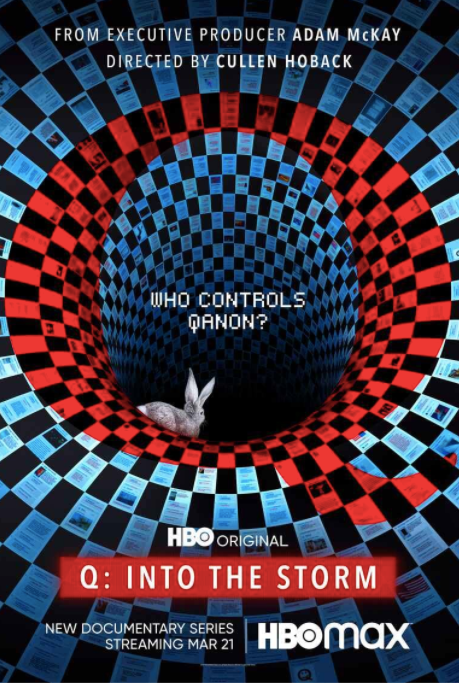
Q: Into the Storm: Riveting, Breathtaking, But Not Completely Persuasive


I just binge-watched Q: Into the Storm, a six-part documentary on HBO Max*.  It's about as breathtaking, daring, and informative a documentary, episode for episode, as ever I've seen.   [Spoilers follow....]

That's in large part because it's extraordinarily current, ending a day or two after the insurrection at the Capitol on January 6, 2021.  But it's also because Cullen Hoback, who made the series as well as stars in it as its investigator, managed to present a life-and-death true story, with real people you gradually come to know surprisingly well, and a grade-A real mystery all in one series.

The mystery is at the heart and soul of this documentary: who is the Q in QAnon?   We think Q's a he.  We know Trump was (and maybe today still is) the mythical arch hero in Q's and the QAnons' mythology, and that the real Trump began to retweet and maybe truly believe some of their ideas.   We know that the January 6, 2021 attack on the Capitol was at least in part inspired by their beliefs.   We know that, although conspiracy theories have likely been with humanity since Neanderthals were the most prevalent form of our species, that QAnon is to date the quintessential creation of social media.  What we don't know is: who was or is Q?

Into the Storm is the story of how Hoback struggled to answer that question, and indeed thinks he answered it.   The reason I'm putting the resolution of this documentary in those terms, though, is that ... I'm not completely convinced about Hoback's answer.  The two best choices that Hoback presents are Steve Bannon and Ron Watkins, 8Chan administrator and who knows what else.  (I assume you know who Bannon is.)  In a decisive turning point in the documentary, Watkins tries to convince Hoback that Bannon is Q, via IP address locators, and the fact that Q seemed to have access to information that only a Trump insider would have.  But Hoback doesn't think Q would be so stupid as to make his IP address available even to as savvy an Internet player as Ron Watkins, and finds that Bannon said Michael Flynn (another QAnon hero) was a disaster, and Hoback therefore concludes instead that Ron Watkins is actually Q, and was trying to throw Hoback off track by offering up Bannon.

I'm willing to say, on the basis of documentary, that I think Ron Watkins is likely Q, but I'm not totally convinced.  One of Hoback's main reasons for thinking Watkins is Q is Watkins' inconsistent statements about what he knew and didn't know about what Q was posting.  But people make inconsistent statements all the time.   Also, unless I missed it, I don't think Hoback ever provides a clear explanation of how Watkins, who wasn't a Trump insider, obtained the Trump insider info that Q displayed.  And just as Hoback thinks Ron Watkins deliberately said things to disguise his true identity, surely Bannon would have done the same (such as trashing Flynn) to get people to look elsewhere for Q.

So, I think Bannon is still in the running, as at least an outside shot.  Or Q could be someone else, or maybe a team of people, another hypothesis considered then discarded in the documentary.  But that ambiguity does not make Q: Into the Storm one bit less worthy of viewing, as an all too-frightening, all too human, astute depiction of what happened and almost happened in America and the world.

*Special thanks to my student, Kayla Auza (in my Digital Media and Public Responsibility class this term at Fordham University), who recommended that I watch Into the Storm.


Saturday, May 30, 2020

Spaceship Earth: The Misunderstood Success


I don't often watch documentaries, and review them even less often, but Spaceship Earth is an exception, because it tells at least two highly significant stories: (1) the attempt to construct a totally self-contained environment or biosphere (Biosphere 2) on Earth, with human inhabitants, as a template for what could be sent out to our solar system and beyond in the future; and (2) the media misreporting of what Biosphere 2 accomplished.

The truth is that Biosphere 2 was unable to maintain total self-sufficiency.  At seventeen months into its two year 1991-1993 mission, oxygen was imported from the outside into the biosphere to combat the sharp reduction in oxygen from 20.9 to 14.2 percent of the biosphere atmosphere.  Obviously, this is not something that could have been done in the middle of a mission to Mars or anyplace off the Earth.  But the media were wrong to report this as evidence that the Biosphere 2 mission failed, or was some kind of publicity stunt rather than a scientific experience.  Apparently no one in the media read British philosopher Karl R. Popper (for example, The Logic of Scientific Discovery), and his widely accepted view that mistakes are the way that science learns and progresses.

The Hulu documentary, named after Buckminster Fuller's apt characterization of our planet as "spaceship Earth," does a fairly good job of reporting and assessing the above, relying on extensive current and historical in-situ interviews with most of the central players in the Biosphere project, including the Biosphereans themselves.   I know at least two people who provided support for Biosphere 2, Carl N. Hodges, an atmospheric physicist at the University of Arizona, who was not in the documentary, and Kathy Dyhr, Director of Public Affairs for Biosphere 2, who had a major role in the documentary.   I had long and riveting conversations with each of them in the mid-1980s, when Biosphere 2 was under planning and construction, and both were students at the Western Behavioral Sciences Institute pioneering online education program, where I was a faculty member and was first introduced to online education, which gave me the idea for Connected Education and which has become so important during our current Coronaviris pandemic.  These conversations, as well as my knowledge of how science works, and plain common sense, are what led me to conclude that the media assessment of Biosphere 2 was so wrong.

But why, then, did the media jump on the bandwagon of Biosphere 2 failure?  The documentary provides one of the two answers.  Steve Bannon - yes, that Steve Bannon - was brought in by financer Ed Bass to run the Biosphere managing company (Space Biosphere Ventures).  Apparently Bannon sought to make a name for himself by publicly and repeated denouncing the project (including destroying some of the crucially valuable data it had collected, according to the documentary).

The second reason is more endemic and intrinsic to the media and to us, its public.  As Phil Ochs pointed out so well in his song "The Crucifixion" (1966), we love to tear down, or see torn down, that which we have built up for adulation.  The idea that we could build here on Earth a habitat which with proper propulsion could take us to the stars was heady, intoxicating stuff.  When it failed to achieve that goal in at least one critically important way, the disappointment that resulted was enough for the media and many viewers to discard the entire project as an ambitious entertainment gambit that flopped.

But facts are stubborn things, and I expect the documentary to continue to bring the truth of Biosphere 2 out to the world and the future, which is that it was an important and major first step that taught us a lot about how we can get beyond this planet to the cosmo beyond.


Friday, January 27, 2017

Colony 2.3: The Wall

Just as Trump is railing on about his wall, Colony 2.3 has a harrowing scene of Will and Charlie scaling a wall, against enemy drone fire that threatens to pick them off. Two of the people on the rope are indeed killed.

And, indeed, intentionally or not, Colony is shaping up this season as a slightly futuristic scenario of what the new President and his worst advisers may want to have in store for us.  Or, who knows what the new President wants, and to what extent he's aware of the consequences.

But just as in our reality, a large part of the story of Colony is the resistance, and how that plays out against collaborators and the unseen aliens - real aliens from outer space, bad aliens, in contrast to our immigrants who good are human beings who want to be part of the American fabric.

Or at least, the American fabric prior to now.  Just as we have no idea where Colony is headed, which makes for good narrative fiction, we have little idea where America is now headed - or how this will all turn out - which makes for a dangerous reality.

Fiction in a dangerous world takes on a new tone, especially if that fiction bears a resemblance to what is going on, off the page and the screen.   And this tension is only heightened, when the people in power in our reality - Trump and Bannon - turn their fire on the media, which includes not only news today but maybe even science fiction like Colony tomorrow.

And I'll be back here with another review next week.

See also Colony 2.1: Prelude ... Colony 2.2: 1969 ... Colony 2.3: The Wall

And see also Colony 1.1: Aliens with Potential ... 1.2: Compelling ... 1.5: Questions ... 1.6: The Provost ... Colony 1.7: Broussard ... Colony 1.8: Moon Base and Transit Zones ... Colony 1.9: Robot Arm ... Colony Season 1 Finale: Not Quite Enough


not exactly aliens, but strange enough ...  The Silk Code

InfiniteRegress.tv