So, I got the email from TVLine yesterday, alerting me to Rebecca Iannucci's 10 Hidden Gems You May Have Missed From This Year’s TV, and was delighted to find The Way Home on the Hallmark Channel on the list of ten, starting with this comment, "Scoff at a Hallmark Channel series’ inclusion on this list if you must, but we were quickly captivated by this time travel drama".
Now, I can't remember the last time I watched anything on Hallmark, if ever, but I was delighted because I'm always up for a time travel movie or TV series I haven't seen before -- time travel is my favorite genre as a reader, viewer, and author (alternate history is a close second, but the two are closely related) -- and I enjoyed The Way Home so much, I binged (the best way to see a TV series) all ten episodes of the first season yesterday, and eagerly await the second season that will start rolling out on Hallmark on January 21.
I'd say the series is somewhere between Outlander and The Time Traveler's Wife, high praise in my book. Like those two series, The Way Home is science fantasy. No time machine or black hole in space is in evidence. No person or group is apparently engineering the time travel. Just a pond with a mind of its own up in Canada.
Now when the mechanism of time travel is fantasy rather than science -- clicking your heels together three times like Dorothy -- that puts a lot of pressure on the narrative to excel in other areas. And that's what The Way Home does, in all kinds of ways. It has a refreshing pop cultural savvy. "There is no way that guy becomes President," Elliot says (has to be about Trump) in 1999, when he asks teenaged Alice (who has traveled from 2023 to 1999) to tell him "something else" about the future. Later, Elliot makes a Marty McFly reference, Alice makes a face like she doesn't know what that is, and Elliot says, "Come on, Back to the Future?"
And the story glistens with literary and even philosophic references. Alice's mother Kat quotes from Faulkner. Lewis Carroll's Alice's Adventures in Wonderland (the original title of the novel) makes a literal appearance in a nice old copy of the book, with the words "I can't go back to yesterday, because I was a different person then" underlined because it has crucial relevance to The Way Home. Kierkegaard's "life can only be understood backwards; but it must be lived forwards" is quoted. The Way Home is sometimes reminiscent of Virgin River -- which my wife and I actually watch as a guilty pleasure -- but that soap opera has nothing approaching a Faulkner or Lewis Carroll quote, let alone Kierkegaard.
Music also plays a major role in The Way Home. One of the best scenes in this first season has older Kat and Elliot singing along to Sister Hazel's "All For You," including mimicking "tryon," as they drive down the road. And "Everything I Wanted," written for the series by Maria Taylor Pens and sung by Alice in the final episode, is one beautiful song.
And before I warn you about spoilers, I was happy to hear Elliot (who in 2023 is a high school science teacher) cite "Novikov's self-consistency principle of a single timeline" to explain why traveling to the past can't change anything in this fictional world. This is the second time I've encountered Novikov in a time travel story in the past few months (see my review of Chris Cosmain's Novikov Windows for the first), and though I prefer being able to change the past in the time travel stories I write, it's good to see Novikov's principle, because it bespeaks a respect for the paradoxes that travel to the past inevitably engenders.
Now as to the plot [Ok, here's the warning about spoilers to follow ... ]
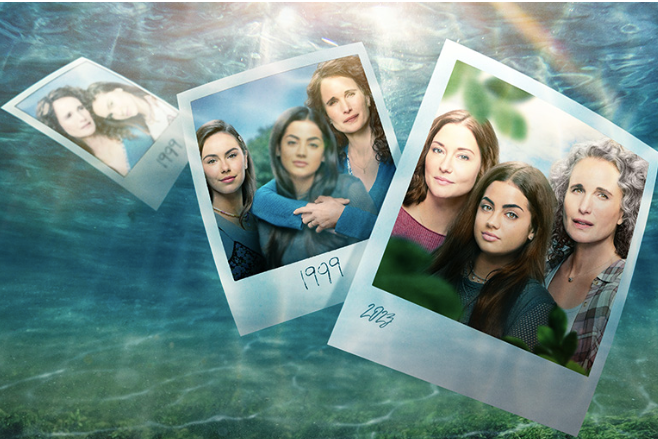
The essence of the story is two people from 2023 -- Alice and her mother, Kat -- traveling via the pond back to 1999, where they interact with people (Kat's mother Del, Elliot, etc) in all sorts of profound ways in life-and-death situations. Elliot in 2023 has knowledge of everything that happened to him with the time travelers in 1999, and that's a central part of the story. But then how come Kat, who meets time traveling Alice when Kat was a teenager in 1999, doesn't remember meeting Alice when Kat is Alice's mother in 2023? Would that be because of Novikov's principle? Ok, maybe, but if so, how come Elliot was able to surmount that? Also, how come the adult Kat from 2023 apparently doesn't look the least bit familiar to her father back in 1999, until the tragic car crash that she accidentally causes in her attempt to stop him from crashing and dying (itself a nice example of the venerable time travel chestnut of time travelers causing the very tragedy they went back in time to prevent).
I also guessed the ending -- Jacob missing because he jumped into the time travel pond, and was for some reason unable to get back -- though I didn't foresee the dog having a significant role, which was a nice touch.
In any case, it's exceedingly difficult to get all the wheels of a complex time travel story moving in synch, and The Way Home does a pretty good job of it. The three women at the heart of the story -- Del, Kat, and Alice -- are brought to life by Andie MacDowell (always a pleasure to see, and she played both older and younger Dels), Chyler Leigh (she memorably played older Kat, first time on the screen for me, she was in Grey's Anatomy, which I don't watch with my wife), and Sadie Laflamme-Snow (the same age Alice in 2023 and 1999, first time on the screen for me as well). And Evan Williams, whom I saw in Blonde and Westworld, did his customarily good work as the adult Elliot.
They'll all be back in the second season, and who knows who else, and I'll be back then, too, next month, with more.
_Slipping_Time_raw_cover.png?width=420&height=180&fit=bounds)
here's a little time travel story, you can read for free

here's the first novel in the Sierra Waters time-travel trilogy