Chuck Todd interviews me about alternate histories
Showing posts with label Michael Shannon. Show all posts

Tuesday, January 10, 2023

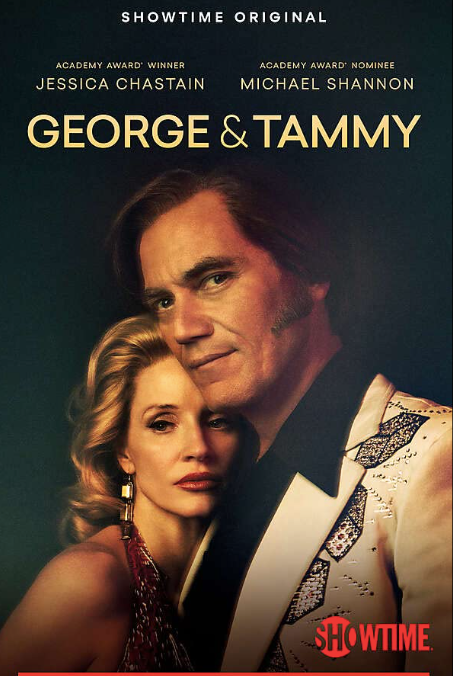
George & Tammy: Two Intertwining Stories


So, the wife and I saw George & Tammy on Showtime, and very much enjoyed it.  Neither of us are especially fans of country music, but we did also watch and really loved Nashville (the TV series) a few years ago.  So much so, that we went to a concert with some of the Nashville stars at the Felt Forum in Madison Square Garden.  (I guess we're secret country & western fans.)

Now, speaking for myself, I of course did know Tammy Wynette's blockbuster hit, "Stand By Your Man". But I'd never heard of most of other songs performed in George & Tammy, and the real joy of the limited six-episode series for me was the discovery of great country songs that were new to me.  Like "Two Story House," released by Tammy and George in 1980, with a catchy melody and a brilliant lyric (song written by Tammy, with David Lindsey and Glenn Douglas Tubb).

The story of George and Tammy --  portrayed memorably well in the song -- is actually very familiar, in reality and on the screen.  A famous male singer gets together with a talented newcomer female singer who is a big fan of his, and she soon eclipses the guy in fame and commercial success.  The personal lives similarly have those ups and downs, as they marry and break up (usually because the guy is an alcoholic) but they still love each other, to the very end.

But the performances of Jessica Chastain as Tammy and Michael Shannon as George were so incandescent and perfect -- including their singing --  that they made that old story very much vivid and alive.  And the particular ending of both the series and the true story of George and Tammy was presented so well in the final episode that whatever else you might think of the rest of the series, you'll think it was worth watching.

So bravo to everyone who made this series, and here's a video of the real Tammy and George singing "Two Story House".

See also Nashville in New York City: Reality Even Better than the Fiction

And here's about the closest I ever came to singing a country song ....

Saturday, October 26, 2019

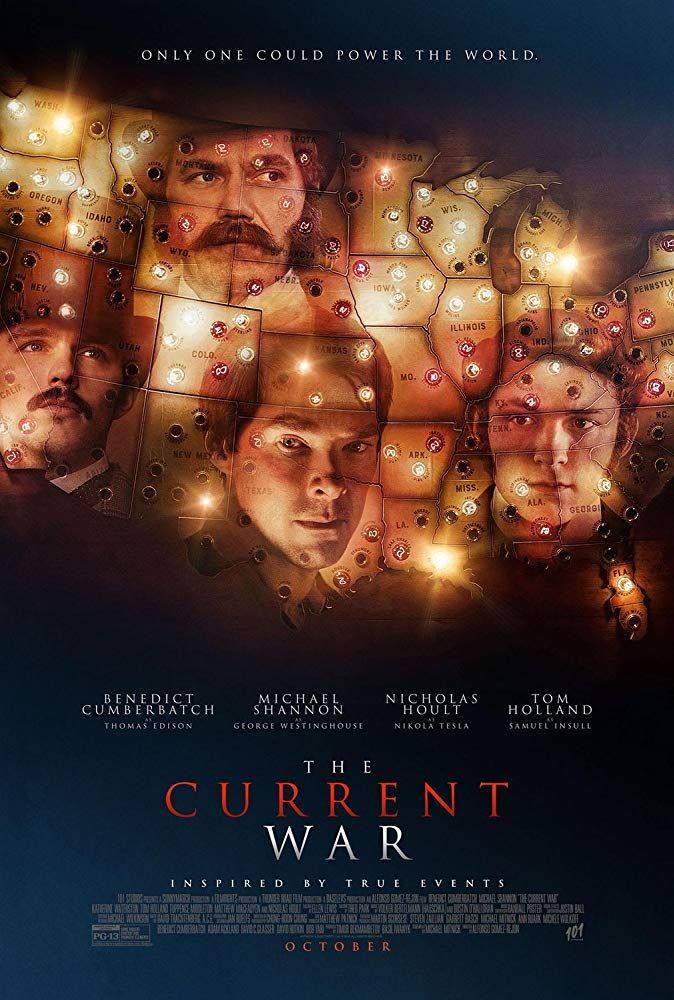
The Current War: "A Lovely Little Movie"


My wife and I just saw The Current War.  She said, as we were leaving the theater, that it was "a lovely little movie".  I agree completely.

The subject was about as big and momentous as you can get: whose brand/kind of electricity, Edison's or Westinghouse's, would become the national standard?  This "war" was fought in the 1880s and 90s.  The winner was George Westinghouse, and his AC (alternate current) indeed became the standard for delivery of electricity that we still use.

The loser, Thomas Edison, was a far more important person in history, having harnessed not only electricity in his electric light, but invented the phonograph and motion pictures (the latter also invented at pretty much the same time by the Lumière brothers in France and William Friese-Greene in England).  But Edison and his team rightly get the credit in the United States.

So what made this movie "lovely".  Edison is usually portrayed in straight-up history books as ruthless and obsessed with success.  Benedict Cumberbatch's Edison has these traits, but they're tempered by a real humanity.  Edison doesn't want to use electricity to take human lives, including in the electric chair, thought to be more humane than hanging.  Yet he gives one of the electric chair champions explicit instructions, in a brazen attempt to stain Westinghouse (also perfectly by portrayed by Michael Shannon, who, like Cumberbatch, is outstanding in everything he does).  And when the electrocution is applied, it turns out to be a very inefficient, cruel method of meting out death.  Question: Did Edison deliberately give poor instructions, because he was steadfast in his desire not to see electricity employed to kill human beings, including those convicted of murder?

The history, as far as I know it, was right on the major details, but perhaps not in every conversation portrayed.  At one point, Edison characterizes his motion pictures as doing for the eye what his invention the phonograph does for the ear.  As I always heard it, it was the phonograph does for the ear what the camera (not Edison's invention, having been invented nearly half a century earlier) does for the ear.   But who really knows.

My wife and I also really enjoyed the movie because we've long been fans of late Victorian culture.  There was something truly heady about the first use of telephones, phonographs, and electric lights,  and this was sensitively and satisfying portrayed in The Current War.  It was also instructive to see the beginning of almost no holds-barred corporate rivalry, and the manipulation of the media to win these battles.

One thing you won't find in this movie, however, is a satisfying portrait of Nikola Tesla, who is suggested as a major character but actually isn't in this narrative.  No matter, there were and will be other movies which focus more primarily on Tesla.

See the movie and enjoy the lights, the tenderness, and the struggling to set up the future, all so well shown on the screen.


Edison has a major role in this novel

Sunday, November 25, 2018

The Little Drummer Girl: Big, Riveting Story


My wife and I binged The Little Drummer Girl on AMC the past few nights, and much enjoyed it.  It's based on master spy novelist (e.g., The Spy Who Came in from the Cold, 1963) John le Carré's 1983 The Little Drummer Girl novel, but since I haven't read it, I won't offer any comparisons.  (I haven't seen the 1984 movie, either.)

The mini-series covers the same political, emotional, ethically quandaried terrain as Spielberg's superb 2005 Munich - mining, in particular, the differences in Mossad about what kinds of retaliation are warranted in the aftermaths of the Munich massacre, and in the case of Drummer Girl, in the wake of a Palestinian bomb that kills an outspoken Talmudic scholar and a young girl.  At what point does the Mossad team, in its lying and manipulation of those around them, and killing when necessary of terrorists, for the purpose not only of retaliation but prevention of future attacks, become as inhuman as those the Mossad is hunting?

Michael Shannon does a great job as Kurtz, head of the Mossad team, who will do whatever is necessary to stop Khalil, the "genius" (in Kurtz's words) responsible for the bomb that killed the scholar and the girl.   Alexander Skarsgård is similarly outstanding as Gadi, a lethally effective and charming agent who has a persistent conscience (he doesn't want to be part of the any retaliation killing).   But  Florence Pugh steals the show as Charlie, the young actress recruited by Kurtz and Gadi to infiltrate the PLO unit and bring down Khalil.   She not only lights up the screen in every scene she's in, but plays her transformations from star-struck ingenue to being almost politically seduced by the terrorists just perfectly.

The Little Drummer Girl is replete with shockers, and will keep you on the edge of your seat until the very end.  Highly recommended.

Wednesday, August 31, 2016

Elvis & Nixon on Amazon: History As It Could Have Been Written


I don't usually review comedies, but Elvis & Nixon isn't really a comedy, though it's billed as such, and even though it does have lots of laughing-out-loud scenes and lines.

But the Amazon original movie mostly is a seemingly cracked but deeply revealing double bio-pic, and a bio-pic not of two lives, but of what led up to a single moment in history when Elvis Presley met Richard Nixon in the White House.  The photograph above, the most requested from the National Archives, captured that moment.

The movie provides the background, true in general, but like all docu-dramas, replete with dialogue written for the movie.

What we learn about Nixon is nothing new, but ever fascinating to see.   He's a deeply insecure man, even in the most powerful office on the planet.  He complains to an aide, before the meeting, that he's not very good-looking, and doesn't have it as easy as guys like the Kennedys and Elvis who are.   Although Elvis doesn't hear this, he later compliments Nixon on his good lucks, as part of his successful effort to butter him up.

Elvis is riven with insecurity, too.  It's not only December 1970, but December or at very least the late Fall of Elvis's career.  Though millions of course know of him and still adore him, it's an older crowd, and he's no longer making the record-breaking records that launched him to superstardom, succeeding Frank Sinatra in the 1950s, gyrating on the Ed Sullivan show, and Elvis knows this.  He hates the Beatles, and is almost bored with his public.   Indeed his passion at this point is what brings him to the White House - collecting police badges, in pursuit of a badge as a Federal agent at large, a position he's conjured into being.

Kevin Spacey at Nixon is of course perfect and superb.  Michael Shannon, last seen to good effect on Boardwalk Empire, is outstanding as Elvis.  If you'd like to know what this off-beat movie most reminds me of it would be the second season of Fargo, which takes place in 1979.   Elvis & Nixon and Fargo have almost nothing specifically in common - the one point of similarity would be Reagan appearing in an episode of Fargo - but the two share a uniquely true, bizarre but incisive ambience you'll find in few other places on the screen.

InfiniteRegress.tv