
Chuck Todd interviews me about alternate histories
Showing posts with label Jordan Axelrad. Show all posts

Tuesday, December 2, 2025

Paul Anka: His Way: The Right Way (Except for One Missing Song)


My wife and I saw Paul Anka: His Way, a 2024 documentary, last night on HBO.  Why did we wait so long to see it?  I don't know. Probably because we weren't paying enough attention.

I've been a fan of Anka since 1957, when I was in 5th grade in PS 96 in The Bronx, and Anka had a great hit, "Diana".  Joel Iskowitz, Jordan Axelrod, Steven Auerbach, and Paul Gorman were in my class.  I started an acapella group, Little Levi and the Emeralds.  I don't think we sang much of "Diana" -- we were more into The Five Satins, The Harptones, and The Del Vikings -- but we sure loved it.

Anka explains and demonstrates at the beginning of the documentary that the ease of playing those 4-chord songs -- C, Am, F, G -- when he sat down at the piano was what drew him into singing and then writing.   And he progressed in extraordinary ways, writing "My Way" for Sinatra, the Johnny Carson theme song, and even some songs with Michael Jackson.  He also wrote "It Doesn't Matter Anymore" for Buddy Holly and "She's a Lady" for Tom Jones, and those are just a fraction of the more than 900 songs Anka has written!

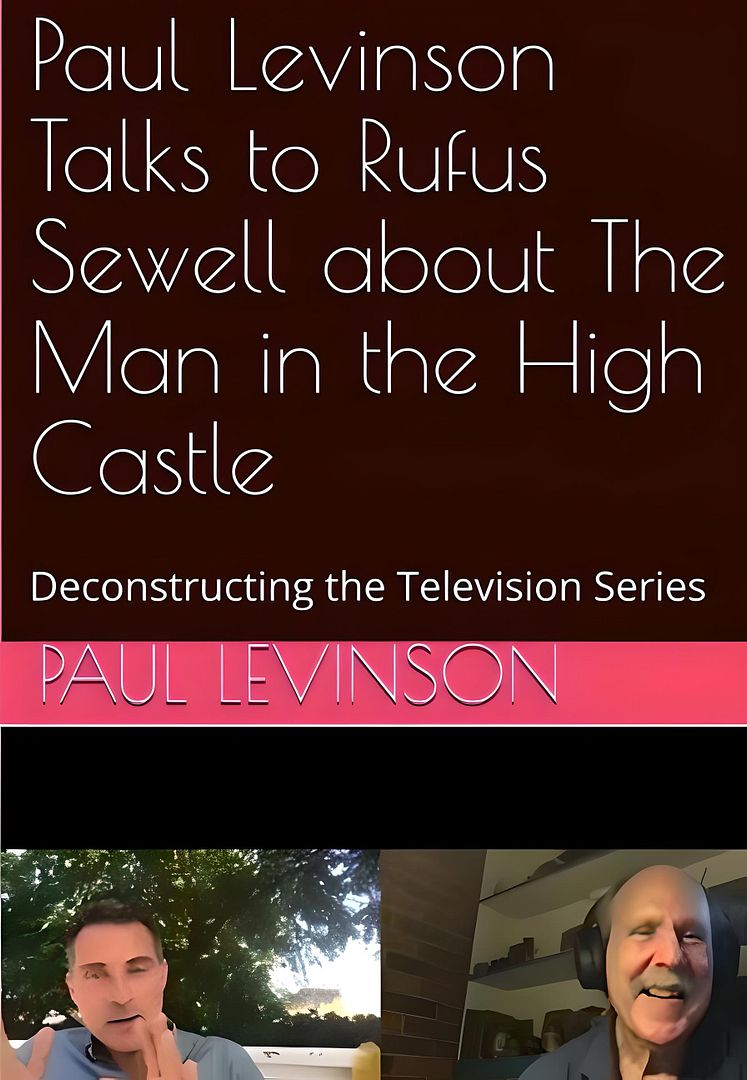
Of course, no documentary can play even small parts of most of that number of songs, but the question always arises (for me, at least) of what songs would I have liked to hear and see Paul Anka perform in His Way?  And, yes, there is one, in particular.  It's a song that played a crucial role in Amazon's adaptation  (by Frank Spotnitz) of Philip K. Dick's The Man in the High Castle, which ran for four seasons (2015-2019) and helped establish streaming as the titan it is today,  The first episode of the second season in 2016 opens with an extended mise-en-scène of protagonist John Smith's (Rufus Sewell brilliantly portrays Smith) young teenage son Thomas getting off the school bus and walking into class.  Everything seems so normally, happily, suburban American, as Thomas Smith (good job Quinn Lord) looks at the girls and walks into school.  We begin to get a disquieting taste of this alternate history in which the Nazis beat America in the Second World War when we see the Nazi insignia on Thomas's arm and then a kid in the class asks Thomas how many slaves George Washington and Thomas Jefferson had.  Thomas Smith then looks at a girl in the class in that certain way, she looks back at him when he isn't looking, but the joy of that budding teenage romance is shattered to pieces for the TV viewer when Thomas is called up to the front of the class to give a Nazi pledge of allegiance that he does with pride.  

Now, this is one of Spotnitz's best conceived and realized scenes, and he hammers it home playing Paul Anka's 1960 hit song, "My Home Town," loudly and softly in the background until Thomas begins the pledge.  This is an upbeat, zestful song, brimming with the enthusiasm and pleasures of living that is a hallmark of Anka's music, especially his early recordings -- the perfect background for the unnerving perversion of American life that the Nazi conquest has wrought.


So, yeah, I missed "My Home Town" in Paul Anka: His Way -- especially given the steps to fascism our country is currently taking -- but the documentary is titled "His Way", that is,  Paul's way, and/or the movie's director and writer John Maggio's way, not my way, and as I've been known to say to someone who tells me that they would have had a character in one of my novels do or say something different than what I had them do or say: hey, go write your own novel. :)   And all in all, there's not much I would change in this rendition of Anka's incredible inspiring life and journey.  At 84 years old, he's still going strong, hasn't reached the top of the mountain yet (as he says), and I'm looking forward to hearing and hearing about the rest of the climb.


more about this book here

Sunday, February 28, 2021

Woody Guthrie's "This Land is Your Land" -- In Yiddish, with a Message


I just love this new, Yiddish rendition of Woody Guthrie's "This Land Is Your Land" for a whole bunch of reasons.

Yiddish is a splendid language, unique in its capacity to describe certain kinds of emotions and human situations, and I'm always glad to see and hear it alive and kicking.
 
The special note at the end is also crucial -- that Woody Guthrie's song is often "sanitized," leaving out the words about "stolen land, lives, and labor," and "this Yiddish version [is] in solidarity with Indigenous, Black, and immigrant voices calling for power, reparation, and justice in this land."  Yes, indeed.  The Jewish people in America have always been strong supporters of those essential values.   

Trump did so much damage in so many areas that it's easy to overlook his Gestapo tactics towards people seeking asylum and freedom in this country on our Southern border.  I'm glad to see Joe Biden moving with speed to reunite children who were separated from their parents seeking entry to this country.  The Democrats now control both Houses of Congress as well as the White House.  Daniel Kahn raises his fist at the end, and the words on the screen urge us to "stay healthy and strong against fascism".  Yes!  And that includes Republicans whose first instinct is to trample on our American values.

In addition to Daniel, great singing by Sarah Gordon, Lorin Sklamberg, Patrick Farrell, Sveta Kundish, Michael Alpert, Linda Gritz, and Yeva Lapsker.   And thanks to Forverts (The Forward) for presenting this.

Thanks also to my old friend, Jordan Axelrad, for bringing this video to my attention.

Thursday, January 4, 2018

Snowy Days and Libraries


looking out our front window a few minutes ago
New York City and points north, west, and south have "blizzard-like conditions" today.  I almost always like these days, because, hey, I'm a professor (at Fordham University in the Bronx) and we like the schools being closed every bit as much as do the students.  And with the Web, you have all the connectivity you need to the world, without going out of your house.   But it wasn't always that way ...

Back in the mid-1960s, I lived in the Bronx, was a student at CCNY around 137th Street in Manhattan, and I worked as a clerk at the George Bruce Branch Library on 125th Street in Harlem.  That was a trip in itself.  I often got lunch at a Chinese restaurant on Broadway, where 25 cents bought a big plate of chou mien, with tea, and an orange slice for dessert.  One of the librarians at the library was Ruth Delany.  When she discovered my love of science fiction - which I read every time I was on any kind of break - she told me about her son, Sam Delany, who was just starting out as a science fiction author.  Little did I know then he would be named Grand Master by the Science Fiction Writers of America in 2013, and I would have the privilege of participating in his selection, since I was a former President of SFWA (1998-2001).

But back to the snow.  More than one blizzard hit the city in the mid-1960s, one of them on a day I was supposed to work at the George Bruce Branch.   CCNY was closed, but the trains were running on a limited schedule, and the library was open.  It had to be.  In those days, although we all had radio and television, a blizzard meant no newspaper delivery, and nothing to read unless it was already in your home.  I called the George Bruce Branch.  Mrs. Delany wasn't in, but the librarian I spoke to told me to go to my local branch - the New York Public Library had intelligently decided that the best way to keep all its branches up and running in the blizzard was have its personnel - librarians (ran the library), clerks (checked out books), and pages (shelved books) - report to work at whatever branch they could walk to.  That, for me, would be the Allerton Branch, about a 10-minute walk from where we lived on Bronx Park East, right around the corner from my Grandma Sarah (who had moved to our neighborhood after decades on the Grand Concourse), and around other corners from my friends Jordie Axelrad and Paul Gorman (Gorman was in several of my rock 'n' roll singing groups back then - here's a home recording of one of our groups, The Transits (which I named after the New York Transit Authority, which ran the trains in those days), singing I Only Want You).

I knew the Allerton Branch well, and loved it.  I used to take every book they had on dinosaurs out for as long as I could.  And when Mrs. Dayson, the librarian at my Junior High School 135, banned me from the school library because all I ever read was science fiction (more details about this here, I should also mention that I dedicated the Kindle edition of The Consciousness Plague to Mrs. Dayson), I brought my wonderful reading obsession to the Allerton Library, and read every science fiction book they had on their shelves.   Indeed, it was there that I first encountered Isaac Asimov's Foundation trilogy, to this day still my favorite science fiction on the page.  (I wrote to him with my analysis of the trilogy, and he sent me this postcard with his response.)

So I was more than happy to go back to the Allerton Branch Library in that blizzard in the 1960s.  Looking back on that time now, it's clear that society had a sensitivity, or at least the New York Public Library did, that may no longer be with us.  The idea of having workers report to the local branches during the blizzard was brilliant - it kept the libraries open to the public on a day when they were especially needed, and they allowed people who worked at the library not to miss a work day and the pay that it brought.

Here's a toast across time to whoever came up with that plan.  And for everyone else - enjoy the snow, whatever you may be reading, and wherever you may be reading it.


InfiniteRegress.tv