22 December 2024: The three latest written interviews of me are here, here and here.
Showing posts with label The Chronology Protection Case. Show all posts

Saturday, April 13, 2024

Quantum Suicide: Beholding the Eye of the Storm


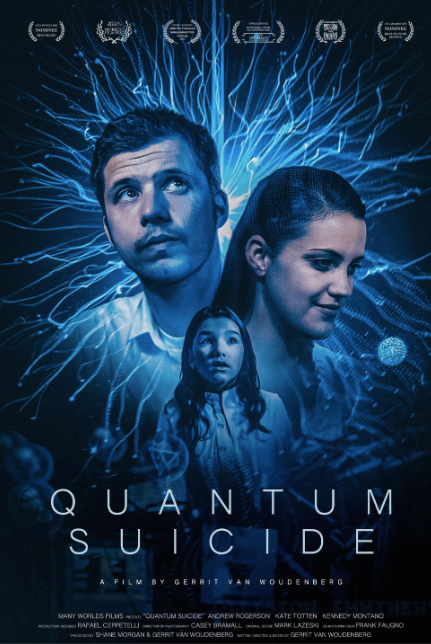
Gerrit Van Woudenberg's Quantum Suicide movie (which he wrote, directed, and -- with Shane Morgan - co-produced) won the Best Sci-Fi Dramatic Feature award at the Philip K. Dick Film Festival last week in New York.  I was at the Festival, and moderated a panel with Van Woudenberg, but I had another appointment when the movie was shown at the Festival.  Van Woudenberg was good enough to give me the URL for a screener, which I just saw and greatly enjoyed.  Herewith a non-spoiler review.

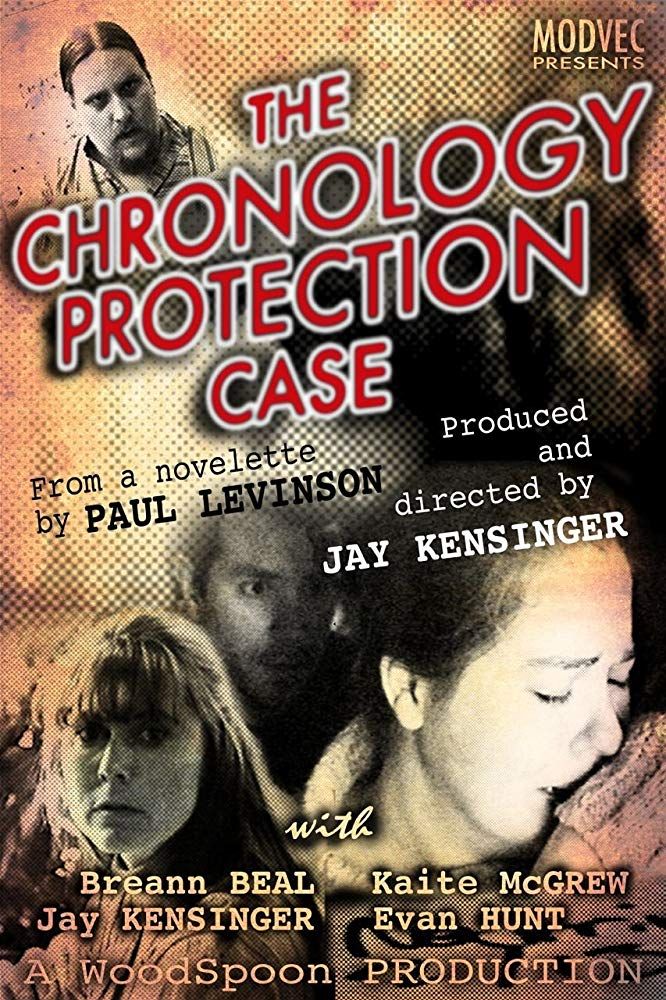
The clockwork of the movie is quantum mechanics, something which will be familiar to readers of my novelette, The Chronology Protection Case, and viewers of the short film that Jay Kensinger made from my story. The multifaceted gist of QM is that is that mere observation of quantum particles affects their location, speed, and existence; that when two particles collide and go off in opposite directions, anything that happens to one instantly influences the other, regardless of how far apart they are, and because this "quantum entanglement" happens regardless of the distance between the particles, it contradicts the widely held notion that speed of light is the ultimate speed in the universe.  Further, particles in themselves exist in either/or states, and observation of a particle determines which state the particle is in, and can even destroy it -- much like, I always think, what trying to fathom the texture of a snowflake with your fingers does to the snowflake.

Quantum Suicide takes this one crucial step further, drawing on the quantum suicide thought-experiment -- in which a gun pointed at the observer can either be shot at the observer's head or not -- and hypothesizing and weaving a story around the premise that therefore the observation of a subatomic particle can also destroy the observer.  Or, more precisely, the experimenter in the eyes of the observer.

But don't think you need to be a quantum physicist to understand and really enjoy this movie.  I'm not, at least in this universe  If you have been a big admirer of Primer -- the now classic 2004 time travel movie -- or any movie that features the scientist or scientists doing concept-bending and earth-shattering work in their spare bedroom or garage, you'll love Quantum Suicide.  Like Kensinger's The Chronology Protection Case, Quantum Suicide features detailed scientific explanations woven into the action, which always feel to me to be something Hugo Gernsback would've greatly appreciated.   And as for work-at-home science, the movie not only features the scientist and his significant other, but their next-door-neighbor, a little girl who also spends her time building radios and ant farms. 

Kennedy Montano does a good job as that precocious girl, Emily, as does Andrew Rogerson as the work-at-home experimenter Cayman with a penchant for self-destruction, and Kate Totten as his life partner Gen who observes Cayman with increasing misgiving. The music in Quantum Suicide, an original score by Mark Lazeski, is suitably pitched between anxiety and terror producing. The movie is currently making the film festival rounds, nominated for six awards and winning another. It will likely be on one of the streaming services this Fall*.  If you crave a little hard science in your science fiction you can't go wrong with Quantum Suicide, and if you don't, you don't know what you're missing.

More information about Quantum Suicide here, including a synopsis of the plot and a trailer.

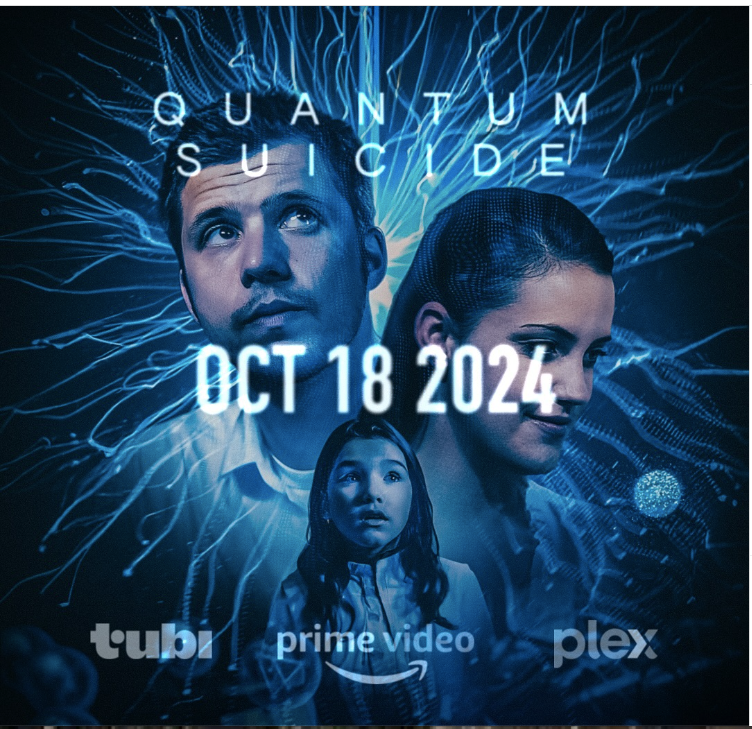
*Note added 13 October 2024: And in fact it will be debuting on Amazon Prime video October 18, 2024. Watch also for my podcast interview with Gerrit Van Woudenberg which will be up here and everywhere you listen to podcasts in the next few days.


watch the movie on Amazon Prime Video


Tuesday, October 17, 2023

podcast: Paul Levinson interviews Chris Cosmain about his Time Travel Novel 'Novikov Windows'


Welcome to Light On Light Through, Episode 356, in which I interview Chris Cosmain about his novel Novikov Windows and time travel. We also discuss how to succeed as a science fiction author.


Check out this episode!

Thursday, August 17, 2023

The Chronology Protection Case Trailer

Jay Kensinger's trailer for The Chronology Protection Case, adapted from 
my novelette, on Amazon Prime Video

Tuesday, December 21, 2021

Time Travel: Reading, Watching, Writing It


The complete lecture (with captions) I gave via Zoom to Michael Waltermathe and Christian Weidermann's Science Fiction and Philosophy class at Ruhr-University Bochum in Germany 16 December 2021. 

Saturday, June 19, 2021

Podcast Interview with Jay Kensinger about The Chronology Protection Case


Welcome to Light On Light Through, Episode 182, in which I interview Jay Kensinger about "The Chronology Protection Case," the short film he made (now on Amazon Prime) from from my 1995 Nebula nominated novelette of the same name.

  • See video of the interview
  • Read the original story
  • See the movie on Prime Video
  • Jay Kensinger's account of how he made the movie
  • complete, uncut radio play of "The Chronology Protection Case," recorded before a live audience at the Mark Goodson Theater in the Museum of Television and Radio in New York City in September 2002, nominated for the Edgar Award for Best Radio Play (radioplay written by Mark Shanahan)
  • audio reading of original "The Chronology Protection Case" [starts at 27min 20secs] 


Check out this episode!

Sunday, August 25, 2019

See You Yesterday: Time Travel meets Black Lives Matter


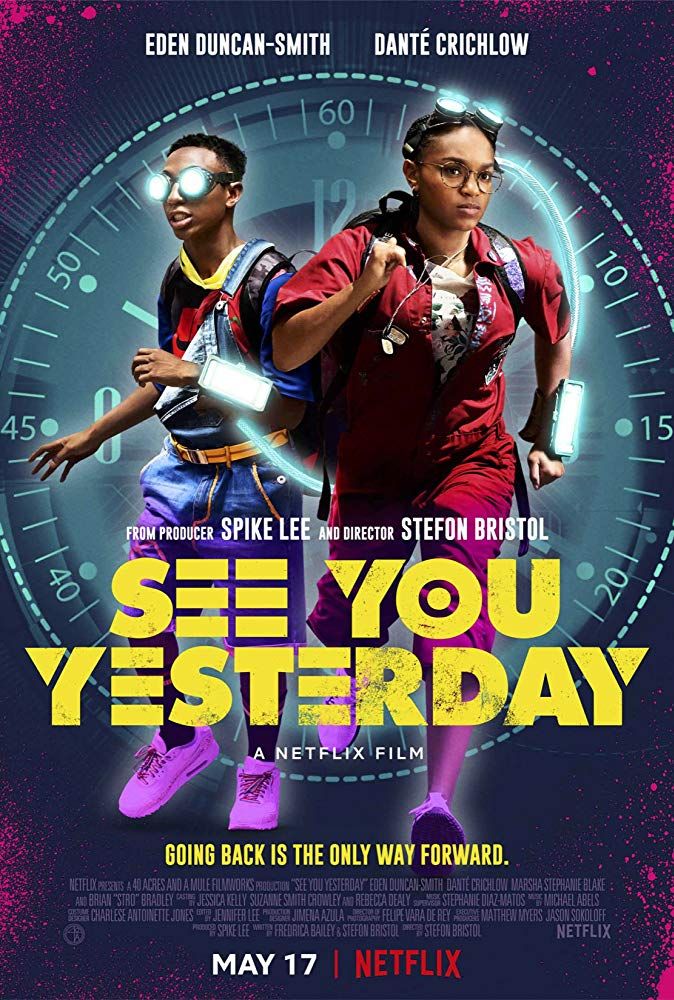
I just saw See You Yesterday, the Spike Lee production, directed and co-written by Stefon Bristol (with Fredrica Bailey), which came out on Netflix this past May.   As a time-travel story, it's good enough.  As a narrative about the continuing murder of African-American young men in American cities by cops, as told through the mechanism of time travel, it's a crucial masterpiece.

C. J. and Sebastian (well played by Eden Duncan-Smith and Dante Crichlow) are two genius Brooklyn high school kids who invent a time machine.  They use it to go a day back in time (its limit) to stop the police killing C. J.'s brother Castro (good performance by Astro), shot down by NYPD who wrongly suspect Castro of robbing a bodega.   They succeed - but Sebastian is shot and killed in the process.  C. J. goes back again to prevent that from happening, but Castro sacrifices himself to save Sebastian.  C. J. goes back one more time, and the movie ends without our knowing what happens this time ...

As I said, a good enough time travel story, by which I mean that it was done well, but we've seen the perverse difficulty of improving history via time travel, including personal history, many times before.  As a commentator on time travel and also a science fiction author, I frequently invoke the stubborn resistance of the universe to change (see, for example, The Chronology Protection Case).

But the melding of this time travel metaphysic with the brutal reality of Black Lives Matter is something we haven't seen before, and something we and everyone needs to know. C. J.'s repeated attempts to undo or prevent the cops' ill-considered, racist bullets with the same lack of result is a powerful, sobering metaphor for the difficulty of bringing to justice police who murder in our off-screen reality.   Even videos, which we've had as far back as Rodney King, beaten to within an inch of his life, don't usually help.

And the ambiguous ending of See You Yesterday similarly captures a profound and unsettling reality in the fight to educate and reform cops, and put the ones who kill innocent people behind bars.  Just as we don't know what C. J. will now do, we have no clear course of action, a pathway everyone can see, towards stopping once and for all these murders of African Americans.

But movies like See You Yesterday are part of the answer.   Getting the word out in as many ways as possible is the only way forward.   Looking into the future, I expect that See You Yesterday will become a classic in this effort.


Tuesday, March 28, 2017

Time After Time 1.5: You Can't and Can Change History

Time After Time was back with episode 1.5 last night - filmed at Silvercup's new Bronx studios, by the way, where I attended a great opening ceremony with Governor Cuomo speaking this past summer.

Changing the Bronx - bringing it back - is what Silvercup North is all about, just as changing history is what Time After Time is all about.  The very notion of time travel is about changing history.   Which is why Stephen Hawking talked about the chronology protection conjecture, and I wrote The Chronology Protection Case, basis of the movie you can see any time for free on Amazon Prime.

Now the theme of both, and of Time After Time 1.5, is that history - or the universe - won't let you change it.   So when John aka Jack the Ripper goes back to World War I in Paris to save his son, it turns out that H. G. doesn't have to go back in time himself to stop John - history, the universe, will do that all on its own.

Except when it doesn't.  Which, of course, can happen in a time travel story, since it's the writer, not really the universe, which/who is calling the shots in the story,  So I would say it's just a matter of time, to coin a phrase, until Wells or who knows who does manage to change something in history in Time After Time - whether in spite of or because of Wells' or John's interventions - just as Silvercup North has changed the course of the Bronx.

Meanwhile, the other story in Time After Time, which will somehow tie into the time machine and Wells, is the work of Brook and her brother. Tonight we saw her heal his wound with some kind of quick-acting DNA-relevant something or other.  That was not only cool, but promises some interesting gambits ahead.

I'm very much liking Time After Time, and looking forward to more.

See also Time after Time: H. G. Wells Back in Action ... Time After Time 1.3: The Red Heads ... Time After Time 1.4: "Mad as a Bag of Ferrets"


The Chronology Protection Case movie, now FREE on Amazon Prime

Monday, February 27, 2017

The Chronology Protection Case short movie now FREE on Amazon Prime


from the 1995 Nebula-nominated novelette, reprinted five times,
adapted into Edgar-nominated radio play ... here's the movie, first
released in 2002, re-cut with new, extended ending in 2013, now
available FREE on Amazon Prime for first time

Thursday, June 9, 2016

12 Monkeys 2.8: Time Itself Wants Time Travel

A really tight, excellently plotted and played, episode 2.8 of 12 Monkeys Monday night, in which time itself plays the decisive role in how the time travel plays out, with time travel itself and its continuance at stake.

 photo CPCPosterKindle02 1_zps5pemuqzw.jpg12 Monkeys has been building up to this personification of time as an entity with a will of its own all season.  I like this approach, and used it to very different effect in The Chronology Protection Case.

In Monday's episode, the fun begins when Katarina orders Cassandra to go back in time and kill Katarina.   She doesn't want to leave her daughter Hannah without her mother, so the time of the killing is literally as Hannah is dying, presumably of the plague.  James is furious about this, and goes back in time to stop it (especially fortunately for this episode, the arrival times of travelers to the past have been perfected to the instant).

Katarina understandably feels guilty about all the death her time-travel machine has engendered, especially recently.   Fortunately for the series, not only James but time itself is against this.   Every killing of Katarina results in a "re-set" of the day, with Katarina and her capacity to invent a time-travel machine still very much alive.  (I like the re-set gambit in time travel a lot, too, and used it in Unburning Alexandria).   In some ways even more heart-rending, every attempt to save Hannah's life - who, it turns out, is suffering not from the plague but something more curable - also results in a re-set.   Time itself not only wants Katarina alive, but heart-broken over the loss of her daughter - this is what it takes to get Katarina in a proper state of mind to invent the time-travel machine.

Fortunately for James and the audience, we have Jennifer on hand to explain what's going on and what needs to be done, as befits her talents as a primary.   James is able to decode her advice to change history by doing nothing, and I won't tell you the ending, in case you haven't seen it, but it's perfect.  It's also gratifying to see James and Cassandra working together and getting closer.

A great ending to a great episode, and I'm looking forward to more next week.

See also 12 Monkeys 2.1: Whatever Will Be, Will Be ... 12 Monkeys 2.2: The Serum ... 12 Monkeys 2.3: Primaries and Paradoxes ... 12 Monkeys 2.4: Saving Time ... 12 Monkeys 2.5: Jennifer's Story ... 12 Monkeys 2.6: "'Tis Death Is Dead" ... 12 Monkeys 2.7: Ultimate Universes

And see also this Italian review, w/reference to Hawking and my story, "The Chronology Protection Case"

And see also 12 Monkeys series on SyFy: Paradox Prominent and Excellent ...12 Monkeys 1.2: Your Future, His Past ... 12 Monkeys 1.3:  Paradoxes, Lies, and Near Intersections ... 12 Monkeys 1.4: "Uneasy Math" ... 12 Monkeys 1.5: The Heart of the Matter ... 12 Monkeys 1.6: Can I Get a Witness? ... 12 Monkeys 1.7: Snowden, the Virus, and the Irresistible ... 12 Monkeys 1.8: Intelligent Vaccine vs. Time Travel ... 12 Monkeys 1.9: Shelley, Keats, and Time Travel ... 12 Monkey 1.10: The Last Jump ... 12 Monkeys 1.11: What-Ifs ... 12 Monkeys 1.2: The Plunge ... 12 Monkeys Season 1 Finale: "Time Travel to Create Time Travel"

#SFWApro


Thursday, November 21, 2013

Science Fiction and Media Theory Trailers

I thought I'd put up a page, which will be continuously updated, for all the trailers that have been posted for my science fiction and media theory.  They range from 6-9 second Vine-like clips, to longer trailers of a minute or two.


Unburning Alexandria  by Paul Levinson


The Silk Code  by Paul Levinson


The Chronology Protection Case movie by Jay Kensinger
from the novelette by Paul Levinson


The Plot to Save Socrates by Paul Levinson


New New Media by Paul Levinson


Hell Scrolls - written by J. Charles Sterin, and published
by JoSara MeDia on my Connected Editions imprint

Thursday, November 14, 2013

The Chronology Protection Case released with new, extended ending

The Chronology Protection Case has been released on iTunes with a new, extended ending.

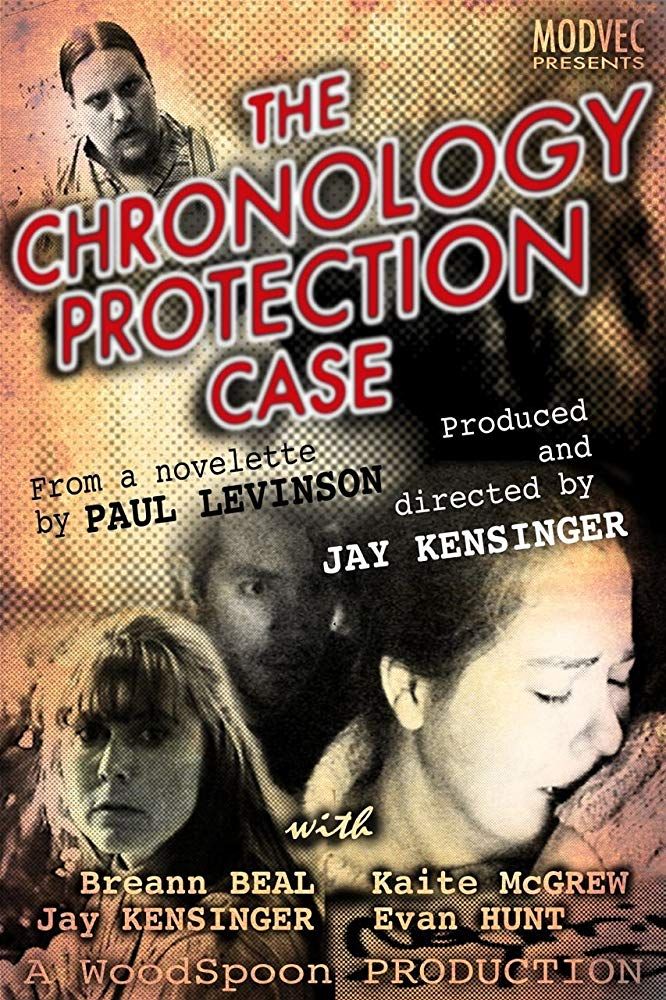
The 40-minute movie by Jay Kensinger, first released in 2002, is an adaptation of Paul Levinson's novelette "The Chronology Protection Case" - inspired by Steven Hawking's "chronology protection conjecture" - and first published in Analog Magazine in September 1995. The novelette was a finalist for the Nebula and Sturgeon Awards, reprinted five times - including in the currently best-selling Mammoth Book of Time Travel - and made into an Edgar nominated radio play.   The novelette is cited in Paul J. Nahin's A Writer's Guide to the Real Science of Plausible Time Travel as the only recent treatment in science fiction of Hawking's conjecture.

Kensinger directed, produced, wrote, and plays the role of Dr. Phil D'Amato in the movie.  D'Amato has appeared in two other novelettes by Levinson - "The Copyright Notice Case' and "The Mendelian Lamp Case" - and in three novels by Levinson, The Silk Code, The Consciousness Plague, and The Pixel Eye.

The extended ending in the 2013 release of the movie brings the story forward from 2002 to 2012, and was written by Levinson and Kensinger.  The 2002 release was shown at science fiction conventions around the east coast, including I-Con and Philcon.

A trailer follows.   More details about the movie on IMDB.


"The Chronology Protection Case" reprinted in
  • The Mammoth Book of Time Travel, ed. Mike Ashley, Robinson Books, 2013 
  • The Best Time Travel Stories of All Time, ed. Barry Malzberg, I-Books, 2003. 
  • Nebula Awards 32: SFWA's Choices for the Best Science Fiction and Fantasy of the Year, ed. Jack Dann, Harcourt Brace, 1998. 
  • Infinite Edge (online magazine), June-July 1997 
  • Supernatural Sleuths, ed. C. G. Waugh & M. Greenberg, ROC Books, 1996


#SFWApro


Paul Levinson and Jay Kensinger at The Chronology Protection Case premiere at I-Con (Stony Brook, NY), in 2002

Jay Kensinger explains how he re-cut The Chronology Protection Case.   And more here on how Paul came to write the original novelette, and how Jay came to make the movie.

Saturday, April 2, 2011

Source Code: Fringe Travel

No Fringe on tonight, so my wife and I went out to see Source Code, which turned out to be a good stand-in for Fringe.   Source Code is in fact a pretty good science fiction movie, with a plot that was a little bit bare bones, with the result that we the viewers had to figure a little too much out, almost on our own.  But a pretty good story, nonetheless.

Here's what I think happened:

Colter (a pilot from Afghanistan) wakes up in Sean's body - alive, well, and awake - on a train approaching Chicago.  He's sitting across from Christina.   He doesn't get how and why she knows him, thinks he, she, and/or everyone around him is crazy.  Before too long - 8 minutes, to be exact -  the train blows up and kills everyone.

We soon learn that Colter is really now on a mission - to find out who set the bomb that blew up the train.  His mentality is able to go back into Colter's body on that train, via a new process known as "source code".   He can be sent back for 8-minutes, to the same time, as many times as necessary - though it takes an emotional toll on him, as noticed by Colleen Goodwin (his direct supervisor, who is concerned about this) and Dr. Rutledge (head of the project, who cares only about this mission).  It is this going back as many times as necessary that has led to some characterizations of Source Code as Quantum Leap meets Groundhog DaySource Code also has some echoes of 12 Monkeys - same gritty feel in parts (just like Fringe) -  but it really has little in common with time travel.

We're eventually told by Rutledge that the source code creates an alternate reality - Colter in Sean's body on the train - and the plan is that if Colter can get the name of the bomber to Goodwin and Rutledge, they can use this to stop a much worse potential explosion, which we learn is a dirty bomb that would take out a big piece of Chicago.

It takes Colter most of the movie to get the bomber's name.  By this time, he's fallen for Christina, and wants to save her, and, while he's at it, all the people on the train.  Rutledge insists that can't happen - the source code is about influencing the future (stopping the big explosion in Chicago) not about changing the past (stopping the bomb on the train).    After Rutledge gets the name of the bomber, which leads to his being stopped before he gets to Chicago, Rutledge wants to erase Colter's memories of this and send him another mission.   Goodwin, who has more empathy for Colter, defies Rutledge and sends Colter back one more time - presumably so he can at least die feeling somewhat fulfilled, by calling his father (who thinks his son Colter was killed in Afghanistan), being with Christina one last 8-minute time, and saving her and everyone on the train by defusing the bomb.

Now we get into somewhat speculative territory.  Here's what I think happened on that score:

On this last mission to the train, Colter has indeed stopped the bomb from going off on the train - in that alternate reality.  This apparently allows that reality to continue, not only with all the original passengers on the train, but with Colter (in Sean's body), so that Christina and Colter live happily ever after, beginning with their kiss on the train that was not followed by the train exploding.

In our reality, Rutledge is furious that Goodwin defied him.  But in the alternate reality - which is now continuing beyond 8 minutes, because Colter stopped the train from exploding - Colter is able to send Goodwin a text that shows that he is not only alive in some sense in this alternate reality lab, but that another reality (our reality) had successfully sent him back to this reality - that is, the reality in which Colter was sent back numerous times from our reality - if you're still with me.

So, all in all, a pretty good story, as I said, but maybe having more in common with Fringe than any time travel story, and a bit short on clear, scientific or pseudo-scientific explanation.

And also a little short on at least one ethical issue: what happened to Sean in the alternate reality?  True, he would have died anyway, without Colter's intervention.  But now Christina thinks she's with Sean, when in "fact" she's with Colter, because in this "happy" ending Sean no longer exists.

***

Hey, if you like science fiction movies that are really about time travel, see Back to the Future, 12 Monkeys, or Deja Vu.    Or check out this low-budget 2002 short movie by Jay Kensinger, adapted from my 1995 novelette published in Analog Science Fiction and Fact Magazine ...  "The Chronology Protection Case" ....


InfiniteRegress.tv