Chuck Todd interviews me about alternate histories
Showing posts with label George Martin. Show all posts

Saturday, November 27, 2021

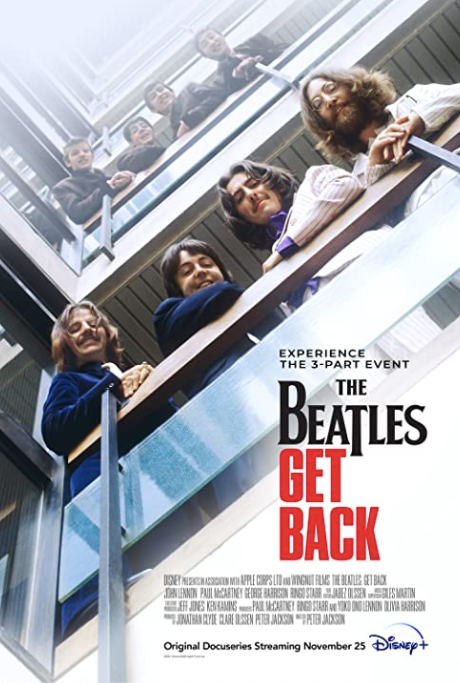
The Beatles: Get Back, Part 3: Up On the Roof


If I had to pick the single best moments in the nearly nine hours of the superb, one-of-a-kind documentary that is Peter Jackson's The Beatles: Get Back, it would be Paul McCartney saying "whew!" smiling, doing a dance, and continuing the concert, after turning and taking note of the robotic cops  (or whatever they call them in London) intruding into the Beatles' rooftop performance.  The same cops on the ground floor had been threatening arrests and claiming they weren't making threats before they demanded to go up to the roof.  Good thing they don't carry guns like the police do here in America.

Widening the focus a bit, the whole rooftop concert was a splendid, high-octane tour-de-force, finally shown in Jackson's movie in its full extent, making the original film of the concert that we've been watching all these years seem two-dimensional in comparison.  That original movie has flashes of the energy of that rooftop performance, which takes full and gorgeous expression in Jackson's documentary. 

It may have been the Beatles' finest moment.  "I've Got a Feeling," which I always really liked, is now in my top handful of all-time favorite Beatle songs -- the energy in McCartney's voice, the oh-yeahs, the nos, Lennon's bit, the instrumentation, is all just extraordinary. 

It certainly was their final moment in a public performance.  Some of the earlier part of Part 3 tells us why:

  • Paul says to George Martin -- with Paul not sure that going on the roof the next day was the best thing, John saying it was, and George Martin saying they had to respect deadlines -- "that's why I'm talking to John not you".
  • A little later, Paul's still not sure about the roof, George Harrison says he'd rather not do it, and Ringo declares they should do the roof concert.  Ringo's opinion carries the day.  But Paul is quietly a little dismayed with Ringo's opinion, or maybe that he has to put up with it.
  • George tells John he wants to do an album of just his own songs, to see "what they all sound like together".  George winds up doing none of his songs on that roof.
But there are many beautiful moments to be treasured in the footage before the concert:

  • George Harrison comes over to Ringo to help him write his song "Octopus's Garden".  It's a wonderful, redeeming moment.
  • And then George Martin gets interested in the song.  Soon we see John on drums on the song.  In previous parts, we saw Paul and George on Ringo's drums.  In an interview conducted much more recently, Ringo lamented that every time he stepped out for a cup of tea, he'd return to find someone else in The Beatles on his drums.  But it's all endearing,
  • Great jamming with Linda's daughter Heather in the studio, and it's great to see how each of The Beatles relate to her.
  • Paul really groovin' and enjoying working on one of George's songs.
  • George Harrison telling John he took John's advice, given some ten years earlier, that when you start writing a song, you should stay up and finish it.
So there was lots of love and good energy between the Beatles, even with all the problems, and the rooftop concert was magnificent.  So why didn't they stay together?  There's clearly even more to the story than Peter Jackson showed us in his documentary.  But watching it changed my perspective on The Beatles forever, largely for the better, and I'll be forever grateful Peter Jackson made it.


And here's "It's Real Life" -- free alternate history short story about The Beatles, made into a radio play and audiobook and winner of The Mary Shelley Award 2023


Sunday, June 18, 2017

Review of Rob Sheffield's Dreaming The Beatles 7 of X: Anatomy of a Ride

Been a bit since I posted a review of Rob Sheffield's Dreaming the Beatles (some 13 days), mostly because this is not a book to be rush-read or even normally read (whatever pace that might be), but savored, and also because I've been writing some science fiction, and there's also the lure of the cool water and soft beach of Cape Cod Bay.  But I wanted to record a few words about Sheffield's chapter on "Ticket to Ride", about as rich and satisfying an extended analysis you can find of a Beatles or any worthy song.

I recall well when "Ticket to Ride" came out in the Spring of 1965.  My friends and I - especially our group, on its way from The Transits to The New Outlook - knew immediately that "Ticket to Ride" was something different.  It had an edge, an imminence, a truth that none of the Beatles' songs quite had before.  (The B-side, "Please Don't Wear Red" aka "Yes It Is," is a masterpiece, too, and a personal favorite.  Not mentioned by Sheffield in this chapter, but it plays a crucial role in my 1997 Loose Ends.)

Back to "Ticket to Ride" - Sheffield tells us why.  It's a song about an adult relationship - Lennon is living with this woman.  It's a song pointed at a unique stage in their relationship - she wants to leave, she's bought a ticket to leave, but she hasn't left yet.  Maybe she won't leave (unlikely), maybe she'll come back (also unlikely), the only unambiguous note in this story is that she's deeply unhappy about living with John.   And as Sheffield aptly says, John is not arguing with her, trying to convince her to stay, he's just at the beginning of trying to understand this.

You just don't usually find relationships at this stage and presented at this level of complexity and ambiguity in love songs, although they are the marrow of real life.  This song also checks in on a quiet tally I've been keeping in my head for more than a half a century: can a love song be as socially significant as a song aimed at some social injustice?  Dylan's "Just Like A Woman" is one, rare example (as are some of Cole Porter's best works)  - but it came a year after "Ticket to Ride".  So the Beatles in terms of socially significant love songs got there first, and these two songs are all the evidence one needs that not all love songs are silly, or even just medium wise.

Sheffield also offers more testimony on behalf of George Martin's deft production skills, remarking on the perfect mix of McCartney's harmony on this track, so it provides resonance to Lennon's introspection without intruding on it.

And I'll be back sooner or later with another review.

See also Review of Rob Sheffield's Dreaming the Beatles 1 of X: The Love Affair ... 2 of X: The Heroine with a Thousand Faces ... 3 of X: Dear Beatles ... 4 of X: Paradox George ... 5 of X: The Power of Yeah ... 6 of X: The Case for Ringo ...  8 of X: Rubber Soul on July 4 ... 9 of X: Covers ... 10 of X: I. A. Richards ... 11 of X: Underrated Revolver ... 12 of X: Sgt. Pepper ... 13 of X: Beatles vs. Stones ... 14 of X: Unending 60s ... 15 of X: Voting for McCartney ... 16 of X: "I'm A Loser" ... 17 of X: The Split ... 18 of X: "Absolute Elsewhere... 19 of X: (Unnecessary but Brilliant) Defense of McCartney ... 20 of X: "All Things Must Pass" ... 21 of X: Resistance ... 22: The 70s Till the End ... 23: Near the Science Fiction Shop ... 24 of 24: The Last Two

And here's "It's Real Life" -- free alternate history short story about The Beatles, made into a radio play and audiobook and winner of The Mary Shelley Award 2023


lots of Beatles in here
InfiniteRegress.tv