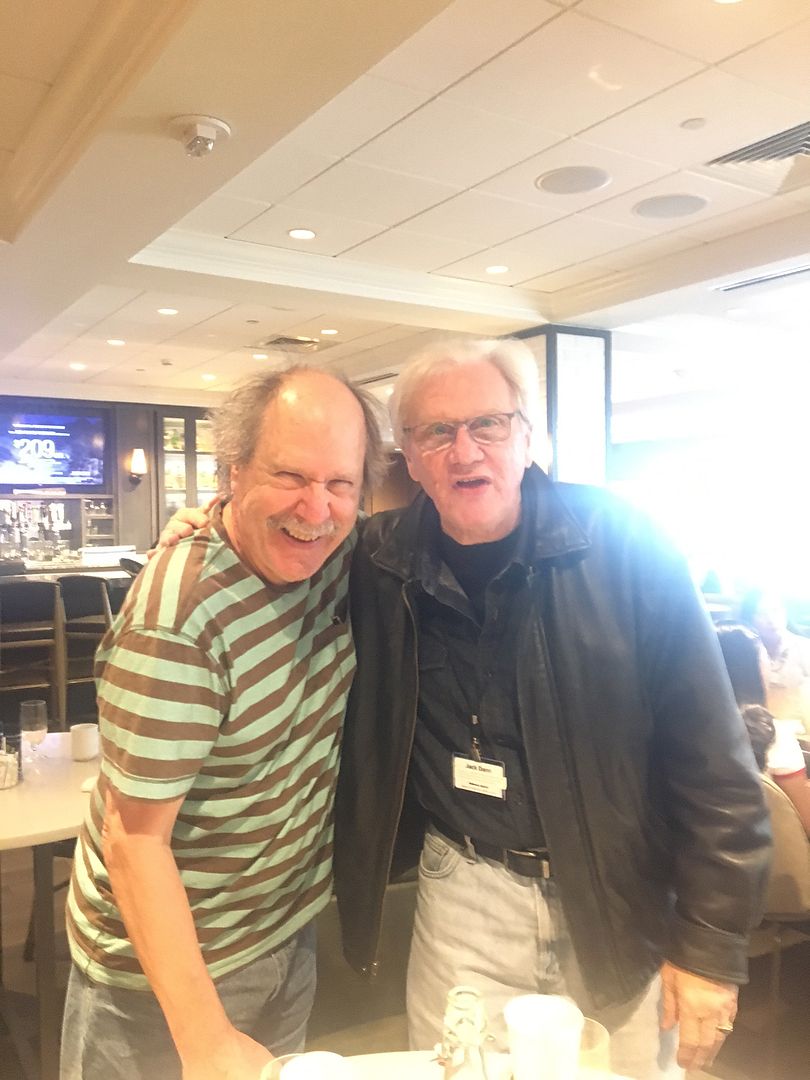
Chuck Todd interviews me about alternate histories
Showing posts with label Lance Strate. Show all posts

Thursday, May 1, 2025

Gary Gumpert's 1960 Gutenberg Galaxy, Featuring Marshall McLuhan, Harley Parker, and Robert Shafer


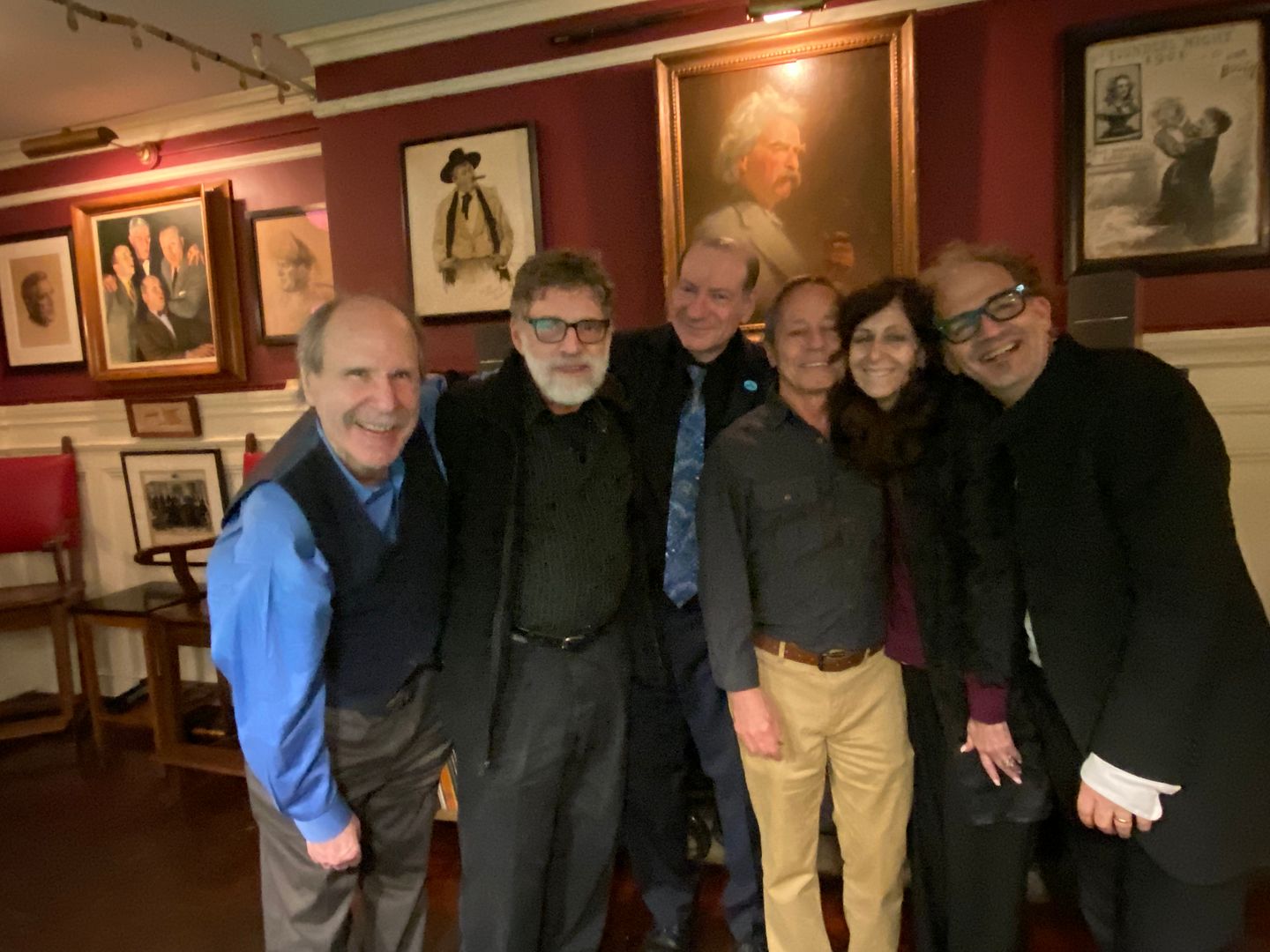
At the Gary Gumpert memorial organized by Lance Strate at The Players in Manhattan late last night: yours truly, Joshua Meyrowitz, Lance, Ed Wachtel, Susan Drucker, Thom Gencarelli (with Mark Twain and others in the back); photo by Michael Grabowski

I saw Gary Gumpert's 1960 Gutenberg Galaxy last night (April 29) at the Memorial Event for Gumpert (who left us late last year at the age of 91) organized by Lance Strate (sponsored by the Institute of General Semantics) at The Players in Manhattan.  The 30-minute black-and-white discussion between Marshall McLuhan, Harley Parker, and Robert Shafer of course is primitive -- but, hey, it had no AI, which should make some people happy (sorry, had to throw that in) -- and is easy enough to laugh at.  A TV on a stand is made to roll in, apparently of its own accord.  A single overburdened camera is made to do all the work.  But the conversation, particularly the things Marshall had to say, the comments he continually made ... well, they were more than enough for me to say this recondite bit of television is an outright, not to be missed, masterpiece.

McLuhan was 49 years old.  Much younger than I am now, just a few years older than my son is now.  His hair was jet black and his tongue was golden.  He had most of the pieces already in place that would populate every book and essay he would soon be writing.  He talked a lot about the global village.  And this was 1960, two years before the launch of the Telstar telecom satellite in 1962 that some people thought gave him the idea for his mini-essay on the global village that would appear in one of his two breakthrough books, entitled The Gutenberg Galaxy, that would appear that same year, in 1962, and would become (along with "the medium is the message" in Understanding Media in 1964) one of his two best-known "probes" (as he liked to call the brilliant insights that poured out of his mind), and indeed was recognized by scholars like me (see my Digital McLuhan in 1999) as nearly literally prescient about the Internet age.  He talked about ear-man vs. eye-man, a lesser-known but key probe he would come to call "acoustic space".  I recall walking down the street with him near the University of Toronto, must have been around 1978, when a glitzy car drove by with 1950s-style fins -- might have been a Chevy Impala -- and he looked at me with that trademark twinkle in his eyes and said, "you know, the automobile retrieves the knight in shining armor".  He didn't say that in Gutenberg Galaxy, the show Gary Gumpert directed, or in The Gutenberg Galaxy, the book McLuhan wrote, but the 30-minute televised conversation teemed with that kind of nonchalant genius that Marshall McLuhan was justly known for.  (I say "justly," because many self-appointed media "experts" who either were too jealous or lazy, or maybe just too creaky in their thinking, professed to not understand a single phrase that McLuhan so seemingly effortlessly produced.)

There does remain the question of who came up with the "Gutenberg Galaxy" phrase, Gumpert or McLuhan?  Gary Gumpert once told me point blank that he not Mcluhan had come up with that title.  I actually got to know McLuhan in person in the late 1970s a lot better than I ever knew Gumpert, and I regret that I never put the question to McLuhan in our many New York and Toronto meetings.  Thus, my final judgement on that question right now is:  I don't know.

But I do know that I hope the world, our 2025 world, gets to see Gumpert's Gutenberg Galaxy as soon as possible.  It's already been digitized.  Let's see it up on YouTube ASAP.

***

Two of my books about McLuhan: Digital McLuhan and McLuhan in Age of Social Media

McLuhan calls me after I sent him my doctoral dissertation, Human Replay: A Theory of the Evolution of Media

More about the Gumpert Memorial and the Institute of General Semantics

Published today: Tom Cooper's Wisdom Weavers: The Lives and Thoughts of Harold Innis and Marshall McLuhan


Friday, March 29, 2024

A Night at The Players in New York City


A night in which I read the first chapter of my new novel, It's Real Life: An Alternate History of The Beatles, play a little music, introduce a character who appeared in the novel, who was in the audience, and answered all kinds of questions from the audience. 

You can get the novel here.

  • "Paul Levinson's It's Real Life is a page-turning exploration into that multiverse known as rock and roll. But it is much more than a marvelous adventure narrated by a master storyteller...it is also an exquisite meditation on the very nature of alternate history." -- Jack Dann, The Fiction Writer's Guide to Alternate History

Thursday, April 12, 2018

Shout-Out to Jack Dann and Joseph F. Patrouch


This came up at Monday's conference on Touching the Face of the Cosmos: On the Intersection of Space Travel and Religion, which I organized at Fordham University.  It arose in my answer to a question I posed to the panel on "Science Fiction Looks at Space Travel and Religion" about what was each panelist's most memorable, profound, or otherwise significant example of a science fiction story, book, movie, or TV series they read or saw, in which the subject was space travel and religion.  On the panel with me were David Walton, Alex Shvartzman, and Lance Strate.  Among others in the audience were conference participants Guy Consolmagno, Molly Vozick-Levinson, Brittany Miller, Michael Waltemathe, James Heiser, Mark Shelhamer, and Tom Klinkowstein.

It was a tough question to answer - there are so many good candidate stories on page and screen - but I figured I owed my panelists and the audience my own answer.  That was actually easy for me - it was Jack Dann's Wandering Stars: An Anthology of Jewish Fantasy and Science Fiction, which is just what it sounds like.  I found it in the Science Fiction Shop - a bookstore I discovered on Hudson Street in Greenwich Village one afternoon in 1974.   I had grown up on science fiction in the 1950s and early 1960s.  (I have many times told the story of how I was banned from my Junior High School Library in 1958 by Mrs. Dayson, the librarian, because I refused to read anything other than science fiction.)  But by the early 1970s, I was more into music and protesting against the Vietnam War than I was into science fiction.  Jack Dann's anthology changed all that forever - rekindled a passion for science fiction (soon as a writer as well as reader) that would never leave me.  And it also deepened my interest in Judaism - my religion - at least a little.

Isaac Asimov wrote the Introduction to Wandering Stars - come to think of it, that's likely what gave me the idea to get Asimov to write the Preface to my own anthology, not science fiction, In Pursuit of Truth: On the Philosophy of Karl Popper, nearly ten years later.  The other book that I bought in the Science Fiction Shop that day was Joseph F. Patrouch's The Science Fiction of Isaac Asimov.  It was the first lengthy assessment of Asimov's work I'd ever read. I devoured it.  I still think it's the best.

Jack Dann and I have become friends (and he has a wonderful novella in the first Touching the Face of the Cosmos volume).  I exchanged paper mail with Joseph Patrouch some decades ago.   The Science Fiction Shop has long since closed.  But those books by Dann and Patrouch will live forever.


Paul Levinson & Jack Dann at Readercon 2019; photo by Tina Vozick

Sunday, January 7, 2018

Media Ecology: A Cartesian Review of Lance Strate's Book

As a few of you may know, I got my PhD from New York University in 1979, in Neil Postman's "Media Ecology" (then new) program.  Postman likely got the name from Marshall McLuhan, who used it in the 1960s, and whom I met and came to know and work with after Postman asked me to write a preface to McLuhan's "Laws of the Media," an early, short presentation of his "laws of the media" that Postman published in the journal et cetera (that was the name of the journal - you can read the article with the preface here).  There's more about the tetrad in my Digital McLuhan and McLuhan in Age of Social Media, and in this talk I gave at Fordham University this past October.

People always wonder what "media ecology" is.   Lance Strate, who got his PhD in the Media Ecology program in 1991, about a decade after me, wrote a book in response, and I can't think of a person better suited to provide a knowledgeable answer.  Strate, my colleague at Fordham University and indeed the person who hired me in 1998, took up the "media ecology" banner when Postman was in his declining years.  Strate created the Media Ecology Association in 1998 and it's still going strong across the world with yearly conferences.  (If you think this makes me a biased reviewer of Strate's book, too bad - read the book, see if you agree, and, if not, tell me on Twitter or wherever where you think I'm wrong - I'm @PaulLev over at Twitter, by the way.)

When reviewing scholarly books - whether in proposal form for would-be publishers, or for a review like this after publication - I always apply a Cartesian test: how accurate is the book in describing theories, ideas, and facts that I know best?  Strate's book does an A-1 job of describing my work in media theory (I generally prefer theory to ecology, but that's just me), including delving into aspects of my work - like my Tetrad "Wheels" of Cultural Evolution - that are not widely known.   As a second indicator, Strate gets Josh Meyrowitz's work just right, too.  I sat next to Josh in our PhD seminars at NYU, and I know more about Josh's work than just anyone else's other than mine.

But Media Ecology does much more.  It situates the field in the larger areas of human scholarship and discourse, connects it to dozens of scholars in addition to Meyrowitz and me, addresses the synapse of communication in everything from the universe at large to the smallest mark on a page.   So, yes, it will tell you, eminently, vividly, clearly, and compellingly what media ecology is all about.

Which I'm not going to tell you here.  Read the book.

Ok, here's a very short answer:  media ecology is about how communication in one form or another, interconnected like living organisms (hence "ecology") makes things happen in our history and our world, because communication is essential to human life.  Or, to borrow from McLuhan, the way I like to put it nowadays is:  media ecology is about how without radio, there would have been no Hitler, and without Twitter, no Trump.

All right, McLuhan, who left us in 1980, was responsible only for the radio part of that.   All I did was apply it to the present.  But that's the point about media ecology:  its principles, which as Strate abundantly shows, predate McLuhan and Postman, and now extend far beyond them, are even more relevant today than when we sat in those seminars at New York University.

To be clear, Strate and I by no means are in agreement about the impact of all or any given media on our lives.  I tend to be more optimistic than Strate, on technologies ranging from space travel to social media (notwithstanding what I think about Twitter and Trump).  But this field has always been about mastering the principles and formulating your own views.   If you'd like a handbook on how to do this, and maximize your understanding of what's going on, get a copy of Media Ecology.


Thursday, December 17, 2015

Touching the Face of the Cosmos just published


Click here, and then on Look Inside, to see Table of Contents


#SFWApro 


right after my interview John Glenn, appearing in the anthology


#7 on Amazon Kindle Top 100 Science and Religion a day after publication

Thursday, March 27, 2008

Ten Things You May Not Have Known about Sierra Waters

from Sierra Waters' MySpace blog...

=========================================================


Tags, Colors and Flavors and Love
Category: Blogging
post by Sierra Water

Lance Strate tagged me.

I confess to not knowing much about tagging in the first decade of the 21st century. But it’s been explained to me that I’m required to list 10 unknown things about me, and then tag 10 other people ... so here goes. (And I’ve got to admit that this should be fun...)

1. My favorite color is sunset orange and my favorite flavor is peach-mango.

2. I cry every time I hear the Beatles’ singing "Real Love," because it was recorded with John Lennon’s voice, years after he was killed, and the Beatles added their voices and instruments to the record. Someday, after I finish my work in Alexandria, I may try to do something about this.

3. Numbers and poetry and harmonies make my heart beat faster.

4. I’ve recently realized that a cuddle with the right person can be almost as good as making love. Actually, I know I’ve always known that, but I didn’t take the time to admit it.

5. I think of Sea Street in Quivett Neck on the Cape as "the town that time forgot." I sometimes walk there, alone, late in the moonlight. You can say hello to me there, if ever you see me.

6. With one exception, I prefer 21st century men over ancient men in bed. On the other hand, ancient women ... :)

7. Synesius, Bishop of Ptolemais, had a lot more style and substance than is admitted in most histories.

8. Falernian wine tastes so fine it makes my eyes water with joy.

9. So far, I have not been able to travel to any time in the future past the end of the 21st century - I’m not sure why.

10. I discovered that the Millennium Club in New York City was known, in an alternate reality, as the Ce-- no, I better not make this public.

Ok - I hope I haven’t revealed too much above, or transgressed any early 21st line of publicly courteous discourse.

And here are my [Sierra Waters'] ten taggees:


Becca Imako
... SciFi Fanatic ... Big God Network ...

Mysterious Galaxy Bookstore ... Sarah Beth Durst ...

Timetravel_0 ... Angelica Waters ... Chris Dickerson (Cisco) ...

Adventures in SciFi Publishing ... Larry: Poet Surfer


more about Sierra Waters...


The Plot to Save Socrates


"challenging fun" - Entertainment Weekly

"a Da Vinci-esque thriller" - New York Daily News

"Sierra Waters is sexy as hell" - curled up with a good book


Read the first chapter of The Plot to Save Socrates
.... FREE!

Sunday, March 2, 2008

MySpace Poet Lance Strate Writes Verses for Sierra Waters

MySpace poet Lance Strate has written verses for time traveller Sierra Waters ...

I sent it to one of her listening posts in 2042, and who knows if it will get through, but you can read it any time at A River Song for Sierra Waters...

Added March 3, 2008: And poet Larry Kuechlin has written this sonnet for Sierra ... Of Water

Sierra is really taking on a life of her own, with a Facebook group, a MySpace page, a Second Life life (see picture below), an appearance in an 18th century painting (see below), and now this poem...

And, of course, there will be more Sierra adventures in Unburning Alexandria...

You can read her story, known to me as of 2007, in The Plot to Save Socrates ... enjoy the first chapter, FREE!


painting by Jean-Baptiste Régnault, 1785
Socrates dragging Alcibiades from the Embrace of S.
InfiniteRegress.tv