reviewing Black Doves; Dark Matter; Dept. Q; Detective Hole; Dexter: Resurrection; Fauda; For All Mankind; Foundation; Hijack; Memory of a Killer; MobLand; Outlander; Paradise; Presumed Innocent; Reacher; Severance; Silo; Slow Horses; Smoke; Star City; Star Trek: Strange New Worlds; Tehran;The: Day of the Jackal, Diplomat, Night Agent; Your Friends & Neighbors +books, films, music, podcasts, politics
George Santayana had irrational faith in reason - I have irrational faith in TV.
Wednesday, November 27, 2024
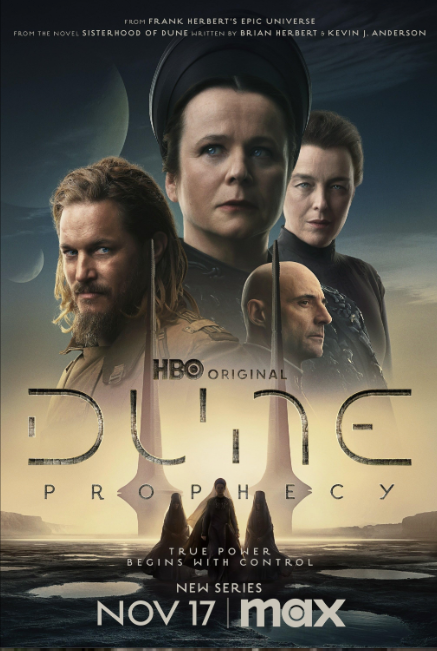
Dune: Prophecy 1.2: The Hart of the Matter

Tuesday, November 19, 2024
Dune: Prophecy 1.1: Compelling Prequel

I just watched the first episode of Dune: Prophecy on HBO Max. Here's a non-spoiler review:
This prequel to the Dune series takes place 10,148 years (you can look up whether that's Earth years) before the birth of Paul Atreides, we're told near the beginning of this first episode. Now the Dune series of novels is second only to the Foundation series of novels, I've thought ever since I started reading science fiction many years ago. And the first episode of Dune: Prophecy has a lot in common with the first Dune novel. Both have some scenes I'd rather not have read or seen. And both start off way too slowly. But Dune proceeded to be monumental in its story and impact, and Dune: Prophecy looks like it could be headed in that direction, too.
The essence of Dune: Prophecy is the establishment and growth into power of the Bene Gesserit, one of the most compelling components of the future Dune saga. The characters in this powerful order that seeks to guide and control the universe by breeding the most appropriate humans for the job are well introduced in this first episode, but my favorite character is Desmond Hart, played by Travis Fimmel, whom I first noticed in his incandescent role of Ragnar Lothbrok in Vikings. He has a way of speaking and acting that dominates every scene he's in, and leaves an indelible impression.
Someone on some social media site remarked that Dune: Prophecy was just Game of Thrones in outer space. I did hear someone comment in Dune: Prophecy about "bending" someone's will, and, as I said, there was a scene or two I would rather not have seen, but the Dune story first came out in two serials published in Analog Magazine in 1964 and 1965, followed by the novel in 1965, so if Game of Thrones and Dune: Prophecy have any connection, it's that Thrones was influenced by the narrative qualities of Prophecy rather than vice versa.
And Dune: Prophecy has a freshness and some unexpected turns -- which I won't tell you about -- all its own. I will tell you that Mark Strong as Emperor Javicco Corrino is memorable -- the Emperors have always been among my favorite Dune characters -- as are Emily Watson and Olivia Williams as the Harkonnen Sisters, who play such important roles.
So if you've been a devotee of the Dune saga, well, you can't go wrong with Prophecy. And if you haven't read or watched yourself into the Dune universe, well, you don't know what you're missing.
See also Dune, Part One: Half the Movie, Twice the Power of Most Other Complete Films ... Dune, Part Two: Not As Good as Part One
Wednesday, November 15, 2023
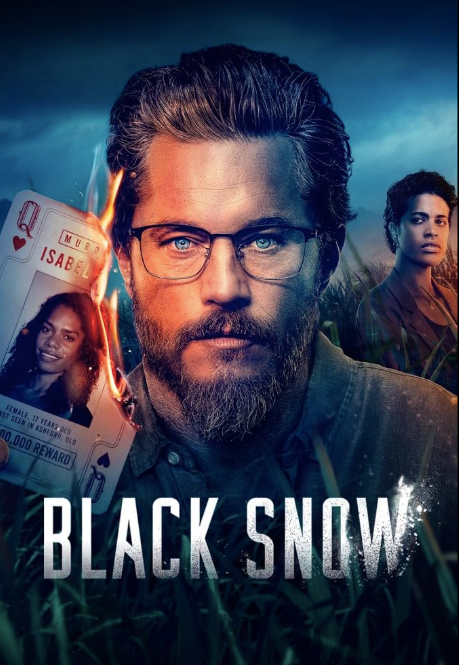
Black Snow: Sinister Histories

I consider Travis Fimmel a must-see actor. His unique, edgy style lit up his starring roles in Vikings and Raised by Wolves (canceled much too soon by HBO, in my arrogant opinion). So I would have watched Black Snow, an Australian cold-case crime drama, for that reason alone, but the series pays off not only with Fimmel but all kinds of other good reasons.
Fimmel in Black Snow plays police detective Cormack, who is drawn to investigate the murder of Isabel Baker, 17, back in 1994, because the murder took place the same day that Cormack's brother went missing.
[Spoiler's ahead ... ]
By the time the series of six episodes ends (or the first season of the series), it looks like there is no connection between Isabel and Cormack's brother. But there's at least another season of storytelling in Cormack searching for his brother, and I'd be happy to see it. And the first season establishes Cormack as a not only intelligently edgy and driven character (Fimmel's specialty), but also someone with a possible romantic relationship with Isabel's younger sister Hazel, who by 2019 (the date of the present in the series) is a totally suitable age for Comack. And the two do have a chemistry.
Black Snow has all kinds of suspects with all kinds of real and imagined motives, but on the chance that you haven't seen it, I won't reveal the killer to you. I can tell you that in addition to Fimmel's convincing acting, the rest of the cast is good, too. Talijah Blackman-Corowa has a thousand-watt smile that makes you regret Isabel's murder even more, and Jemmason Power delivers the range of emotions needed for Isabel's sister who has grown up a lot since Isabel was murdered.
As I mentioned above, there's plenty of room for a second season, and my wife and I will be watching it as soon as it's up on Acorn via Amazon Prime Video.
Friday, February 4, 2022
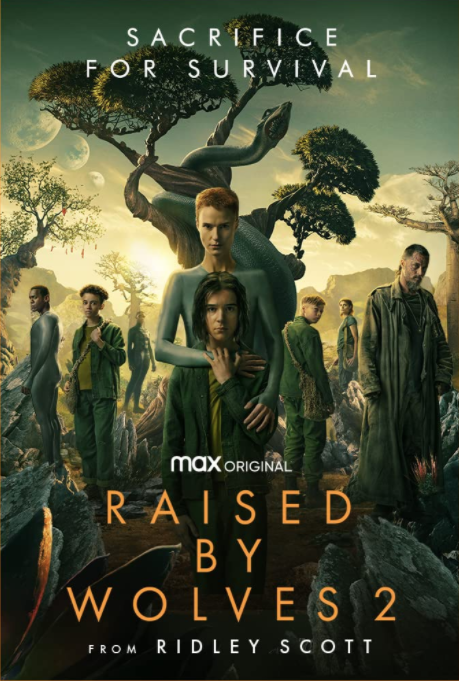
Raised by Wolves 2.1-2: A Viking Out in Space, with Androids

Raised by Wolves was back for a second season on HBO Max yesterday, with two sharp episodes that advanced the narrative in all kinds of intriguing and important ways.
Travis Fimmel was superb, as he was in the first season as the sun god prophet Marcus. The actor has a unique way of expressing emotions, which (of course) first became clear to me in Fimmel's memorable performance as Ragnar in Vikings. In Raised by Wolves, we see it again as Marcus almost seeming to channel Ragnar expresses his fury and disappointment about having to kill an atheist whom Marcus would much rather have converted to his spiritual perspective. And it worked so well -- if you think about it, Ragnar versus the Christian world is much like Marcus versus the godless world out there on that distant planet.
The unfolding story in the atheistic center was multi-layered and fascinating as well. Mother's beloved Campion doesn't see life and his world the same way as his android "mother" on a growing number of crucial issues. He doesn't see the world the same way as Paul, Marcus' adopted son, does either, but the two make a good team. And Mother (well played by Amanda Collin) and Father (well played by Abubakar Salim) don't see eye to eye, as well -- ranging from mother and father differences that we recognize in humans here on Earth (Father tells Mother she needs to treat Campion like an adult) to much more serious life and death situations.
The science fictional elements are vivid, ranging from life in the robotic center to the flying snake that seems reminiscent of Dune. In fact, the whole desert part of the Wolves story reminds of Dune, with nice frightening new ingredients like the acid water. Good thing Raised by Wolves is on in winter, when I'm not likely to want to jump in any nearby ocean for a swim.
I'll be reviewing every episode of this excellent new season of this powerful series, and I'll see you back here next week.
See also Raised by Wolves 1.1: Fast Action and Deep Philosophy ... Raised by Wolves 1.2-3: More than Meets the Eye ... Raised by Wolves 1.4-5: Halfway to Dune ...Raised by Wolves 1.6-7: The Look on Mother's Face ... Raised by Wolves 1.8-1.9: Frankenstein and Motherhood ... Raised by Wolves Season One Finale: The Serpent
Friday, September 11, 2020
Raised by Wolves 1.4-5: Halfway to Dune

I thought the 4th and 5th episodes of Raised by Wolves were really good, especially the 5th, because it gave us a nice big origin story about Mother - how she was created, and endowed/programmed with her mission. Her maker tells her she's humanity's last hope, a nod to Star Wars mythology.
But maybe because I saw the trailer for the new Dune movie the other day, maybe I would have thought this anyway, maybe both factors are at play, but Raised by Wolves really felt to me tonight to be deeply indebted to Dune. The sweeping sand dunes, the monsters hidden in and under the sand, the boy - with the two possible candidates - as the savior, all these speak Muad'dib on Arrakis.
Meanwhile, Travis Fimmel's Marcus, now leading the pack of Sol true-believers, seems increasingly like Ragnar in Vikings. Not only because Fimmel's mannerisms are the same in both narratives - which I don't mind and in fact find appropriate in both - but the characters both are subject to visions, seek advice from strange characters, and have the same reactions to women. In other words, the Marcus character played by Fimmel was deliberately designed to recall Ragnar, and that's also fine with me.
One of those characters also resonates with the Count of Monte Cristo and his mask. Except this mask was put on the character because he raped women in hibernation over the long voyage. His reason: Sol commanded him to populate the species, though he doesn't deny the carnal pleasure he obtained from following Sol's commands. Since he's in a mask, that can't help but raise the question of who he is? I'll make a wild guess: maybe the master programmer of androids who created Mother back on a dying Earth?
Anyway, these echos of Dune and Star Wars, not to mention of course Blade Runner, point to the depth of Raised by Wolves, not that it's too derivative. An important science fiction series should be standing on the shoulders of giants, and I'll be back here next week to tell you how Jack and the Beanstalk fares with these giants.
See also Raised by Wolves 1.1: Fast Action and Deep Philosophy ... Raised by Wolves 1.2-3: More than Meets the Eye
Tuesday, September 1, 2020
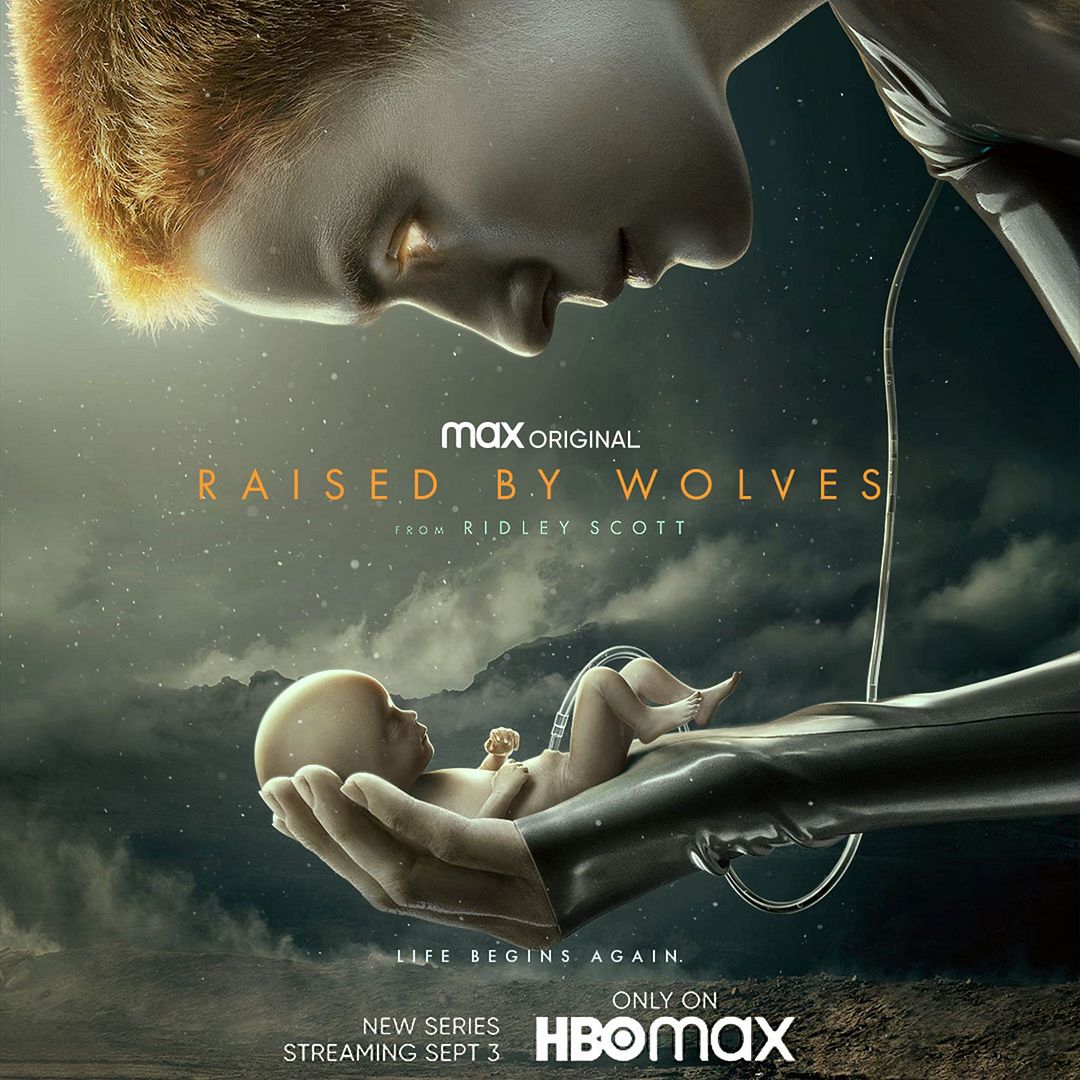
Raised by Wolves 1.1: Fast Action and Deep Philosophy

I just saw Raised by Wolves 1.1, courtesy of HBO Max, where the series is set to debut this Thursday, September 3. In a sentence, it's a big concept, altogether excellent combination of fast action and deep philosophy, as befits Executive Producer Ridley Scott, and especially well-suited to our pandemic ridden time, when the very fate of humanity could well be at stake if things get much worse.
The narrative features androids and space travel (the action) and a conflict between true believers and atheists (the philosophy) who have left a dying Earth. As such, the series is one big step more promising than the excellent Westworld, at least to my science fictional tastes, because it tells a story not only of humans and androids, but sets it way out in space, on a planet around another star. The flavor is therefore closest to 2001 than anything else, even though Raised by Wolves has not much else in common with Clarke's story and Kubrick's movie.
The special effects and overall cinematography are top-notch to the point of breathtaking at times. The acting is also fine, and it was good to see Travis Fimmel from Vikings back on the screen. Amanda Collin is fine as Mother the android, and her character comes with the awesome power of killing everything around her with a scream (reminds me, in an odd way, of the episode "Sound that Kills" in the ancient Science Fiction Theater television show). Munro Lennon-Ritchie and Jadon Holdsworth as Campion put in good performances, and it will be fun to see how this crucial character - a young boy whose allegiances to belief have not been settled as yet - develops.
I'd add that if ever there was a series I wanted to binge-watch to the end - at least, of this first season - Raised by Wolves appears to be that. But I'll take it the way it's being presented, and will be back here with subsequent reviews.
Thursday, December 22, 2016
Vikings 4.14: Penultimate Ragnar?
Among the high points of the conversation was Athelstan, how Ragnar and Ecbert both loved him, competed for his attention, with Ragnar saying and Ecbert acknowledging that Athelstan loved Ragnar more, which is why he went back to Scandinavia. (I always thought that Athelstan went back with Ragnar more from a motive to learn more about this strange new culture, than the magnetism of Ragnar, but the two factors are related.) But Ragnar also feels deep guilt about Floki's murder of Athelstan, and Ragnar's failure to protect his friend.
The appearance of Athelstan's son in many ways epitomized this profound scene. It indicated that Athestan would be continuing in some way in the flesh, and gave Ragnar another chance to show his love for Athelstan, in that long hug.
The death of Athelstan and his continuance in his son also serves as prelude for the ultimate message of the conversation between Ragnar and Ecbert. Ragnar feels his time on this Earth is ending, and he wants to take his leave in a way that most protects his sons and his legacy.
The look in Ecbert's eyes when he realizes what Ragar is asking him to do, well, just said it all - and superb, deftly effective acting in this season from both Linus Roache and Travis Fimmel.
So will Ragnar be dispatched to Valhalla in the next episode? The coming attractions certainly suggest that, but we've been surprised before, and as much as I like change, I'd like to see Ragnar stay on forever.
See also Vikings 4.1: I'll Still Take Paris ... Vikings 4.2: Sacred Texts ...Vikings 4.4: Speaking the Language ... Vikings 4.5: Knives ... Vikings 4.8: Ships Up Cliff ... Vikings 4.10: "God Bless Paris" ... Vikings 4.11: Ragnar's Sons ... Vikings 4.12: Two Expeditions ... Vikings 4.13: Family
And see also Vikings 3.1. Fighting and Farming ... Vikings 3.2: Leonard Nimoy ...Vikings 3.3: We'll Always Have Paris ... Vikings 3.4: They Call Me the Wanderer ... Vikings 3.5: Massacre ... Vikings 3.6: Athelstan and Floki ...Vikings 3.7: At the Gates ... Vikings 3.8: Battle for Paris ... Vikings 3.9: The Conquered ... Vikings Season 3 Finale: Normandy
And see also Vikings 2.1-2: Upping the Ante of Conquest ... Vikings 2.4: Wise King ... Vikings 2.5: Caught in the Middle ... Vikings 2.6: The Guardians ...Vikings 2.7: Volatile Mix ... Vikings 2.8: Great Post-Apocalyptic Narrative ... Vikings Season 2 Finale: Satisfying, Surprising, Superb
And see also Vikings ... Vikings 1.2: Lindisfarne ... Vikings 1.3: The Priest ... Vikings 1.4: Twist and Testudo ... Vikings 1.5: Freud and Family ... Vikings 1.7: Religion and Battle ... Vikings 1.8: Sacrifice
... Vikings Season 1 Finale: Below the Ash
historical science fiction - a little further back in time