Chuck Todd interviews me about alternate histories
Showing posts with label Seth MacFarlane. Show all posts

Friday, November 25, 2022

Why the "Flowers Never Bend" Performance in The Orville 3.9 Will Last Forever


This sweet soulful rendition by Gordon (Scott Grimes) and Charly (Anne Winters) of Simon & Garfunkel's "Flowers Never Bend with the Rainfall" this past July on the 9th episode of the 3rd Season of The Orville certainly wasn't the first vocal performance in a TV drama or comedy that wasn't a musical.  It's not even the first sustained singing in a Star Trek or Star Trek inspired TV show.  Uhura sang "Beyond Antares" in a memorable scene with Spock (in "The Conscience of the King,” episode 1.13 of the original Star Trek series in December 1966) and a couple of other times on the USS Enterprise on television back then.

But "Beyond Antares" was an original song, from the 23rd century, when it was heard for the first time in Star Trek, and therefore couldn't evoke any of the memories and feelings that Simon & Garfunkel's "Flowers" brought forth a few months ago, rooted in the dozens of times in millions of homes and cars in which Parsley, Sage, Rosemary and Thyme (the LP which contained "Flowers") was first released, heard, and loved in October 1966, enriched by the increasing number of people who would continue to hear that song in the years ahead, as Simon & Garfunkel, both together and individually, became and continued to be musical icons.

That was the main reason Grimes and Winters' beautiful performance really struck me the first time I heard and saw their performance in July.  The other reason was the assembled group from The Orville, who were fortunate to hear this rendition in person.   Not only who they were -- the species and role of their characters in the series -- but their expressions as Gordon and Charly sang for them were just perfect.

But this one minute and thirty seconds has really stayed with me since the summer.  I now consider it easily the best musical performance in any science fiction on the screen.  And I think I know why.

[Spoilers follow ... ]

It's because we learned, as season 3 progressed and concluded with its 10th episode, that Charly singing "my life will never end" had a meaning and resonance that Paul Simon couldn't have foreseen when he wrote those lyrics way back in the 1960s.  In that 10th episode, Charly's life does bravely end.  Her heroic sacrifice would have been hard to forget in any case.  But making that sacrifice after singing that line was a masterstroke.  Surely, Seth MacFarlane (and co-writers Brannon Braga and André Bormanis) must have known what would happen to Charly in the 10th episode when they decided to have her sing that song with that line in the 9th episode.

And I'd expect the actors in The Orville would have known about Charly's fate as well.  Look at Kelly's face around 30 seconds into the video.  She's standing next to Ed, both really enjoying the performance, smiling, but at 30 or so seconds she momentarily almost loses that smile.  And that's right around the time Charly sings, "pretend, my life will never end".  Coincidence?  I don't think so.  Was she directed to briefly lose that smile?  I have no idea -- perhaps Adrianne Palicki, who plays Kelly so well, was consciously or unconsciously in touch with what she knew was going to happen to Charly, and was hit by that awful irony.

A beautiful, haunting song, brought to life by two beautiful voices and acoustic strings, strummed and plucked, in a scene that I predict will be seen and heard in the corridors of unique science fiction forever.

Renew The Orville!

See also The Orville 3.1: Life and Death ... 3.2: "Come and Get Me ..." ... 3.3: What Do Bill Barr and Ed Mercer Have in Common? ... 3.4: The Captain's Daughter ... 3.5: Topa ... 3.6: Masterpiece of Time Travel with a Missed Opportunity ... 3.7: Seconding that Emotion ... 3.8: Dolly Parton and Topa ... 3.9: Why It's Becoming Better than any Current Star Trek ... 3.10: Matrimony and the Prime Directive

And see also The Orville 2.1: Relief and Romance ... The Orville 2.2: Porn Addiction and Planetary Disintegration ... The Orville 2.3: Alara ... The Orville 2.4: Billy Joel ... The Orville 2.5: Escape at Regor 2 ... The Orville 2.6: "Singin' in the Rain" ... The Orville 2.7: Love and Death ...  The Orville 2.8: Recalling Čapek, Part 1  ... The Orville 2.9: Recalling Čapek, Part 2 ... The Orville: 2.10: Exploding Blood ... The Orville 2.11: Time Capsule, Space Station, and Harmony ... The Orville 2.12: Hello Dolly! ... The Orville 2.13: Time Travel! ... The Orville Season 2 Finale: Alternate History!

And see also The Orville 1.1-1.5: Star Trek's Back ... The Orville 1.6-9: Masterful ... The Orville 1.10: Bring in the Clowns ... The Orville 1.11: Eating Yaphit ... The Orville 1.12: Faith in Reason and the Prime Directive


Monday, July 29, 2019

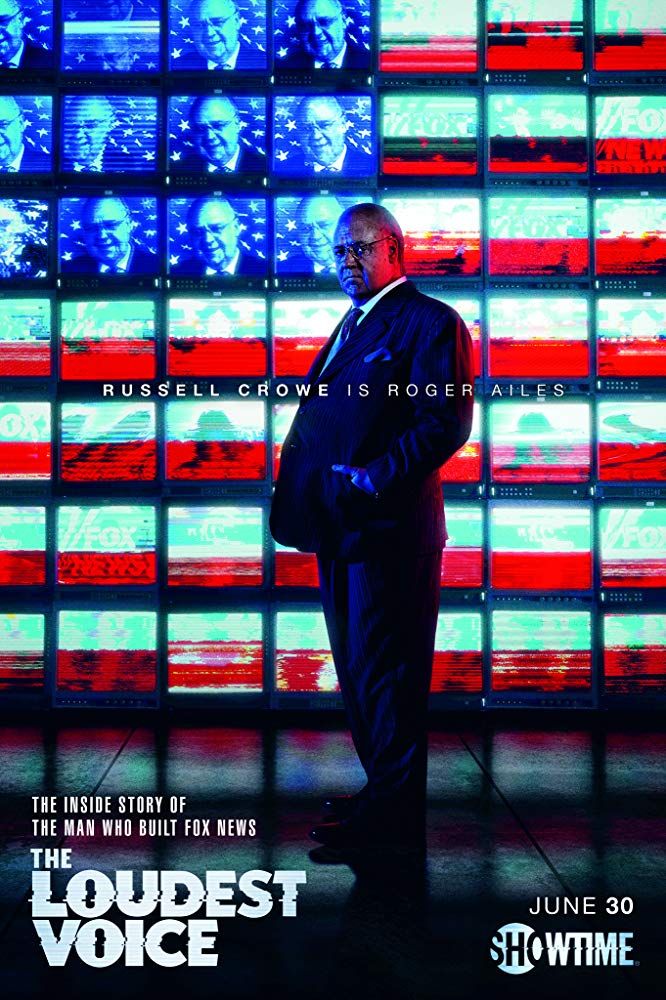
The Loudest Voice 1.5: Was Ailes Really All That Powerful?


The fifth episode of The Loudest Voice makes clear what the series has been more than hinting at all along: it was Ailes more than anyone else who put Trump in the White House.  Or, at least, the coming attractions do, after we see Ailes do his utmost to get Obama to lose in 2012.  Ailes blames his failure on that score to the lameness of Romney as a candidate.

I should point out that I'm not a particular believer in any single reason for Trump's winning in the Electoral College. Not the Russians, not Facebook, not Ailes.  All of those contributed in one way or another, but none was decisive, and even all together, those reasons, and those kinds of reasons, don't add up to a factor that was much more important: there were enough racist people in the country, along with people who see their futures eclipsed by what I and others see as progress, like health care for all, that they put Trump over the top.  Because they just happened to be in the right places to do this, given the oddities of our electoral system.

So Ailes, who played a role, was not quite the king maker he's made out to be in The Loudest Voice, and Ailes himself apparently and presumably believed.  A genius for understanding what a significant segment of the American public wanted in its news, yes.  A paranoid conservative with boundless confidence, willing to always act on those beliefs, yes.  A womanizer, yes.   But if he was responsible for Trump, he shares that awful distinction with millions of other Americans.

Back to tonight's episode, it was another powerhouse of docu-drama.   His firing of Brian Lewis, his near destruction of Joe, his groping of Gretchen - all parts strongly played by their actors (Seth MacFarlane, Emory Cohen, Naomi Watts) - not to mention the searing off-the-charts performance of Russell Crowe as Ailes - make The Loudest Voice a show to behold.

See also:  The Loudest Voice 1.1: Fox Launch ... The Loudest Voice 1.2: September 11 and After ... The Loudest Voice 1.3: Prelude to Trump ... The Loudest Voice 1.4: "We Create the News"


Friday, April 19, 2019

The Orville 2.13: Time Travel!


I've said many times in my many places that time travel is my favorite genre of science fiction.  The best episodes of Star Trek TOS and TNG were time travel stories - "City on the Edge of Forever" in TOS, "Yesterday's Enterprise" in TNG.  So I was expecting that sooner or later The Orville would check in with a time travel story - if not quite as superb as the TOS and TNG stories, right up there in excellence, anyway.   It did so tonight.

The time travel goodies in episode 2.13 come in three parts:

1. Kelly, seven years younger, arrives on The Orville, after some quantum force or whatever amplifies the power of a nascent time-travel device.  On the deck, the main characters discuss how that could be - wouldn't current Kelly remember that her younger self appeared on The Orville?  Everyone agrees that the answer to this paradox is the multiple worlds hypothesis - a new reality in which young Kelly appeared, right next to older Kelly and older Ed, was created at the instant young Kelly traveled to the future.  That new reality is separate from the original reality in which we have been watching The Orville. Good for The Orville for (a) recognizing the paradox (not every time travel story does), and (b) coming up with the best solution (multiple worlds).

2. Isaac et al figure out a way to send young Kelly back to her time (after some fun romantic interludes with Ed, and some soul searching conversations with her older self).  But ... if young Kelly successfully returns to her past, which would be the same as the past she left, how come older Kelly has no memory of her time as her younger self in the future?  Claire can give her a memory wipe.  Another good solution to a temporal problem, and I liked the deft way the metaphysics switched from multiple realities to time travel in a single reality frame.

3.  Young Kelly gets back to her past, but when young Ed calls her the next day, she tells him that they shouldn't see each other.  Nice touch!  The memory wipe may have erased the memories but not the visceral feelings Kelly brought back with her from the future.   Of course, the two will have to get together sooner or later, otherwise the stories we've been seeing on The Orville the past two seasons would be completely undermined.  My guess is young Ed will be persistent and young Kelly will choose him over her misgivings from the future.

And there could be an implicit part 4 to this, as well.  The experience tonight will get older Kelly and older Ed to get back together in the future. Or - maybe they'll read this and decide not to, because they don't want their future prescribed by some blog review.  Either way, tonight and its aftermath will make for a great story (and continued fine acting by Adrianne Palicki and Seth MacFarlane).

See also The Orville 2.1: Relief and Romance ... The Orville 2.2: Porn Addiction and Planetary Disintegration ... The Orville 2.3: Alara ... The Orville 2.4: Billy Joel ... The Orville 2.5: Escape at Regor 2 ... The Orville 2.6: "Singin' in the Rain" ... The Orville 2.7: Love and Death ...  The Orville 2.8: Recalling Čapek, Part 1  ... The Orville 2.9: Recalling Čapek, Part 2 ... The Orville: 2.10: Exploding Blood ... The Orville 2.11: Time Capsule, Space Station, and Harmony ... The Orville 2.12: Hello Dolly!

And see also The Orville 1.1-1.5: Star Trek's Back ... The Orville 1.6-9: Masterful ... The Orville 1.10: Bring in the Clowns ... The Orville 1.11: Eating Yaphit ... The Orville 1.12: Faith in Reason and the Prime Directive


watch The Chronology Protection Case FREE on Amazon Prime


Friday, January 11, 2019

The Orville 2.3: Alara


A really outstanding episode of The Orville tonight - 2.3 - high on powerful storyline, a little less broad humor than usual (but enough to get some chuckles) - and that was before the shocker of an ending.

It's always satisfying to see a nonhuman world fleshed out, and we get that as Alara goes back to her home planet Xelayah and her family, to get a slow cure for her physical deterioration.  Plus we get a good psycho story, in the form of John Billingsley playing an intelligent neighbor driven over the edge by the need to avenge (a perfect part for Billingsley) the death of his son, which he sees as due to Alara's father (played by another natural in the role, Robert Picardo).   We get beautiful seaside scenes - which reminded me of where we go for summers on Cape Cod - and an unnerving rendition of  you can't trust the neighbors.  (I told my wife that now I'm a little worried about our neighbors on the Cape).

But that ending... Alara announces, after she returns to The Orville and is back in the fold, that she want to go home to her planet and family.  This is a refreshing, even brilliant, twist on similar stories we've encountered many times before, in science fiction and otherwise, which always end with the character in question returning from that alluring shore leave to resume her or his professional post.  Kudos to Cherry Chevapravatdumrong for writing this and Seth MacFarlane for approving this (though I have no idea who came up with the twist).  Jon Cassar, whose work I always liked in 24, did a good job directing.

But amidst all this praise, I can't say I'm happy at all about Alara leaving.  I'm hoping that the real twist here will be that she rejoins The Orville pretty soon.  When departures like this happen, it's always possible that the actress called this shot, because she got a starring role in a big movie.  Halston Sage could certainly carry such a role - but I'd still rather see her continue her fine work on The Orville.

I'll keep you posted.


love across alternate realities

See also The Orville 2.1: Relief and Romance ... The Orville 2.2: Porn Addiction and Planetary Disintegration

And see also The Orville 1.1-1.5: Star Trek's Back ... The Orville 1.6-9: Masterful ... The Orville 1.10: Bring in the Clowns ... The Orville 1.11: Eating Yaphit ... The Orville 1.12: Faith in Reason and the Prime Directive


1st starship to Alpha Centauri ... had only enough fuel to get there

Thursday, December 7, 2017

The Orville 1.12: Faith in Reason and the Prime Directive


An excellent season 1 finale of The Orville tonight - 1.12 - which picks up on what I long ago adopted as the mantra of this blog (see above), what George Santayana called an "irrational faith in reason".

That philosophic recognition - that the value of reason cannot be demonstrated without an appeal to reason, which in assuming the value of the very proposition under investigation is circular reasoning, or illogical, and is a form of infinite regress - was a cornerstone not only Santayana's philosophy, but Bertrand Russell's and Karl Popper's.

In The Orville, it's the solution to a violation of what in Star Trek is known as the prime directive, or the need for an advanced civilization to keep clear of any less-advanced civilization, lest it pollute it and derail its evolution.  Of course, in Star Trek that happened all the time - Kirk violated the Prime Directive with near abandon - and it happens tonight when Kelly visits a planet, in a primitive stage of pre-civilization, that phases into our universe every 700 or so years in its timeline, which plays out as 11 or so days in ours.  In the tritest part of the story, a religious cult grows up around Kelly.  But the resolution is pretty nifty.

And it entails a faith in reason.  Isaac is left on the planet - because, as in Star Trek, the only way to undo a contamination caused by a violation of the Prime Directive is to violate it again (a sort of paradox in itself) - and he manages to transform the faith in Kelly into a faith in reason.   And this, as Santayana, Russell, and Popper argued, is the basis or best defense of rationality over irrationality on our Planet Earth, as well.

Did Seth MacFarlane read those philosophers?  Maybe, very likely, who knows?  But what I do know is that he's created a space opera it is as profound as it is funny - or maybe as funny as it is profound - and it's funny and profound indeed.

And I'll see you all here for season 2.

See also The Orville 1.1-1.5: Star Trek's Back ... The Orville 1.6-9: Masterful ... The Orville 1.10: Bring in the Clowns ... The Orville 1.11: Eating Yaphit


1st starship to Alpha Centauri ... had only enough fuel to get there

Monday, November 13, 2017

The Orville 1.1-5: Star Trek's Back!

I'd planned on catching up on all the episodes of The Orville thus far before writing a review, but episode 1.5 was so good - and a time travel story to boot, my favorite kind of science fiction - that I couldn't wait any longer.  So here's this, and then I'll post another review when I'm caught up, and then I'll review every episode that comes after.

First, let me thank my colleague at Fordham University, Lance Strate, who recommended The Orville to me just last week.  He has a pretty good track record, his best recommendation so far being the reboot of Battlestar Galactica, which was much better than the original and superb.

I'm tempted to say The Orville is to Star Trek: The Original Series as Battlestar Galactica 2004 was to Battlestar Galactica 1978, but that wouldn't be quite right, because: (1) The original Star Trek was one of the best series ever on television, and the first BSG was, if not one of the worst, certainly nothing special, and (2) Battlestar Galactica 2004 was so dark as to be apocalyptic whereas The Orville is laugh-out-loud funny.

That's not surprising, since Seth MacFarlane not only stars in this latter day Star Trek as Captain Ed Mercer but is the creator of the series.  And the jokes are not only funny and continuous, with words like "dick" tossed around in just about every episode, but they don't interfere in the slightest with the outstanding science fiction in every episode, which was the strong suit of the original Star Trek.

In fact, I'd say The Orville is more like Star Trek the original series, truer to its pace and elan and sense of wonder, than any Star Trek since, with the exception of Star Trek: The Next Generation, which was in some ways better and some ways worse (and, come to think of it, The Orville is in some ways more reminiscent of the best parts of TNG and its interspecies-diverse crew than it is of TOS).  But everything else that's come since, whether on TV or in the movies, is just not as good, whatever their redeeming qualities.  (Ok, I only saw the first episode of Discovery, because I'm too cheap to pay for yet another streaming service, but that first episode was at best only all right in comparison to the first episode of The Orville.)

I won't summarize that for you - if you haven't seen it, do - but each of the five episodes I've seen so far packs a different kind of punch.  To return to episode 5, it's not quite as good as "City on the Edge of Forever" from TOS or "Yesterday's Enterprise" from TNG -- which are about the two best hours of time travel ever on television -- but it's pretty close, has respect for all the paradoxes of time travel, and like almost all fine time travel, even a thread I don't quite get.  When Kelly confronts Ed about telling the time traveler about Kelly and Ed's marital problems (they got divorced, because Ed found Kelly in bed with an alien who came in blue),  Ed says of course the time traveler knew, she came from the future, and Kelly says no, our problem took place in the past, and Ed admits he told the traveler.  But ... wait a minute, maybe that was a joke!

Kelly, by the way, is played by Adrianne Palicki of Friday Night Lights, and I'm always happy to see a star from that great series on TV again, just as I am about anyone from The Wire.  The crew, by the way, consists of five humans (Ed and Kelly, a woman doctor, and two guys on the bridge or whatever that is), a younger officer who looks like a Bajoran (well played by Halston Sage), a Lt.  Commander of some sort who looks like a Klingon (and lays an egg - not a bad joke, as Ed quips, but offspring), and some kind of highly intelligent android who sounds like Data but looks like the Tinman digital edition and maybe a little C3PO.  There's also an intelligent kind of slime with Norm MacDonald's voice, but I'm not sure if he's part of the crew.  These homages to Star Trek are of course deliberate and delightful, as is the music and the overall feel of the series.

Star Trek's back!

See also: The Orville 1.6-9: Masterful ... The Orville 1.10: Bring in the Clowns


1st starship to Alpha Centauri ... had only enough fuel to get there
InfiniteRegress.tv