
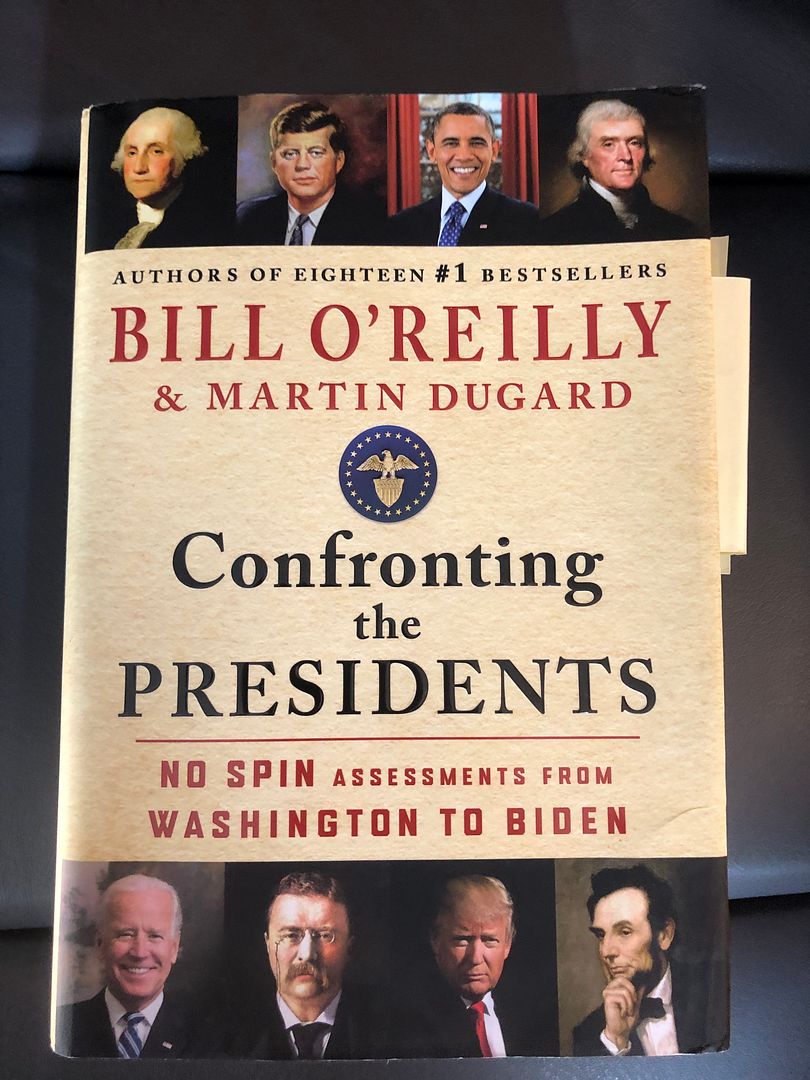
I started reading Bill O'Reilly and Martin Dugard's new 400+ page book on Friday. I finished it last night -- Monday night. That should give you an idea of how important and captivating Confronting the Presidents is.
It is subtitled "No Spin Assessments from Washington to Biden". But that obscures what the book actually is: assessments of US Presidents from Washington to Obama, co-written by O'Reilly and Dugard, followed by assessments of Trump and Biden written by O'Reilly, and assessments of Trump and Biden written by Dugard. I'll explain near the end of this review why I think that distinction is crucial.
First, let me begin by saying I was on the O'Reilly's Fox show, The Factor, several times over 20 years ago (here's the video of my first appearance in January 2004), and four times on O'Reilly's No Spin News podcast several years ago. We have strongly different political opinions, but I very much enjoyed our conversations. O'Reilly has written numerous best-selling books, and O'Reilly and Dugard have a best-selling series (the "Killing" series about assassinations, attempted assassinations, killings of terrorists, etc), which I haven't read, but based on the writing in Confronting the Presidents, I expect that I eventually will, or at least read some of the books.
That writing is crisp, informative, and even exciting. In part because most of it is in the present tense -- "At the start of Jefferson's second term, he is sixty-one years old. He is no longer the young idealist...." And in part because it has so many facts, big and little, that I didn't know and, after reading them in Confronting the Presidents, I think I should have known. Like Theodore Roosevelt planning to run for a third term as president in 1919, before he died, and LBJ having a decades-long affair with Alice Glass, which Lady Bird knew about, and only ended when Alice left him because she was so furious about the Vietnam War.
We learn what each president ate for breakfast (right, I find that interesting), what kind of exercise they preferred, and how they died. There's lots of humor in the book, but cradled in an underlying gravity and mortality. And this is not because of what happened to Lincoln, Garfield, McKinley, and JFK, and almost happened to several others, but because as the authors make clear, the job of president, given the power to make one's dreams come true, is almost guaranteed not to be fulfilled, meaning your dreams will end up broken, their only chance being some future president may pick one up and carry it to victory in some more hospitable time.
Another salient point of history which I already knew as a media historian, and Confronting the Presidents makes abundantly clear, is that the intense polarization in our current world, (wrongly often blamed on social media, I would say), actually has been in the United States of America from the very beginning. Editors of newspapers were prosecuted under the Alien and Sedition Act that John Adams signed into law, and O'Reilly and Dugard tell us that Alexander Hamilton wrote that Adams was "a mere old woman and unfit for president".
As a professor and lifelong student of communication and media studies, I was also glad to see that Confronting the Presidents notes that First Lady "Carrie" Harrison brought electricity to the White House but she and her husband Benjamin (1889-1893) were afraid of being electrocuted, radio began to have a big influence on politics in the 1920s, and of course TV took center stage in the 1960s. (See my continually updated McLuhan in an Age of Social Media for how and when television gave way to the social media president.)
***
But this powerhouse book, brimming with fascinating, useful, and important information, concludes its confrontation of presidents with Barack Obama. An "Afterword" briefly gives O'Reilly's and Dugard's assessments of Trump and Biden independently. The reason for this change in format isn't given, but it must be because Trump's presidency may not be finished (he's currently running for a second term), and at the time the book was written, neither was Biden's (he had not yet withdrawn from the current election).
I'm making such a big deal about this because O'Reilly's assessments of Trump and Biden are the first in the book I strongly disagree with. No mention is made of Trump's treatment of COVID, and the attack on the Capitol he instigated on January 6, 2021 is barely mentioned, as a political mistake, not the fundamental attack on our democracy that it was. Even more incredibly, O'Reilly ranks Biden as the second worst president in American history (after James Buchanan).
As I said at the beginning of this review, O'Reilly and I are on opposite sides of the political spectrum. But I was nonetheless taken aback by what he said about Biden and didn't say about Trump because I found his joint assessments with Dugard about other progressive presidents like Obama and Clinton, and conservatives like Nixon, to be right on key.
Obviously, Dugard was a moderating factor, and he had plenty to say in his own assessment of Trump about January 6, 2021 (because of this, he ranks Trump the worst president, one below Herbert Hoover). Dugard also had some praise for Biden, and went so far as to say he hopes Biden wins in 2024 (the book was completed, again, before Biden withdrew from the race).
So what you'll get from Confronting the Presidents is a fair and balanced -- to use that Fox cliche -- assessment of every American President prior to Trump. Then, for Trump and Biden, separate assessments from each author, which taken together accurately reflect the current polarization of this country.
I'm not sure what I would have suggested to the two authors prior to publication about how to conclude this book. Maybe conclude with Obama with no Afterword. Or maybe struggle to find some common ground as the authors did for every other president. But I can say I recommend this book to anyone who'd like to have a handy, accessible guide to the people who have been at the top of our noble, imperfect experiment with democracy.


