Chuck Todd interviews me about alternate histories
Showing posts with label Fringe. Show all posts

Monday, May 24, 2021

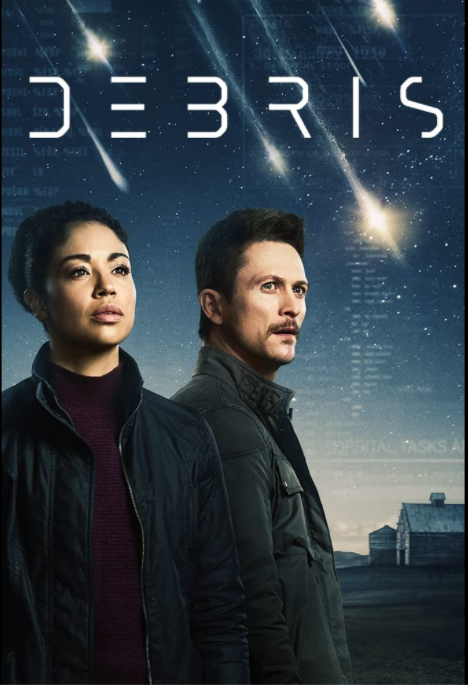
Debris Season One Finale: Fringe with a Vengeance

Well, I and many others have been saying how reminiscent Debris is of Fringe, and sure enough, in tonight's season one finale, John Noble shows up as maybe the head of Influx, certainly at least a little higher than Anson and Finola's father.   In any case, Noble's Otto is a lot meaner than Walter Bishop, and very likely doesn't have a cow that gives milk in his lab.  (Just dawned on me that maybe Devin Nunes has some connection to all of this?)

We'll no doubt be seeing more of Otto in season two, if there is such a season, which we don't yet know.  And there were lots of other promising developments in tonight's finale.  Finola's father is totally in with Influx.   Bryan had some very early encounter with Debris, and he's been taking injections to ward off possible ill effects, which is exactly what happened tonight.  And in the last minute or so of this episode, we see a clone or whatever in the works for and of Finola.

I'm still very partial not only to the show, but the Influx credo which Finola's father again eloquently intoned tonight: let the people not their governments decide what to do with the interstellar tech that has fallen to Earth.   As I mentioned in a review of an earlier episode, I made essentially the same point at 1min24secs to 1min47secs in this 2010 interview on the History Channel:


But I do think Debris has been too diffuse this season, too slow to get to the punchline, though all of this took a sharp turn for the better with the two-part alternate reality episode a few weeks back.  I say, give Debris another season to find its pace.  Extraterrestrial technology is a hugely suggestive tableau, and I'd like to see another season of it realized.

Friday, March 12, 2021

Debris 1.2: Clones


Well, I liked Debris 1.2 on NBC this week considerably more than 1.1 the week before, and that's always a good sign.  The story hung together a little better, and maybe that was because its main theme was clones.

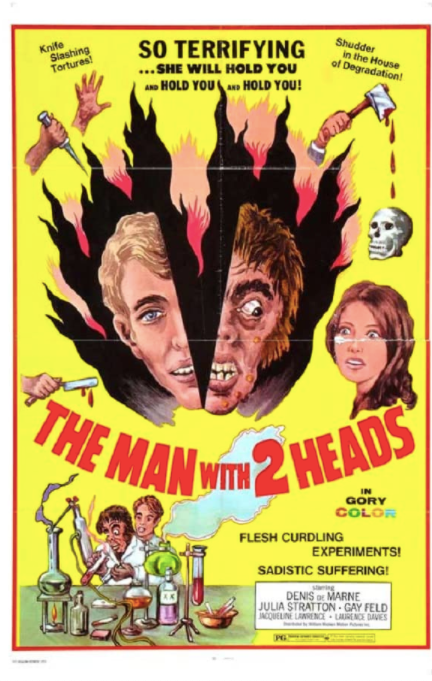
One -- or, at least two -- were clones of Bryan.  He kills one of them, which gave Craig the opportunity of getting off a good sarcastic line, something to the effect that it hurts to kill what you love most in this world.  The other was a clone of Bryan with two heads, which harkened back to some movie from back in the 1970s, I think, about a guy with two heads (ok, here it is, The Thing With Two Heads, starring Rosey Grier, 1972).


I should have mentioned last week that the creator of Debris is J. H. Wyman who did a lot of work on the late, lamented Fringe.   That show had a deliberate B-movie 1950s feel to it, which Debris almost happily picks up on.  I don't mean this as an insult.  I've been a fan since I was eight or nine years old.


The other clone of interest in this episode is Eric, who is wounded by a piece of alien debris that fell on his house, which then did him the favor of creating some of clones of him, while it moved pieces of cars and other non-alien wreckage around his home.   To mark the spot?  Who knows, or why.

The pace of Debris is amazingly slow in terms of telling us what's really going on here.  It holds its cards very close to its chest.  So far, in two weeks, all we've learned about the grand scheme of things in this narrative is that an alien shipwreck left debris on Planet Earth which is causing all kinds of strange effects.

As in Fringe, these effects so far are a blend of horror and science fiction, and that's ok by me.  But I'd like to learn more, and  I guess that's the reason for the slow pace.  I'd also like to see a little more story for Finnola the MI-6 agent, played by Riann Steele.

See also Debris 1.1 Some Probability of Gems Among the Pieces

first starship to Alpha Centauri ... and they only had enough fuel to get there


Sunday, June 9, 2019

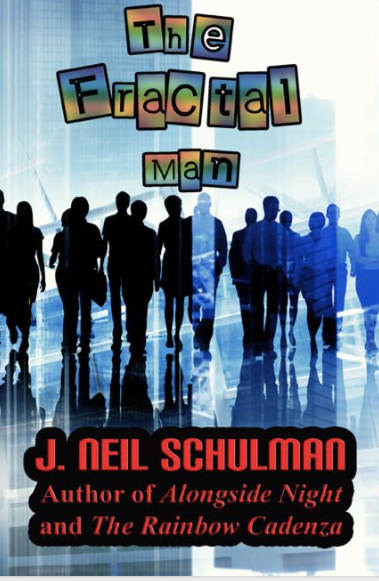
Review of J. Neil Schulman's The Fractal Man: Alternate Reality Autobiographies


Alternate realities have become something of a vogue in science fiction, especially on television with Fringe and Counterpart.  I've even tried my hand at it in a few short stories such as The Other Car.  But J. Neil Schulman has outdone all of this with his novel The Fractal Man, which for most of its 160 some odd pages - meant literally as well as a figure of speech here - is not only a masterpiece of alternate reality, but one of the best science fiction novels I've ever read, literally.

It's also a tour de force of meta-fiction and autobiography.  What do I mean by that?  Well, the main character - the narrator - is David Albaugh, a character in Schulman's 1979 novel Alongside Night, played by Schulman in the 2014 movie that Schulman wrote and directed.  In The Fractal Man, we meet Schulman - one of Albaugh's fractals, i.e., existences in an alternate reality - to the point of the character Schulman warning Albaugh about a danger that lies ahead, because, after all, Schulman wrote Albaugh's account of Albaugh's  alternate reality adventures which is the novel The Fractal Man.   I'd say I'm a sucker for that kind of science fiction, but if a I'm a sucker for delighting in that, then anyone with any appreciation for the finer tropes of science fiction, carried to their logical extents and well beyond, should be a sucker, too.

And the novel is chocked full of tidbits to delight the science fiction devotee and anyone with a taste for new ways of thinking about old things.   Distant galaxies that we see in our reality may be alternate timelines.   Arguments that a couple may have over whether an event unfolded this way or that way may reflect an alternate reality that one of the couple for some reason came from or has access to.   Everything from timeless music to time travel is woven into the undulating fabric.  It's all served up so well that I don't even mind that Schulman and most of his alternates are thorough-going libertarians, in contrast to me (I'm an absolutist only about the government keeping its hands off of all media and communication, i.e., the First Amendment). 

Schulman sprinkles in some of his real libertarian friends as greater and lesser characters in this novel.   We know each other and have worked together, but I can't hold it too much against him that I didn't make the grade, because I'm not a close friend of his, and, as I said, I'm not an across-the-board libertarian.   And he makes up for this with some derring-do espionage escapades across realities, and a galactic scope that reminds of both Asimov and Heinlein, which is no mean feat  (Schulman, at least in this reality, did an important interview with Heinlein in 1973).

What I do hold against the novel is a long play within the novel, near the end, that has lots of relevance to the novel's philosophy and was excellent in and of itself, but comes out of left field, so much so that the reader is offered the option of skipping ahead.  This doesn't exonerate the play's inclusion.

But, hey, the rest of the novel is so bright and wonderful - such an intellectually exciting and satisfying ride - that I put it up there with David S. Michaels and Daniel Brenton's Red Moon and David Walton's Three Laws Lethal (to be published in two days, look for my review) as one of the best standalone science fiction novels I've ever had the pleasure of reading.   Is it a contradiction to describe The Fractal Man and its immersion in alternate realities as a standalone novel?  There's a sequel afoot - "The Metronome Misnomer - the title comes from a fractal version of the author in The Fractal Man, who wrote a book of that title in an alternate timeline" (this quote from Schulman's biography at the end of The Fractal Man) - so you may not need to answer that.


more alternate reality - "flat-out fantastic" - Scifi and Scary

Tuesday, April 10, 2018

The Crossing 1.2: Calling for More Time Travel

The Crossing moved into its regular season last night - or maybe it did a week ago, when its first episode was rebroadcast on ABC, having first played earlier on Hulu - but the series is anything but regular, and I mean that in pretty much a good way.

It's part time travel, part super-humans ala (I guess) Fringe, and part fast-driving FBI and local law enforcement caught up in a conspiracy and a plague from the future and all kinds of things.  Readers of Infinite Regress won't be surprised to find that the part I find most interesting is the time travel, but that part's been the least developed so far.  It's only the second episode, and there's still time to roll this out, but so far we have no idea how the time travel was created or stumbled upon, only that hundreds of "commons" came here from the future, that some number have been here for a long time already, and that at least one super-human or Apex came along for the ride, too.

Instead of the time travel, we've seen a lot of scenes with the Apex - a mother who loves her common (adopted) girl - finding the girl as a little baby in the future, and frantically looking for her in our present where (when) they both traveled.  She has a tempestuous (so far, only professional) relationship with the local sheriff, and manages to survive massive hit squads, though not unscathed.

Another Strike Force show we don't need - though the first rendition of that series was excellent, and I'm starting to watch the second.  Instead, we - meaning, I - could use a well-done time travel narrative.  (I can always use one of those.) But for this to happen, we need to see more time travel in The Crossing, and learn more - much more - about it.

In terms of other similar series, Lost was hit and miss (but mostly hit), the same for Fringe, but The Event (whose producers Jay Beattie and Dan Dworkin also are creators of The Crossing) and Alcatraz never really got off the ground or hit their stride because they lacked a clear allegiance to the time-travel genre or in fact any genre.  Will be fun to see if The Crossing is more like Lost or Alcatraz.

See also The Crossing: Lost Again, But OK

Sunday, February 25, 2018

Counterpart 1.6: Alternate Prince, Funeral, and Clear Clare

Another deeply interesting episode - 1.6 - of Counterpart tonight, which moves the story along in tantalizing drops and a big reveal.

As I've said earlier, Counterpart is if nothing else a taut spy story, though of course it's something more.  That duality - spy story and something more - was captured perfectly in the "love the lie" conversation between Howard Prime and the butcher's widow.  She assumes that HP and her husband were spies for Russia or the United States.  That would be compelling enough, in the way that any good spy story is.  But of course, Howard Prime and we know that they were/are spies for an alternate reality.

And we learn through this episode that that alternate reality really has it in for us.  The deaths they're meting out are more than you get in the usual spy games.   The killings are part of an effort to wipe us out completely.

What are they - the alternates us's - so angry about?  I mean, we learn that Prince is still alive there.  Not as momentous as JFK (the big reveal about the alternate reality in Fringe), and not as wonderful as saving John Lennon would be (at least, in my book, figuratively and literally - in "Saving Lennon" in Peter Brown Called, but I won't tell you if the time traveler succeeds) - but, hey, Prince living is still pretty impressive.   But that's not enough to budge the huge chip on alternate Berlin's shoulder.  The look in Clare's eyes at the end is clear and deadly.

But there's also some hope, I suppose, in Howard Prime, who does have more of good Howard in him than meets the eye, showing real compassion to the butcher's widow.  And even Nadia at the edge of her alternate's funeral may be thinking something vaguely humane.

I'm looking forward to finding out more next week.


See also  Counterpart 1.1: Fringe on Espionage ... Counterpart 1.2: Two Different Worlds ... Counterpart 1.3: Identification and Pandemic ... Counterpart 1.4: The Switch ... Counterpart 1.5: Ménage à Alternates


Friday, February 16, 2018

The Cloverfield Paradox: Fringe Meets Star Trek


Well, there really wasn't any paradox in it (things going very wrong does not equate to paradox), and the story was at least much horror as science fiction, but The Cloverfield Paradox on Netflix was pretty good science fiction of the alternate-reality variety anyway.

Earth in the future is in the throws of a grievous energy crisis.  Hope is placed in a new particle accelerator, to be tested in the Cloverfield space station.  A slightly nutty scientist or sooth-sayer warns that the energies that will be released in this test could rip reality apart and unleash untold monsters.  Of course, no one pays him any heed.

But indeed the tests do rip reality apart, or at least bring it into interactive smashing contact with another reality.  This is manifested by a woman who shows up in the metalwork of the station - literally - and a guy who loses his arm to the other reality (the arm comes back and writes our crew vital information), and you get the picture.  This is what I meant by Fringe (the Star Trek part comes from the crew in space).  The Cloverfield Paradox somehow mixes horror and humor in a way that only J. J. Abrams, one of the producers, can do it (hey, maybe that's the paradox).

There are good surprises, double-crosses, and breathtaking scenes throughout.  The protagonist, Ava (well played by Gugu Mbatha-Raw, pictured above) is given the choice of reuniting with the family she lost in her/our reality - she can do this by going to the alternate reality - or saving our reality.   I won't tell what she does.

I will say that the changes unleashed by the particle accelerator usher in all kinds of horrors not only in space, but Earth as well.  Enjoy.


more alternate reality - "flat-out fantastic" - Scifi and Scary

Tuesday, December 26, 2017

Triple Hit: Parallel Schrödingers

Parallel worlds lurk behind a lot of time travel - since one way of getting around the paradox of that, if you changed the past, how would the earlier you in the future know that the past needed to be changed if it no longer existed, but if the new reality were a parallel reality, in which the event that needed changing now never happened, there would be no problem, since the time traveler came from the old reality - but it's not often been explored in the movies, though it was a mainstay of Fringe and is the theme of Counterpart, just now beginning on Starz.

All of which is to say I was eager to see Triple Hit, because it's a movie (free on Amazon), in which parallel universes are almost the whole story.  The "almost," though, is its main problem, since it also brings in space travel and time travel, and is a bit of a free-for-all hodge-podge of science fiction tropes.

But it has its moments.  Triple Hit (2009, originally Schrödinger's Girl - you ever notice how the original titles are usually much better than what they've been changed to?) tells the story of Rebecca/Anastasia/Sarah, Dave/David/Dmitri, Matt/Matthew/Mateus, etc in three parallel realities (worlds) in which Rebecca/Anastasia/Sarah is/are trying to break on through to at least one of the other realities.  All of the realities are some version of our United Kingdom.  One of them is pretty much like ours, another seems like a high-tech white-coated European Union, and the third, the most fun, is a "People's Republic," replete with a statue of Stalin and obeisance to the Soviet Union(!).

Of course something goes wrong with the attempt and frenetic craziness and mayhem ensue, done up almost in a slapstick 1950s bug-eyed-monster B-movie kind of style.  So ... it's hard to take Triple Hit seriously, but it is fun, especially in the wee hours of the morning, with good multiple campy performances by Abigail Tarttelin as Rebecca/Anastasia/Sarah.  See it if parallel worlds are your cups of tea.

  
more parallel realities ...

Sunday, December 10, 2017

Counterpart 1.1: Fringe on Espionage

One of the best parts of the late, lamented Fringe - in fact, maybe the best part, tied for first place with its time travel - was its alternate reality.  It was brought about by Walter some years earlier - actually, not brought about, but Walter brought into being the bridge - which in turn brought us access to an alternate reality in which JFK wasn't assassinated, Walter was sane, and lots of cool things like that.

Counterpart - the first episode of which was on Starz tonight as a sneak peak preview - has a lot of that Fringy quality, but so far, nothing as major in the two realities as JFK survived in one of them.  Instead - and instead of the science fiction that inhabited every scene in Fringe - we get what could be a first class espionage story.

The other Howard Silk - perfectly played by J. K. Simmons - tells our Howard Silk (also perfectly played by Simmons) - that one reality split into two due to some Cold War experiment gone wrong 30 years ago.   So both Silks were exactly the same until that split, sharing not only identical DNA but identical memories.

One nice part of this story, so far, is that it's not completely clear which reality is ours - that is, which one is the reality I'm now in as I write this review.  Well, I guess since the show Counterpart exists in neither of the two realities in the show Counterpart, the answer is I'm now in neither.

But you know what I mean when I wonder which reality on the screen is ours, and I'd say it's the one in which Howard is a tough spy not a Caspar Milquetoast.  There's also an excellent twist at the end of the first episode pertaining to the tough Howard, but I won't spoil it for you.

I will be back in January with more reviews when Counterpart resumes.


more alternate reality - "flat-out fantastic" - Scifi and Scary

Saturday, August 20, 2016

Stranger Things 1.6-1.8: Lando to Fringe


And herewith a review of the last three episodes of Stranger Things, Season 1 -

  • I say Season 1, because the ending certainly cries out for another season.  That, and the justified popularity of Season 1, makes a second season a dead certainty - or maybe live certainty would be a better word, given the context.
  • El aka Eleven is certainly alive in some form - why else would Hopper be leaving her favorite food for her out in the woods?  And this of course opens a whole bunch of questions starting from what happened to her when she destroyed the monster, to why is she hiding in or near the woods?
  • Will's being infected by the tentacled monster is the trite part of the ending, but it provides a good, dangerous foundation for things to come.
  • Is Barb dead? Probably/maybe - I thought I saw her with a tentacle in her mouth, and no one as far as we know rescued her, but you never know.
  • Dr. Brenner looks like he was killed, too - but without seeing a dismembered or eaten-before-our-eyes body, you never know about that, either.
In general, I'd say this fine series is most reminiscent of Fringe, especially with the tank of water being a conduit to another plane.  Fringe, of course, was 21st century not 1980s, but it was very 1950s retro - see Fringe Science for more on this - so Stranger Things is retro even if it comes by that via an intentional or unintentional indebtedness to Fringe.

Stranger Things also has a great sense of humor, with the riffs on Lando Calrission being my favorite in the concluding episodes.  Bring on the next season already!

See also Stranger Things 1.1-1.5: Parallel Horror


more parallel worlds ... "flat-out fantastic" - Scifi and Scary

Saturday, January 24, 2015

12 Monkeys series 1.3: Paradoxes, Lies, and Near Intersections

Well, I broke down and watched the next episode of 12 Monkeys - 1.3, available on SyFy On Demand for just 24 hours from midnight last night.  Hey, why shouldn't I watch a show earlier than it's being aired, it's a show about time travel, right?   But be forewarned - or warned, or whatever the proper usage - to either not read this review until after 10pm Eastern next week, January 30, or get a few soft spoilers here.

First, and this is not a spoiler, I've been meaning to point out the coincidence of 12 Monkeys on television as a series so soon after the Ebola outbreak that dominated much of our news in the real world this past Fall.   This obviously trumps and is much more significant that the fortuitous North Korean coincidence in episode 1.2 last week (or, actually, yesterday).   Indeed, the nearness of Ebola to 12 Monkeys gives the series an urgency and verisimilitude that it wouldn't have had just last year, in January 2014.

And a lot of the action in 1.3 takes place in Haiti, as Cassandra goes there in 2014 to stop a plague that could be THE plague but turns out to be just river fever, whatever exactly that is.   But the real action here is Cassandra (and Jones) telling Cole to keep clear of Cassandra in Haiti - he too is on a mission there - so as not to contaminate i.e., bend the timeline which Cole will need from Cassandra in the future. Back in Haiti, Cole also manages to scar the Tom Noonan creepo character, thereby closing that little loop, as well as kill someone that Cassandra slept with and was beginning to really care about, but Cole doesn't know this (until later, in the future, when he lies to Cassandra about killing Andre).  All of which is testament to the care that this series is taking in following the logical consequences of the paradoxes that time travel engenders - keep the paradoxes ever in mind, and steering clear of them whenever possible - which as I said in my review of the first episode is a hallmark of good time travel science fiction in my book.    I should also say, apropos Cole and Cassandra, that Aaron Stanford and Amanda Schull are both doing a really excellent, appealing, and convincing job in those lead roles.

Meanwhile, there's also some important action taking place in the 2040s future of the story - much more than in the movie, by the way.   Ramse (played by Kirk Acevedo of Fringe fame) is a major character in this future, where we learn that the time travel facility may soon be under attack from some kind of human group not sick, as far as we know.

At this point, I'm enjoying the television series about as much as the movie - including the differences, which is saying a lot indeed, because the movie was superb.  But the paradoxes, lies, and near intersections through time are making 12 Monkeys exceptional television.

See also 12 Monkeys series on SyFy: Paradox Prominent and Excellent ... 12 Monkeys 1.2: Your Future, His Past ... 12 Monkeys 1.4: "Uneasy Math"

podcast review of Predestination and 12 Monkeys


 three time travel novels: the Sierra Waters trilogy

 photo LateLessons1_zpsogsvk12k.jpg
three time travel stories (with more to come)


The Chronology Protection Case movie 

~~~ +++ ~~~

#SFWApro

Monday, December 8, 2014

The Affair 1.8: "I Love You / I Love You, Too"

It was good to see The Affair 1.8 tonight - I missed it last week.   The episode could have been titled "Noah to the rescue," which was the way Alison sees Noah, in her attempt to deal with her self-possessed mother and her grandmother's impeding death and after.

Significantly, Cole is as always wrapped up in his business - selling the ranch - and gives Alison almost no support - the support she needs and wants from him - in her struggle to come to terms with her grandmother's fate.  Cole of all people should understand why this is so painful and important to Alison, putting her in touch, as it does, with how she felt and still feels about the loss of their son.  But Cole is what he is, and even being good and loving in bed doesn't make him what Alison so keenly requires at this point in her life.

But Noah is.  In contrast to Cole's unaware remoteness,  Noah in one of his best scenes in the series seeks to comfort Alison by telling her the crucial truth that the loss of a parent or grandparent, wounding as it might be, is not in league with the anguish of losing a child.   Noah never lost a child (as far as we know).  But he's just a more sensitive person than Cole, and because of that he is what Alison most needs at this moment.

Since all of this occurs in Alison's story, what we're seeing here is her good opinion of Noah, and how he came through for her.  They don't (yet) sleep together again, but this will be the foundation of why they soon will, even though Noah was the one who ended that affair of the summer and Alison thus has every reason not to want to ever see him again, let alone in bed. The crucial exchange here is where Noah softly tells Alison, "I love you," and she replies, "I love you, too."  That says it all.

Meanwhile, we get a long view of Helen tonight - that is, how Noah sees Helen in the aftermath of his confession.  She doesn't accept his gift, and in the psychologist's office - played by Blair Brown (of recent Fringe fame, along with Joshua Jackson) - we learn that she married Noah because she thought he was "safe" - something which he certainly can't be happy to hear.

The conversation between Noah and his father-in-law Bruce is also important, because, like in A Christmas Carol, it gives Noah a glimpse of his future, and what he might well feel if he lets Alison vanish from his life.

The police detective is in menacing presence at the ends of both half hours. As I've previously said, I find this part of the story usually the least compelling.  The great strength of The Affair is its profound human drama, and I'm looking forward to more of that next week.


podcast review of every 1st season episode

Tuesday, October 7, 2014

The Affair Premiere: Sneak Preview Review

Just saw The Affair's first episode, nearly a week before show time on Showtime, thanks to Showtime On Demand, for everyone who has that.   The following review has spoilers.

The first episode is neatly split into two parts - two, mirror stories - a he-said, she-said, about the beginning of the affair, or how Noah and Alison first met.  This is a good piece of writing, with agreement on all the events, but differences on who initiated conversations and suggestions, such as who suggested that Noah take an outdoor shower - Noah or Alison.

The background is also appealing.  Noah is a grade-school teacher and an author of - so far - just one novel.  As his rich father-in-law obnoxiously tells him, most people have one book in them, and that's it.   Noah, of course, wants more.  He's happily married, with four kids, but life isn't the best it could be for him.  Not only has his first book not been all that successful - good enough to get a contract and advance for the second, but no best-seller - but with four kids he's lucky if he has a chance to make love to his wife.  At least, that's how he sees things.  He's an attractive man, in his story, who is somewhat unappreciated by his wife but wanted by other women.

Alison's story is more profound, certainly more tragic.  She and her husband (or partner) lost their six-year old son.   Her husband is beginning to get over the pain, but not yet Alison.  He wants to sleep with her, but she's not comfortable making love with their son still so much on her mind.   She's attracted - a bit, in her vision - to Noah, but not as much as Noah thinks she's attracted to him in his vision.

Both stories are presented to a police detective, at some future time - years in the future - as Noah and Alison are being separately interviewed.  In this sense, The Affair resonated with True Detective.   At this point, it's not clear what the interviews are about - apparently the death of one of their partners, likely Alison's, which may be a murder.

The acting is excellent.   Dominic West is his customarily superb - and I'm impressed, as always, not only with his acting but his American accent, which I first took note of in my reviews of The Wire. Joshua Jackson is back in his first major series since Fringe, but the character he plays in The Affair - Alison's partner Cole - is so far a lot less likable than Peter on Fringe.   Maura Tierney as Noah's wife is good in this part, as is Ruth Wilson as Alison in hers.

The filming is Long Island seashore evocative, and the mixture of the infidelity with some kind of likely murder makes The Affair an attractive contender off to a strong start.

See also The Affair 1.2: Time Travel! ... The Affair 1.3: The Agent and the Sleepers ... The Affair 1.4: Come Together ... The Affair 1.5: Alison's Episode ... The Affair 1.6: Drugs and Vision  ... The Affair 1.7: True Confessions ...  The Affair 1.8: "I Love You / I Love You, Too" ... The Affair 1.9: Who Else on the Train? ... The Affair Season One Finale: The Arrest and the Rest

 
a different kind of affair and murder

#SFWApro  #SHO_TheAffair


podcast review of every 1st season episode

Wednesday, April 23, 2014

The Good Wife 5.18: Tying Up Loose Ends

A powerful Good Wife 5.18 Sunday night, which tied up lots of loose ends, and moved the narrative along to new, more stable ground, which will be a good foundation for future developments.

The realization that the NSA had been tapping her phone conversations snapped Alicia out of her depression about Will's death.  This had all kinds of beneficial consequences.   She gave an aggressive defense of Finn, which shut down, at least for now, the dastardly attempt of the new state prosecutor to make Finn the scapegoat for Will's death.  (But it's great to see Michael Cerveris aka the Observer from Fringe play the prosector Castro.)   And Peter's brilliant political maneuvering to get the NSA to back off - after Alicia alerts him to the problem, which afflicts them both - serves as the basis for something a rapprochement between the two.

The NSA story, in general, has been of the high points of this season's The Good Wife, which has easily been its best season so far.   The NSA has been woven in and out of several crucial story lines, and though it's a relief to see this put to rest, I have a feeling we won't be seeing the last of the NSA, if not in this season than the next.

Back at the firm, the big addition of course is Michael J. Fox's Louis Canning as a named partner.  The flirtation with Alicia coming back was good, but only as a bubble quickly burst.  Alicia on her own - that is, with Cary - puts her and the overall narrative in a much better position to make waves, cause trouble, rise to the occasion, and keep The Good Wife on the high-energy level it's been on this season.

CBS has complained that it's not fair that shows like The Good Wife, which perform all year with 20+ episodes, be judged for the Emmys against shows like Breaking Bad and Game of Thrones which air only a third to a half as many episodes.   Hart Hanson, show runner of Bones, has tweeted much the same.   My view: CBS and Hanson are right.  The Emmys should split the dramatic series award into Long and Short forms, just as the Hugos and Nebulas have separate awards for science fiction novels and short stories (and, indeed, for novellas and novelettes).  This should be in addition to the mini-series category, which has been subject to controversies of its own.

See also I Dreamt I Called Will Gardner Last Night

And The Good Wife 5.1: Capital Punishment and Politicians' Daughters ... The Good Wife 5.5: The Villain in this Story ... The Good Wife 5.9: Reddit, Crowd Sourcing, and the First Amendment on Trial ... The Good Wife 5.11: Bowling Bowls and Bogdanovich ... The Good Wife 5.13: NSA on Television ... The Good Wife: 5.15: Stunner!


#SFWApro


Like police fiction in Chicago?   See The Consciousness Plague ...


Saturday, March 8, 2014

Helix 1.10: The Curse of Immortality

More answers in Helix 1.10 last night - most from the mouth of Gunnar (I think that was his name) found chained in yet another subterranean place a little away from the main base, looking like an escape Observer from Fringe, but with silver eyes, no less.

The news that Hiroshi put him there is the least surprising of what he says.   The silver eyes are a sign of his immortality.  Further, he can go 4 minutes without oxygen, 4 days without water, and 40 days without food - not spectacularly better than what we humans can do, but definitely an improvement in our survival quotients.  There is also a limit of 500 on how many immortals there can be, presumably at any one time.

Most interesting and profound of what the immortal in the basement says is what a drag it is to be immortal.  The action of the genes which compels the continuation of life is no fun to feel.   His price for immortality is ten thousand or whatever deaths.   This part of Helix thus puts it in league with a splinter of a genre in science fiction, in which immortality proves to be a curse.  I recall a story I read years ago, in which the immortal just got gradually older, more and more decrepit, wasting away, but never dying.    In this context, what Gunnar wants most is to be put out of his immortality.

Other facts that come to light in Helix 1.10 is that the late Constance Sutton's group all have silver eyes - we already knew that Constance had them - and are far more than a greedy, ruthless corporation.  But still unknown is whether they are aliens, or humans who have evolved to a higher level (though not higher as far as the guy in the basement is concerned).

Meanwhile, back at the base, Sarah's cancer has progressed.  But, as was apparent and I've been saying since we saw Sarah's first tremor, some combination of the virus and bright eyes will save her.

Helix is still taking its time to reveal what's going on, but is now spiraling along quite well.


Like biological science fiction? Try The Silk Code

#SFWApro


Wednesday, March 5, 2014

Revolution 2.15: Not Time Travel

Well, it turns out in Revolution 2.15 that Aaron did not travel back to 2014.   He was dreaming, courtesy of the nanites, of being back in 2014 - which as Charlie in his dream tells him, is like The Matrix.   In other words, a much less impressive gambit than time travel - though I liked the first Matrix movie well enough - with a few clunkers and some good sequences mixed together.

The first inkling we get that this is not time travel is when Aaron sees Chris Hayes on MSNBC on the morning of March 5, 2014.   In fact, not only was Hayes not on this very morning - today, in our reality, a nice touch - but he's not on any weekday morning.  He used to be on weekend mornings, but Steve Kornacki took over that spot when Hayes was promoted to weekday evenings on MSNBC.

So rather than our reality, Aaron is a victim of a nanite induced dream, for the purpose of getting him to fix their defective code.  It was fun seeing our characters in this nanite induced vision - also reminiscent of Star Trek's famous "Menagerie" episode - even if Charlie in the dream did get shot in the head.  But the various inducements that Aaron's own legitimate mind used to get him to snap out of it - like jumping off a roof to induce fear - we're a little obvious.

Good twist, though, in the way the nanites ultimately succeeded, first in getting Aaron to believe their induced dream that he escaped them, his then realizing that this was a dream, too, but ultimately fixing the defective code because he saw that the death of the nanites could result in the real death of his friends and loved ones.

So we're left with a pretty good standalone episode - which also has echoes of some of Fringe - and a world without electrical power (except in lightning) in which the nanites, at least for now, continue to hold sway.

At very least, this paves the way for some good subsequent episodes.

See also Revolution 2.1: "The Last Surviving Friend" ... Revolution 2.2: Reanimation ... Revolution 2.4: Nanites and ... Maybe Aliens? ... Revolution 2.7: Firestarter Aaron vs. the Creepster ... Revolution 2.9: The Boy and the Attitude ... Revolution 2.10: Mexico and More ... Revolution 2.11: Captives and Nanites ... Revolution 2.12: Eugenics and Lubbock ... Revolution 2.13: Steve Tyler, Mummy ... Revolution 2.14: Time Travel!

And see also Revolution: Preview Review  ... Revolution 1.2: Fast Changes ... Revolution 1.14: Nanites and Jack Bauer ... Revolution 1.15: Major Tom and More 24 ... Revolution 1.16: Feeling a Little Like the Hatch in Lost ... Revolution 1.17: Even Better Nanites ... Revolution 1.18: Whodunnit? ... Revolution 1.19: Cheney's Bunker ... Revolution Season 1 Finale: Good Pivot

 
Like real time travel in fiction?   Try The Plot to Save Socrates ...

InfiniteRegress.tv