
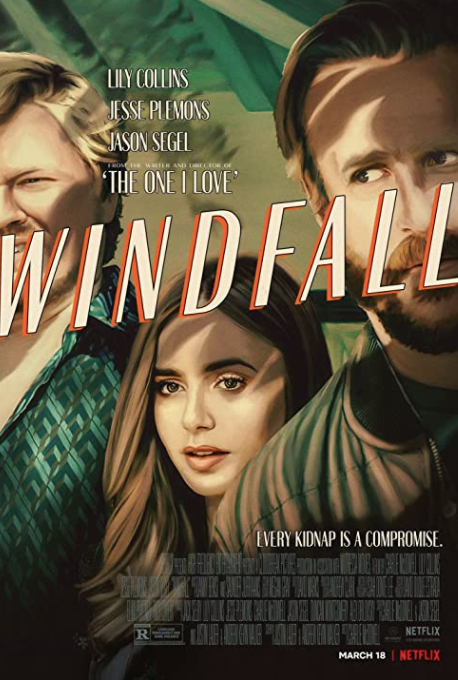
Checking in with a review of Windfall, a consciously Hitchcockian movie -- especially through the opening credits and music -- just up on Netflix a few days now. I'm a big fan of Hitchcock's work, so I don't mind anything that does a good job of capturing his ambience, which Windfall admirably does.
The other distinguishing characteristic of Windfall is that it has just three stars, all playing unnamed characters, and a fourth character, a co-star, billed in the credits as gardener. And that's ok, too, because the characters are all memorable. They would the very rich husband (Jesse Plemons) and wife (Lily Collins), the man who breaks into their home (Jason Segel), and the aforementioned gardener (Omar Leyva). And the last thing I'll mention before I warn you about spoilers is that there's a touch of black comedy lurking around a lot of this story, and the character with the most charm is that the man who breaks in.
Ok, that's two things, and here's your warning: [Spoilers ahead ... ]
Actually, all I want to talk about is the ending, in which the wife kills the burglar, as he stops to tie his ever-loose shoelace* and leave with the satchel of money, and then goes on (the wife, that is) to shoot her husband to death. Now, I get why she kills her husband. She's put up with his self-absorption for two days -- the burglar and his presence throwing an ugly spotlight on that -- and she's been revealed to her husband (by the burglar) as taking birth control pills even though he wants a baby. So I get why, after all she's been through, she wants to set herself totally free by killing him. *I've long thought life is too short for shoelaces -- I wear crocs -- and it struck me as notable that shoelaces ended this burglar's life.
But what gets her to first kill the burglar? I see two possible reasons: 1. She doesn't want him to abscond with all of her and her husband's money (which, if she had any inkling that she would then kill her husband, would soon be all hers). Or, was it: 2. She was afraid that the burglar, after walking out the door with the money, was going to turn around, walk back in, and kill her and her husband? He had indeed left, or been on the verge of leaving, and then turned around and walked back into the house, many times already.
Or maybe both of those motives came into play. What's clear is that her burst of lethal energy, whether born of greed or self-preservation, was a suitably shocking conclusion to this narrowly drawn criminal drama in a sunny California orange grove. Hats off to director and writer Charlie McDowell, and writers Jason Segel (yes, the burglar) and Jason Lader.


 The Discovery (2017, Netflix) is a strange, edgy, powerfully soft-spoken movie about a scientific attempt to find, map, and understand the afterlife. As such, it bears some resemblance to Kiefer Sutherland's 1990 Flatliners (coincidentally remade in 2017, but I haven't yet seen it). The Discovery sports Robert Redford in a quite central role, with Jason Segel, Rooney Mara (House of Cards), Jesse Plemons (Friday Night Lights), and Riley Keough (first season of The Girlfriend Experience) in leading and strong supporting roles.
