Chuck Todd interviews me about alternate histories
Showing posts with label media evolution. Show all posts

Thursday, August 14, 2025

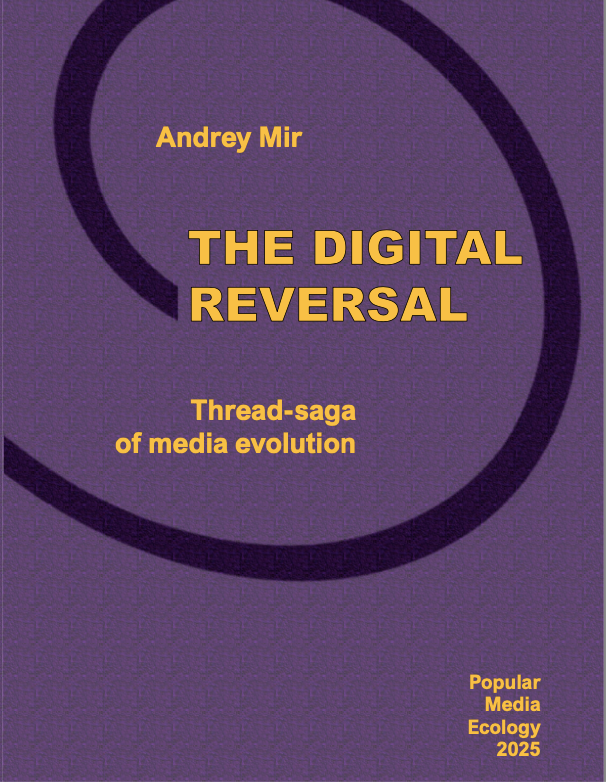
Review of Andrey Mir's The Digital Reversal: Media, Social Media, AI, and the Fate of Humanity


Andrey Mir's The Digital Reversal, building on his recent series of books with pathbreaking analyses, is so far ahead of any other scholarly work in understanding what's going on in the media world, and hence the world per se, today, that it hurts, even as it brilliantly elucidates. I'm in strong disagreement with Mir's insistence in his final chapter that humanity as we know it is inevitably doomed by the media evolution he so astutely traces and explains, but I nonetheless am sure that if you want to know where we are and perhaps what to do about this immensely difficult world we inhabit in 2025, you can do nothing better than read The Digital Reversal.

The foundation of Mir's book, the basis of its title, comes from Marshall McLuhan's "Laws of the Media," which postulate that all technologies have four modes of existence:  they amplify or enhance some aspect of communication and life, they obsolesce an aspect of life that was previously amplified, they retrieve an aspect that had previously been obsolesced, and ultimately they reverse or flip into some new kind of technology that has some relation to the original but is markedly different.   Since I first began thinking about the Laws of Media or Tetrad and published a Preface to one of McLuhan's first articles about the Laws in 1977, I've found radio and television to be a clear example of how the Laws work:  Radio amplifies speech, music, news, verbal communication by sending it instantly across great distances with no wires; obsolesces printed newspapers and wired telephones; retrieves verbal communication with those close to us; and reverses into television.   Now, lest you think that there's not much difference in the impact of radio and television, consider that radio made possible not only FDR and Churchill, but Hitler and Stalin, whereas the political impact of television brought us JFK, Reagan, and Obama, and, on the other side of the world, Gorbachev.  That's because radio boosted unseen power, in contrast to television, which showed us what the would-be people of power looked liked.  Nixon lost the television debates with JFK and thereby the election because Nixon looked sweaty and shifty in his reaction shots on TV while Kennedy looked cool and comfortable and in control.

Mir's Digital Reversal, then, delves into something that happened to us -- is still happening to us, right now -- after the revolution in personal computers and the Internet in the 1980s and 1990s.  The reversal happened quickly, virtually overnight, if we look at the time it took the printing press to make its mark, and then electronic media, and every media shift that came before those two momentous developments.  "The blogosphere, cellphones, and tablets already belong to media archaeology," Mir correctly notes.  And he proceeds to tell us the results of this reversal.   Building upon his Postjournalism and the Death of Newspapers (2020), Mir notes that the search for truth and the goal of accuracy in traditional journalism has been supplanted by the quest for Likes and Shares online and the self-affirmation they provide.  Joining this reversal is what Mir calls the "emancipation of authorship" and I call "consumers becoming producers" (in New New Media, 2009), with conservatives and reactionaries joining progressives online in the 2010s, coalescing with a few of them into MAGA aggrieved Americans pushing glittering outright lies, electing Donald Trump in 2016, falling short in 2020 (probably due to COVID), and putting Trump back in office in last year's election.

But Mir expects this digital reversal to do far worse than Trump to humanity.  After detailing the impact of the digital reversal on everything from how we know -- epistemology -- to how we sense and perceive, in a philosophic tour-de-force that Immanuel Kant would have welcomed, Mir turns to an issue that everyone in and out of academe seems to be talking and writing about these days: AI.   And his view on that, I'm happy and unhappy to say, explicitly builds upon my "anthropotropic" theory of media evolution, that I came up with and developed in my 1978 doctoral dissertation, Human Replay: A Theory of the Evolution of Media:  as media evolve, they attempt under our invention to replicate as much of our natural modes of communication as possible, as the media extend our communication beyond our original, unmediated ways of conveying information.  Writing extended our voice beyond its immediate surroundings, but sacrificed the pitch and all the acoustic characteristics of speech.  Telephone and radio eventually corrected that, but left out what we see when someone talks to us face to face, in person.  Television and then Facetime, Skype, and Zoom corrected or "replayed" that crucial missing nonverbal visual aspect of speech.

And Mir argues, regarding AI, that it will be responsible for the greatest flip of all:  human replay will flip into human replacement.  That is, the AI that we invented will replace us, merge with us into something in the AI's favor, in the very near future.  Among the many casualties, we won't go physically out beyond the planet into space anymore. "Deep space exploration—anything beyond Mars (and even that’s unlikely)—will never happen. There’s no real practical need for it" because "why bother escaping polluted, annoying Earth for Mars if you can escape into an induced, endlessly modifiable reality? Chasing interstellar travel is like staring into the rearview mirror."  (My response:  We'll keep going physically out into space, because we'll never find out what we're doing here in this universe from down here on this planet -- see Touching the Face of the Cosmos: On the Intersection of Space Travel and Religion for more.)

But not going out beyond this planet is the least of Mir's apocalyptic vision for the immediate future, which "will occur sometime in the middle of this century".  Mir writes, "humans themselves are becoming digital—so far just metaphorically, but soon literally, and not in the literate sense of the word."  Not just metaphorically?  Meaning, what? That sometime around 2050, if I live that long, my blood cells, my brain, my DNA, or whatever will literally turn into some kind of digital code, which will replace my self-awareness?  Mir says about Douglas Rushkoff and his book Team Human: "he takes a moral stance and insists on people’s ability—and even duty—to seize back control of media evolution".  Who says it's out of control, let alone totally out of control?   Trump's ascension is drastically not enough to support this claim. True, he was elected U. S. President twice, but he also was defeated once, and the first time he won, he nonetheless lost the popular vote.  A far more likely explanation for his success in 2024 was Biden's disastrous performance in their June 2024 debate (see my continually updated McLuhan in an Age of Social Media for more -- it makes the point that maybe debates have outlived their usefulness).

Mir's final paragraph -- all his paragraphs are deliberately the length of Tweets -- advises “'Endure and abstain' is literacy’s last resort, futile but noble."  But as Jim Bishop wrote in the New York Journal-American on March 14, 1959: "The future is an opaque mirror."  Mir is flawless, perceptive, ingenious, splendid when he writes about the past up to the present.  But like any other mortal, he cannot possibly predict the future with any acumen, certainly not 25 years from now.  By then, this very book, The Digital Reversal, may well have woken enough of us up, so we don't sleepwalk into this AI nightmare.


Tuesday, November 10, 2020

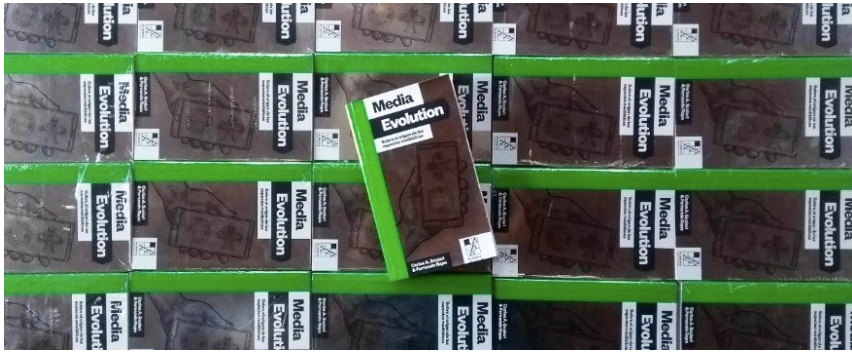
Carlos Scolari and Fernando Rapa's Media Evolution: A Review


Marshall McLuhan burst onto the scene and became the preeminent thinker about media and their effects upon us -- a position he still comfortably holds -- with the publication of his two masterful works, The Gutenberg Galaxy (1962) and Understanding Media (1964). These two were unconventional books -- Gutenberg Galaxy exploded the very notion of chapters and turned them into blog posts almost 40 years before there were blogs online -- but they were undeniably books.

Not so, or not quite, the pair of publications that followed.   These were a lot a closer to Mad Magazine than a book, or, if a book at all, more like a graphic novel than a proper or improper scholarly book.  They were also co-written -- which has nothing to do with their structure, but is worth noting -- with Quentin Fiore (The Medium is The Massage, 1967; War and Peace in the Global Village, 1968).  McLuhan followed these with more "conventional" Gutenberg Galaxy-type books, which also were co-written, leaving The Medium is the Massage and War and Peace in the Global Village as standalone high-water marks of how to conduct a scholarly probe ala Alfred E. Newman.

But those two serio-comic books are chocked full of insights, worthwhile to profound, about the media world back then and where it might be headed.  My own first book about McLuhan (Digital McLuhan: A Guide to the Information Millennium, 1999), a scholarly investigation in a form that your great-grandmother's professor would be comfortable reading (if not necessarily agreeing with) has quotes from and references to the two McLuhan-Fiore books in just about every chapter.  And I cherish the worn, cracking paperbacks of these sibling books on my bookshelf, right next to the other harder, hardcover works by McLuhan, or McLuhan and co-authors.

So I was truly pleased to get a copy of Carlos Scolari and Fernando Rapa's Media Evolution (Scolari's words, Rapa's graphic designs), which will fit right up there on my bookshelves next to Medium is the Massage and War and Peace in the Global Village.  Most of the words are in Spanish, which I can barely read, but the images are pretty much all you need to get what the book is talking about it, and they're images Quentin Fiore, and Marshall McLuhan, would surely have appreciated.   The references in the book are also in the McLuhanesque tradition -- deep and far reaching -- and range from close McLuhan associates such as Bob Logan to science fiction pathbreakers like Bruce Sterling.  Hey, Scolari even managed to get a photocopy of a relevant page from my 1979 doctoral dissertation (Human Replay: A Theory of the Evolution of Media) into his book.

So, pick up a copy of Media Evolution, and enjoy and learn, whatever language you most like to read.


Friday, October 23, 2020

Why the US Gov Going after Google is Not a Good Idea


Welcome to Light On Light Through, Episode 151, in which I argue that the U. S. government pursuing anti-trust action against Google is not a good idea.   My reasons range from media evolution, which responds to human needs, taking care of information monopolies as it did regarding Microsoft's near-monopoly in the 1990s, to Trump's real reasons for going after Google.

Links to articles and books mentioned in the podcast:

Other relevant podcast episodes:


Check out this episode!

Monday, November 20, 2017

Why the Government Should Always Keep Its Hands Off Media

The news that the Trump administration is suing to block the merger of AT& T and Time Warner - presumably stemming from Trump's pique over CNN's truthful reporting of news about Trump, which he deems to be "fake news" (CNN has long been part of Time Warner) - is unsurprising, and sadly demonstrates a point I've been making for decades: the government should keep its hands entirely off media, including not bringing to bear anti-trust laws.

I was never much in favor of anti-trust laws, anyway - the marketplace is a better regulator of business than the government - but when applied to businesses that have nothing or not much to do with communication, they are not unconstitutional.   In the case of media, any attempt to regulate - whether its content, its corporate structure, any aspect of media - is a blatant violation of the First Amendment, and its provision that "Congress shall make no law ... abridging the freedom of speech, or of the press."

And even when well-intended, such anti-trust laws are unnecessary when applied to media.  As I argued in my 1998 article in The Industry Standard - "Leave Poor Microsoft Alone" (not my title) - all the handwringing over Microsoft dominating the personal computing industry back then was not needed, and ignorant of media evolution.   As I point out in my Human Replay: A Theory of the Evolution of Media, history has shown that we humans bend media to what we want as consumers, not what corporations may try to dictate.  And sure enough, as the hue-and-cry against Microsoft in the late 1990s was reaching a crescendo, Apple was already on the way to staging a comeback with their rehire of Steve Jobs - a comeback which reversed the dominance of Microsoft, and left Apple in the powerful position it still has today.

The bottom line of all this is the Founding Fathers were right in what they put in the First Amendment.  For democracy to function well, government should have zero control of media - zero, whether Trump, Clinton, Obama, anyone in between.  (Which, by the way, is why I'm also no fan of so-called net neutrality.)


Monday, January 2, 2017

The Perversity of Things: review #3 of X: The Evolution of Media

Continuing with my review (#3 of X) of The Perversity of Things: Hugo Gernsback on Media, Tinkering, and Scientifiction, edited by Grant Wythoff (University of Minnesota Press, 2016), having now read pages 18-27 of Wythoff's 59-page Introduction to the 359-page volume:

Reading Wythoff's Introduction, as I've already said, is to encounter a wealth of information on every page, and occasionally a treasure-trove at that.  On page 25, for example, Wythoff tells and shows us how Gernsback thought about media in ways a lot like Marshall McLuhan, and understood them and their impact on our lives in similar ways.  Then, on the same page, we find that Gernsback had a special interest in the evolution of media, in particular how old and new media compete for survival. Wythoff observes that, in "Is Radio At a Standstill?" (1926), "Gernsback makes a striking media-historical analogy between the supposed threat that the rise of radio posed to established phonograph manufacturers and the impact of 'battery eliminator' radio sets" on "conventional battery manufacturers,"  concluding that "competing formats do not replace but rather force one another to find their own unique attributes, simply as a matter of survival."

As fate would have it, this was exactly one of the main points I made in my PhD dissertation, "Human Replay: A Theory of the Evolution of Media," which I sent up to Marshall McLuhan in the summer of 1978, before I gave it my dissertation adviser at New York University, Neil Postman. (Here is a recording of McLuhan's initial response, in a voice-mail he sent me, shortly later, after he had read "the first 100 pages".)  The way I put it in my dissertation - and in subsequent works, such as The Soft Edge: A Natural History and Future of the Information Revolution - was that the media we invent compete for a place in the satisfaction of our human needs, or a "human/media ecological niche".  They often achieve this in surprising ways.  Radio not only survived but thrived in the aftermath of television, because it worked in our ecological niche of hearing without seeing (we can easily close our eyes, it grows dark every night, etc).  But silent movies did not survive the advent of talkies, because we rarely see without hearing (we have no earlids, etc).

Now, when I wrote that dissertation in the late 1970s (which will soon appear in translation by Wu Jianzhong in China), I of course knew about Gernsback, but as the founding editor of Amazing Stories and one of the founding parents of science fiction.   One of the values of Wythoff's extraordinary work is precisely that it calls attention to other, equally important and interrelated, contributions of Gernsback.  (I did manage to quote from Tom Swift and His Photo Telephone, 1914, by the pseudonymous Victor Appleton, in my dissertation - but only because I picked up a copy of that book at used book store.)

As a parting point for this review/musing, this section of the book also highlights Gernsback's sponsorship of illustrations in his magazines to the tell science fiction stories - in some ways, more effectively than the words,  In age in which cinema was just getting started, and television was a few years off, the illustration was the prime vehicle for our imaginative vision, and all that it could convey.  Gernsback, in that sense, was also a founder of the great and continuing tradition science fiction we see so prominetly on the screen.

And I'll be continuing these reviews soon.

See alsoThe Perversity of Things: review #1 of X: Gernsback as Philosopher of Technology ... #2 of X: Learning by Doing ... #4 of X: Gernsback and the First Amendment ... #5 of X: Amateurs vs. Corporations ... #6 of X: Thought Experiments and Toys ... #7 of X: The Invention of Invention, and the Advent of Science Fiction ... #8 of X: Definitions and Fake News


Sunday, August 18, 2013

Hell on Wheels 3.3: Talking and Walking

Hell on Wheels 3.3 starts with a great little piece of anonymous media history - Bohannan smashing his finger as he hammers in the electrical connection at the top of a telegraph pole alongside the railroad. Telegraph and rail went up hand in hand in the middle of the 19th century, the partnership between communication and transportation - between walking and talking - that has always characterized our life on this planet.  The smartphone, which allows you to talk anywhere you may walk - or drive, or fly, or train - is but the latest embodiment of this coupling.

The telegraph connection plays a crucial role in Hell on Wheels 3.3.   Bohannan at first thinks Indians were responsible for an attack on his train crew and cattle.  He telegraphs the nearby US cavalry and tells them to hunt down the Indians and how "no mercy".  He later discovers that, actually, the Indians were not to blame.  But the troop commander chooses to ignore the second, correcting telegram that Bohannan sent along.

That commander is one racist piece of work, and speaks for lots that was wrong in America not only back then but today.  He relies on lame pseudo-science to pronounce the Indians sub-human, and even has a cracked theory to explain why the South lost the Civil War.  He's right that America was on its way to dominating the planet, but one wonders if America could have attained such a predominant position - which had the great benefit of defeating the Soviets and as well as Nazis - without the racist underpinnings that still afflict us.

Meanwhile, Bohannan continues to be a much sharper, redefined character in this third season of life and work on the railroad, and I'm looking forward to more.

See also Hell on Wheels 3.1-2: Bohannan in Command

And see also  Hell on Wheels: Blood, Sweat, and Tears on the Track, and the Telegraph ... Hell on Wheels 1.6: Horse vs. Rail ... Hell on Wheels 1.8: Multiple Tracks ... Hell on Wheels 1.9: Historical Inevitable and Unknown ... Hell on Wheels Season One Finale: Greek Tragedy, Western Style


#SFWApro

download Hell on Wheels season 3 on

Monday, October 15, 2012

Boardwalk Empire 3.5: "10 L'Chaim"

A superb Boardwalk Empire last night, with a multitude of sharp lines and situations.  But my favorite goes to Eddie Cantor - a real entertainer in our history - who not only speaks Yiddishisms, but serves them with a sense of humor.  He tutors Nucky in the toast "L'Chaim" - to life! - and adds that he knows some people in prison serving "10 years L'Chaim".

But there's a dark side to Nucky's relationship with Eddie.  Like the Johnny Fontane character in the Godfather (presumably based on the real life Frank Sinatra), the real life Eddie Cantor in Boardwalk Empire is under Nucky's thumb.  Nucky wants Eddie to star in a new music with Billie.  When Eddie refuses - he doesn't want to renege on a commitment he made to Jerome Kern (another real life musical writer and producer) - Nucky has Chalkie come over and make Eddie an offer he can't refuse.

This is in character for the new, tougher, more violent Nucky that we met at the end of season two last year, when Nucky shoots Jimmy point blank.  Nucky's standing up to everyone in this season - refusing not to get his way - including even Arnold Rothstein, who calls Nucky out on his coming up to New York just to see Billie.  Nucky retorts to Rothstein: unlike you, I'm not dead below the waist.  Good line.

Nucky also tries to take out Rosetti, which, as always with Rosetti, is quite a story in itself.  We see Rosetti at play - first in auto-erotic-asphyxia with a woman, then "joking" with a newspaper delivery boy.  The joke is actually pretty media savvy - as many Boardwalk Empire lines are.  Rosetti asks the delivery boy if the newspaper is new; the boy (about 13-14) assures Rosetti it is;  Rosetti then asks, looking at the newspaper, why "all this stuff happened yesterday"?   That's indeed the reality of newspapers, and one reason why their circulation has been declining in our Internet age.   But back to Nucky: he sends a team to take out Rosettit, whom they find, ropes around his and the woman's neck.  Rosetti manages to grab a gun, shooting ensues, and when the gun play is over Rosetti is fine but the woman and the newspaper boy have been shot to death.   We already knew it wasn't safe to get involved in any kind of joke line with Rosetti, because he was prone to kill the conversationist. This time, even though Rosetti seems to like the newspaper boy, he dies because of his association with Rosetti and his joking anyway.   A chilling O'Henryesque twist.

There are also some good continuing story lines with the fictional Van Alden in Chicago and real life Cabinet Secretaries in Washington.  And it was good to see Dominic Chianese again (he had a good evening, with major role in The Good Wife over on CBS).  But speaking of real life: was Eddie Cantor really ever forced by a mobster to back out of a part in a musical?  I don't know - I'll look into it and see what I can find - but it was an instructive moment in an excellent episode.

See also Boardwalk Empire 3.1: Happy News Year 1923  ... Boardwalk Empire 3.2: Gasoline and the White Rock Girl ... Boardwalk Empire 3.3: The Showgirl and The Psycho


"As a genre-bending blend of police procedural and science fiction, The Silk Code delivers on its promises." -- Gerald Jonas, The New York Times Book Review

Sunday, October 16, 2011

Occupy Wall Street, Direct Democracy, Social Media: A Thumbnail History of Media and Politics Since Ancient Athens

IMG_2252
The role of social media in triggering and facilitating the now world-wide Occupy Wall Street protests - of Twitter, Facebook, YouTube, Google+, and kindred systems in getting word out about Occupations, and documenting them for the world to see and join - has been remarked upon so often as to almost seem a cliche.  But the link between social media and direct democracy is true and profound, and is the current culmination of an evolution of media and political expression that began in ancient times.

Back in the city state of Athens, in the time of Pericles, direct democracy arose, in part because of the new literacy that allowed citizens to be informed of public events and the views and actions of their leaders.   The words that these people read were handwritten, which meant that anyone who wanted to write and be read could do so.  Writing and publishing were just as about as easy, in other words, as reading.  

All of that changed dramatically with the invention of the printing press, which had the wonderful result of spreading the written word to millions, but the anti-democratic effect of greatly reducing the ratio of published writers to readers.   Millions of people became accustomed to reading words written by a handful of others.   Unsurprisingly, when democracy slowly re-emerged in the Renaissance and the Age of Reason, it was not the direct democracy of Ancient Athens.  Instead, it was a representative kind of democracy, in which elected officials made all the decisions, and all the people could do was vote the representatives up or down.   This was almost exactly parallel to the transformation in information production and reception brought about by the printing press, in which all the people could do is read and agree or disagree with a book or manifesto or pamphlet, and in no way write or produce it, unless you were in the less than one-percent of the population fortunate to have a monarch's or a printer's (later publisher's) favor.

This inequality of producer and consumer - few producers and legion consumers - was not only continued but exacerbated by the advent of broadcast media, which reduced the number of producers (harder to get your views on radio and television than in newspapers, which at least has letters to the editors) while increasing the number of consumers.   People in representative democracies became better informed, but the information was created by fewer and fewer people.  In some countries, such as the Soviet Union and Nazi Germany, this inequality was masterfully mined to do away with democracy altogether.

The introduction of Facebook, Twitter, and YouTube in the first decade of the 21st century shifted that ratio back to a more even distribution of producer and consumer for the first time since the handwritten manuscript held sway in Ancient Athens.   These new media live online, but they were unlike other new media like Amazon and iTunes, which still run for the most part like traditional publishing media, with few producers and many consumers.   In contrast, any one can Tweet, post a status on Facebook, upload a video to YouTube - any consumer could become a producer.  That's why I say these new social media are not just new but "new new media".

People in the streets, demanding freedom and justice in the Arab Spring, and redress of economic grievances in the United States, Europe, and Asia, are the healthy and long-overdue political expression of the revolution in social or new new media.  The Occupy movements are expressing a dissatisfaction with others making decisions for us - with our elected representatives doing the bidding of banks rather than the people who elected them.

With means of expressing one's political views in almost everyone's pockets and hands, the age of mass media and representative democracy may well be in irreversible decline, replaced by the more equitable system of direct democracy in which the majority not only truly rules, but in which everyone's views can get a public hearing, and everyone can vote at any and all times.   Campaigns such as Dylan Ratigan's to "get the money out of politics" may be well meaning, but miss the point that it's representative democracy itself that must go or be transformed into a system of democracy that always moves to the people's views.

I talked about all of this a bit more and led a discussion after the 7:15pm screening of Tiffany Shlain's new movie Connected, at the Angelika Film Center in New York City this Wednesday, October 19.

I also discussed many of these issues on Good Day Street Talk, Fox-NY-5, on a panel taped on Thursday October 20 and broadcast Saturday October.   Video is here:


Occupy Wall Street Chronicles, Part 1

Saturday, March 21, 2009

Notes on McLuhan: More Unseen in the Rear-View Mirror

Marshall McLuhan's "rear-view mirror" metaphor has long been one of my favorites - "we look at the present through a rear-view mirror, we march backwards into the future" (McLuhan & Quentin Fiore, The Medium is the Massage, 1967) - by which McLuhan meant that we first understand the future by relating it to the past. The danger of such initial perceptions is that we can miss and misunderstand important, unexpected impacts of new media. A radio is much more than a wireless (telegraph or telephone) - it brought into being the simultaneous mass audience, and was a powerful tool for good and bad political leaders ranging from FDR and Churchill to Hitler and Stalin.

But I realized this morning, on a panel at the Lunacon science fiction convention, that the rear-view mirror not only obscures or distracts from the future, but does the same for the deeper past.

Think about it. All we see in the rear-view is what we immediately passed - not what we passed on the previous block or in the previous hour. Similarly, if we engage new media, technologies, and events by only their immediate predecessors, we lose sight of the deeper history from which they emerge.

Radio was not only not just a wireless, not only a simultaneous mass medium, but was a kind of public speaker's corner which went much further back in our history than the telephone and the telegraph. McLuhan did talk about these retrievals of the deeper past in his "laws of media," but they also have a role in what is unseen in the rear-view mirror.

Something to consider - how do our new technologies relate to the deeper past that stretches out far beyond and before the rear-view mirror...

Sunday, November 16, 2008

Keeping President Obama with His Email

You see the story in New York Times yesterday?

Prospects do not look for Barack Obama to continue sending and receiving email once he gets into the White House.

... he will probably be forced to sign off. In addition to concerns about e-mail security, he faces the Presidential Records Act, which puts his correspondence in the official record and ultimately up for public review, and the threat of subpoenas. A decision has not been made on whether he could become the first e-mailing president, but aides said that seemed doubtful.


It's not quite clear who, exactly, would be forcing the new President to do this. I think the President giving up his email is a terrible idea.

So what if the law requires all Presidential communications to be eventually available for public review? Surely a system could be devised which would automatically record all email that the President sends and receives. Come to think of it, isn't that what happens on every gmail or yahoo mail account right now?

More important, a President must be able to communicate in whatever way is most comfortable and effective for him. A person in his position needs to devote maximum attention to thinking and communication, without having to be handicapped by using old-fashioned paper, telephone, and other systems. Email has grown astronomically in the past decade for good reason: it has all the advantages of writing - permanence - and yet it is as immediate as speech. Plus, it is global and easily searchable.

And this is what some media Neanderthals want to deny to the new President?

My prediction: Obama will indeed become the first emailing President. Email me if I'm wrong.

For more on the advantages of email, see
The Soft Edge: A Natural History and Future of the Information Revolution.

Wednesday, November 5, 2008

Hologram of Jessica Yellin on CNN Last Night - I Saw Something Like This in 1979

How many of you saw Wolf Blitzer interviewing Jessica Yellin's hologram in CNN's coverage of the election returns last night? I you didn't, check it out below.

We've come a long way since Princess Leia in Star Wars. Back then, I wrote in my doctoral dissertation, "Human Replay: A Theory of the Evolution of Media" (1979), that "the third dimensional will replace the two dimensional image as surely and completely as color replaced black-and-white, and talkies replaced silent movies" (p. 282). But it's been a long time in coming - first developed back in 1949, we've seen holograms on credit cards and as special effects in movies. How close are we to seeing it a regular basis on television?

The better question is, how long will be it before our very televisions and movies and web screens are three dimensional - which show people, like Jessica Yellin, from all 360 degrees, from back, sides, and front, as she was standing there and talking to Wolf Blitzer in person?

High-definition television has taken us a big step closer, because the hologram needs a much better resolution of image than our older television screens provide. Fiber optic bandwidth increase has also been an important step towards holographic TV. But predicting the advent of a new medium in specific years is always a risky undertaking - the fax was invented back in the 1800s, and didn't become a major player in media until in the 1980s.

But, sooner or later, holography will be here. As I explain in my "anthropotropic" theory of media evolution, we invent technologies that communicate for us in increasingly human ways. Thus, as the above quote says, photography has evolved from black-and-white to color, silent to talking, still to moving - after all, we see in color, almost always hear some sound when we're looking at something, and the world is in motion. And just as dramatically as all that has happened, we will someday have holography for everything we see in our living rooms and on our desks and in the devices we carry and hold in our hands. The third dimensional is already part of our perception of the world. (See Human Replay: A Theory of the Evolution of Media and The Soft Edge: A Natural History and Future of the Information Revolution for more.)

In the meantime, here's Jessica Yellin ...


PS - added a few hours after the above -

Some people on Gizmodo and elsewhere are claiming that the Yellin appearance (and also a dance done on CNN by Wil.i.am) were not "really" holograms.

Here's the gist of the response I posted:

About the CNN holograms being "real" or not:

First, there of course were no three dimensional images walking around out of the screen in anyone's living room. So if that's what anyone means by saying no way these were holograms, that's of course correct.

But if we're referring to the fact that Blitzer was talking to an empty stage - not the hologram of Yellin - then I think what we saw can still be correctly called a hologram. We saw a three dimensional image within the TV frame, talking to the flesh-and-blood Blitzer. That image was still a hologram for us, the viewer, regardless of what Blitzer saw or didn't see.

Or, put otherwise, I don't see a meaningful difference between a hologram on a stage broadcast on TV, and a blank stage in which three dimensional information is synched into the broadcast from another source and looks three-dimensional on the 2-D screen at home.

Or, put additionally otherwise, I see no meaningful distinction in this context between (i) an illusion of an illusion or hologram and (ii) an illusion or hologram - no difference between (i) an illusion of an illusion and (ii) an illusion.

Thursday, November 8, 2007

my Second Life interview this past Monday

My interview on Second Life, by Kenny Hubble (Ken Hudson) this past Monday.... I'm on the left, Ken's on the right...


... thanks to the good folks at SLCN.tv - the Second Life Cable Network - for producing this Second Life video...

Sunday, August 19, 2007

Paper, Stone, iPhone

People have been complaining about the big stack of paper printouts they have received from AT&T for their iPhone service. Some have been objecting almost as much to the paper delivery as to the bill, saying that if the iPhone were as a true harbinger of the future as its champions (including me) claim, its telephone carrier would have figured out a way to send the bill electronically.

But I doubt that paper’s really the issue. I've never seen anyone object to getting paper cash in hand.

Paper, of course, has long been waived around as an early item to be replaced by the digital revolution. I remember lots of talk and writing back in the 1980s about the "paperless office". It didn't happen.

I’ll let Sierra Waters, heroine of my novel The Plot to Save Socrates, explain why. Here’s what she’s thinking on the very first page of the novel:

The Plot to Save Socrates

...written on the only substance which could survive decades, maybe longer, without batteries, which required only the light of the sun to be read, or the moon on a good night, or a flickering flame when there was no moon. Paper. A marvelous invention. Thin and durable...


And paper also has what I call "reliable locatability" - what’s written on one part of a piece of paper today will be in the same place tomorrow. Interestingly, paper - like parchment, vellum, and papyrus - was initially invented as a means of liberating the written word from its carvings on stone. But in the digital age, one of the main advantages of paper is its durability.

Which is why, much as I dislike bills, I actually prefer getting them on paper. I like having handy copies of how I spend my money.

Meanwhile, if the history of phone and online service is any indication, iPhone AT&T service will sooner or later progress to very low, flat rates for huge amounts of data - which I doubt that anyone will be complaining about, whether on paper or screen.

See also The Secret Riches of the Panda

And, for more on the history and future of paper - The Soft Edge: A Natural History and Future of the Information Revolution


The Plot to Save Socrates


"challenging fun" - Entertainment Weekly

"a Da Vinci-esque thriller" - New York Daily News

"Sierra Waters is sexy as hell" - curled up with a good book

Thursday, July 26, 2007

Obama Girl in Old and New Media

I wanted to mention a fascinating and instructive episode in the BarelyPolitical.com Obama Girl revolution - which I didn't get a chance to mention, last week.

It's from the four divas on The View, discussing the first Obama Girl video a few weeks ago. Most of it is good fun. But, at the end, Joy Behar opines that, because Amber Lee Ettinger, the actress who plays Obama Girl, said "I don't know who I'm voting for," this is an example, according to Behar, of "hookerville ... she's an actress".

Now this has received a lot of bemused commentary, and Amber Lee has since said she has considered all of the candidates, and she indeed expects to vote for Obama, but ...

There are several important points which deserve to be remembered in this episode:

1. Behar's point was inane even before Amber Lee announced whom she was supporting. She's an actress - as Behar recognizes. This means that everything she says and does in the videos is part of a role she's performing. It matters not in the slightest who the actress supports - any more than whether James Gandolfini thinks the mob is a good way of life. I would bet anyone in kindergarten or higher understands this.

2. But there's also a deeper, media-evolutionary point here: old media, and their stars and proponents, are frequently hostile to new media. This can take many forms. D. W. Griffith, one of the great pioneering filmmakers, considered himself a prostitite (hookerville...) for not working in the legitimate medium of his time, the theater. Stars of silent movies lashed out at talkies (in some cases, understandably, because their voices didn't match their faces).

In the current, fast-moving realm of audio-visual narrative media, we have new media (YouTube), middle-aged media (all-news cable), and old media (the networks - on which is The View). Not surprisingly, the BarelyPolitical.com team and Amber Lee have done very well on Fox News. CNN is clearly very aware of YouTube (doing the YouTube Presidential debates), and MSNBC is, too (though MSNBC missed an important beat, I think, in not getting those YouTube debates on its air).

But old media - of which Joy Behar is a classic expression - just don't get it. Like the sinking CBS Evening News, the networks are sliding downward, and anything really cutting edge will fly and flourish off it...

In the meantime, here's the entire 2 and 1/2 minute clip from The View, for your viewing pleasure...


See also The Barely Political Revolution

Monday, July 23, 2007

Online Furniture

I don't know about you, but I find shopping for furniture the old-fashioned way, in stores, a real pain. You have to drive to the store, of course. You see a sofa or an arm chair you like - but another customer is sitting in it. You can stretch out on a bed, but, let's face it, you can't really sleep or even nap on it in a store. And, if you're lucky to find something you like, you have to make arrangements to have it delivered.

On of the great things about Web shopping, and about Furniturefromhome.com in particular, is you can look at sofas, chairs, beds, anything you sit, relax, or dream on, as fast or as leisurely as you like, at your own pace. Whether you're looking for furniture for the home office, bedroom furniture, or bar stools, it's all there online for you.

You can browse and shop by room - living room, game room, dining room, bedroom, etc. You can specify your color preference - cherry, brown, black, neutral, and more. And can look at styles and categories - like bookcases, which I can never seem to get enough of at home or in the office.

The bar stool selections are especially cool - I counted over 90 items for sale. I wouldn't mind grooving in a swivel bar stool, jiggling a glass of ginger beer and lime, right now.

Furniture from Home has lots of sale items, too. I saw a Vanilla White Leather Living Room Furniture Set, a Cherry King Queen Sleigh Bedroom Furniture Set, an Espresso Dining Room Furniture Counter Height Table Set, and a lot more.

All from the convenience of the rocking chair I'm now sitting in and writing from. Shopping for Furniture from Home. I can't think of a more relaxing and effective way to go shopping. Score another real convenience for the digital revolution.

this is a sponsored post

Monday, July 16, 2007

Digital Framez

Media evolution proceeds in spurts - some parts of new media progress faster than others. Digital photography has revolutionized the ease of taking photographs. But the display of our photographs has either remained in the pre-digital age, when we print out our photos and put them in static frames, or has relied upon the awkward procedure of everyone who wants to see a photograph or an album craning their necks around a computer.

Digital Framez has a solution - a digital photo frame, which can display either single photos or albums. You can set the time you would like the photo to display, and the transition time from photo to photo in your digital album. You can place the digital picture frames on any wall, or set them on your coffee or side table.

The great snapshots from your digital cameras and camera phones need no longer be hostage to the past. They can be displayed in a manner in tune with the digital age. You can display a digital movie in your digital photo frame, too.

I wrote about something I call "digi-prints" in my science fiction novel, Borrowed Tides. You can see a similar magic in Harry Potter's photographs.

Now you can begin to enjoy something like this for your own photographs in Digital Framez.

this is a smorty-sponsored post

Wednesday, July 4, 2007

iPhone: Not Better iPod but New Species of Media

Steve Jobs said last January that the iPhone was "the best iPod ever," and now Rolling Stone, switched, and folks all over the Web are debating and assessing this point...

Which, I think, misses the point entirely.

Was television a better kind of radio? Was early word processing a better kind of typewriting? Was writing a better kind of speaking?

Of course - but those new media were much more - they were new media, which did things so far beyond their predecessors that they deserved and received a different name.

The "phone" in iPhone should signal that is a very different beast from the iPod. Sure, it plays MP3s and podcasts. But its telephone and web-play features make it an entirely different and unique kind of beast...

The Soft Edge by LevinsonA new species in the evolution of media...

See also: Hats off to George Hotz ... iPhone Arrives - I Predicted It in 1979 and iPhone Boosts Literacy and History Lesson: iPhone Sales Will Exceed Expectations and New York Times' David Pogue Sings "I Want An iPhone" to "My Way" ... Nano iPhone and the Dymaxion Principle ... Harry Potter and iPhone ...


and ... I'll be talkin' iPhone on my weekly KNX1070 Sunday interview, 7:20am Pacific time, July 8


The Plot to Save Socrates


"challenging fun" - Entertainment Weekly

"a Da Vinci-esque thriller" - New York Daily News

"Sierra Waters is sexy as hell" - curled up with a good book

Friday, June 29, 2007

iPhone Arrives... (I Predicted It In 1979)

Brief post to mark, with pleasure, the arrival of the iPhone...

The cornucopia of the Internet - what I call the "medium of media" - songs, YouTube, e-mail, the works - on your cell phone.

I wrote, in my doctoral dissertation way back in 1979 - "Human Replay: A Theory of the Evolution of Media" - p. 275, that "the wireless, portable evolution of media should continue to the point of providing any individual with access to all the information of the planet, from any place on the planet, indoors and outdoors, and of course even beyond the planet itself as communication extends into the solar system and cosmos beyond." And I added, on p. 276, that this "'systemless' system ... will eventually give the individual the same unrestrained access to information on the global basis that the individual has always enjoyed to information in the immediate physical environment."

I expected that to happen in my lifetime, but maybe not this soon.

After all, 1979 was the very very dawn of our personal computer age.

Cellphone by Levinson
My 2004 book, Cellphone: The Story of the World's Most Mobile Medium, and How It Has Transformed Everything, is essentially about what the iPhone, and other devices like it, are doing...


And here's a clip of me on the Discovery Channel, this past December, talking about the import of cell phones in our lives...


A fine day ... but, I'll probably wait a little until the price of the iPhone and its service comes down. I'm not only a happy futurist, but a cheapskate...

See also Hats off to George Hotz ... iPhone Boosts Literacy and History Lesson: iPhone Sales Will Exceed Expectations and iPhone: Not Better iPod But New Species of Media and New York Times' David Pogue Sings "I Want An iPhone" to "My Way" ... Mouth-Watering iPhone Commercial and the Real World ... Nano iPhone and the Dymaxion Principle ... Harry Potter and iPhone ...

and ... I'll be talkin' iPhone on my weekly KNX1070 Sunday interview, 7:20am Pacific time, July 8


The Plot to Save Socrates


"challenging fun" - Entertainment Weekly

"a Da Vinci-esque thriller" - New York Daily News

"Sierra Waters is sexy as hell" - curled up with a good book
InfiniteRegress.tv