Chuck Todd interviews me about alternate histories
Showing posts with label J. K. Simmons. Show all posts

Saturday, December 21, 2024

Juror #2: Hitchcockian Courtroom


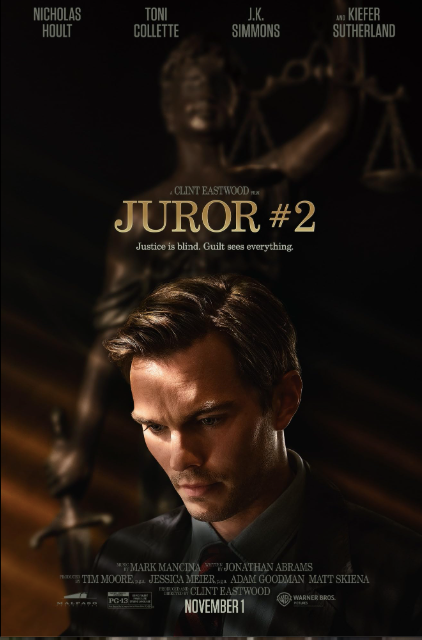
Just saw Juror #2 on Max, directed by Clint Eastwood (in his early 90s), and "rumored" (Wikipedia's word) to be the final movie he'll be directing.  I can tell you that the movie is powerful indeed, a twisty legal thriller, reminiscent of some of Hitchcock's work -- the writer, Jonathan Abrams, deserves some of the credit for that -- and I surely hope that Eastwood is able to direct a few more.   

[And there will be spoilers about the set-up ahead ... ]

The set-up is ingenuously provocative: Justin finds himself on a jury hearing and then deliberating the case of James, on trial for murdering his girlfriend, Kendall.  The two were seen arguing in a nearly violent way in a bar, but Justin knows that James didn't do it, because based on where Kendall's body was found, he's horrified to realize that the deer he thought he struck on the road on a rain-swept night was actually Kendall.   Justin is a fundamentally decent person.  But his wife Allison, who lost their earlier twins, is now very pregnant, not to mention that he wouldn't want to go to prison anyway, so his dilemma is how can he make sure James does not go to prison for a crime he didn't commit, while Justin stays out of prison himself?

That's what I mean about the movie being Hitchcockian.  In movies like Strangers on a Train, Hitchcock excelled in heroes or anti-heroics caught in the grips of world-class ethical dilemmas.  Juror #2 is also lifted by excellent acting.  Nicholas Hoult and Zoey Deutch -- I don't recall seeing Hoult on the screen before, and I've seen Deutch just once, in The Outfit, where she was excellent -- were just perfect as Justin and Allison.   J. K. Simmons and Kiefer Sutherland play characters who are medium important, but memorable.  

I won't tell you what the ending is, except it certainly leaves the door open for a sequel.  If you're a fan of the order part -- aka the courtroom part -- of Law & Order and its spinoffs, you can't go wrong with Juror #2.

***

Here, in case you're interested, is the true story of the time I was foreperson on a jury here in Westchester, NY.

Saturday, May 21, 2022

Night Sky: Down Home Portal Done Up Memorably


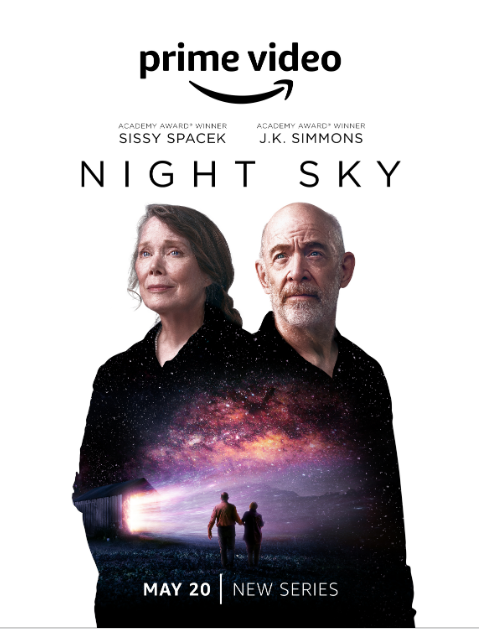
Just finished binging Night Sky on Amazon Prime Video, another travel to other worlds narrative that does it not through space ships or time machines, but some kind of conduits or portals built by some interstellar or intertemporal civilization.   Outer Range did a good job of this with a time-travel hole out on the range.  Night Sky does this with a portal to another world in a shack in the backyard.  And it's lifted immensely by two peerless lead performances by J. K. Simmons as Franklin York and Sissy Spacek as Irene York, an aging married couple in the fictitious town of Farnsworth, Illinois.

[Spoilers ahead ... ]

Let's start at the end of the eight-episode season to see what I think we know:  As Irene demonstrated pretty early on, the alien world outside their window comes packed with oxygen.  Which is why she and Franklin survived at the end, and their neighbor Byron likely did, too.  The body that we saw with the knife sticking out of him was likely the guardian Jude killed in his escape to our planet, and why he was all bloodied with someone else's blood when Irene first saw him and took him into her and Frank's home.

Ok, what else do we know?  There are "apostates" who escape "guardian" control.  Jude is an apostate, Stella and Nick are guardians.  And there are also guardians who have left that role, and help apostates or at very least don't hunt them.   Hannah (played Sonya Walger from Lost, Flashforward, For All Mankind, and many more) refers to this third group, of which she is a member, as the "fallen".   So that's a nice set-up of characters and allegiances. 

Back to the portals:  they connect different parts of the Earth -- characters use them to travel instantly from Mexico to Newark, NJ, and from Farnsworth to Bangkok -- and Earth to at least one other planet, the one that has oxygen, and some kind of little city not far from its side of the portal.   Whoever built them did that as long as several hundred years ago -- there's a sketch of a door to a portal in Argentina in the early 1700s.

The personal story of the Yorks is touching and  powerful, all the more because it is brought to life by such brilliant acting.  The other characters range from interesting to compelling, which is a good range for a series like this.  Denise, the granddaughter (well played by Kiah McKirnan), was especially effective in her story, starting to go down the same troubled path as her father, rescued by Jude, her knight in shining armor.

Questions remain.  What happened to Byron?  Where is Jude's father?  This all adds up to a memorable series -- creds to creator Holden Miller -- which would be well served by a sequel, which I'd binge a day or two after it was released, as I did with this first season.  My wife, not generally a fan of science fiction, enjoyed it, too.


Thursday, July 8, 2021

Podcast Review of The Tomorrow War


Welcome to Light On Light Through, Episode 185,  in which I review The Tomorrow War.    So, I saw today in The Hollywood Reporter that The Tomorrow War has been picked up for a sequel on Amazon Prime Video -- which supports my view  that, contrary to some nitpicking critics, The Tomorrow War is one excellent movie!   Listen to my review and find out why.  (No real spoilers, except at the very end of my review.)


Check out this episode!

Monday, July 5, 2021

The Tomorrow War: Cli-Fi, Interstellar, Time Travel


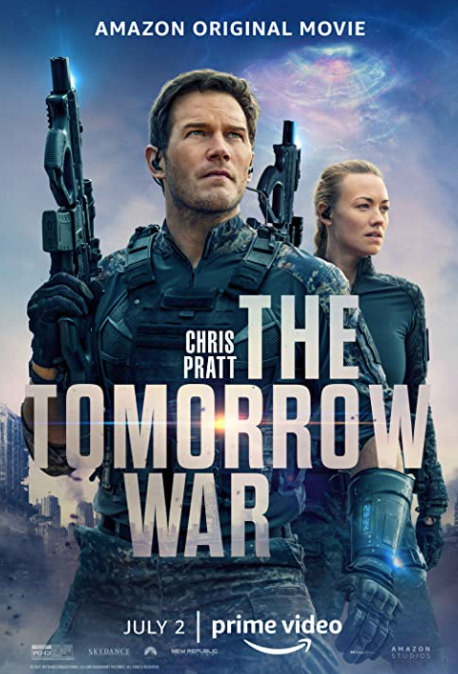
I saw The Tomorrow War on Amazon Prime Video late last night.  Some myopic critics gave it mixed reviews.  I thought it was just excellent.  And not because of the time travel, which was ok, but because of the unfolding plot of the movie, which brings in interstellar species, climate change, and parent-child relationships in an original and rewarding way.

The time travel set-up is the most ordinary part of the movie.  Humans from the future come back to our time to recruit soldiers to help in a desperate, losing fight against a species from outer space that moves around here on Earth so quickly they're very difficult to kill.   Severing their heads from their body does the trick, but that's tough to do when dozens of these creatures are on screeching lightning attack for every one human soldier.  So ... former Green Beret and biology teacher Dan Forester is sent pretty much on a suicide mission to maybe briefly delay the extinction of humanity when he's recruited aka yanked from 2022 and whipped three decades into the future.

Until he meets his daughter, Muri, whom he last hugged when she was a precocious little girl, now in the future a fighting colonel and a brilliant scientist working on some last hopes for humanity.   Here's where the movie takes off.  The relationship between the embattled Muri and her father is heart-rending and beautiful.  Dan helps her develop a toxin that can kill the horrific creatures, but of course all they have is a small amount of it, so the only way it can save the day is for Dan to go back in time and kill the Whitespikes (that's their name) right after they first arrived.

But when did they arrive?  Much earlier than anyone thought.  And here I'll leave this recounting of the narrative, on the slight chance that you're reading this and haven't seen the movie.*[footnote spoiler]  But the location and time of the interstellar arrival and why the monsters took so long to emerge is a compelling slice of cli-fi.  

Meanwhile, the action scenes -- the battles with the Whitespikes -- are breathtaking and top notch.  Yvonne Strahovski -- who was excellent in Dexter and 24: Live Another Day -- was even better as Muri in The Tomorrow War.  J. K. Simmons is a pleasure to see in any role, and he was perfect as Dan's estranged father.  And Chris Pratt was fine as Dan, reminding me at times of Tom Cruise in Mission Impossible.

My advice: forget about the nitpicking critics.  Sit back and enjoy an adrenaline pumping, thought provoking, A-1 summer science fiction movie.


a different kind of time travel

=================================================


*I will say, for people who saw the movie, that we could call the world in which Dan goes into the future, before he destroys the Whitespikes, World 1.  In that world, the adult Muri dies.  The destruction of the Whitespikes instantly shifts World 1 into World 2, where the narrative concludes with Dan reunited with his family and young Muri.  She probably will become a brilliant scientist, but she won't be fighting the Whitespikes and won't be killed by them, because they no longer exist.  That part of the story is the best time travel part.

Friday, April 9, 2021

Defending Jacob: Testing Family Ties


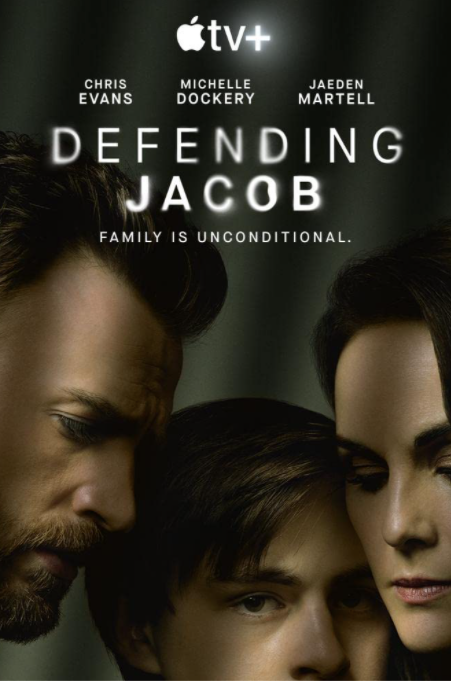
I don't think I've ever seen a mini-series like Defending Jacob, up on AppleTV+ where it's been for nearly a year, based on a novel of the same name by William Landay which I didn't read.  It oscillates back and forth between two possible truths or endings, and manages to end without resolving that pendulum, in a way that makes you feel that you've confronted some profound mystery or reality of human life, because likely you have.

[Some spoilers follow ...]

The question is whether not Jacob, in his mid-teens, killed his schoolmate Ben.  He says he didn't, but he's a strange kid who gives off strange vibes.  He's highly intelligent and has an above-it-all ambience.  A shrink says he lacks empathy.  His father is not sure, but pretty much believes his son.  His mother is not sure, either, but believes Jacob less than does his father.

On Jacob's side of the story, there's child predator named Patz who is in the area, has pictures of Ben on his phone, and erases them.   But Jacob wrote a short story after Ben's murder, which gives a psychological take on the crime that seems autobiographical.  Twist after twist makes Jacob seem a victim, and then a killer, then a victim, then a killer.  It's the kind of thing that can drive his parents crazy, and almost does, especially Jacob's mother.

In the last series of twists, Patz leaves a suicide note of confession, but Jacob's father Andy learns that his father (Jacob's grandfather) had someone put a gun to Patz's head and made him write the note, right before the gunman made it look that Patz had hung himself.  Jacob's family goes to Mexico to celebrate, but Jacob and a girl go off walking on a beach, he returns with a different shirt, and the girl is missing.  Did Jacob kill her? It seems so -- until the girl shows up the next day.  She'd been drugged at a party.

So you get the picture.  There's a lot more that happens, both before and after those scenes, but the series ends without us knowing whether Jacob is a killer or just one unlucky kid.   And there's something that Adam was calling his wife Laurie (Jacob's mother) to tell her, and we don't know what that is, either (or maybe I missed it).

All of this is delivered by outstanding acting at every turn, but especially Jaeden Martell as Jacob, Michelle Dockery as Laurie, Chris Evans as Adam, J. K. Simmons as the grandfather, and Cherry Jones as Jacob's lawyer.  If you want a roller-coaster ride in an amusement park dedicated to the proposition that we don't know anything for sure in life, especially about the people who are closest to us, see Defending Jacob.  You won't forget it.


Saturday, March 6, 2021

Palm Springs: Quantum Mechanics in Addition to Romance and Comedy in this Time-Loop Movie


So I reviewed an excellent time-loop movie (on Amazon Prime Video) here a few weeks ago -- The Map of Tiny Perfect Things -- and I figured I might as well review another time-loop movie, Palm Springs, that came out almost eight months ago on Hulu, in hopes that it would be excellent, too.  It was.

Like The Map, Palm Springs is the story of not one but two people (actually, three) caught and interacting in a time-loop.   Like The Map and Groundhog Day, there's lots of romance and comedy underscored with some serious threads.   As a minor point, I also like that quantum mechanics are explicitly brought into Palm Spring, and [spoiler ahead]

Sarah applies her understanding of QM to get her and Nyles out of the loop.  The more important story is the love that the two find, as they struggle in the throes of the loop to make sense of it and their lives.  Their romance, despite the comedy, actually has a realistic basis not too often seen in any kind of movie: Nyles (Adam Samberg) loves Sarah (Christin Milioti) more than she loves him, but she does love him, and loves him enough, to make their commitment to each other and their escape from the loop work.

The third spoke in this time-looped wheel is Roy, played by none other than J. K. Simmons.   Roy's living a pretty good life in the loop, but he's more than happy that Sarah contacts him with her escape solution.  

Back to the QM: not that this crucially matters, but I generally like science fiction more than fantasy, which made Palm Spring refreshing for me, after The Map and Groundhog Day, both of which are fantasies.  So I guess the quantum mechanics is a little more than a minor point.

And I just heard that Hulu has a new time-loop movie.  I have no idea if QM plays a role, but I'll definitely be seeing and reviewing it very soon.  It should provide an opportunity to wonder if Infinite Regress -- this blog -- may be stuck in some time-loop of time-loops movies.


Sunday, December 9, 2018

Counterpart 2.1: "Strange" and "Lucky"


Counterpart is one of the strangest science fiction series ever on television.  It is also one of the best.  That's why it wasn't the least bit strange that I was glad to see it return for its second season tonight.

"Strange" also plays a major role in tonight's story.  Emily Silk, back from not the dead but a coma, is having trouble adjusting to home life in our world.  In particular, she finds her husband Howard a little strange - he doesn't seem quite right to her.  We know why - this Howard is not really her Howard, the Howard she is married to.  It is Howard from the other world, under cover here as our Howard.  Though he puts on a good act, he's not quite as affable as Howard her husband.  This Howard certainly betrays to us on the other side of the screen a hard glint in the eye, when he thinks Emily isn't looking.

By the way, I have to say, again, how impressed I am with J. K. Simmons.   He is able to play tough Howard portraying softer Howard just perfectly, when he (tough Howard) is trying with about 99% success to be softer.  That can't be easy to do for an actor.

He also portrays just tough Howard to a tee, like when he's taking to his colleague other-worlder Clare.  This bring us to the second key word tonight - "lucky".  That's what Peter says to himself and to us he's been, up until now.  Followed by he's not going to rely on that anymore.  He has a daughter and a wife to protect, even though his wife Clare is from the other side, which means Peter must be ready to protect himself from her, too.

Just what this Clare will ultimately do is a big question left over from the first season.  She says having a daughter has changed her, and her deepest loyalties, and demonstrated this last season.  But tonight, in that conversation with Howard, she sure seems loyal to that other side that trained her.  Or maybe she's putting on an act for him.  In a world in which doppelgangers lurk almost around every corner, you better be ready to put on an act any time it's needed.  Your life may and likely does depend upon it.

As I said, Counterpart is a strange show.  And we're lucky to have it.   And good to see Betty Gabriel in an important role as Naya Temple, new bureau chief on our side.  I'll see you here next week with review of the next episode.

In the meantime, check out the rough mix of my song "Samantha," recorded last month at Old Bear Records in Batavia, NY, and due to be released on my new album of science fiction related songs in 2019.  ("Samantha" is about love between people from parallel worlds.) 


See also  Counterpart 1.1: Fringe on Espionage ... Counterpart 1.2: Two Different Worlds ... Counterpart 1.3: Identification and Pandemic ... Counterpart 1.4: The Switch ... Counterpart 1.5: Ménage à Alternates ... Counterpart 1.6: Alternate Prince, Funeral, and Clear Clare ... Counterpart 1.7: Spying Across Dimensions ... Counterpart 1.8: Conversations ... Counterpart 2.9: The Spy Who Came Into the Fold ... Counterpart Season 1 Finale: Stuck in the Middle


more alternate reality - "flat-out fantastic" - Scifi and Scary

Monday, February 12, 2018

Counterpart 1.4: The Switch

A really superb episode 1.4 of Counterpart last night - my favorite so far - in which the two Howards switch sides.  Again, the acting of J. K. Simmons is Emmy-worthy.  Here the kind Howard from our world has to play the tough Howard from the other side, and vice versa, and both do it just right.  This series is a pleasure to see just because of Simmons' acting.

But the storyline is deep and effective, too.  Our Howard and his Emily (now in the hospital) lost their baby, already named Anna, in a miscarriage.  On the other side, the tough Howard is long divorced from Emily, but their daughter Anna is an adult, with a commanding presence (not surprising, given her parents).

Our Howard and that Emily are of course attracted to one another, but the beginning of their relationship that we saw last night was fueled by the need that he has for his wife (she's been in a coma in the hospital since she was run down) and she for man who looks just like her husband but, in her words, is far better than he.   It's a relationship I haven't seen before in any narrative.  It's born of science fiction but is about as real as it gets for two human beings - very early, quiet, and preliminary, but already memorable and very powerful.

The Baldwin story is an interesting take on the classic spy story too.  Seduced by a woman who betrays her, by taking her gun, but Baldwin triumphs over the man who comes to kill her, anyway, with some strong one-on-one combat.  The whole sequence was a James Bond interlude for the 21st century.

Counterpart has now established itself not just as a series with an original and compelling idea, but an execution to match.


See also  Counterpart 1.1: Fringe on Espionage ... Counterpart 1.2: Two Different Worlds ... Counterpart 1.3: Identification and Pandemic


more alternate reality - "flat-out fantastic" - Scifi and Scary

Monday, February 5, 2018

Counterpart 1.3: Identification and Pandemic

A very important episode 1.3 of Counterpart tonight, in which we get an answer to a central question, or at least a question which I've seen as fundamental since the first episode:

The world with the nice Howard - the mild-mannered Howard Silk - is our world.  The alternate with tough Howard, aka Howard Prime, is the reality that was created some decades ago.   How do we know this?  We're told it suffered a major pandemic in its cities which wiped out a lot of its population.  That didn't happen in our reality, the home of nice Howard.  Hence that reality is ours.  To be clear, that doesn't exactly mean that the tough reality split off from ours.  Before the split, there was only one reality, ours.  But since the split, ours is the one with nice Howard and no pandemic. And the other reality, not ours, was hardened by the pandemic, with the result (among who knows how many other results) that that Howard is a much more violent character.

We also learn more about both Emilies, but I won't say more,  lest I reveal some big spoilers.  But, clearly, there are a lot of secrets and surprises in this story.

Two other points, about the general setting.  Someone who doesn't like the relationship between two realities says he wishes they (the tough side) would just build a "wall," and forget about our side.  The mention of a wall shows that setting Counterpart in Germany is no accident.  Berlin, after all, was separated by a wall, until the end of the Cold War.

But that wall in our off-screen reality was big and forbidding.   In Counterpart - and this is the second point - the two realities are separated by a tunnel - which actually reminds me of a tunnel under the City College of New York, that connected Shepard and Harris Halls.  I used to use it when I was a student there in the 1960s, and I was late to class on cold rainy days. A not particularly cosy, but not forbidding, kind of tunnel.

Counterpart continues to be a good, special kind of spy/science fiction amalgam, with especially great acting by J. K. Simmons as both Howards.

See also  Counterpart 1.1: Fringe on Espionage ... Counterpart 1.2: Two Different Worlds


more alternate reality - "flat-out fantastic" - Scifi and Scary

Sunday, December 10, 2017

Counterpart 1.1: Fringe on Espionage

One of the best parts of the late, lamented Fringe - in fact, maybe the best part, tied for first place with its time travel - was its alternate reality.  It was brought about by Walter some years earlier - actually, not brought about, but Walter brought into being the bridge - which in turn brought us access to an alternate reality in which JFK wasn't assassinated, Walter was sane, and lots of cool things like that.

Counterpart - the first episode of which was on Starz tonight as a sneak peak preview - has a lot of that Fringy quality, but so far, nothing as major in the two realities as JFK survived in one of them.  Instead - and instead of the science fiction that inhabited every scene in Fringe - we get what could be a first class espionage story.

The other Howard Silk - perfectly played by J. K. Simmons - tells our Howard Silk (also perfectly played by Simmons) - that one reality split into two due to some Cold War experiment gone wrong 30 years ago.   So both Silks were exactly the same until that split, sharing not only identical DNA but identical memories.

One nice part of this story, so far, is that it's not completely clear which reality is ours - that is, which one is the reality I'm now in as I write this review.  Well, I guess since the show Counterpart exists in neither of the two realities in the show Counterpart, the answer is I'm now in neither.

But you know what I mean when I wonder which reality on the screen is ours, and I'd say it's the one in which Howard is a tough spy not a Caspar Milquetoast.  There's also an excellent twist at the end of the first episode pertaining to the tough Howard, but I won't spoil it for you.

I will be back in January with more reviews when Counterpart resumes.


more alternate reality - "flat-out fantastic" - Scifi and Scary
InfiniteRegress.tv