Chuck Todd interviews me about alternate histories
Showing posts with label John Stith. Show all posts

Sunday, March 26, 2023

The Ark 1.8: "Follow Your Future Selves"


Checking in with a review of The Ark 1.8.  If it seems that I'm posting this review a little later than usual, you may be right.   On the other hand, that may just be your perception.  Maybe, in reality -- whatever exactly that may be -- I actually posted this review a day or two ago.  It only seems to you that I'm posting this now, because we're traveling faster than than light, so what happened yesterday or the day before yesterday seems like it's happening now.

That makes sense, right?  Don't ask me, because if I'm traveling faster than light I probably wouldn't know.  Now, last time I checked, we here on Planet Earth are not traveling faster than light.  We're traveling at whatever speed it takes for our planet to circle around the sun, in what we call a year.

Is that clear now?  Of course not.  But I've got to give The Ark credit for presenting this enigma on the screen in a way that almost does make sense.  Alicia, genius that she is, has figured out how to retrofit Ark 1 with the faster-than-light drive that powered Ark 3.  This was developed in principle by Trust but actually put in motion by Trust's successor.   So Trust understands it, or least how to make sense of being on a ship that's moving faster than light, and he helps guide his wife and Alicia to get to a place on Ark 1 where the three catch up to their future selves, i.e., things seem normal on Ark 1, though the ship is apparently not closer to Proxima B.

His wife, by the way, is the jealous type.  Sooner or later she'll walk in on Trust when he's pursuing his proclivities, and who knows what might happen then.  With any luck, someone on the ship will increase its speed even faster -- analogous to exceeding Mach 10 like we saw in Top Gun: Maverick -- and that could shake the wife's confidence in what she thinks she's seeing.

Star Trek has portrayed faster-than-light travel ever since 1960s.  Creds to The Ark for portraying it in a way I haven't seen before.  About the closest might be John Stith's murder mystery on a ship traveling FTL in Redshift Rendezvous -- but, hey, that hasn't been as yet made into a movie or TV series as yet.  So to see it on a screen -- assuming you haven't seen this yet -- follow your future self and watch this episode of The Ark.

See also The Ark 1.1: Worth Watching ... 1.2: Why I'M Enjoying It ... 1.3: Asteroid and Comet ... 1.4: Hallucinations ... 1.5-1.6: More than One ... 1.7: "You Know My Name (Look Up The Number)"

a second ship around Proxima Centauri B, too ...


Monday, March 29, 2021

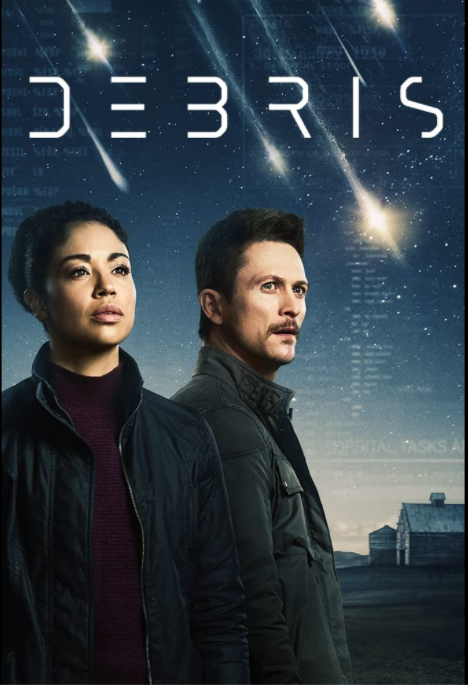
Debris 1.5: Fine Tuning


Make that two weeks in a row with strong episodes of Debris -- in fact, tonight's episode 1.5 was even better than last week's, on all kinds of levels.

The destruction was averted, and it would have been a major piece of devastation indeed: sending a piece of Manhattan to who knows where.  This evokes not only the song "I'll Take Manhattan," but John Stith's novel Manhattan Transfer.  It requires not one but two pieces of interstellar debris, posted in just the right places, fine tuned in appropriately near-distanced skyscrapers. 

And the beings doing this come not from the stars -- at least as far as we know -- but are apparently the human beings in Influx, that mysterious organization trying to marshall the powers of the debris for their own benefit.   They take pills which enable them to teleport through short, maybe longer, spaces, and the guy with the beard who is in command can join in a song playing blocks away.

Again, all of this feels like an update of Fringe, and that's just fine.   Debris has the addition of the CIA/MI6 complex relationship of incomplete allies, and this is being well developed as well, in the interactions of Finola and Bryan, both with one another and with their higher-ups in the agencies.

What I'd still like to see: how about a joint mission out into space to see exactly where the interstellar ship first appeared?   If there were no such thing as discrete networks and streaming services down here on Earth in our reality, there could be a crossover event between Debris and For All Mankind.  But I'll settle for whatever Debris can dish out.

See also Debris 1.1 Some Probability of Gems Among the Pieces ... Debris 1.2: Clones ... Debris 1.3: Trapped Out of Time ... Debris 1.4: Suspentia Belief


Saturday, May 23, 2020

Snowpiercer 1.1: Promising Hybrid


With the summer heat approaching, it's always good to see a show about the cold.  Even better, in this time of Coronavirus lock down, a series in which some of the people are crowded together, and one character even yearns "to be alone for one hour," is very welcome.

But does Snowpiercer, a series about what's left of humanity on a frozen Earth hurtling around the world on a huge, myriad-car train, have what it takes aside from the summer and COVID-19?  Based on the first episode (I haven't seen the 2013 movie or read the graphic novel on which the movie and hence the series is based), I'd say: Yes!

And that's not because of the science fiction, at least thus far, which is pretty standard and thin, for a dystopian thriller: a bit of suspended animation, cars that grow lush food, and the train itself.  But Snowpiercer has promise in the detective part of its story: a "tailee" (people who weren't invited onto the train, got on by jumping on, and are kept in the back) who was a homicide detective before the Earth grew cold, called upon by the people in charge on the train to solve a murder.

In other words, the post-apocalyptic train could be a real winner, not because of the train itself, but because of the great backdrop the train provides for a murder story.  I've always been a big fan of science fiction/detective hybrids - Isaac Asimov's robot detective stories, John Stith's "Nick Naught" detective stories - which inspired me to write my own blend of the genres in The Chronology Protection Case, The Silk Code, and other stories.

So, I'm up for watching and reviewing the rest of Snowpiercer, especially after the big twist at the end of the first episode.  I'll see you back here in a few days, after the second episode airs on TNT.


Sunday, August 18, 2019

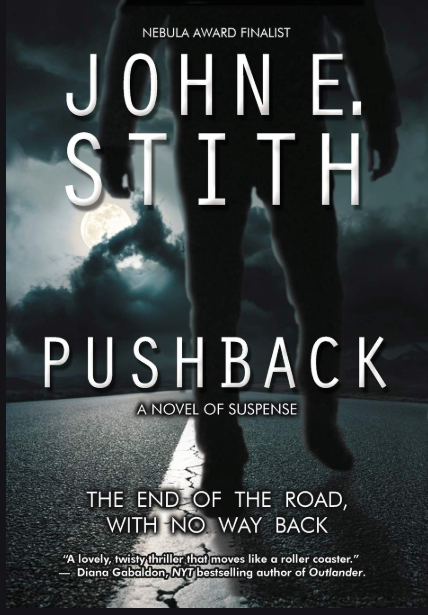
Review of John Stith's Pushback: Grab It


I usually review science fiction novels here.  But when I came across Pushback, an adrenalin pumping mystery novel by John Stith, who wrote Red Shift Rendezvous, one of my all-time favorite science fiction novels, hey, how could I resist?  Besides, the who dunnit of mystery and detective fiction is a close cousin of the what dunnit of science fiction.

The basic story of Pushback is an amiable investment counselor in Colorado Springs, Dave Barlow, finds himself the victim of an increasing series of pranks - increasing in both frequency and intensity - which soon became bizarre and sadistic attempts to murder him.   It starts when he shows up to a high school reunion and nobody remembers him because the people at the reunion are unknown to Dave and vice versa.  This escalates into his car filled with concrete, Dave almost killed in a hit-and run, his home leveled, Dave poisoned having dinner in a nice restaurant with a pretty actress trying to help him, and Dave nearly being blasted by a shotgun rigged to go off when he shows up at a client's home to talk finances.  Who is behind this and why?

Dave may be amiable but he's no slouch.  He fights back with intelligence and style, reported through the wry voice of John Stith, who serves up this surprising tale with his customary eye for detail, keen sense of humor, and immersion in decades of popular culture.  Dave is equally at home citing Z Z Top and learning how to explode eggs in a microwave on YouTube.  Middle-aged guys coming at Dave with golf clubs are "foursomes of the dead," and he notices a woman in tight jeans "closer to the paint family than the clothing family".

On that last point, there's plenty of romance in Pusback via Dave's new love, Cathy, and a winning tenderness throughout, making it no surprise that the novel was nominated for the Daphne du Maurier Award.   The location in Colorado Springs makes for a great pastel background for this narrative, which, come to think of it, would look great on any kind of screen. 

See also Book Review: Redshift Rendezvous by John Stith is Perfect Science Fiction Mystery Hybrid

Wednesday, March 26, 2014

Book Review: Redshift Rendezvous by John Stith is Perfect Science Fiction Mystery Hybrid

I've published dozens of reviews of science fiction novels by well-known and little-known authors in the past few decades, in the New York Review of Science Fiction, Tangent, the Journal of Social and Evolutionary Systems, and other places.  I thought it was time to begin putting these reviews up on this blog, one or two a month, right alongside the more numerous reviews of television series.

To start, here's my 1992 review, published in the Journal of Social and Evolutionary Systems, of John Stith's  Redshift Rendezvous (Ace, 1990, 256 pp.), now available on Kindle.   People often ask me to name a science fiction/ mystery hybrid that really works.  Isaac Asimov's robot stories (in contrast to his faster-than-light ships in space) are a good example.   And then there's Redshift Rendezvous, in some ways even truer to the hybrid ideal ...


Faster than light travel has been one of the most intriguing and frustrating challenges of science fiction, which generally distinguishes itself from fantasy by writing about technologies and events that are at least scientifically plausible. But according to Einstein's theory of special relativity, movement at faster than light speeds is flatly impossible, and the slightly more lenient theory of general relativity insists that objects attain infinite mass at light speeds. So how, then, is science fiction to write about human relations across star systems and galaxies in human time frames?

One approach might be to contest Einstein's proscriptions on super-luminary travel on scientific or philosophic of science terms. If we agree with the philosopher Karl Popper that even the best corroborated scientific theories are nonetheless highly fallible and destined for falsification -- as Einstein himself did -- then fiction writers should have little trouble amending Einstein much the same as Einstein amended Newton. But not many science fiction writers seem aware of Popper, or indeed sophisticated discussions of philosophy of science, at least insofar as these might pertain to speed of light.

The result has been a science fiction that by and large has repealed Einstein without much of a hearing. Whether the hyperspace drive of Asimov in the 40s or the warp drive of Star Trek and most else in between, travel at faster than light speeds has been more of an assumption than a challenge in a genre which is supposed to engage rather than subsume technological puzzles. (Cryogenic solutions that posit transport of frozen humans to be wakened upon reaching their destination at least have the merit of not ignoring Einstein. Frank Herbert's approach of beings "folding" space in the Dune series has an Einsteinian plausibility, but relies a bit too much on the quantum mechanical idea of mind pushing matter to be satisfyingly scientific.)

Even more disappointing than the repeal by fiat of Einstein has been science fiction's treatment of human relations in the faster than light environments. That treatment has usually been a simple transplantation of human dynamics from Earth to far vaster realms, with the assumption that travel from here to Tau Ceti and beyond should in principle be no different in terms of human effects than our capacity to easily travel now from New York to Los Angeles. But history and philosophy of technology have shown over and over again that new modes of transportation profoundly transform their passengers -- the medium is the message, as McLuhan pointed out, whether communication or transportation -- and science fiction that treats a trip across the galaxy as no different in human principle than a trip across the country thus shortchanges its readers.

Which is why John Stith's Redshift Rendezvous is so refreshing. The book is in many respects a standard adventure of murder and hijacking in space. But in one crucial regard this book is extraordinary in science fiction: it deals with the human detail of faster than light travel. Indeed, speed of light and its consequences is the real hero of this book.

The "Redshift" is a ship that travels faster than light, and Stith posits that speed of light inside the ship is therefore reduced to some ten meters per second, or 30 million times slower than its usual speed. This is far from always pleasant, and passengers are advised to keep their lifebelts on at all times (in order for their neural chemistry to operate at normal speeds), and trust their kinesthetic rather than optical perceptions.

Simple dining can be very interesting in this environment -- a morsel of fish turns indigo as it enters its eater's mouth and life field -- but committing and solving murders are even more so (the latter can be done by removing the victim's lifebelt). The chief security officer single-handedly manages to nearly disable an entire terrorist crew by virtue of his superior understanding of human movement and vision aboard his ship, and in the end he calls upon the physics of the ship's corridors to quite literally hoist the villain on her own petard.

If you like your science fiction to treat faster than light travel with a bit more respect than Dorothy clicking her heels together three times to go from Oz to Kansas, you'll enjoy this book. I look forward to return voyages on the Redshift and other Stith vessels that speculate on the stretching of natural laws and its effect on humans.


"As a genre-bending blend of police procedural and science fiction,
The Silk Code delivers on its promises." - The New York Times Book Review

#SFWApro
InfiniteRegress.tv