Chuck Todd interviews me about alternate histories
Showing posts with label Twitter. Show all posts

Wednesday, February 10, 2021

Review of Andrey Mir's Postjournalism and the Death of Newspapers

The full title of Postjournalism and the Death of Newspapers. The Media after Trump: Manufacturing Anger and Polarization by Andrey Mir says it all:  the delivery of news on Twitter and social media to an increasing majority of people has replaced the attempt to disseminate facts and truth on traditional news media, with the new goal of massive engagement via likes, retweets, and shares, with the result that an informed public, however imperfectly constructed, is being shoved aside by a polarized populace seething with anger.  I would add: this is also the best book on media theory and assessment written in forty years.

Mir brings to bear the media insight of Marshall McLuhan, the political savvy of Walter Lippmann, the radical economy of Edward Herman and Noam Chomsky, and much more in his detailed and probing analysis.  The 20th century began with newspapers selling news to readers and concluded with newspapers and radio and TV selling news to advertisers.  Both systems, though flawed, and for different reasons, were committed to making their utmost efforts to report the truth. Readers wouldn't tolerate too many falsities in their newspapers, and advertisers did not want to be associated with them, either.

All of that changed with the advent of social media, cheered at first, by many, including me, as uncorking the voice of the people, and pushing the haughty gatekeepers aka editors out of the way.   It was a case of Dylan's "Don't stand in the doorway, don't block up the hall." Occupy Wall Street and the Arab Spring were seen by me and many others as early triumphs of these unshacklings of information.  I still feel that way about social media and their potentials.  But Mir convincingly tags and explains the darkside of this same liberation of news.

On Twitter, readers pay nothing for the news other than their time.  Viewers pay nothing for broadcast news, either, but the advertisers do.  Ads appear on social media, too, but they're barely distinguishable from the myriad bits of news, which all too often are no longer news, but opinion.  And since the posters of these news opinions seek validation via likes, shares, and retweets, a kind of natural selection winnows out the more moderate opinions.  The more controversial and extreme the fact-opinion, the more likely it is to be retweeted.

This tide of polarization engulfs the traditional media, too.  Mir explains, “Centrist experts can appear in the media, but they are not those who generate buzz, virality, and spin-off in the polarized media environment aimed at frustrating and engaging" (p. 316).   When was the last time you saw a Trumpist or even a moderate on MSNBC or CNN?   Once in a blue moon, at most. As a viewer of these two cable news stations, no more immune than any other human to the polarization and anger of our age, I can attest to being annoyed and even angry when a Trumpist or even a moderate appears unchallenged by aggressive hosts on these stations.  I don't watch much of Fox News, but from what I've seen, the same and worse is true in reverse: progressives unchallenged or not by hosts are virtually nonexistent over there.  Moreover, some hosts on Fox have no problem spouting outright lies like Trump won the 2020 election as fact.

Keep in mind that Mir made all of these observations about the intensification of angers in this, our socially mediated age, prior to Trump's mob storming the U. S. Capitol on January 6 of this year.  I just saw, today, the second day of Trump's second impeachment trial in the U. S. Senate, a video that captured the sick fascistic depravity of that mob, and how close they came to killing the Vice President of the United States, the Speaker of the House, and who knows how many Senators and Representatives -- how close that Hitlerian, Trumpist mob, who pretend to be Americans, came to dealing out mass death, were it not for the bravery and savvy of the Capitol and District of Columbia police who were so vastly outnumbered.  They were outnumbered by the physical manifestation of the online mobs that Mir describes in Postjournalsm -- physical mobs that sought to cancel democracy by cancelling the lives of its elected representatives.

I remain an optimist, and, like John Milton, a believer in human rationality, and its capacity to stand up to illogical and inchoate emotion.  But it failed before, in Nazi Germany, and it almost failed here in the United States at the end of Trump's term in office.

If you'd like to learn more about how this state of the country and world came to be, read Mir's book.  You'll likely learn more from Postjournalism -- as chocked full of extensive research as it with prescient lines like "There were no revolutions before newspapers, and there will be none after; only riots (yet, maybe, coups)"(p. 451) -- than from the past dozen books you've read or will read on the subject.


Monday, January 25, 2021

Podcast: Twitter Ban of Trump Was Right, Even Though It Violates the Spirit of the First Amendment


Welcome to Light On Light Through, Episode 165, in which Brian Standing on WORT-FM Radio (Madison, Wisconsin) interviews me about why I think Twitter's banning of Donald Trump was the right thing to do, even though that violates what I call the "spirit of the First Amendment".  We also discuss why I think government should keep its hands off social media.

Further reading:


Check out this episode!

Wednesday, December 18, 2019

A Media Theorist Looks at Today's Impeachment: Tape Recorder, Telephone, and Television

"It started with a phone call," Brian Williams just aptly said on his MSNBC show, The 11th Hour, about what ignited today's impeachment of Donald Trump by the House of Representatives.  That phone call, as everyone knows, was the one in which Trump tried to extort Volodymyr Zelensky, President of the Ukraine, to announce an investigation into Joe Biden and his son - "arms for dirt," as Former Federal Prosecutor Glenn Kirschner characterizes the price (dirt on the Bidens) that Trump was attempting to exact from Zelensky for release of crucial U. S. weaponry to the Ukrainians.

Fortunately, for those who value decency, the phone call was leaky.  It was overheard, and then became known to the world via a whistleblower's good work.   The Nixon tapes in 1974, which resulted in Nixon's resignation in order to avoid impeachment, became the phone call in 2019 which made Trump's impeachment unavoidable unless he too had resigned, which he never would.

And in the aftermath of that phone call, television took front and center stage, including through the historical vote for impeachment tonight.   Traditional media, telephone and television, bringing a President to the edge of removal, just as the tapes had done to Nixon.

I think it's significant that, with all the attention Twitter and social media correctly receive as vehicles and conduits of politics today, it was two traditional media, which arose much earlier than social media, that carried the ball in Trump's impeachment.  Which is evidence of a point I often make: new media rarely obliterate older media.  Instead, though the newer media get most of the attention, the older media continue to do their job.

Tape recording, telephone, television.  Older media, with venerable values.  Just like democracy itself and its victory today.


Sunday, April 8, 2018

Homeland 7.9: Franny vs. the Job or the U. S. Hacks Twitter

Whew, another outstanding, heart-pounding episode of Homeland just on tonight - 7.9 - about as good as it gets on Homeland (which is, remarkable indeed), and, in this case, about the best on the series so far in one of the underlying foundations of the series:  Franny vs. the job.

That dilemma of which is more important to Carrie, which should she give her best attention to, underlies just about everything in these stories since Franny was born.  But tonight the tug on Carrie's very soul was never more acute.  She leaves Dante in the hospital, under incredibly tight security, to reclaim Franny - which, Carrie soon discovers, means literally reclaiming her daughter from her (Carrie's) sister.

But the security at the hospital, though bristling and apparently air-tight, is still no match for the resourceful Yevgeny.   And, in a series of life-and-death moves with all kinds of possible outcomes, Yevgeny apparently kills Dante.  (Yeah, there are spoilers in this review.)  (And I say "apparently" because I'm not completely sure we saw Dante dead.)

And Carrie, about to leave the school with her daughter, has to rush back to the hospital.  Carrie almost hits Franny as she's quickly backing up in her car, and ... Carrie's shattered.  Worse, I would say, than once again.

And that's not the only almost one-of-a-kind development in tonight's hour.  The other is the U. S. government hacking Twitter to turn a Russian code back on the Russians to destroy their network.  I wonder how Twitter feels about that?

All I know is that this hour was one high of an adrenalin ride, and another first-rate spy story, and I'll see you back here next week.


And see also  Homeland on Showtime ... Homeland 1.8: Surprises ... Homeland Concludes First Season: Exceptional


Sunday, January 7, 2018

Media Ecology: A Cartesian Review of Lance Strate's Book

As a few of you may know, I got my PhD from New York University in 1979, in Neil Postman's "Media Ecology" (then new) program.  Postman likely got the name from Marshall McLuhan, who used it in the 1960s, and whom I met and came to know and work with after Postman asked me to write a preface to McLuhan's "Laws of the Media," an early, short presentation of his "laws of the media" that Postman published in the journal et cetera (that was the name of the journal - you can read the article with the preface here).  There's more about the tetrad in my Digital McLuhan and McLuhan in Age of Social Media, and in this talk I gave at Fordham University this past October.

People always wonder what "media ecology" is.   Lance Strate, who got his PhD in the Media Ecology program in 1991, about a decade after me, wrote a book in response, and I can't think of a person better suited to provide a knowledgeable answer.  Strate, my colleague at Fordham University and indeed the person who hired me in 1998, took up the "media ecology" banner when Postman was in his declining years.  Strate created the Media Ecology Association in 1998 and it's still going strong across the world with yearly conferences.  (If you think this makes me a biased reviewer of Strate's book, too bad - read the book, see if you agree, and, if not, tell me on Twitter or wherever where you think I'm wrong - I'm @PaulLev over at Twitter, by the way.)

When reviewing scholarly books - whether in proposal form for would-be publishers, or for a review like this after publication - I always apply a Cartesian test: how accurate is the book in describing theories, ideas, and facts that I know best?  Strate's book does an A-1 job of describing my work in media theory (I generally prefer theory to ecology, but that's just me), including delving into aspects of my work - like my Tetrad "Wheels" of Cultural Evolution - that are not widely known.   As a second indicator, Strate gets Josh Meyrowitz's work just right, too.  I sat next to Josh in our PhD seminars at NYU, and I know more about Josh's work than just anyone else's other than mine.

But Media Ecology does much more.  It situates the field in the larger areas of human scholarship and discourse, connects it to dozens of scholars in addition to Meyrowitz and me, addresses the synapse of communication in everything from the universe at large to the smallest mark on a page.   So, yes, it will tell you, eminently, vividly, clearly, and compellingly what media ecology is all about.

Which I'm not going to tell you here.  Read the book.

Ok, here's a very short answer:  media ecology is about how communication in one form or another, interconnected like living organisms (hence "ecology") makes things happen in our history and our world, because communication is essential to human life.  Or, to borrow from McLuhan, the way I like to put it nowadays is:  media ecology is about how without radio, there would have been no Hitler, and without Twitter, no Trump.

All right, McLuhan, who left us in 1980, was responsible only for the radio part of that.   All I did was apply it to the present.  But that's the point about media ecology:  its principles, which as Strate abundantly shows, predate McLuhan and Postman, and now extend far beyond them, are even more relevant today than when we sat in those seminars at New York University.

To be clear, Strate and I by no means are in agreement about the impact of all or any given media on our lives.  I tend to be more optimistic than Strate, on technologies ranging from space travel to social media (notwithstanding what I think about Twitter and Trump).  But this field has always been about mastering the principles and formulating your own views.   If you'd like a handbook on how to do this, and maximize your understanding of what's going on, get a copy of Media Ecology.


Wednesday, December 6, 2017

Government Regulation of Social Media Would Be A 'Cure' Far Worse Than The Disease

In case you missed this, my article published 28 November 2017 in The Conversation ...

Government regulation of social media would be a 'cure' far worse than the disease


File 20171121 6039 10hgvnh.jpg?ixlib=rb 1.1
                    NextNewMedia
Paul Levinson, Fordham University


In recent weeks, Congress has grilled Twitter, Facebook and Google about their role in allowing foreign interests to place ads and articles intended to divide the electorate and spread false information during the 2016 election.

Now a number of people in and out of government are calling for federal regulation of social media.
Lay down some rules, the thinking goes, and we would be able to prevent the infestation of bots and fake news from our news feeds and ads. Democracy would be saved – or, at least, foreign interference in our elections kept in check.

However, as someone who has studied and taught the First Amendment for decades, I would argue that if such regulations were enacted, the main victims would be not the purveyors of fake news, but our freedom of expression. In my view, the result would do far more damage to our democracy than any foreign misinformation campaign ever could.

Free speech being attacked from all sides


The First Amendment is under a lot of duress.

Arguably, it’s been that way since the Supreme Court’s “clear and present danger” decision in 1919, which spelled out when limits on free speech could be lawful. It not only held that the government had an obligation to stop someone from “falsely shouting fire in a theater,” but also opened the gates to all manner of government violations of the First Amendment injunction that “Congress shall make no law…abridging the freedom of speech, or of the press.”

These range from the FCC’s “Fairness Doctrine,” which was upheld by the Supreme Court, that required broadcasters to present controversial issues in a balanced way (in the FCC’s view), to the FCC’s warning to radio broadcasters in 1971 not to play songs that glorified drug use, which actually had the effect of limiting the airplay of songs that critiqued drug culture.

Indeed, with the exception of Supreme Court decisions in the Pentagon Papers case in 1971 and the Communications Decency Act in 1997, the American government has systematically increased its control of media.

The situation has gotten much worse over the past year. President Trump has tweeted about withholding the licenses of NBC affiliates and lashed out at other media not to his liking.
Although Trump’s bluster about limiting and punishing media may be easy enough to deride, the fact that he is in the White House – and has the ability to appoint FCC commissioners – means his threats must be taken seriously.

Meanwhile, a theory of philosopher Karl Popper – the “paradox of tolerance” – is being widely cited as a justification for outlawing hate speech, notwithstanding the First Amendment. From his 1945 book “The Open Society and its Enemies,” it says that tolerance defeats itself when it permits intolerant speech.

I studied Popper extensively while researching my first book, an anthology of essays about Popper’s work. There are many aspects of Popper’s philosophy to admire, but I don’t believe the “paradox of tolerance” is among them.

To ban hate speech could turn our tolerant, democratic society into precisely the kind of state that hate speech is calling for: It could open up an opportunity for all sorts of speech to be dubbed “hate speech.”

A slippery slope


When regulating fake news on social media sites, there’s the danger of the same sort of phenomenon taking place. And it’s exactly why the well-meaning hue-and-cry that the government needs to intervene and forbid social media sites from disseminating fake news or allowing accounts that are actually bots is so dangerous.

Fake news is nothing new. Centuries ago, anti-Semitic publications spread rumors that Jews murdered Christian children and drank their blood on holidays.
Over the past two years, social media have increased the amplitude and reach of fake news. But there’s also been the ascension of a political figure – Trump – who has turned the tables by labeling any unwelcome news as “fake.”


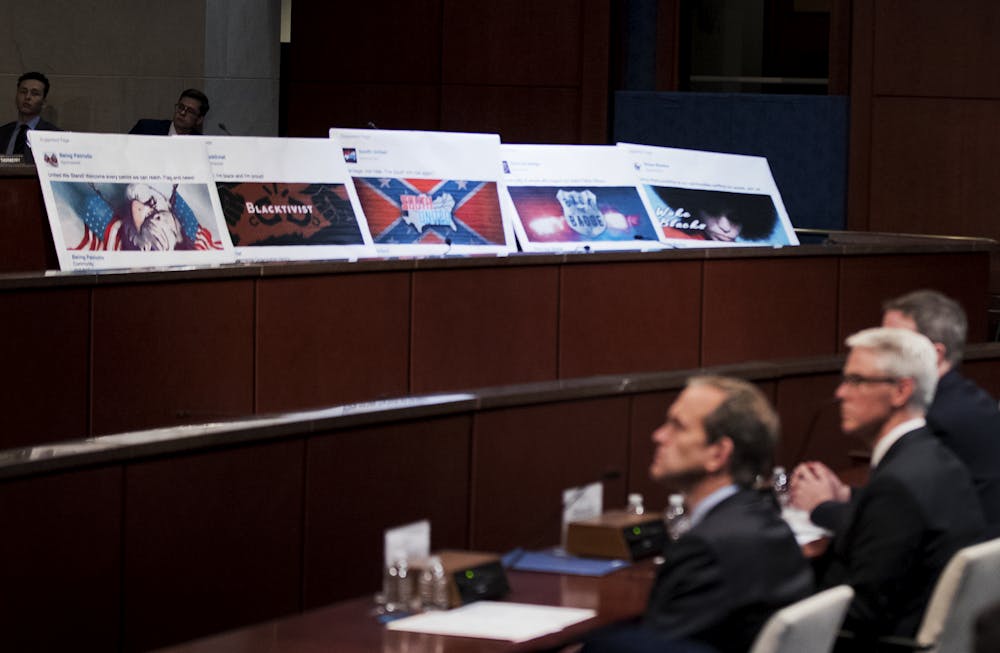
Facebook ads linked to a Russian effort to disrupt 
the American political process are displayed as 
representatives from Google, Facebook and Twitter 
testify before the House Intelligence Committee on Nov. 1. 
Manuel Balce Ceneta/AP Photo

The latter should be more than enough reason to reject calls for government censorship of fake news. After all, who’s to say a government that determines what’s “fake” won’t simply follow Trump’s lead, and suppress critical and truthful content under the guise that it’s fake?

Instead, social media networks could develop and implement algorithms for identifying and removing fake news by marshaling the same engines that spread fake news in the first place. These algorithms would not be administered by the government; rather, Facebook and other social media would be responsible.

Twitter has already made considerable progress flagging and removing accounts that spread Islamic State propaganda. There’s no reason to think that the same process can’t be applied to Russian bots seeking to inflame political discord and therein damage America’s political system.

Such self-regulation is in the best interest of these media companies. It would increase the confidence of their users in what they encounter online. It would also have the added benefit of keeping government regulators at bay.

In the end, the ultimate antidote to fake news and bots is the rationality of the human mind.
As John Milton famously urged in his “Areopagitica,” if you let truth and falsity fight it out in the marketplace of ideas, human rationality will most likely choose the truth. Regulating what can enter that marketplace could impair or destroy this process, by inadvertently keeping truth from public awareness.

Rational thinking’s ability to identify fake news is more than a Miltonian ideal: It’s been demonstrated in a carefully conducted 2015 experiment. When given a small financial incentive, the subjects were able to identify fake news as fake, even if the fake news supported the political views of the subjects.

Indeed, rationality is deeply implicit in democracy itself. You can’t have the latter without the former.
The Conversation

The key in combating fake news and kindred attacks on our body politic is to give our rationality maximum access to all information, including the truth. And in my view, this means resisting any attempts by government to limit the information that reaches us.

Paul Levinson, Professor of Communication and Media Studies, Fordham University

This article was originally published on The Conversation. Read the original article.

Saturday, December 31, 2016

The Perversity of Things: review #1 of X: Gernsback as Philosopher of Technology

I just started reading The Perversity of Things: Hugo Gernsback on Media, Tinkering, and Scientifiction, edited by Grant Wythoff (University of Minnesota Press, 2016).  I've read the first 8 pages of Wythoff's 59-page masterful Introduction to the 359-page volume, and there's so much to say about this, because there's so much on every page, that I thought I'd post a series of reviews here, rather than try to cram everything that needs to be said about this volume into one long unwieldy review.  After all, I just posted three reviews of The Man in the High Castle second season on Amazon, even though I binge-watched it over two evenings.

I'm looking forward to spending ten times longer if not more on The Perversity of Things, which seeks to put Gernsback, most known as the father of pulp magazine science fiction due to his publication of Amazing Stories, the first magazine devoted only to science fiction, beginning in 1926. I've always had a special interest in Amazing Stories, given that it was the first "pro" magazine to publish one of my science fiction stories - "Albert's Cradle" in 1993 (thanks again, Kim Mohan, who was editor) - but The Perversity of Things is much more than a meticulously researched compendium about Gernsback's philosophy of science fiction, though it is that, too.

But as the first eight pages of Wythoff's Introduction explain and detail - each page is a small feast for the intellect - this book is about Gernsback as a philosopher of technology, and his unrecognized position as such. Wythoff tells us that the title of this book comes from what Gernsback thought and said about "things" - "the perversity of things" -which can confound, confuse, and irritate us when we (the public) have no experience with them.  We, and alas, much of media criticism and what passes as scholarship, are therefore prone to see what's wrong not right with new technology and media, and blame them for every evil in our society (look at the beating Twitter has taken for Trump's election - as if Twitter somehow forced people to vote for him). Wythoff contends that Gernsback's life project was to do just the opposite - enable the public to learn what was right about new technology, and use it for the betterment of our species.

Wythoff supports his arguments not only with powerful logic, but comprehensive research expressed in copious footnotes and illustrations from the time (at this point, the beginning of the 20th century and its publications).  On the footnotes, it's been years since I've read such well-written mini-essays, and it's a pleasure and enlightening to see them again.  (The last time I did anything like this in my own work was in my Mind at Large: Knowing in the Technological Age, 1988, which explored technology as an embodiment of human ideas and imagination.)

It's fair and sad to say that Gernsback ultimately lost his battle.  The Man in the High Castle, superb and astonishing as it is, represents the kind of science fiction that won, in 1962 when the novel was first published, and now.  As Wythoff points out, it's amazing that we had much optimism about science and technology after the ravages of the First World War, but we did.  And that somehow lasted even past the Second World War, but not the 1960s, when, as I mentioned in my review of Star Trek Beyond just last night, the Star Trek series on television represented the last major science fictional paean to how we could improve our species and the cosmos beyond our planet with our science and technology.

There have been some exceptions to this tide - such as some of the stories in Hartwell and Cramer's Hard SF Renaissance (2004) - but the fact that Wythoff put this book together and got it published by a major academic press, the fact that the Star Trek franchise is still flourishing, speak more ringingly to the survival of Gernsback's vision despite the pummeling it has received.  The Perversity of Things will be a handbook for the resurgence of that vision - it's the best new scholarly book I've read in decades - and I'll be back here with another installment of my reviews soon in the New Year.

See also The Perversity of Things: review #2 of X: Learning by Doing ... #3 of X: The Evolution of Media ... #4 of X: Gernsback and the First Amendment ... #5 of X: Amateurs vs. Corporations ... #6 of X: Thought Experiments and Toys ... #7 of X: The Invention of Invention, and the Advent of Science Fiction ... #8 of X: Definitions and Fake News


Monday, October 3, 2016

Four Rudy Giuliani's on Twitter

I saw this earlier today on Meet the Press, and meant to write about it.

Rudy Giuliani is being interviewed by Chuck Todd, who cites a tweet from Giuliani.

Giuliani says that tweet wasn't by me - that there are four accounts impersonating him on Twitter. Todd says ok, drops the question, and moves on to something else.

What's going on?

Well, if you look for Giuliani on Twitter, you'll indeed find four accounts - actually, more than four - none of which have the coveted blue check mark, which indicates that the account was verified in some arcane way by Twitter.  Donald Trump's account has the check - and that's how we know that @realDonaldTrump  is really Donald Trump and @realDoneldTrump  is not.

I'm too lazy to paste the four bogus Giuliani accounts here - you can easily find them yourself - but, since indeed none have verifying check marks, I'll buy that none are really Giuliani.  But this begs the question of: why doesn't Giuliani get his own, real verified account?

Chuck Todd, as he often does, failed to follow up when Giuliani denounced the tweet as not his.   So we're left guessing why Giuliani doesn't have a check mark.   Is he on Twitter by some other name? Did Twitter not deign to give Giuliani a check mark?  (Hey, it happens - I don't have check mark on my @PaulLev account either.)

But whatever the reason, the result led to a signal moment in television news today, when the flagship Sunday news show of them all - Meet the Press debuted on NBC in 1947 - had to withdraw a question to a guest because it was about a tweet that in fact the guest didn't make, even though there are four accounts on Twitter tweeting under the guest's name.

More evidence for what I've said in McLuhan in an Age of Social Media about Twitter having toppled television as the cutting edge medium for delivery of news, and everyone other than the people on television knowing this.

Wednesday, February 3, 2016

Why Money Doesn't Matter As Much As Some Think in Politics

I've been arguing for years about Citizens United - and its lack of baneful influence on our political system.  Which is to say -  I think that big money has not distorted or disrupted our elections or political process.

The best example, until now, has been the re-election of Barack Obama in 2012.  Big money did everything it could to stop him.  But it couldn't erase Romney's thoughtless comment about the "47%" not mattering, and the video recording of that comment likely helped him lose the election. YouTube beat big money.

This year, Bernie Sanders is doing pretty well - explicitly denouncing the role of money in politics provided by corporate giants.   Clearly, if that money were so unstoppable in its influence, Sanders wouldn't be where he is today.

And a statistic just released today shows another way in which money has had little if any lasting influence in the 2016 Presidential campaign thus far.  As indicated in the chart, shown earlier on MSNBC, Jeb Bush has far and away spent the most per vote received by any GOP candidate - which means he has spent the most amount of money, and received the last in return in voter support. Conversely, Trump has spend the least - and his low expenditures have given him a second place finish in Iowa in a crowed field.


Clearly, then, money is not a decisive factor.  Social media are apparently more decisive.  In Trump's case, his domination of Twitter brought him to second place (and the fact that it was second, not first, shows that social media have their limits, too -  see here for more).

I've always thought that, as John Milton and Thomas Jefferson pointed out, when truth and falsity are given access in the marketplace of ideas, people will recognize the truth and vote their self-interests. This is where social media find their limits, too - human rationality can recognize a lie, or bombast such as Trump's, whether presented in a high-cost ad or in a no-cost Tweet.  But the advent of social media means that, regardless of how much money may be spent to the contrary, someone, somewhere, will be able to express a fact or a view closer to the truth.   And with the mass media picking up more from social media, that fact will sooner or later be broadcast to millions.

Tuesday, February 2, 2016

What the Trump Defeat in Iowa Says about the Limits of Social Media

I don't think I've seen anyone mention this as yet, so I'll make the point here:  I think Trump's defeat in Iowa last night, coming in a clear second to Ted Cruz, says something about the limits of social media.

Or at least that a superior number of Twitter followers did not equate to success in a political caucus. Trump has 5.99 million followers on Twitter.   Cruz has 779 thousand.   I have no idea how many of them are in Iowa, but Cruz's victory in Iowa shows that Twitter clout isn't all it's cracked up to be - at least, not politically - and that other factors enter in voters choices in caucuses.

Ron Paul actually learned a similar lesson back in 2008.   Twitter was much smaller then, but there was a lot of political action on Digg, which operated like Reddit does now, and was much bigger than Reddit back then.   In those days, editorials and other articles on the Internet praising Ron Paul were regularly voted up to the front page of Digg by its readers.   Articles about Ron Paul dominated Digg for months and months.  But when the primaries came, Ron Paul was in single digits.  (For more on social media in the election of 2008, see my New New Media.)

Hillary and Bernie are more equally matched now on Twitter - Hillary has 5.28 million followers, in comparison to Bernie's 1.3 million and 1.33 million on his two active accounts - which makes it no surprise, Twitter-wise, that the two finished so neck-and-neck in Iowa.   Or even that Hillary won, albeit by the most narrow margin.

But unlike the Democrats, for which numbers of Twitter followers were roughly in synch with the Iowa results, the defeat of Trump given his huge Twitter presence says something else.   Likely the reason for the Trump discrepancy has something to do with the nature of his Tweets, and what it is about them and him that attracts so many followers.   Unlike Hillary and Bernie and Cruz, Trump's in fact have very little political content, trafficking instead in broad insults and truculent declarations.  It may well be that these are fun to read but insufficient to galvanize true political support.  Which would certainly be a good thing for our country.


Saturday, April 4, 2015

Bones 10.12: The Digital Revolution

Bones has had a long flirtation with social media.   As I talked about in my book, New New Media
On the love or appreciation side, we have another example in the case of “The Glowing Bones in the Old Stone House,” or Episode 20 in the second season of “Bones” on Fox TV in the spring of 2007. The murder victim, a chef, had a MySpace page with videos of her restaurant, and this figures in the investigation. In the special commentary on the DVD that was later released, Stephen Nathan (writer), Caleb Deschanel (father of the lead actress, Emily Deschanel, and director of this episode) and Emily explain that the producers uploaded the restaurant videos to MySpace five weeks before the episode, as a way of generating interest in the episode. This was a savvy move—what better way of creating buzz than putting elements of a fictional television story on a real social medium and in turn presenting that social medium as part of the story.
Bones returned to social media in a big way in episode 10.12 this week, in which Twitter comes in for a round of opining from all sides.  Bones starts off an opponent, but then decides to follow her publisher's advice to get active on Twitter, as a remedy for her lagging book sales, and the ignominy of finding her book in the cut-price remainder section of the bookstore in the opening setting scene. But she remains delightfully clueless about how to use it, ranging from linking to arcane scientific papers - hey, I occasionally do that myself - to having an unerring knack for clunky hashtags.

Fortunately, she has great support from Booth, who's surprisingly savvy about Twitter - I'm not sure why I say surprisingly, but I guess Booth is usually a bit more behind the times in media trends - and excellent practical advice from her intern, who understands Twitter at least as well as any of you reading this right now.   On the other side, we get a scathing critique from Angela, who offers the tired view that Twitter is somehow dehumanizing. (I'm disappointed in you, Angela!)

In the end, Bones becomes adept, attaining a decent number of followers, a good short-form technique, and a sense of how to best use photos.   In a way, this whole story is a parable for Bones in every social situation: she starts out awkward but lovable, and, in the end, finds a way to master it and make it all her own.   Much like the evolution of Twitter itself, where I'll now be posting a link to this very review.


Bones 100 and 200 podcast reviews


And see also Bones 9.1: The Sweet Misery of Love ... Bones 9.2: Bobcat, Identity Theft, and Sweets ... Bones 9.3 and NCIS 11.2: Sweets and Ziva ... Bones 9.4: Metaphysics of Death in a Television Series ... Bones 9.5: Val and Deep Blue ... Bones 9.6: The Wedding ... Bones 9.7: Watch Out, Buenos Aires ...Bones 9.8: The Bug in the Neck ... Bones 9.9: Friday Night Bones in the Courtroom ... Bones 9.10: Horse Pucky ... Bones 9.11: Angels in Equations ... Bones 9.12: Fingernails ... Bones 9.13: Meets Nashville, and Wendell ... Bones 9.14: "You Cannot Drink Your Glass Away" ... Bones 9.15: Hodgins' Brother and the Ripped Off Toe ... Bones 9.16: Lampreys, Professors, and Insurance Companies ... Bones 9.17: Spartacus in the Kitchen ... Bones 9.18: Meets Day of the Triffids ... Bones 9.19: The Cornucopic Urn ... Bones 9.20: Above the Law ... Bones 9.21: Freezing and Thawing ... Bones 9.22: Promotion ... Bones 9.23: The New Intern ... Bones Season 9 Finale: Upping the Ante

And see also Bones 8.1: Walk Like an Egyptian ... Bones 8.2 of Contention ... Bones 8.3: Not Rotting Behind a Desk  ... Bones 8.4: Slashing Tiger and Donald Trump ... Bones 8.5: Applesauce on Election Eve ... Bones 8.6: Election Day ... Bones 8.7: Dollops in the Sky with Diamonds ...Bones 8.8: The Talking Remains ... Bones 8.9: I Am A Camera ... Bones 8.10-11: Double Bones ...Bones 8.12: Face of Enigmatic Evil ... Bones 8.13: Two for the Price of One ... Bones 8.14: Real Life ... Bones 8.15: The Magic Bullet and the Be-Spontaneous Paradox ... Bones 8.16: Bitter-Sweet Sweets and Honest Finn ... Bones 8.17: "Not Time Share, Time Travel" ... Bones 8.18: Couples ... Bones 8.19: The Head in the Toilet ... Bones 8.20: On Camera ... Bones 8.21: Christine, Hot Sauce, and the Judge ... Bones 8.22: Musical-Chair Parents ... Bones 8.23: The Bluff ... Bones Season 8 Finale: Can't Buy the Last Few Minutes

And see also Bones 7.1: Almost Home Sweet Home ... Bones 7.2: The New Kid and the Fluke ...Bones 7.3: Lance Bond and Prince Charmington ... Bones 7.4: The Tush on the Xerox ... Bones 7.5: Sexy Vehicle ... Bones 7.6: The Reassembler ... Bones 7.7: Baby! ... Bones 7.8: Parents ...Bones 7.9: Tabitha's Salon ... Bones 7.10: Mobile ... Bones 7.11: Truffles and Max ... Bones 7.12: The Corpse is Hanson ... Bones Season 7 Finale: Suspect Bones

And see also Bones 6.1: The Linchpin ... Bones 6.2: Hannah and her Prospects ... Bones 6.3 at the Jersey Shore, Yo, and Plymouth Rock ... Bones 6.4 Sans Hannah ... Bones 6.5: Shot and Pretty ... Bones 6.6: Accidental Relations ... Bones 6.7:  Newman and "Death by Chocolate" ...Bones 6.8: Melted Bones ... Bones 6.9: Adelbert Ames, Jr. ... Bones 6.10: Reflections ... Bones 6.11: The End and the Beginning of a Mystery ... Bones 6.12 Meets Big Love ... Bones 6.13: The Marrying Kind ... Bones 6.14: Bones' Acting Ability ... Bones 6.15: "Lunch for the Palin Family" ...Bones 6.16: Stuck in an Elevator, Stuck in Times ... Bones 6.17: The 8th Pair of Feet ... Bones 6.18: The Wile E. Chupacabra ... Bones 6.19 Test Runs The Finder ... Bones 6.20: This Very Statement is a Lie ... Bones 6.21: Sensitive Bones ... Bones 6.22: Phoenix Love ... Bones Season 6 Finale: Beautiful

And see also Bones: Hilarity and Crime and Bones is Back For Season 5: What Is Love? and 5.2: Anonymous Donors and Pipes and 5.3: Bones in Amish Country and 5.4: Bones Meets Peyton Place and Desperate Housewives and Ancient Bones 5.5 and Bones 5.6: A Chicken in Every Viewer's Pot and Psychological Bones 5.7 and Bones 5.8: Booth's "Pops" and Bones 5.9 Meets Avatar and Videogamers ... Bad Santa, Heart-Warming Bones 5.10 ... Bones 5.11: Of UFOs, Bloggers, and Triangles ... Bones 5.12: A Famous Skeleton and Angela's Baby ... Love with Teeth on Bones 5.13 ... Faith vs. Science vs. Psychology in Bones 5.14 ... Page 187 in Bones 5.15 ...Bones 100: Two Deep Kisses and One Wild Relationship ... Bones 5.17: The Deadly Stars ...Bones Under Water in 5.18 ... Bones 5.19: Ergo Together ...  Bones 5.20: Ergo Together ... Bones 5.21: The Rarity of Happy Endings ... Bones Season 5 Finale: Eye and Evolution

#SFWApro


Neanderthal bones
   

InfiniteRegress.tv