Chuck Todd interviews me about alternate histories
Showing posts with label Jay Kensinger. Show all posts

Saturday, April 13, 2024

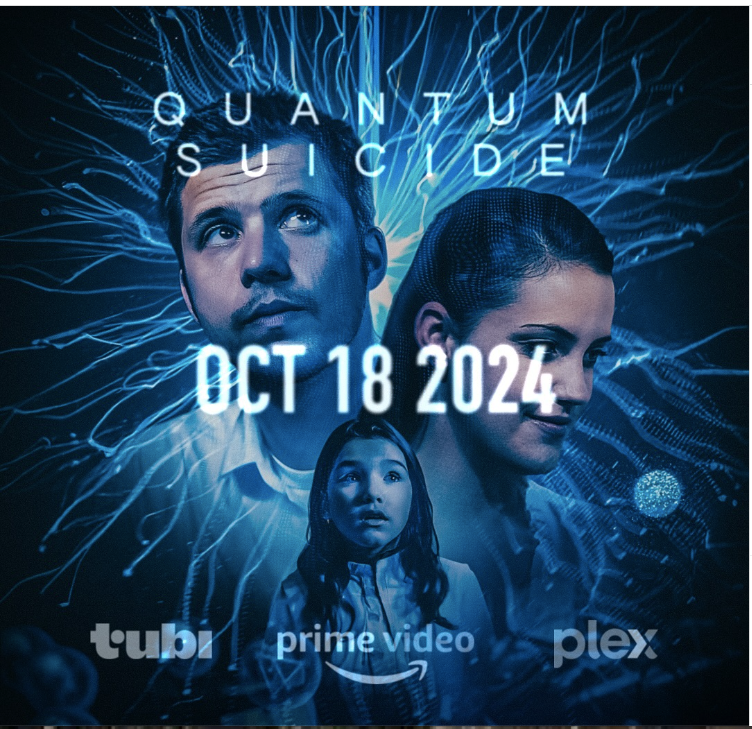
Quantum Suicide: Beholding the Eye of the Storm


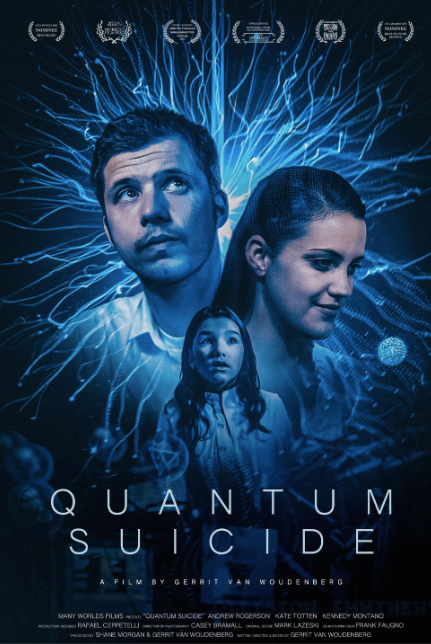
Gerrit Van Woudenberg's Quantum Suicide movie (which he wrote, directed, and -- with Shane Morgan - co-produced) won the Best Sci-Fi Dramatic Feature award at the Philip K. Dick Film Festival last week in New York.  I was at the Festival, and moderated a panel with Van Woudenberg, but I had another appointment when the movie was shown at the Festival.  Van Woudenberg was good enough to give me the URL for a screener, which I just saw and greatly enjoyed.  Herewith a non-spoiler review.

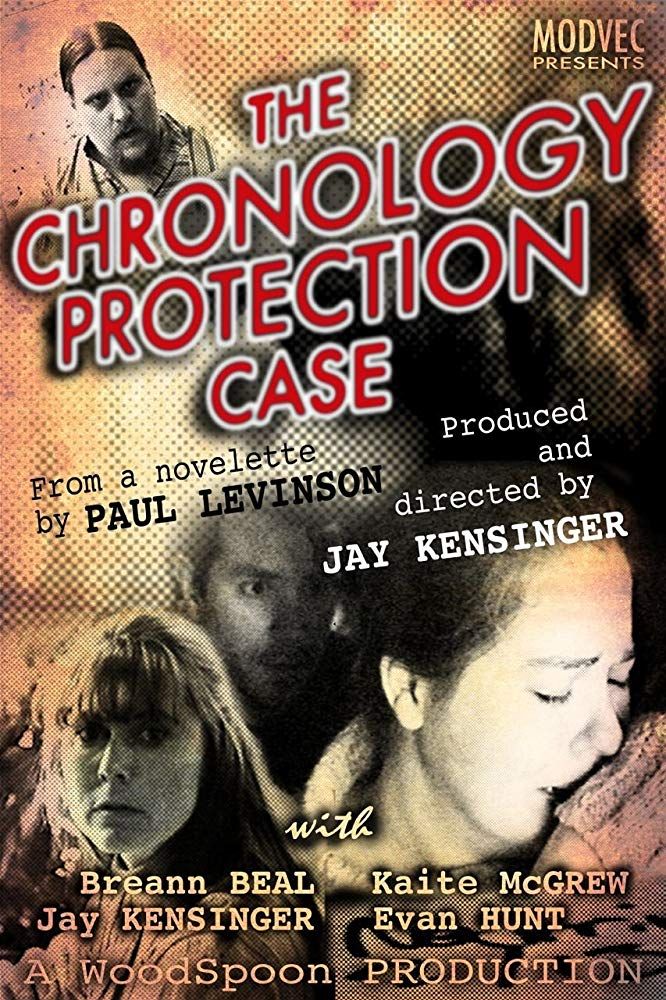
The clockwork of the movie is quantum mechanics, something which will be familiar to readers of my novelette, The Chronology Protection Case, and viewers of the short film that Jay Kensinger made from my story. The multifaceted gist of QM is that is that mere observation of quantum particles affects their location, speed, and existence; that when two particles collide and go off in opposite directions, anything that happens to one instantly influences the other, regardless of how far apart they are, and because this "quantum entanglement" happens regardless of the distance between the particles, it contradicts the widely held notion that speed of light is the ultimate speed in the universe.  Further, particles in themselves exist in either/or states, and observation of a particle determines which state the particle is in, and can even destroy it -- much like, I always think, what trying to fathom the texture of a snowflake with your fingers does to the snowflake.

Quantum Suicide takes this one crucial step further, drawing on the quantum suicide thought-experiment -- in which a gun pointed at the observer can either be shot at the observer's head or not -- and hypothesizing and weaving a story around the premise that therefore the observation of a subatomic particle can also destroy the observer.  Or, more precisely, the experimenter in the eyes of the observer.

But don't think you need to be a quantum physicist to understand and really enjoy this movie.  I'm not, at least in this universe  If you have been a big admirer of Primer -- the now classic 2004 time travel movie -- or any movie that features the scientist or scientists doing concept-bending and earth-shattering work in their spare bedroom or garage, you'll love Quantum Suicide.  Like Kensinger's The Chronology Protection Case, Quantum Suicide features detailed scientific explanations woven into the action, which always feel to me to be something Hugo Gernsback would've greatly appreciated.   And as for work-at-home science, the movie not only features the scientist and his significant other, but their next-door-neighbor, a little girl who also spends her time building radios and ant farms. 

Kennedy Montano does a good job as that precocious girl, Emily, as does Andrew Rogerson as the work-at-home experimenter Cayman with a penchant for self-destruction, and Kate Totten as his life partner Gen who observes Cayman with increasing misgiving. The music in Quantum Suicide, an original score by Mark Lazeski, is suitably pitched between anxiety and terror producing. The movie is currently making the film festival rounds, nominated for six awards and winning another. It will likely be on one of the streaming services this Fall*.  If you crave a little hard science in your science fiction you can't go wrong with Quantum Suicide, and if you don't, you don't know what you're missing.

More information about Quantum Suicide here, including a synopsis of the plot and a trailer.

*Note added 13 October 2024: And in fact it will be debuting on Amazon Prime video October 18, 2024. Watch also for my podcast interview with Gerrit Van Woudenberg which will be up here and everywhere you listen to podcasts in the next few days.


watch the movie on Amazon Prime Video


Thursday, August 17, 2023

The Chronology Protection Case Trailer

Jay Kensinger's trailer for The Chronology Protection Case, adapted from 
my novelette, on Amazon Prime Video

Sunday, November 20, 2022

Greg Bear, RIP: Three Ways In Which He Bettered My Life


                          Greg Bear -- File 770

Greg Bear, author of more than 50 science fiction books, left us yesterday at the too-young age of 71.  I'll leave it to others to detail the superb, riveting stories he told us in those books, and tell you instead about three significant ways he had a personal impact on my life.  I was always happy to run into him at a science fiction convention, but these three encounters were more than that.

1.  I wrote a review somewhere of the Foundation prequel trilogy Gregory Benford (Foundation's Fear), Greg Bear (Foundation and Chaos), and David Brin (Foundation's Triumph) -- or maybe it was just a comment on some board -- at the end of the 1990s, a few years after Isaac Asimov's death.   I said that I enjoyed all three novels, but, surprisingly, Greg Bear's was the best.  (I guess I was surprised because I expected that all three would be so good it wouldn't be so easy to rank them.) Greg and I had already been in occasional touch -- he had been President of the Science Fiction Writers of America from 1988-1990, and I was President of SFWA from 1998-2001 -- and I got a genial email response from Greg almost immediately after my review/comment was published.  "Why are you surprised?"

There was something refreshing and reassuring about those four words that immediately struck me.  I was already egotistical -- most writers are -- but Greg's response, in addition to making me laugh, showed me how right and important it was to stand up for yourself when circumstances called for that.  Modesty isn't all it's cracked up to be.

2. In February 2002, I received a package in the mail.  It contained a videotape made by Jay Kensinger, of a short movie he had made of my 1995 novelette, "The Chronology Protection Case," first published in Analog Magazine, already reprinted then in several places, and a finalist for the Nebula and Sturgeon Awards.  Jay apologized in the letter for not letting me know he was making this movie, not seeing if he needed some contract with me, etc.  He included his phone number, and when I called him, eager to talk to this guy who had made a movie from my story, he again profusely apologized and told me he had walked up to Greg Bear at a book signing, said how worried he was that I was going to be upset that he had made the movie without my permission, but he wanted to contact me and what did Greg think he should do?  He told me Greg gave him a big smiled and assured him, "I know Paul Levinson and he'll be nothing but thrilled."  Greg knew me well.  (And he knew himself  -- he had the heart and soul of a writer.)   You can watch the movie here, on Amazon Prime Video.

3. As I mentioned, Greg and I first got to know each other when I was President of SFWA, 1998-2001, and I sought his advice on a variety of issues, as a former President.  Greg and I agreed on just about everything, including that it was no fun at all being president of a writer's organization -- certainly a small fraction of the fun of being a writer.  I learned then a lesson that I learned once again when I was Chair of my Department of Communication and Media Studies at Fordham University shortly after, from 2002-2008.   Don't do it.  Administration doesn't combine well with the creative process.

There are few people in my life from whom I learned so much, and was so fortunate to have known, than Greg Bear.  Rest in peace, my friend.


Sunday, June 19, 2022

Syd and Chloe and the Myriad Worlds: Metaphysical Adventures


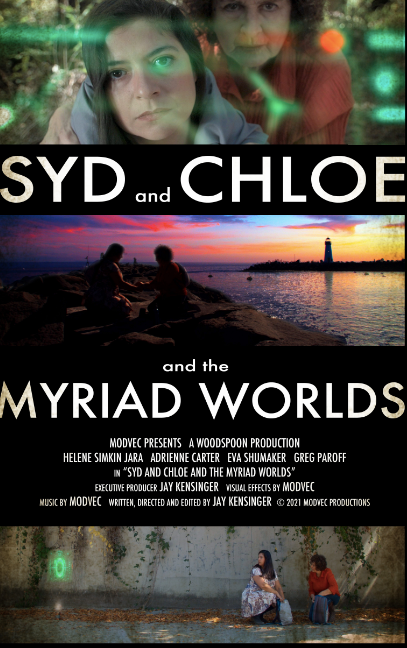
Just saw Jay Kensinger's Syd and Chloe and the Myriad Worlds 40-minute short film (he wrote, directed, and has a cameo at the end of the movie).  It's a provocative, excellent science fiction movie, with a great metaphysical premise, and a fun rendition.

[Mild spoilers ahead ... ]

The premise: if you subtract one class of things from an infinite set or universe, that universe will still be infinite (because infinite in effect means immune from subtraction) but it will nonetheless be lacking that thing or class of things.  As far as I know, Kensinger himself came up with this powerful and profound idea,  and it's compelling indeed.

And Syd and Chloe and the Myriad Worlds shows that it makes for a fine little movie.  The two title characters are inter-reality agents -- they can travel from one reality or universe to another -- and they're after William, a psychopathic robot who is pruning or deleting realities not to his liking.  They're joined by Melanie, presumably of this our Earth, who plays a decisive role in the resolution of the peril.

The actors are unknown to me, except for Kensinger, who wrote and directed and starred in The Chronology Protection Case, a short film he made from my novelette of the same name (right, I'm not an objective viewer of Kensinger's work -- but, trust me, I wouldn't write a review that said how much I enjoyed any movie of his, unless I really very much enjoyed it).  I'll also mention here, while on the subject of Kensinger, that he also wrote the music for Syd and Chloe, which also worked very well.

Back to the acting, I thought Eva Shumaker as Melanie was really good.  She has an expressive face, and I expect a future in acting if she pursues it. Adrienne Carter as Chloe and Helene Simkin Jara as Syd make an unorthodox, even memorable pair of agents, and Greg Paroff is suitably chilling as William.

Syd and Chloe will be making the rounds at film festivals.  Here, to whet your appetite, is the trailer.   Catch it and then the movie if you can.


watch The Chronology Protection Case FREE on Amazon Prime


More about the making of this movie and Jay Kensinger's other films at MODVEC

Tuesday, December 21, 2021

Time Travel: Reading, Watching, Writing It


The complete lecture (with captions) I gave via Zoom to Michael Waltermathe and Christian Weidermann's Science Fiction and Philosophy class at Ruhr-University Bochum in Germany 16 December 2021. 

Saturday, June 19, 2021

Podcast Interview with Jay Kensinger about The Chronology Protection Case


Welcome to Light On Light Through, Episode 182, in which I interview Jay Kensinger about "The Chronology Protection Case," the short film he made (now on Amazon Prime) from from my 1995 Nebula nominated novelette of the same name.

  • See video of the interview
  • Read the original story
  • See the movie on Prime Video
  • Jay Kensinger's account of how he made the movie
  • complete, uncut radio play of "The Chronology Protection Case," recorded before a live audience at the Mark Goodson Theater in the Museum of Television and Radio in New York City in September 2002, nominated for the Edgar Award for Best Radio Play (radioplay written by Mark Shanahan)
  • audio reading of original "The Chronology Protection Case" [starts at 27min 20secs] 


Check out this episode!

Friday, December 7, 2018

The Life and Times of Phil D'Amato


I was pleased to find out today that my novel The Consciousness Plague - second novel in my Phil D'Amato series - is referenced in Damien Broderick's recently published Consciousness and Science Fiction.

Phil's had a pretty exciting life, since he first appeared in my novelette, The Chronology Protection Case, published in Analog Magazine in September 1995, and reprinted six times.   Here's a complete list of exploits, followed by a podcast episode, and photos and videos:


  • 1995: "The Chronology Protection Case," Analog Magazine, nominated for Nebula and Sturgeon Awards, reprinted six times in: The Mammoth Book of Time Travel, 2013; The Best Time Travel Stories of All Time, 2003; Nebula Awards 32: SFWA’s Choices for the Best Science Fiction and Fantasy of the Year, 1998; Infinite Edge (online magazine), June-July 1997; Supernatural Sleuths, 1996 
  • 1996: "The Copyright Notice Case," Analog Magazine, nominated for Nebula Award 
  • 1997: "The Mendelian Lamp Case," Analog Magazine, reprinted four times in: The Hard SF Renaissance, 2002; Ikarie (translated, Czech Republic), 2002; Science Fiction Theater, 1999; Year’s Best SF3, 1998
  • 1999: The Silk Code, Tor Books, winner of Locus Award for Best First Science Fiction Novel of 1999 
  • 2002: The Consciousness Plague, Tor Books 
  • 2002: Jay Kensinger's short film of "The Chronology Protection Case" 
  • 2002: Mark Shanahan's radio play of "The Chronology Protection Case," nominated for the Edgar Award 
  • 2003: The Pixel Eye, Tor Books, nominated for Prometheus Award 
  • 2007: The Silk Code podiobook, performed and produced by Shaun Farrell, in Top 20 Podiobooks of 2007 
  • 2012: "author's cut" Kindle and Nook ebook editions of The Silk Code published by JoSara Media 
  • 2013: "author's cut" Kindle and Nook ebook editions of The Consciousness Plague published by JoSara Media 
  • 2013: new version of “The Chronology Protection Case” short film, with extended ending written by Paul Levinson and Jay Kensinger; on Amazon Prime Video 
  • 2014: "author's cut" Kindle and Nook ebook editions of The Pixel Eye published by JoSara Media
  • 2016: Rita Ora uses The Silk Code in her Tezenis campaign (see video).


Check out the Phil D'Amato page on Facebook.

Thursday, March 15, 2018

Thank You Stephen Hawking

Stephen Hawking was an inspiration to numerous people, so it's no surprise his work has had a pivotal impact on my own life and work.

The dream of most fiction writers - I'd assume, having not taken a formal poll - is to have their work made into movie.  So far, that's happened to me just once.  And it's because of Steven Hawking's work.

In 1994, Wired Magazine published a short article by me, Telnet to the Future, in which I argued that time travel was impossible.   Shortly later, I received a note from Jack Sarfatti, a physicist who believed the opposite.  But he acknowledged that none other than Stephen Hawking apparently agreed with me, having recently published about his "chronology protection conjecture," which allowed that, even were time travel physically possible, the Universe would not allow it, and would act in defense against its own unraveling by time travelers to stop any time travel from happening.

In my always slightly deranged mind, a science fiction murder mystery immediately suggested itself, and resulted in The Chronology Protection Case, which Stan Schmidt was good enough to publish as a novelette in Analog Magazine in 1995.  It's been nominated for the Nebula Award, been reprinted half a dozen times, and has been a required text in a writing class in the Midwest for a going on a decade now.

And Jay Kensinger made it into a high concept, low budget movie, which screens at science fiction conventions around the country, has been a finalist in several film festivals, and for the past two years has been available for free viewing on Amazon Prime.

If we ever come out with a new version - which we did in 2013 for the original movie made in 2002 - I'll be sure to thank Stephen Hawking - not just for inspiring this little movie, but for work and a life that has inspired millions and will no doubt continue to do so until the end of time.

Sunday, December 24, 2017

Jacob's Paradox: Between Genesis and Milton

I figured I would expand the purview of my year-end plunge into time-travel feature movies and TV series on Netflix to time-travel shorts on Amazon Prime (Netflix doesn't have many if any time-travel shorts).  First up is Jacob's Paradox from 2015, a 36-minute narrative, written, directed, and starring Michael Peake (this is a common configuration in shorts - Jay Kensinger wrote, directed, and starred in The Chronology Protection Case, based on my novelette of the same name).
The name Jacob's Paradox is reminiscent of the Biblical Jacob's Ladder.  But when you're dealing with time travel and paradox, you often wind up not climbing up to heaven as the Biblical Jacob did, but falling into hell, as the Jacob in this short does.   And though I've always agreed with Milton's Lucifer that it's better to reign in Hell than serve in Heaven, Jacob doesn't even get to do that in Jacob's Paradox.

This Jacob is a professor who lectures his physics class on the grandfather paradox - if you traveled to the past and killed your grandfather before he sired your mother or father, how would you have been able to travel to the past in the first place, since you wouldn't have existed.  Professor Jacob provides two "solutions" - something will stop you from killing grandpa, or, a new alternate reality will come into being with no you, but since the you who traveled to the past comes from the first reality, the paradox is averted.

So informed, the audience is set for what the thrust of the movie will be: Jacob is going to travel a little bit into the past to save his wife, who was murdered by an intruder in their home when Jacob wasn't there.  Jacob's plan is to travel back to the past and indeed be there, and stop the killer,

I won't spoil the ending for you, except to say it's excellent and O'Henry-esque, with good performances by Peake as Jacob and Mindy Heithaus as as philosophy professor.  Recommended viewing, with room for a sequel.

 
watch The Chronology Protection Case FREE on Amazon Prime


read time travel stories FREE on Amazon Prime

Friday, January 2, 2015

The State of my Short Fiction at the Start of 2015

Hey, I don't talk enough about my short fiction, which I enjoy writing every bit as much as my novels.   But it's been percolating along with publications the past few years, so I thought I'd provide a little summary of what's been going on and what will be happening in 2015:

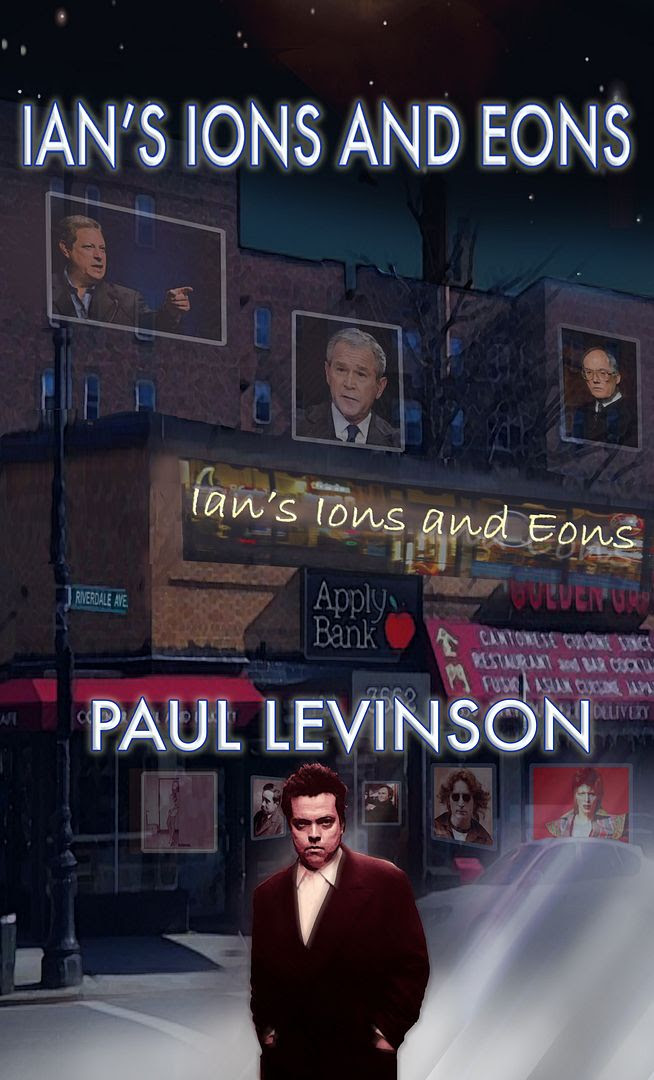
  • "Ian, George, and George" is the most recent story I've had published in Analog (December 2013).   It's the 3rd story in the "Ian's Ions and Eons" time travel series, and the 14th published in Analog over all.  I expect to be getting all of these up as Kindle ebooks this year.  I've already started with my 1997 novella,  Loose Ends, nominated for the Hugo, Nebula, and Sturgeon Awards.
  • "The Chronology Protection Case," first published in Analog in September 1995, was reprinted for the fifth time in The Mammoth Book of Time Travel (July 2013), a best seller on Amazon. The novelette was the basis of The Chronology Protection Case short film made by Jay Kensinger in 2002, recut with a new extended ending in 2013.  You can also read it free on Wattpad.    It's being used again in 2015 as reading in an enlightened class at the College of Dupage in Glen Ellyn, Illinois.
  • "Extra Credit" was published in BuzzMag - where it's available free of charge - in July 2012.  It was reprinted in December 2014 in the Altered States cyberpunk anthology, for which I also had the pleasure of writing the Introduction.  And it will be reprinted again, in Chinese translation by He Daokuan, in The Essential Levinson, 2nd edition, to be published in China in 2015 by Remnin Press.
  • "Synchronicity" was published in Buzzy Mag, where it's available free of charge, in May 2014.
  • "Sam's Requests" - the strangest story I've ever written - will be published in Buzzy Mag in a just a few days - January 9, 2015.  You've heard of space opera?  I consider this space rock 'n' roll, literally.   Mark your calendars.
  • "The Wallet" - science fiction based on something that actually happened to me - will be published in the Sci Phi Journal early this year (likely February, in issue #4).  Here's what an earlier issue of this magazine at the intersection of science fiction and philosophy looked like.
  • "The Kyss" will appear around Valentine's Day in Speculative St. Valentine's Day Drabbles, edited by Jorge Salgado-Reyes and Roy C. Booth, the same guys who put together Altered States.  At 100 words, "The Kyss" will be the shortest story I've ever had published - not that I believe in short kisses, but a "drabble" is supposed to be just 100 words.
  • "The Last Train to Margaretville" is the first "shared world" story I've written.  It will likely be the last, because even though I loved writing it, I still like writing more in worlds of my total creation.   It was published in the Walk the Fire 2 antho edited and conceived by John Mierau in December 2013.  You can hear me do a reading of it here.
  • And to end on a charitable note: I contributed two new stories, "Transfer of Power" and "The Chimps Shall Lead," to Something to Read, published in December 2014, a special charity anthology edited by Stella Wilkinson,  for which all proceeds go to a children's hospital in England.   Why England?  I do the like country and that's where the invitation came from.   Happy to do the same for an American charity, or for that matter, any charity on this or any other planet.
So that's the long of it about my short fiction, for now.  I'll try to keep this page updated, or maybe make these summaries a yearly thing.  Hey, I still love the long form, too - and below are six of my novels you can get in a heartbeat on Amazon.


thanks to Joel Iskowitz for illustrating the six above covers

Thursday, November 21, 2013

Science Fiction and Media Theory Trailers

I thought I'd put up a page, which will be continuously updated, for all the trailers that have been posted for my science fiction and media theory.  They range from 6-9 second Vine-like clips, to longer trailers of a minute or two.


Unburning Alexandria  by Paul Levinson


The Silk Code  by Paul Levinson


The Chronology Protection Case movie by Jay Kensinger
from the novelette by Paul Levinson


The Plot to Save Socrates by Paul Levinson


New New Media by Paul Levinson


Hell Scrolls - written by J. Charles Sterin, and published
by JoSara MeDia on my Connected Editions imprint

Thursday, November 14, 2013

The Chronology Protection Case released with new, extended ending

The Chronology Protection Case has been released on iTunes with a new, extended ending.

The 40-minute movie by Jay Kensinger, first released in 2002, is an adaptation of Paul Levinson's novelette "The Chronology Protection Case" - inspired by Steven Hawking's "chronology protection conjecture" - and first published in Analog Magazine in September 1995. The novelette was a finalist for the Nebula and Sturgeon Awards, reprinted five times - including in the currently best-selling Mammoth Book of Time Travel - and made into an Edgar nominated radio play.   The novelette is cited in Paul J. Nahin's A Writer's Guide to the Real Science of Plausible Time Travel as the only recent treatment in science fiction of Hawking's conjecture.

Kensinger directed, produced, wrote, and plays the role of Dr. Phil D'Amato in the movie.  D'Amato has appeared in two other novelettes by Levinson - "The Copyright Notice Case' and "The Mendelian Lamp Case" - and in three novels by Levinson, The Silk Code, The Consciousness Plague, and The Pixel Eye.

The extended ending in the 2013 release of the movie brings the story forward from 2002 to 2012, and was written by Levinson and Kensinger.  The 2002 release was shown at science fiction conventions around the east coast, including I-Con and Philcon.

A trailer follows.   More details about the movie on IMDB.


"The Chronology Protection Case" reprinted in
  • The Mammoth Book of Time Travel, ed. Mike Ashley, Robinson Books, 2013 
  • The Best Time Travel Stories of All Time, ed. Barry Malzberg, I-Books, 2003. 
  • Nebula Awards 32: SFWA's Choices for the Best Science Fiction and Fantasy of the Year, ed. Jack Dann, Harcourt Brace, 1998. 
  • Infinite Edge (online magazine), June-July 1997 
  • Supernatural Sleuths, ed. C. G. Waugh & M. Greenberg, ROC Books, 1996


#SFWApro


Paul Levinson and Jay Kensinger at The Chronology Protection Case premiere at I-Con (Stony Brook, NY), in 2002

Jay Kensinger explains how he re-cut The Chronology Protection Case.   And more here on how Paul came to write the original novelette, and how Jay came to make the movie.

InfiniteRegress.tv