Chuck Todd interviews me about alternate histories
Showing posts with label Jonathan Groff. Show all posts

Wednesday, December 22, 2021

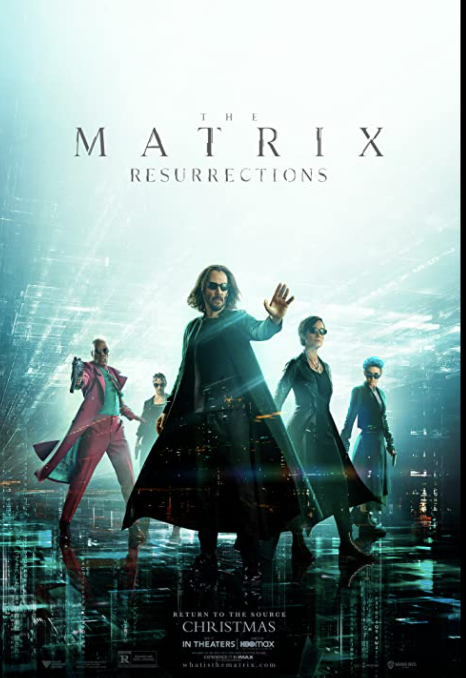
The Matrix Resurrections: Great Mix of Deep Philosophy and Fast-Moving Action


I just saw The Matrix Resurrections on HBO Max.  It may be the best Matrix since The Matrix -- that is, the first movie, so I'm saying Resurrections may be better than the two earlier sequels, certainly better than the third in the original trilogy, Revolutions.

One of the reasons I'm thinking this is how well the meta angle is handled in Resurrections.  We find Neo working as a programmer, whose great accomplishment was writing a computer game called "The Matrix".  He's sucked into a journey in which reality vs. fiction as an explanation for what is happening vie for our attention at every incandescent turn, and there are many of them.  

[Note: For once, or as a rarity, there WON'T be any big spoilers ahead ... ]

Let's talk about the acting.  Keanu Reeves as Neo and Carrie-Anne Moss as Trinity were excellent.  I was prepared to be annoyed at Yahya Abdul-Mateen II as Morpheus and Jonathan Groff as Smith, because their original incarnations by Laurence Fishburne and Hugo Weaving were so brilliantly, searingly memorable.   But the new actors for these crucial characters were quite good.  In the first three movies, Smith was for most part the more keenly acted and therefore more unforgettable character -- delivering such now immortal lines as, to Neo, "How can you speak if you have no mouth?" with perfect laser, razor precision --  and even though Groff is not quite as knife's edge as Weaving, his Smith will be somewhat memorable, too.

Among the new characters, by far my favorite was Neil Patrick Harris as The Analyst -- a big step up from Doogie Howser, MD but in a related medical profession -- and I very much liked the unpredictable villainous kindred relationship between him and Smith.  Both had a fair share of bon mots, and if I had to choose the most profound it would be The Analyst's observation that feelings make fictions real.  In addition to these lines that could have come from Plato -- who notoriously distrusted both feelings and art (see his Republic) -- we also get some good ultra-contemporary commentary from some of the characters.  I guess my favorite would be the Merovingian's, a returning character, who lashes out at both Facebook and Wikipedia in a tense, verge of bursting into action scene.  It's probably worth noting that Facebook didn't exist when we last saw Merv in Revolutions in 2003, and Wikipedia was just a tiny three years old, so his denunciation of these two social media giants is understandable, if not fair to Wikipedia, which has done far more good and much less damage than Facebook.

Without telling you anything more about the plot, I'll say it's plausible, exciting, and works well with its three predecessors.   The action and special effects were outstanding, as always, and the characters' awareness of the deep philosophic issues that underlie their exploits endows this movie with a refreshing intellectual heft.  I'd say The Matrix Resurrections is a triumph of a reboot, and one of the best now around in the burgeoning genre.




Thursday, August 22, 2019

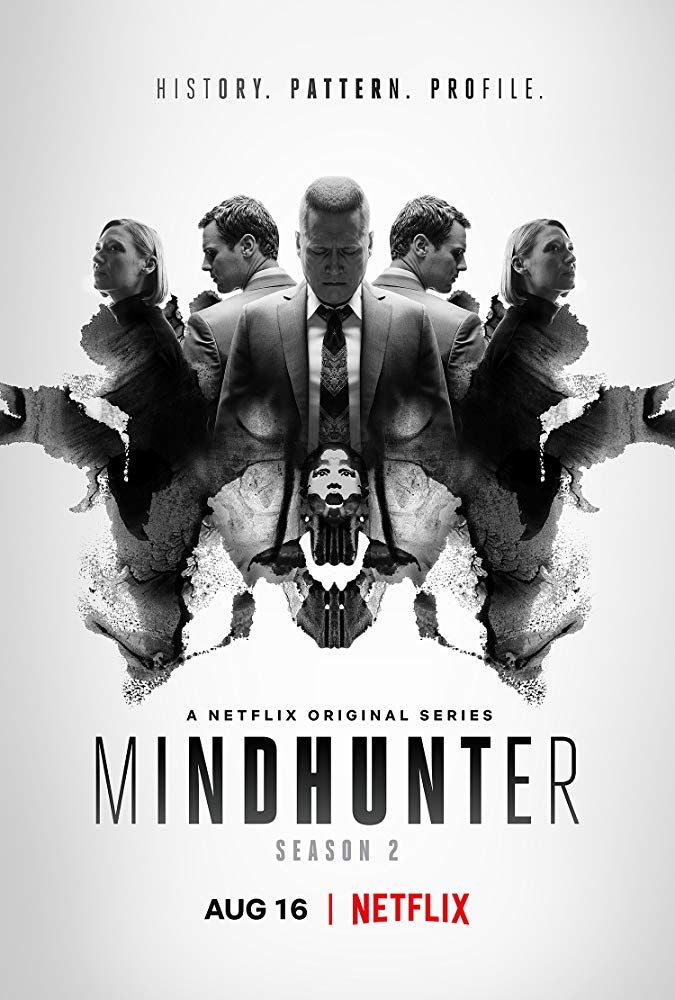
Mindhunter 2: Riveting Nonfiction vs. Fiction


My wife and I very much enjoyed the first season of Mindhunter, but, whew, the second season was much better - more compelling - in just about every way, except one.

Among the highlights were interviews with the Son of Sam and Charles Manson. Having seen Once Upon a Time in Hollywood a few weeks ago, the Manson interview, and a bit later, disciple Tex, one of the actual killers, was especially riveting.   And the long harrowing story of the Atlanta Child Murders, culminating with the arrest and conviction of Wayne Williams for just two out of most of 28+ which he likely committed, was a masterpiece in itself.

The one part I didn't care for was the story of Brian, Bill Tench's son, who witnesses the murder of a little child, tries to revive the child by placing him on a crucifix (at least, that's the best interpretation his parents can make of this), and is profoundly traumatized by all of this.  I guess the creators of Mindhunter thought that putting the senior FBI hunter in this situation - his son may be on the way to becoming a sicko killer - made for a powerful narrative.  I thought it was mostly distracting.

Mindhunter is based on real characters, but is not even docudrama-level true, given that, unlike the serial killers, the main BSU players were not actual people.  This in some ways was a good move, since it allows for intriguing developments of the characters that may or may not have actually happened at the FBI.  Dr. Wendy Carr's (Anna Torv) love life would be an example of this strategy working well.

But the time given to Brian's story, making it almost a counterpoint to the unfolding Atlanta story, was just too much.  Yes, it had the advantage of keeping Tench (brilliantly played by Holt McCallany), away from Atlanta much more than he wanted. but surely some other development could have done the same thing.   The problem with Brian's story is that its emotional intensity was so strong that it sapped energy from the intense Atlanta story.   In effect, what you have is complete fiction (Brian's story) competing with fact-based historical narrative (Atlanta).  Given that the strong suit of Mindhunter its reflection of the reality of the BSU and its revolutionary way of apprehending serial killers, to water that down with a big fictitious story makes not much sense.  (See The Wrap - which liked the Brian story - for research that it is fictitious.)

But ... the rest of Mindhunter was so outstanding that my wife and I will be sure to watch its season 3, which has yet to be announced.   It will be something to see Holden Ford's (Jonathan Groff) astonishing mind bring down the BTK killer and who knows who else.

See also Mindhunter: Best of Its Kind


Friday, October 27, 2017

Mindhunter: Best of its Kind

Imagine Criminal Minds - which my wife and I watched a lot of, but stopped, a year or two ago - as you might have wanted it to be: sharper intellectual focus, honest language, real serial killers, deeper character development, nudity when called for but actually no scenes of torture or murder - and you have Mindhunter, a 10-episode season (which I hope is the first) on Netflix.  In other words, a show about the BAU, but at its inception in the late 1970s, and unencumbered by the limitations and ticks of network TV.

Mindhunter is produced by House of Cards producer David Fincher, and unsurprisingly has such deft touches as subtitles when a couple are having a key conversation in a noisy bar, and the first mention I've ever heard (twice in Mindhunter) of Erving Goffman, a pathbreaking sociologist from the 1950s and 1960s who talked about the masks we all wear, and the difference between the front and back regions of our personas, or what we show to the world at large versus what we keep private to our families or closest relationships.

That high intellectual octane animates this whole series, and is brought to life by standout performances by Jonathan Groff as the young FBI agent Holden Ford trying to establish a science of understanding and even predicting psychos and sociopaths, and his older partner Bill Tench, played by Holt McCallany (Lights Out!), who pretty much supports what Holden is trying to do but is not entirely comfortable with his methods.   In this battle to establish a new, more effective, scientifically grounded method of identifying and stopping serial killers, Mindhunter also bears strong resemblances to the recently aired and excellent Manhunt: Unabomber series (and there's a lot of Jim Fitzgerald who in reality broke the Unabomber case in the fictional Holden Ford), and even a little of Masters of Sex, which I was sorry to see cancelled.

As a special treat, Mindhunter has Fringe's Anna Torv as a sociologist who joins the team.  She provides one of the Goffman references, and Holden's girlfriend, well-played by Hannah Gross, doing graduate work in sociology, offers the other.  The serial killers, ranging from Richard Speck to Edmund Kemper, are truly chilling, and we get all this with words, not scenes of their horrific actions.

An old friend, photographer Emon Hassan, strongly recommended this series.  I'm doing to same to all of you.


It all started in the hot summer of 1960, when Marilyn Monroe walked off the set of The Misfits and began to hear a haunting song in her head, "Goodbye Norma Jean" ...
InfiniteRegress.tv