reviewing Black Doves; Dark Matter; Dept. Q; Detective Hole; Dexter: Resurrection; Fauda; For All Mankind; Foundation; Hijack; Memory of a Killer; MobLand; Outlander; Paradise; Presumed Innocent; Severance; Silo; Slow Horses; Smoke; Star City; Star Trek: Strange New Worlds; Tehran;The: Day of the Jackal, Diplomat, Night Agent; Your Friends & Neighbors +books, films, music, podcasts, politics
George Santayana had irrational faith in reason - I have irrational faith in TV.
Chuck Todd interviews me about alternate histories
I've been interviewed over the past three months by several newspapers, websites, and a radio show, about the impact of the Coronavirus on television, the Internet, and online education and entertainment. The titles and publications (with links) appear below. I'll add to this list when new articles appear.
"Watching cable news to see inside newsmakers’ homes," KCRW Radio (Los Angeles), May 13, 2020.
"Legacy news, social media giants converge in new era of censorship," Just the News, May 2, 2020.
"Donald Trump Now Says His Disinfectant Comments Were 'Sarcastic' — But They Were Widely Taken As Serious," DEADLINE, April 24, 2020.
"Dr. Phil, Dr. Oz, Dr. Drew: TV Talking Heads Trigger Backlash For Coronavirus Comments," DEADLINE, 17 April 2020.
"The long and winding evolution of Dr. Drew, back in the spotlight after a coronavirus controversy," Washington Post, 13 April 2020.
"Our TVs are full of characters spreading germs and now we can never unsee it," Washington Post, 24 March 2020. (Note: This article may be behind a paywall. If you can't access it, you can read it here.)
"Can the Internet Break From Overuse?" How Stuff Works, March 25, 2020
I just saw the new Fahrenheit 451 - the HBO movie, based on Ray Bradbury's justly lionized 1953 novel of the same name, made into an excellent 1966 movie of the same name by François Truffaut. The new HBO movie by Ramin Bahrani obviously had a lot to live up to with that kind of pedigree. I'm here to tell you that it did - which puts me at odds with the numerous dyspeptic reviews it's already received on IMDb (at this point, 5.1/10), Rotten Tomatoes (32%), and Roger Ebert (2/4). That's no surprise - I often find the established wisdom of professional and nonprofessional critics myopic.
But to the HBO movie - what I look for in a remake is something different, important, and if possible, more meaningfully current than in the original or earlier versions, while maintaining the best parts, including memorable details of the original. Again, not an easy task. But the new Fahrenheit 451 does it potently and beautifully.
The lie that Benjamin Franklin started fire brigades in America to burn rather than extinguish fires, with the truth that Franklin wanted fire fighters to put out fires being denounced as a lie, was one of the starkest parts of the original story. It's in the new movie, too, but the truth is denounced as not just a lie but "fake" - a clear reference to our current crisis of fake news.
Another chillingly effective detail in the original is Captain Beatty extolling the "equality" of all books being burned, and holding up a copy of Mein Kampf as an example. The scene is chilling because it tempts us to think that it's good if some books are burned - in this case, a book preaching hate, written by a monster who implemented that hate in the worst way. And the scene has special relevance to our struggle in 2018 with "hate speech" and what to do about it. (See my The First Amendment in the Age of Post-Truth for my brief argument as to why we must not burn or censor it.)
But the new Fahreinheit also introduces something brand new to the story - which has gotten some critics crazy. In the new ending ... wait, I won't tell you the ending, because I don't want to spoil it for you if haven't yet seen the movie. But I can tell you the radically new element upon which the ending is predicated: our heroes do more than memorize books, so each person becomes a book, which is the inspiring, ennobling upshot of the original. In the new movie, our heroes are also working on a plan to encode the text of every book, the digital code of every film, every piece of music, into DNA, where it can be stored and spread via biology. In other words, a good greater than any number of brave individuals.
Now I think that's a really cool departure from the original - and not just because I explored the biological potency and uses of information in my first novel, The Silk Code (reviewed here in The New York Times - one review I really liked). But in the movie, this plan is brilliant and makes every sense. After all, the villains are touting digital information (because it can be easily manipulated - another bow to fake news) over books, where the information is stable and reliable. (The information in books has what I call "reliable locatability" - what's on page 77 of any book will be there on page 77 next week or next year or next century, as long as the book isn't burned. See my New New Media, 2nd edition, p. 77 - not a novel - for more.)
Anyway - you needn't take my word for it. See Fahrenheit 451 on HBO and see if you agree.
What better way to conclude the year than with a review of the next section of Rob Sheffield's Dreaming the Beatles, which has accompanied me for more than half a year now, as I read the book bit by bit, with still more to follow, I'm glad to say, in 2018. This is the case - what better way - even though we're knocking on the door of the saddest part of the story, and indeed are already there.
Sheffield presents a grimmer than usual portrait of George Harrison in 1970s, after the Beatles disbanded. He's dissolute, unable to hit his notes or remember his lyrics, verbally happy about the breakup but ravaged by cocaine and booze. I knew none of this in the 70s. I was beginning to pull away from music by the middle of the decade, and wouldn't regain my daily proximity until, well ... this very year, and the coming of the Beatles Channel on Sirius XM Radio (not just the music but priceless I-was-there commentary by Peter Asher on his "From Me To You" and his commentary of the listener-voted Top 100 show, where I learned, for example, that the "cool bendy guitar" work on "Ticket to Ride" was by Paul not George) all stoked by Sheffield's book.
I'd heard "All Things Must Pass" in the 1970s, but didn't recognize it for what it was until 2008, when I was finishing up the first edition of New New Media, and chose "All Things Must Pass" as, ironically, a perfect example of the immortality of music on YouTube, or of some great things never passing.
Sheffield cites someone who says "All Things Must Pass" is the "wisest" song the Beatles never included on an album (they decided not include it on Let It Be). He agrees, and judges it one of the very best of the Beatles songs released to the world after the group broke up. I'd agree, and would go a little further.
First, along with "Taxman" and "My Guitar Gently Weeps," I think "All Things Must Pass" is among the best Beatle songs ever written by members of the group during and after they were together. The lyric is in a class by itself, and couldn't have been written by Lennon or McCartney, or by Lennon and McCartney, either. If Harrison was significantly responsible for the Beatles, in his way as much as Lennon or McCartney, "All Things Must Pass," with its wisdom, sensitivity, and cutting edge, tells us why. It is at least as extraordinary as the closest Lennon and McCartney songs in theme, which I guess would be "Across the Universe," "Long and Winding Road," and "Two of Us".
Ironically but indicatively, the best performance of "All Things Must Pass" now on video is at the George 2002 memorial concert, and is sung just perfectly by Paul. (And, of course, I can't now find this video on YouTube - here it is on Vimeo.) (If your soul doesn't get choked up watching this video, you're not fully human.) The song indeed passed, but unto another Beatle, and therein the future at large, and humanity both here and now on Planet Earth and in the future in the stars.
Happy New Year everyone - I'll see you here next year, very soon, with more reviews of this superb book.
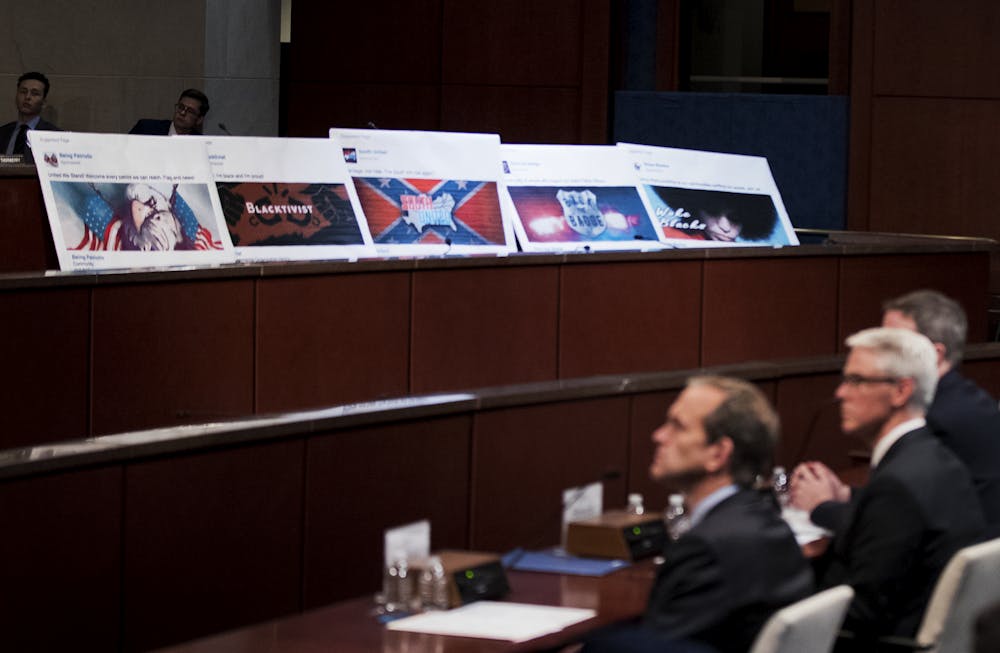
In recent weeks, Congress has grilled Twitter, Facebook and Google about their role in allowing foreign interests to place ads and articles intended to divide the electorate and spread false information during the 2016 election.
Now a number of people in and out of government are calling for federal regulation of social media. Lay down some rules, the thinking goes, and we would be able to prevent the infestation of bots and fake news from our news feeds and ads. Democracy would be saved – or, at least, foreign interference in our elections kept in check.
However, as someone who has studied and taught the First Amendment for decades, I would argue that if such regulations were enacted, the main victims would be not the purveyors of fake news, but our freedom of expression. In my view, the result would do far more damage to our democracy than any foreign misinformation campaign ever could.
Free speech being attacked from all sides
The First Amendment is under a lot of duress.
Arguably, it’s been that way since the Supreme Court’s “clear and present danger” decision in 1919, which spelled out when limits on free speech could be lawful. It not only held that the government had an obligation to stop someone from “falsely shouting fire in a theater,” but also opened the gates to all manner of government violations of the First Amendment injunction that “Congress shall make no law…abridging the freedom of speech, or of the press.”
Indeed, with the exception of Supreme Court decisions in the Pentagon Papers case in 1971 and the Communications Decency Act in 1997, the American government has systematically increased its control of media.
The situation has gotten much worse over the past year. President Trump has tweeted about withholding the licenses of NBC affiliates and lashed out at other media not to his liking.
Although Trump’s bluster about limiting and punishing media may be easy enough to deride, the fact that he is in the White House – and has the ability to appoint FCC commissioners – means his threats must be taken seriously.
Meanwhile, a theory of philosopher Karl Popper – the “paradox of tolerance” – is being widely cited as a justification for outlawing hate speech, notwithstanding the First Amendment. From his 1945 book “The Open Society and its Enemies,” it says that tolerance defeats itself when it permits intolerant speech.
I studied Popper extensively while researching my first book, an anthology of essays about Popper’s work. There are many aspects of Popper’s philosophy to admire, but I don’t believe the “paradox of tolerance” is among them.
To ban hate speech could turn our tolerant, democratic society into precisely the kind of state that hate speech is calling for: It could open up an opportunity for all sorts of speech to be dubbed “hate speech.”
A slippery slope
When regulating fake news on social media sites, there’s the danger of the same sort of phenomenon taking place. And it’s exactly why the well-meaning hue-and-cry that the government needs to intervene and forbid social media sites from disseminating fake news or allowing accounts that are actually bots is so dangerous.
Fake news is nothing new. Centuries ago, anti-Semitic publications spread rumors that Jews murdered Christian children and drank their blood on holidays.
Over the past two years, social media have increased the amplitude and reach of fake news. But there’s also been the ascension of a political figure – Trump – who has turned the tables by labeling any unwelcome news as “fake.”
Facebook ads linked to a Russian effort to disrupt the American political process are displayed as representatives from Google, Facebook and Twittertestify before the House Intelligence Committee on Nov. 1.Manuel Balce Ceneta/AP Photo
The latter should be more than enough reason to reject calls for government censorship of fake news. After all, who’s to say a government that determines what’s “fake” won’t simply follow Trump’s lead, and suppress critical and truthful content under the guise that it’s fake?
Instead, social media networks could develop and implement algorithms for identifying and removing fake news by marshaling the same engines that spread fake news in the first place. These algorithms would not be administered by the government; rather, Facebook and other social media would be responsible.
Twitter has already made considerable progress flagging and removing accounts that spread Islamic State propaganda. There’s no reason to think that the same process can’t be applied to Russian bots seeking to inflame political discord and therein damage America’s political system.
Such self-regulation is in the best interest of these media companies. It would increase the confidence of their users in what they encounter online. It would also have the added benefit of keeping government regulators at bay.
In the end, the ultimate antidote to fake news and bots is the rationality of the human mind.
As John Milton famously urged in his “Areopagitica,” if you let truth and falsity fight it out in the marketplace of ideas, human rationality will most likely choose the truth. Regulating what can enter that marketplace could impair or destroy this process, by inadvertently keeping truth from public awareness.
Rational thinking’s ability to identify fake news is more than a Miltonian ideal: It’s been demonstrated in a carefully conducted 2015 experiment. When given a small financial incentive, the subjects were able to identify fake news as fake, even if the fake news supported the political views of the subjects.
Indeed, rationality is deeply implicit in democracy itself. You can’t have the latter without the former.
The key in combating fake news and kindred attacks on our body politic is to give our rationality maximum access to all information, including the truth. And in my view, this means resisting any attempts by government to limit the information that reaches us.
Continuing with my review (#5 of X) of The Perversity of Things: Hugo Gernsback on Media, Tinkering, and Scientifiction, edited by Grant Wythoff (University of Minnesota Press, 2016). I'm now focusing on pages 28-36 of Wythoff's 59-page Introduction to the 359-page volume, with the proviso that these reviews reflect my not Wythoff's organization of his motherlode of research and analysis.
Wythoff begins this group of pages with a discussion of the important role that women played in creating Gernsback's magazines (recognized by Gernsback) and in the ideal public pressing forward with the technological revolution - a presence which runs contrary to the historical gloss of middle-class young men being the carriers of these ideas, which as Wythoff shows also ignored the role of the working class. But this sociology of science fiction and technocracy soon gives way to a consideration of an issue which is in many ways more fundamental: the tension between talented amateurs and corporate scientists as the spearheads of technological evolution.
Gernsback was clearly a champion of the latter, though Wythoff points out that Gernsback was not allergic to corporate culture, and willing to accept it if it further technological progress. But the most significant part of this section is Wythoff's study of the sheer speed with radio was transformed from an amateur to a corporate endeavor - literally in a handful of years. Not to get too melodramatic about this, but it is almost as if radio's very success, so fervently desired by its first amateur practitioners (who both constructed and listened to radio), spelled the very end of those amateurs, who could not possibly service the millions of Americans who quickly came to love and rely on radio, once its genie of entertainment and news was let out of the bottle.
I'd add here, however, that it's important to note that the amateur impulse, and the great things it engenders, was not extinguished with the corporate co-option of radio in the 1920s. After all, Steve Jobs, Mark Zuckerberg, and the founders of Twitter were none other than amateurs in our own time, and although their revolutionizing inventions have now, too, become corporatized, there is no reason to think the amateur will not spring forth yet again in the future - or right now, though we don't yet quite know about it.
It's too bad that Gernsback didn't live long enough to see the digital revolution which his tinkering in the early days of electronic media presaged. Like McLuhan, Gernsback died a little before the digital age which both foresaw, in different, complementary ways. But their ideas and visions live on, and fortunately in the case of Gernsback, we have Wythoff's The Perversity of Things to carry it forward.
And I'll be back here soon with my next review of this book.
Continuing with my review (#2 of X) of The Perversity of Things: Hugo Gernsback on Media, Tinkering, and Scientifiction, edited by Grant Wythoff (University of Minnesota Press, 2016), having now read pages 9-17 of Wythoff's 59-page rich (an understatement) Introduction to the 359-page volume: Wythoff tells us that Gernsback advocated what current media studies calls "critical making" - or "a material engagement with technology as a means of understanding it".
This is a key concept, which was actually promulgated at some length and depth by the pragmatic philosopher John Dewey, a contemporary of Gernsback, and author of Experience and Nature (1925), which argued not only that real experience with the world (in today's parlance, hands-on experience) was a good way of understanding it - in contrast to just thinking about it - but the best way of knowing it, and the only likely way to get reliable and reliably testable knowledge. And, indeed, that's precisely the approach I took with my New New Media (2009) - studying what are now much more widely known as social media by using them, adopting them fully into my professional pursuits and life. My Facebook and Twitter accounts, and this very blog, were started in that pursuit.
This anthropological approach to studying our own technologies was the reason gadgetry lived alongside science fiction in Gernsback's publications and work - the two were co-essential, mutually catalytic parts of Gernsback's same project: getting us, more of us, and better informed, into the future.
Wythoff's Introduction at this point commences a more traditional biography of Gernsback, though there's almost nothing traditional in his life's work or the way Wythoff presents it. I was interested in such tidbits as Gernbach's father in Luxembourg made his money as a wine wholesaler. This provides another instance of the connection I've noticed between wine and the evolution of media, the most outstanding example of which is Gutenberg's use of the wine press and its interchangeable grape crushers in his development of the printing press and its interchangeable type, a crucial step beyond the static printing block technology invented in China.
I also didn't know - though maybe that's just me - that Lewis Mumford, ultimately a caustic critic not only of technological progress but many other things I hold dear, ranging from McLuhan's ideas to the need of our species to get beyond this planet into space, was first published, at 15 years of age, in Gernsbach's Modern Electrics, in the very same issue that carried the first part of Gernsbach's celebrated "Ralph 124C 41+". (That issue was published in 1911. Mumford was still at least even-handed about technology when his important Technics and Civilization was published in 1934, where I first got to know his work. By the time of his publication in the two-part Myth of the Machine at end of the 1960s - Technics and Human Development and The Pentagon of Power - Mumford had become an implacable critic of the modern technological enterprise. He thought he had seen the light, but I always thought he had gone over to the Dark Side of thinking about technology.)
And I'll conclude this second review, with a promise for more, by noting that Wythoff offers us these spark plugs for thought by employing the possibilities of the printed page in a way that McLuhan would have admired, given his War and Peace in the Global Village, The Medium is the Massage, and other books in the late 1960s, where the image and the photograph were always in surprising relationships with the words on the page. On page 17, for example, we find a part of a page from Modern Electrics intruding on the top of the page, with a newspaper clipping from the time intruding on the Modern Electrics page, all because the copy of Modern Electrics which Wythoff perused at the Princeton University Library actually had this clipping attached. The Perversity of Things, in other words, not only has soaring and in-depth writing, but a layout to match it.
A great example of the power of social media has been going on all day today: House of Representative Democrats have been staging a sit-in to get the NRA-whipped Republicans off the dime in enacting new gun control legislation. The Republicans control the House, and with it the ability of CSPAN to carry House events live to the nation and world. Unsurprisingly, the cowardly Republican leaders of the House refused to let CSPAN do its job, and cut off its cameras.
But the United States and the world have been seeing what's going on just fine, thanks to CSPAN picking up feeds on Periscope.
This is a big victory for democracy, as well as what social media can do on behalf of freedom. Unregulated by any authority other than the conscience of people who point their smartphones in the right direction with an app like Periscope, social media can bring people the truth when political authorities think it would be better to suppress it.
This is exactly what I've been saying for years, especially in New New Media. Ultimately, the people are more important than their elected representatives in a democracy, and when the elected representatives do the wrong thing, social media allow the people to correct that.
The Republicans are wrong not only in trying to shut off coverage of the House sit-in, but in saying no to sensible gun reform, which is the reason that House Democrats are sitting in. The Republicans have a big majority in the House of Representatives, and would no doubt be able to easily defeat any Democratic proposal for gun control. So why won't they even allow a gun control bill to come to a vote? The answer: the Republicans don't want to be on record as opposing such life-saving legislation. That's why having a video record of what the Democrats want to do - have a vote on a gun control bill - is so important.
We all should vote this Fall for people who want to safeguard our lives as well as our freedoms.
I've been arguing for years about Citizens United - and its lack of baneful influence on our political system. Which is to say - I think that big money has not distorted or disrupted our elections or political process.
The best example, until now, has been the re-election of Barack Obama in 2012. Big money did everything it could to stop him. But it couldn't erase Romney's thoughtless comment about the "47%" not mattering, and the video recording of that comment likely helped him lose the election. YouTube beat big money.
This year, Bernie Sanders is doing pretty well - explicitly denouncing the role of money in politics provided by corporate giants. Clearly, if that money were so unstoppable in its influence, Sanders wouldn't be where he is today.
And a statistic just released today shows another way in which money has had little if any lasting influence in the 2016 Presidential campaign thus far. As indicated in the chart, shown earlier on MSNBC, Jeb Bush has far and away spent the most per vote received by any GOP candidate - which means he has spent the most amount of money, and received the last in return in voter support. Conversely, Trump has spend the least - and his low expenditures have given him a second place finish in Iowa in a crowed field.
Clearly, then, money is not a decisive factor. Social media are apparently more decisive. In Trump's case, his domination of Twitter brought him to second place (and the fact that it was second, not first, shows that social media have their limits, too - see here for more).
I've always thought that, as John Milton and Thomas Jefferson pointed out, when truth and falsity are given access in the marketplace of ideas, people will recognize the truth and vote their self-interests. This is where social media find their limits, too - human rationality can recognize a lie, or bombast such as Trump's, whether presented in a high-cost ad or in a no-cost Tweet. But the advent of social media means that, regardless of how much money may be spent to the contrary, someone, somewhere, will be able to express a fact or a view closer to the truth. And with the mass media picking up more from social media, that fact will sooner or later be broadcast to millions.
I don't think I've seen anyone mention this as yet, so I'll make the point here: I think Trump's defeat in Iowa last night, coming in a clear second to Ted Cruz, says something about the limits of social media.
Or at least that a superior number of Twitter followers did not equate to success in a political caucus. Trump has 5.99 million followers on Twitter. Cruz has 779 thousand. I have no idea how many of them are in Iowa, but Cruz's victory in Iowa shows that Twitter clout isn't all it's cracked up to be - at least, not politically - and that other factors enter in voters choices in caucuses.
Ron Paul actually learned a similar lesson back in 2008. Twitter was much smaller then, but there was a lot of political action on Digg, which operated like Reddit does now, and was much bigger than Reddit back then. In those days, editorials and other articles on the Internet praising Ron Paul were regularly voted up to the front page of Digg by its readers. Articles about Ron Paul dominated Digg for months and months. But when the primaries came, Ron Paul was in single digits. (For more on social media in the election of 2008, see my New New Media.)
Hillary and Bernie are more equally matched now on Twitter - Hillary has 5.28 million followers, in comparison to Bernie's 1.3 million and 1.33 million on his two active accounts - which makes it no surprise, Twitter-wise, that the two finished so neck-and-neck in Iowa. Or even that Hillary won, albeit by the most narrow margin.
But unlike the Democrats, for which numbers of Twitter followers were roughly in synch with the Iowa results, the defeat of Trump given his huge Twitter presence says something else. Likely the reason for the Trump discrepancy has something to do with the nature of his Tweets, and what it is about them and him that attracts so many followers. Unlike Hillary and Bernie and Cruz, Trump's in fact have very little political content, trafficking instead in broad insults and truculent declarations. It may well be that these are fun to read but insufficient to galvanize true political support. Which would certainly be a good thing for our country.
Bones has had a long flirtation with social media. As I talked about in my book, New New Media
On the love or appreciation side, we have another example in the case of “The Glowing Bones in the Old Stone House,” or Episode 20 in the second season of “Bones” on Fox TV in the spring of 2007. The murder victim, a chef, had a MySpace page with videos of her restaurant, and this figures in the investigation. In the special commentary on the DVD that was later released, Stephen Nathan (writer), Caleb Deschanel (father of the lead actress, Emily Deschanel, and director of this episode) and Emily explain that the producers uploaded the restaurant videos to MySpace five weeks before the episode, as a way of generating interest in the episode. This was a savvy move—what better way of creating buzz than putting elements of a fictional television story on a real social medium and in turn presenting that social medium as part of the story.
Bones returned to social media in a big way in episode 10.12 this week, in which Twitter comes in for a round of opining from all sides. Bones starts off an opponent, but then decides to follow her publisher's advice to get active on Twitter, as a remedy for her lagging book sales, and the ignominy of finding her book in the cut-price remainder section of the bookstore in the opening setting scene. But she remains delightfully clueless about how to use it, ranging from linking to arcane scientific papers - hey, I occasionally do that myself - to having an unerring knack for clunky hashtags.
Fortunately, she has great support from Booth, who's surprisingly savvy about Twitter - I'm not sure why I say surprisingly, but I guess Booth is usually a bit more behind the times in media trends - and excellent practical advice from her intern, who understands Twitter at least as well as any of you reading this right now. On the other side, we get a scathing critique from Angela, who offers the tired view that Twitter is somehow dehumanizing. (I'm disappointed in you, Angela!)
In the end, Bones becomes adept, attaining a decent number of followers, a good short-form technique, and a sense of how to best use photos. In a way, this whole story is a parable for Bones in every social situation: she starts out awkward but lovable, and, in the end, finds a way to master it and make it all her own. Much like the evolution of Twitter itself, where I'll now be posting a link to this very review.






 Fortunately, she has great support from Booth, who's surprisingly savvy about Twitter - I'm not sure why I say surprisingly, but I guess Booth is usually a bit more behind the times in media trends - and excellent practical advice from her intern, who understands Twitter at least as well as any of you reading this right now. On the other side, we get a scathing critique from Angela, who offers the tired view that Twitter is somehow dehumanizing. (I'm disappointed in you, Angela!)
