Chuck Todd interviews me about alternate histories
Showing posts with label Arthur C. Clarke. Show all posts

Sunday, March 31, 2024

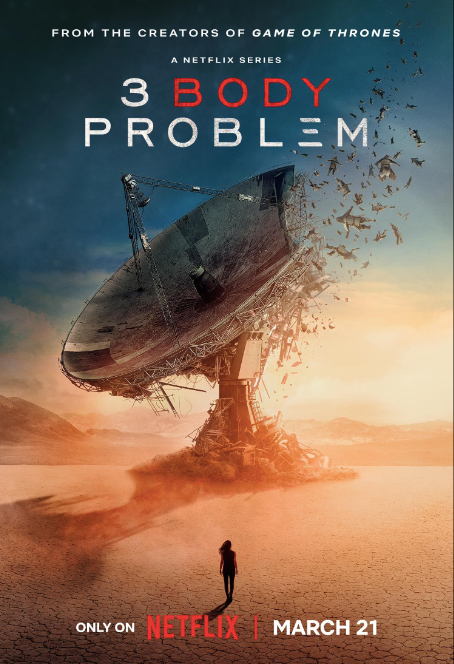
3 Body Problem: The Joke Was Great, and the Last Few Episodes Were Even Better


I haven't read the novel by Liu Cixin and its sequels, and I didn't read much about the series because I wanted to be surprised.  I'd say the first season of 3 Body Problem was superb -- a powerful mix of thought-provoking, stunning action, and heartbreaking human stories, all in support of a story of a life-threatening interstellar intelligent species, the San-Ti, who have been in contact with our planet for more than 50 years and now are approaching us, some 400 years away from arriving, which may mean the end of our species.  And there was a wise and funny joke about Einstein and God which I hadn't heard before.

But almost all of that happened in the last few episodes, and the beginning and middle of the eight-episode first season was bogged down with a computer game the interstellar beings are doling out to various people on Earth for various reasons.   I've always enjoyed science fiction about computer games interacting with reality, beginning with Orson Scott Card's path-breaking and brainy Ender's Game, but its situation in 3 Body Problem was needlessly repetitive.  The heart of 3 Body was closer to Arthur C. Clarke's Childhood's End and Damon Knight's "To Serve Man" (see this collection of Knight's stories), and the first season of the 3 Body television series, whatever may have been done in the novel, should have spent more time on that.  (This slow start is reminiscent of another iconic novel in science fiction, Frank Herbert's Dune, that also took a long time to get going, but once it did was fabulous, and led to not just a trilogy but a whole series, exceeded in excellence only by Isaac Asimov's Foundation novels, in my opinion.)

But speaking of hearts and brains, biology was actually far more the star of the first season than was space travel.  This puts 3 Body Problem in a league with Andrew Niccol's debut motion picture Gattaca.  If I'm making 3 Body sound derivative, that's because it is, but that's ok, because the first season puts all of these perennial elements of science fiction together in an original, compelling way.  It's not every day you see a science fiction series starting in Mao's China and its emphasis on ideology over truth (a problem unfortunately arising now in the United States and other parts of the world, off the fiction screen and for real), moving into a life-and-death James Bondian present fighting for the survival in the future of our very species.  

Ironically, the unflattering depiction of intellectual life in Mao's China at the beginning of the 3 Body Problem television series contradicts the warning that five Republican US Senators sent to Netflix in 2020 that the TV series would just be spreading Chinese propaganda. Of course, those Senators and no one other than the creators of the TV series had any idea what would actually be depicted in the TV series, and thus those Senators based their concerns on the novel. The original Chinese publication of the novel indeed did not begin with the jolting scene of a physicist brutally killed in the throes of the cultural revolution -- because he believes in truth over ideology -- but that scene did appear in the middle of the original Chinese novel, and at the beginning of the English translation (Liu Cixin confirms that he wrote the novel with that scene at the beginning). Apparently those US Senators didn't take the time to read the novel before offering their ill-founded concerns about the TV series.

In any case, I don't recall seeing anything quite like this TV series at all, and I'm eagerly awaiting the second season and more.  The dialog, by the way, was excellent, as was the acting.  Nearly everyone was new to me, other than Game of Thrones' Liam Cunningham, and it was good to see him on the screen again. Kudos to David Benioff, D.B. Weiss, and Alexander Woo for creating the series, and kudos to me for not having to warn you about spoilers in this review, because they really aren't any, are there?



Sunday, June 30, 2019

Minor Quibble with Kamala Harris: The Opposite of Science Fact is not Science Fiction

Although it's at most a minor quibble with Kamala Harris's superb performance in this past Thursday's Democratic debate - see my assessment of that over here - I thought, as a past President of the Science Fiction Writers of America (1998-2001), that I ought to weigh in on a concern which has made it all the way to The Washington Post.

The concern arises from Harris's point made during the debate that our response to climate change needs to be based on "science fact not science fiction".   Unfortunately, this contrast, likely the product of one of Harris's writers not what she herself may think, shows a woeful misunderstanding and ignorance of science fiction.  Anyone who has read any of Asimov, Heinlein, and Clarke, not to mention Verne and Wells, would know that science fiction does not deny or belittle science.  To the contrary, the essence of science fiction is to use science as a foundation to explore dramatic situations, including global catastrophes, and predictions of the future.

As a science fiction author myself - of novels and short stories - I have had the majority of my short stories (some 17) published in Analog Magazine, aka Analog Science Fiction and Fact Magazine.  Over the years, newer writers have asked me what I would recommend for enhancing their chances of getting published in Analog.  My answer: get your science right, and make sure it plays a decisive part in your story.

The fundamental connection between science fiction and science fact has been recognized by scientists such as Marvin Minsky, who said Asimov's robot stories inspired Minsky's life-long work in AI, and by Nobel Laureate Paul Krugman, who cited Asimov's Foundation series as inspiration for Krugman's work in economics.

And, to get back to Harris's inapt comparison, it's not that hard to find suitable opposites to science - pseudo-science, fantasy, conspiracy theory, all would have worked well in Harris's formulation.

But, as I said, this is a minor quibble, and now that I've gotten it of my system, I can return to thinking about who is the best candidate to beat Trump.  Harris's performance on Thursday makes her a major contender.


Tuesday, June 11, 2019

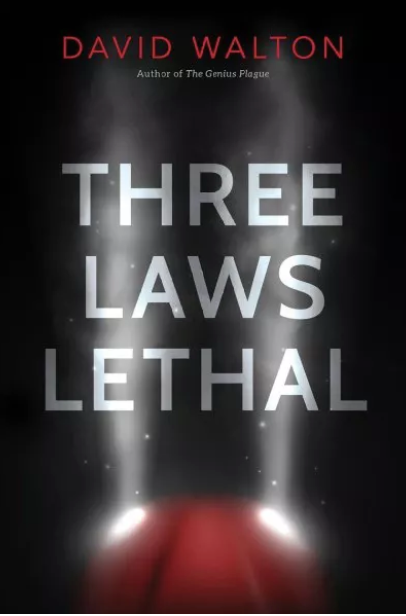
Review of David Walton's Three Laws Lethal: A Few Minutes and Decades Into the Future


David Walton's newest novel, Three Laws Lethal - title inspired by Isaac Asimov's three laws of robotics - begins with what certainly is an ethical quandary that typifies our increasingly AI-driven age, in this case, driven literally.  A mother with her children are passengers in an AI-driven automobile.  She can turn around and tell them to stop arguing, without risking an accident.  She marvels at being in the driver's seat with her hands off the wheel.  And then ...  A big tree falls in front of them.  To plow into the tree would risk the death of both mother and children.  The AI computes the deadly odds, and acts upon it, instantly swerving the car to the right to avoid the tree.  Unfortunately, there's a biker in that lane, and he's killed by the swerving car.

It's not that the AI didn't see the biker - the problem is that it did, and decided the mother and children's lives were more worth saving than the biker's.  Now, people driving in our reality make split-second decisions like this all the time.  They're maybe not quite decisions but instant gut reactions.  Would anyone for a moment think of charging a mother with vehicular homicide if she did what the AI did in the car?  Of course not.   But there's something deeply disturbing about an AI making this decision, any decision, that results in the loss of innocent human life.

This is the problem that opens David Walton's novel, just published by Pyr today.  It's a narrative that is as philosophically profound as it is breathtaking.   Asimov imagined/foresaw that all robots could and would be programmed with three laws:  1. A robot can never do harm, or allow harm to be done, to a human being.  2. A robot must follow all orders given to it by a human, except when following such an order would contradict the first law, i.e., harm or allow harm to be befall a human.  3. A robot must always act to protect itself, except when that would contradict the first or second law.  Asimov wrote great novels and stories that explored what could happen when these laws were bent or broken.  In that sense Three Laws Lethal is an extrapolation of Asimov, a meditation on how an AI programmed to protect human lives can end up taking a life - a life that threatens no one, but whose existence nonetheless must be ended to protect the people the AI serves.  The novel is also Asimovian in the sense that it is an un-put-downable read.

Exploration of driverless cars makes Three Laws Lethal not a story happening the day after tomorrow, as they used to say back in the 1950s, but maybe more like a few minutes from now.  An Uber driverless car already killed a woman in Tempe, Arizona in 2018.  This apparently was more a malfunction than a deliberate decision of the car to kill the woman (a pedestrian walking her bicycle in the street), so it didn't raise the kind of wrenching ethical dilemmas posed by Walton.   But Walton also explores, with the same panache and savvy, the corporate competition and intrigue that has characterized the digital revolution since it began in the 1980s.  In this case, we go from intrigue to outright assassinations, and self-driving cars to fleets that can work as an attack force.  Malignant AIs reminiscent of HAL (an Arthur C. Clarke not Asimov creation) also figure in this story, pitching it at least a few years and maybe decades into the future. 

All of this is played out by a memorable cast of characters all along the continuum of fundamental human decency, which at the bad end includes a willingness to do the aforementioned  murders to get desired results.   In as much Asimov's robot stories were also detective stories, this makes Three Laws Lethal an Asimovian story in yet a third, appealing sense.

Although Asimov defined the genre of sentient robots and therefore AIs, the other two titans of the golden age of science made important contributions to this crucial sub-genre.  In addition to Clarke's homicidal HAL, Robert Heinlein's self-sacrificing Mike has a permanent place in the AI pantheon.  No one can duplicate those achievements, but it's good to see that David Walton is carrying forward that tradition so well as we move to ever more AI in our cars and lives in the 21st century.


Tuesday, October 2, 2018

Manifest 1.2: Arthur C. Clarke's Magic


Precious little offered in Manifest 1.2 about what happened to those passengers on that fateful flight - or who or what caused it to happen - with the government team going over the usual suspects including aliens, etc.

God and magic also came into some other conversations, with Ben observing that "Any sufficiently advanced technology is indistinguishable from magic." Great line - but I would've liked it better had Ben (meaning the writers, producers, or director of this episode), added that Arthur C. Clarke wrote that years ago.  (I don't like plagiarism in any form.)

Otherwise, the compelling, if obvious, family and romantic dilemmas continued to develop in this episode.  Ben and Michaela are both apparently forgiving.  Michaela seems to forgive Lourdes - her best friend - for marrying her almost fiancee, and Ben is understanding if not accepting of his wife Grace's relationship with the other guy.   As a romantic drama, Manifest is firing on all cylinders, and there will no doubt be more ahead.  The course of true love never did run smooth (Shakespeare), especially when time travel is involved (me).

And time travel is why I'll keep watching Manifest.  I'd like to know what caused the plane to jump more than five years in time, and what connection that has to the voices our time-traveling passengers are hearing.   And I'm hoping, to get back to Arthur C. Clarke, that the explanation is technological not magical.

We'll see.

See also Manifest 1.1: Canterbury Voices

Thursday, December 17, 2015

Childhood's End 1.3: Literally

There's no denying that Childhood's End, which concluded its mini-series on SyFy last night, is a masterful rendition of Arthur C. Clarke's 1954 novel, which was itself a masterpiece.  Indeed, the story rendered on the screen in many scenes had more power than the novel.

But as I said in my review of the first episode, I didn't like the ending when I first read the novel in the late 1950s, and I felt the same, maybe even more so, when I saw it on television last night.

[Spoilers ensue ... read on only if you've already seen the third episode, or don't care ... ]

We learn in the third part of the mini-series, as in the novel, that the reason that Karellen doesn't want Ricky and his current wife to have children is he wants to spare them the exquisite pain of losing them.   This is an inevitable part of the literal ascension of humanity into a higher stage of evolution, in which human children become no longer children but the first expressions of this new species.

As such, this childhood's end is, in effect, a brief on behalf of children becoming liberated from and superior to their parents.  I have no problem with that at all - in fact, it's already our way of life.  But why can they never see their parents again - why is the ascension of the children mutually exclusive to continuing their relationship with their parents, aunts, uncles, grandparents, and adult members of their families?  That's the part I've always had a problem with - first, as a boy in the 1950s, and now as a parent myself.

The reason in the narrative, of course, is that the Earth itself is ending.  But why must that be?  Why couldn't humans continue on Earth, even as their children went out into the cosmos as a higher power?

Well, Clarke wrote the story, I didn't, and he's more than entitled to write the story he wanted to write.   And as I said, he did it masterfully, as did the makers of this mini-series.   So, by all means see it, but don't look for me to recommend it and its profoundly unhappy ending.


See also Childhood's End 1.1: Familiar Territory ... 1.2: Losing My Religion


#SFWApro 


Tuesday, December 15, 2015

Childhood's End 1.1: Familiar Territory

The first of the three-part Childhood's End mini-series began on the SyFy Channel tonight with a statement that Arthur C. Clarke's 1954 novel of that name changed and influenced science fiction for decades.   That's true.   When I read the novel a few years after its publication, it certainly changed my view of science fiction, making it more relevant to human life than even the great works by Isaac Asimov and Robert Heinlein, which I still enjoyed more.  But the quietly breathtaking revelations of Childhood's End and the questions they raised were not to be matched.

The problem, though, as far as tonight's mini-series is concerned, was the pervasiveness of the influence of Childhood's End and its story of an alien visitation on Earth - a pervasiveness in all forms of science fiction, but especially on the television screen.  Damon Knight's "To Serve Man" on The Twilight Zone a few years later, The Invaders with Roy Thinnes the next decade, V at its beginning and best in decades after that, all drew upon the story of Childhood's End in different and memorable ways.   And that, inevitably, makes Childhood's End on television tonight less original, and therefore a little less compelling than it was as a novel in 1954.

Still, it was pretty good.  I knew the truth of what the Overlords looked like, but their unveiling was still a strong moment, and I'd imagine especially so and more so for anyone who hadn't read the novel.   I'm interested enough to see where this goes, and if the mini-series diverges in any way from the novel, whose ending was something that I didn't much like back then.

But it will be tough going.  Unlike The Man in the High Castle, whose daring, stunning alternate history was something we haven't seen at all on any television screen, Childhood's End is too familiar, too reminiscent of too many science fiction motifs, to be great - at least, so far.  And we'll see how the next two days go.

See also Childhood's End 1.2: Losing My Religion and Childhood's End 1.3: Literally


#SFWApro 


Monday, August 31, 2015

Falling Skies Concludes

Well, although everything up to the ending in this, the very last episode of Falling Skies, was more of the recent same - which is to say, not very interesting or original - the series managed to pull off a memorable conclusion in its last few minutes.

Memorable because, against all odds, there was real change and optimism in that last scene.  Tom giving a speech, maybe prelude to his becoming President, Weaver cleaned up, and everyone looking a little older and very good.  And Tom's last words, that we learned that we're not alone, were just right for the conclusion of this difficult series.

Difficult because, well, how many times, how many ways, can you tell the story of we humans somehow surviving against overwhelming, all but impossible odds?   And our success, based on the premise that if you can destroy the queen, you can wipe out the whole civilization, is not only cliche but was introduced out of the blue just a few episodes ago.

Still, Noah Wylie's acting, and his character Tom Mason and his three boys, and throw in Will Patton's Weaver, especially in this and the previous season, have made an indelible contribution to the science fictional genre of invasions from outer space.   It comes down from Wells' War of the Worlds, through Heinlein's The Puppet Masters and Clarke's Childhood's End  and Damon Knight's "To Serve Man," which was also a great Twilight Zone episode - all of which were much better stories than Falling Skies. But Falling Skies, because of somehow the realness, the uniqueness, of the Mason family, or the impact of this overwhelming invasion on this family, and its stubborn carrying of hope when everything was against them, deserves to be counted among those incredible narratives.

Perhaps we'll discover alien beings out there in the universe tomorrow - or, if our luck turns really bad, be attacked by them.  But till then, Falling Skies will be a fiction worth watching and recalling, with all of its flaws.

See also Falling Skies 5.1: Still Worthy of Viewing ... Falling Skies 5.2: Hybrid ... Falling Skies 5.7: Back Up There ... Falling Skies 5.9: Plummeting

And see also Falling Skies 4.1: Weak Start ... Falling Skies 4.2: Enemy of my Enemy ... Falling Skies 4.3: Still Falling ... Falling Skies 4.5: Cloudy ...Falling Skies 4.7: Massacre Indeed ... Falling Skies 4.8: Spike ... Falling Skies Espheni: How to Pronounce? ... Falling Skies 4.9: To the Moon, Anne, To the Moon ... Falling Skies 4.10: Lexi ... Falling Skies Season 4 Finale: Self-Sacrifice and Redemption

And see also Falling Skies 3.1-2: It's the Acting ... Falling Skies 3.3: The Smile ... Falling Skies 3.4: Hal vs. Ben ... Falling Skies 3.6: The Masons ...Falling Skies 3.7: The Mole and a Likely Answer ... Falling Skies 3.8: Back Cracked Home ... Falling Skies Season 3 Finale: Dust in Hand

And see also Falling Skies Returns  ... Falling Skies 2.6: Ben's Motives ... Falling Skies Second Season Finale

And see also Falling Skies 1.1-2 ... Falling Skies 1.3 meets Puppet Masters ... Falling Skies 1.4: Drizzle ... Falling Skies 1.5: Ben ... Falling Skies 1.6: Fifth Column ... Falling Skies 1.7: The Fate of Traitors ... Falling Skies 1.8: Weaver's Story ... Falling Skies Concludes First Season

#SFWApro


no aliens, but definitely insects

Friday, January 15, 2010

Fringe 2.12: Classic Science Fiction Chianti, with Hints of Star Trek, Twilight Zone & Arthur C. Clarke

A really heart-warming, outstanding episode 2.11 of Fringe tonight - this one definitely moving forward in this, our universe and Fringe's second season, and providing some of the best development of Walter's character we've seen in almost two years.

The story is another fine take of 1950s science fiction, with a neat 21st-century twist.  A town named Edina has people who look deformed - sometimes.  Are they "metamorphs," beings like werewolves who can transform themselves, either at will or under the influence of moonlight or something else?  Not quite.  The first hint we get of the truth is a beautiful butterfly which may really look like a bedraggled moth.  It's unlikely the moth willed itself to look better.

But was moonlight the cause?  Not quite that, either.  Walter realizes what's really happening, as he remembers a US Army piece of research he worked on briefly in the 1970s - an attempt to render soldiers invisible by scrambled the optic nerves of all who see them.  The experiment failed, and also left all inhabitants of Edina (where the research was being conducted) badly disfigured.   The head scientist did his best to remedy this:  he created an electromagnetic pulse which fooled the eyes of everyone who lived in the town, everyone who visited the town, into not seeing the inhabitants as disfigured.   The town people could live quiet, normal lives, which could withstand the scrutiny of any one who happened by.

The plan, which has worked for years, begins to unravel when a boy - reminiscent of the kid who was able to literally change people's minds in Episode 2.7 (another excellent episode this season) - tries to leave town.  A cop from a neighboring town picks the boy up on the road.  The boy's true face becomes visible as the car leaves town, people from Edina can't let people outside the town know the truth, and several police are killed.

After Walter solves the case - quoting what an old "friend" said about "any sufficiently advanced technology [being] indistinguishable from magic" (that would be Arthur C. Clarke, cool tie-in!) - Walter pleads with Broyles not to report the discovery, so the people of Edina can return to their quiet lives.  It's a great moment, for Walter, who's been a showing more heart and less insanity with every episode, and Broyles, who grants Walter's request.   Like the ending of The Menagerie on Star Trek, the ending of this episode of Fringe gives the disfigured the opportunity of continuing to live their lives with their saving illusions.  (This episode also reminded me of the classic Twilight Zone "Eye of the Beholder" episode, though most of the two stories are quite different.)

And as a coda, Walter tells Peter that he's grateful that Peter has chosen to see Walter in a good light, which shines a light on the question of how long will Walter be able to keep Peter from knowing his true identity - unless, maybe, Peter already knows it.


5-min podcast review of Fringe

See also Top Notch Return of Fringe Second Season ... Fringe 2.2 and The Mole People ... Fringe 2.3 and the Human Body as Bomb ... Fringe 2.4 Unfolds and Takes Wing ... Fringe 2.5: Peter in Alternate Reality and Wi-Fi for the Mind ... A Different Stripe of Fringe in 2.6 ... The Kid Who Changed Minds in Fringe 2.7 ... Fringe 2.8: The Eternal Bald Observers ... Fringe 2.9: Walter's Journey ... Fringe 2.10: Walter's Brain, Harry Potter, and Flowers for Algernon ...  New Fringe on Monday Night: In Alternate Universe?

See also reviews of Season One Fringe Begins ... Fringe 2 and 3: The Anthology Tightrope ... 4: The Eternal Bald Observer ... 7: A Bullet Can Scramble a Dead Brain's Transmission ... 8. Heroic Walter and Apple Through Steel ... 9. Razor-Tipped Butterflies of the Mind ... 10. Shattered Pieces Come Together Through Space and Times ... 11. A Traitor, a Crimimal, and a Lunatic ... 12, 13, 14: Fringe and Teleportation ... 15: Fringe is Back with Feral Child, Pheromones, and Bald Men ... 17. Fringe in New York, with Oliva as Her Suspect ... 18. Heroes and Villains across Fringe ... Stephen King, Arthur C. Clarke, and Star Trek in Penultimate Fringe ... Fringe Alternate Reality Finale: Science Fiction At Its Best


Saturday, January 2, 2010

Wells, Clarke, and District 9

Continuing to catch up on 2009 science fiction movies, with nothing playing on first-run television this week, I saw District 9 the other night. The applause is justified.

First contact stories, aliens landing on Earth, have been a staple at least since H. G. Wells' War of the Worlds at the turn of 19th into the 20th century and continuing with Arthur C. Clarke's Childhood's End in the 1950s, V on television in the early 1980s (and again this year) and the Alien Nation movie in 1988. District 9 manages to tell such a story in an original, heart-tugging, humorous way. The aliens seem bedraggled, pathetic. They're kept in filthy camps after they arrive. And they're about to be deported to even worse conditions. With all of this happening in South Africa, the parallels to apartheid are obvious and well taken: we treat others badly, that seems to be in our human nature.

But, from the very beginning, there should have been a nagging question for we humans: if the aliens are so pathetic, how did they manage to build a huge star ship and get here?

As the eviction continues, we start to see some of the scientific brilliance of the aliens. Meanwhile, one of the relocation officers, Wikus, is exposed to an alien chemical that gradually transforms him into an alien. This brings District 9 into another classic science fiction category - humans transformed into aliens - which we saw to excellent effect less than two weeks ago, in Avatar. In Wikus's case, he wants to stop and reverse the transformation, and this leads to an alliance with an alien scientist on Earth and his son, and a breathtaking last 30 minutes of the movie.

District 9 does a fine job of continuing the tradition of Wells and Clarke, and makes a memorable contribution to the canon. I'm definitely up for a sequel.


4-min podcast review of District 9


Special Discount Coupons for Angie's List, Avis, Budget Rent-a-Car, eBags, eHarmony, eMusic, Nutrisystem


Tuesday, May 5, 2009

Stephen King, Arthur C. Clarke & Star Trek on Penultimate Fringe

Well, they threw in the science fictional kitchen sink on the penultimate first season episode of Fringe tonight - a fine and fanciful thing, if, like me, you love science fiction - as well some media-history science fiction concerning the phonograph, which also appeals to the media historian part of me.

King's pyrokinesis - the capacity to create fires through sheer mental focus - was mentioned by name, Clarke's Childhood's End (one of my childhood and still favorites) is on the bookshelf of a victim who can't control her pyrokinetic powers, and there's a guy who thinks he's Spock. (I predict some sort of recondite, glimmering connection to Fringe in the new Star Trek movie, which I'll be seeing this Friday. J. J. Abrams across space and time.)

And the story was crackerjack sharp on Fringe tonight, too. Peter builds a device to help Walter make digital copies of his old vinyl records, and this device is able to recover sound - speech and a cellphone number - from a molten window. As I pointed out in in my media history and future The Soft Edge, and worked into the story in my science fiction The Silk Code, the phonograph is at basis a very old technological process, in no need of electricity. Conceivably, ancient potters could have captured ambient sound in the clay they were molding....

Olivia also finally gets rid of the irritating FBI official who is trying to drum her out of business. Well, actually, he's working for bad guys, and Olivia doesn't plan to kill him, it just happens when she gets one of his intended victims to focus her fire-starting power away from Olivia and her, and it ends up burning up the FBI guy.
Good riddance to bad luggage.

But who, really, are the bad guys. Lots of things are pointing to William Bell, whom we'll meet next week, but it's pretty clear, I think, that Bell is just trying to prepare to fend off the real baddies ....

Klingons?

Nah, I don't think J. J. Abrams would go that far. But the eternal bald observer has collected Walter, and we should find out something about where they're going next week, in the Season 1 finale...


8-min podcast review of Fringe penultimate

See also Fringe Begins ... Fringe 2 and 3: The Anthology Tightrope ... 4: The Eternal Bald Observer ... 7: A Bullet Can Scramble a Dead Brain's Transmission ... 8. Heroic Walter and Apple Through Steel ... 9. Razor-Tipped Butterflies of the Mind ... 10. Shattered Pieces Come Together Through Space and Times ... 11. A Traitor, a Crimimal, and a Lunatic ... 12, 13, 14: Fringe and Teleportation ... 15: Fringe is Back with Feral Child, Pheromones, and Bald Men ... 17. Fringe in New York, with Oliva as Her Suspect ... 18. Heroes and Villains across Fringe


The Plot to Save Socrates


"challenging fun" - Entertainment Weekly

"a Da Vinci-esque thriller" - New York Daily News

"Sierra Waters is sexy as hell" - curled up with a good book


more about The Plot to Save Socrates...

Get your own at Profile Pitstop.com

Tuesday, March 18, 2008

Arthur C. Clarke, Last of Titans, Is Gone

Back in the 1950s, three science fiction writers accounted for the lion's share and more of my great reading - Isaac Asimov, Robert Heinlein, and Arthur C. Clarke. Asimov and Heinlein have, sadly, been long gone. Arthur C. Clarke died today at age 90.

His Childhood's End, and its haunting, mystical story of aliens - the Overlords - coming to Earth, captured me when I was younger than ten. I still count it as among the best novels I've ever read.

Clarke was not as prolific as Asimov or Heinlein, but that didn't matter. His connection to the cosmos had a probity, a clarity, and even a sweetness, all its own. Clarke continued this kind of writing in movies as well as books and stories - he is of course best known as the writer of Kubrick's 2001.

2001 was the year, as fate would have it, that I was finishing my second term as President of the Science Fiction Writers of America. On more than one occasion, I called upon Arthur C. Clarke for his sage advice.

But Clarke contributed more than eternally haunting science fiction. He was also a futurist, and in 1945 he published a famous article which predicted the role of artificial satellites in telecommunication - 1945, way back then, that's what I call perceptive.

When I published my book about the impact of cell phones in 2004 - Cellphone: The Story of the World's Most Mobile Medium, and How It Has Transformed Everything - I knew that there was only one person I wanted to write a blurb for the book. Arthur C. Clarke, already in tenuous health, obliged me. His is the only blurb on the book.

I was privileged to read his writing, see his movies, and know him, at least a little, in the past ten years. We'll never see another like him.
InfiniteRegress.tv