Chuck Todd interviews me about alternate histories
Showing posts with label book reviews. Show all posts

Thursday, August 14, 2025

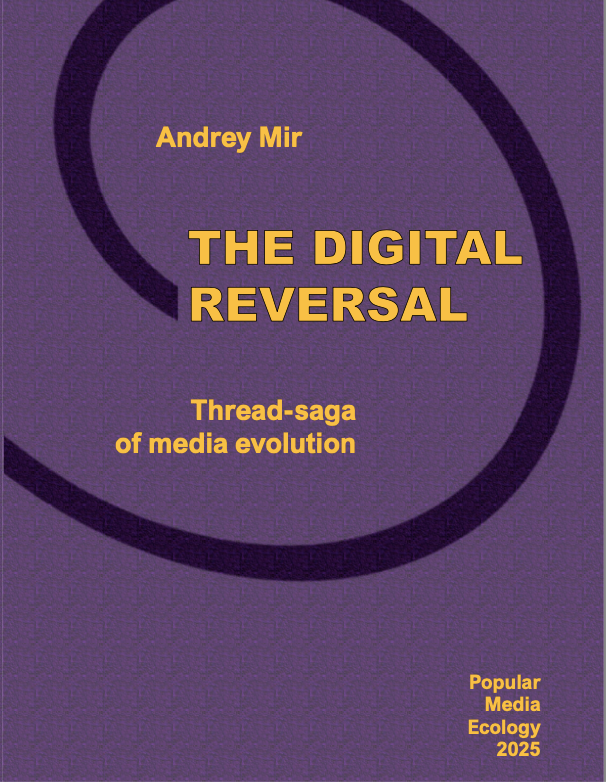
Review of Andrey Mir's The Digital Reversal: Media, Social Media, AI, and the Fate of Humanity


Andrey Mir's The Digital Reversal, building on his recent series of books with pathbreaking analyses, is so far ahead of any other scholarly work in understanding what's going on in the media world, and hence the world per se, today, that it hurts, even as it brilliantly elucidates. I'm in strong disagreement with Mir's insistence in his final chapter that humanity as we know it is inevitably doomed by the media evolution he so astutely traces and explains, but I nonetheless am sure that if you want to know where we are and perhaps what to do about this immensely difficult world we inhabit in 2025, you can do nothing better than read The Digital Reversal.

The foundation of Mir's book, the basis of its title, comes from Marshall McLuhan's "Laws of the Media," which postulate that all technologies have four modes of existence:  they amplify or enhance some aspect of communication and life, they obsolesce an aspect of life that was previously amplified, they retrieve an aspect that had previously been obsolesced, and ultimately they reverse or flip into some new kind of technology that has some relation to the original but is markedly different.   Since I first began thinking about the Laws of Media or Tetrad and published a Preface to one of McLuhan's first articles about the Laws in 1977, I've found radio and television to be a clear example of how the Laws work:  Radio amplifies speech, music, news, verbal communication by sending it instantly across great distances with no wires; obsolesces printed newspapers and wired telephones; retrieves verbal communication with those close to us; and reverses into television.   Now, lest you think that there's not much difference in the impact of radio and television, consider that radio made possible not only FDR and Churchill, but Hitler and Stalin, whereas the political impact of television brought us JFK, Reagan, and Obama, and, on the other side of the world, Gorbachev.  That's because radio boosted unseen power, in contrast to television, which showed us what the would-be people of power looked liked.  Nixon lost the television debates with JFK and thereby the election because Nixon looked sweaty and shifty in his reaction shots on TV while Kennedy looked cool and comfortable and in control.

Mir's Digital Reversal, then, delves into something that happened to us -- is still happening to us, right now -- after the revolution in personal computers and the Internet in the 1980s and 1990s.  The reversal happened quickly, virtually overnight, if we look at the time it took the printing press to make its mark, and then electronic media, and every media shift that came before those two momentous developments.  "The blogosphere, cellphones, and tablets already belong to media archaeology," Mir correctly notes.  And he proceeds to tell us the results of this reversal.   Building upon his Postjournalism and the Death of Newspapers (2020), Mir notes that the search for truth and the goal of accuracy in traditional journalism has been supplanted by the quest for Likes and Shares online and the self-affirmation they provide.  Joining this reversal is what Mir calls the "emancipation of authorship" and I call "consumers becoming producers" (in New New Media, 2009), with conservatives and reactionaries joining progressives online in the 2010s, coalescing with a few of them into MAGA aggrieved Americans pushing glittering outright lies, electing Donald Trump in 2016, falling short in 2020 (probably due to COVID), and putting Trump back in office in last year's election.

But Mir expects this digital reversal to do far worse than Trump to humanity.  After detailing the impact of the digital reversal on everything from how we know -- epistemology -- to how we sense and perceive, in a philosophic tour-de-force that Immanuel Kant would have welcomed, Mir turns to an issue that everyone in and out of academe seems to be talking and writing about these days: AI.   And his view on that, I'm happy and unhappy to say, explicitly builds upon my "anthropotropic" theory of media evolution, that I came up with and developed in my 1978 doctoral dissertation, Human Replay: A Theory of the Evolution of Media:  as media evolve, they attempt under our invention to replicate as much of our natural modes of communication as possible, as the media extend our communication beyond our original, unmediated ways of conveying information.  Writing extended our voice beyond its immediate surroundings, but sacrificed the pitch and all the acoustic characteristics of speech.  Telephone and radio eventually corrected that, but left out what we see when someone talks to us face to face, in person.  Television and then Facetime, Skype, and Zoom corrected or "replayed" that crucial missing nonverbal visual aspect of speech.

And Mir argues, regarding AI, that it will be responsible for the greatest flip of all:  human replay will flip into human replacement.  That is, the AI that we invented will replace us, merge with us into something in the AI's favor, in the very near future.  Among the many casualties, we won't go physically out beyond the planet into space anymore. "Deep space exploration—anything beyond Mars (and even that’s unlikely)—will never happen. There’s no real practical need for it" because "why bother escaping polluted, annoying Earth for Mars if you can escape into an induced, endlessly modifiable reality? Chasing interstellar travel is like staring into the rearview mirror."  (My response:  We'll keep going physically out into space, because we'll never find out what we're doing here in this universe from down here on this planet -- see Touching the Face of the Cosmos: On the Intersection of Space Travel and Religion for more.)

But not going out beyond this planet is the least of Mir's apocalyptic vision for the immediate future, which "will occur sometime in the middle of this century".  Mir writes, "humans themselves are becoming digital—so far just metaphorically, but soon literally, and not in the literate sense of the word."  Not just metaphorically?  Meaning, what? That sometime around 2050, if I live that long, my blood cells, my brain, my DNA, or whatever will literally turn into some kind of digital code, which will replace my self-awareness?  Mir says about Douglas Rushkoff and his book Team Human: "he takes a moral stance and insists on people’s ability—and even duty—to seize back control of media evolution".  Who says it's out of control, let alone totally out of control?   Trump's ascension is drastically not enough to support this claim. True, he was elected U. S. President twice, but he also was defeated once, and the first time he won, he nonetheless lost the popular vote.  A far more likely explanation for his success in 2024 was Biden's disastrous performance in their June 2024 debate (see my continually updated McLuhan in an Age of Social Media for more -- it makes the point that maybe debates have outlived their usefulness).

Mir's final paragraph -- all his paragraphs are deliberately the length of Tweets -- advises “'Endure and abstain' is literacy’s last resort, futile but noble."  But as Jim Bishop wrote in the New York Journal-American on March 14, 1959: "The future is an opaque mirror."  Mir is flawless, perceptive, ingenious, splendid when he writes about the past up to the present.  But like any other mortal, he cannot possibly predict the future with any acumen, certainly not 25 years from now.  By then, this very book, The Digital Reversal, may well have woken enough of us up, so we don't sleepwalk into this AI nightmare.


Sunday, January 12, 2025

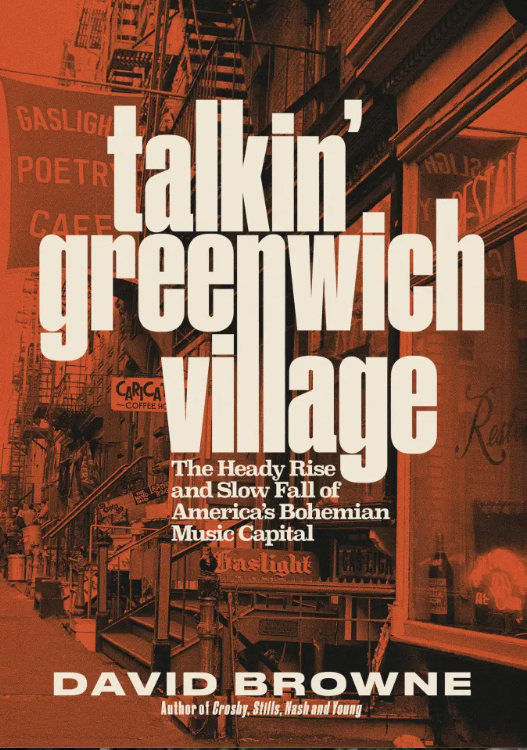
Review of David Browne's Talkin' Greenwich Village: Cornucopic Rainbow Biography


                                    more about the book here

If ever there was a time-travel ticket to a past and a place that you knew so well you could still see the sun glinting through the tree leaves, hear the din of the eateries as you walked by, and, most important, still hear the music that actually defied any given time or place, it would be David Browne's book, Talkin' Greenwich Village: The Heady Rise and Slow Fall of America's Bohemian Music Capital.  That's because Browne has a way of writing, an eye for detail, a penchant for commentary, that draws you in to fill the background you in one way or another actually experienced, or, what Marshall McLuhan called "cool".

Yeah, I sang doo-wop in Washington Square Park with my acapela group The Transits in the early 1960s, and then my folk-rock group The New Outlook a few years later (Ellie Greenwich and Mike Rashkow heard us uptown one Sunday afternoon in Central Park, and signed us to Atlantic Records, after changing our name to The Other Voices), but the way I really got to know the village was finishing up my BA in Journalism at NYU, then going a few blocks up to the New School for an M.A., then back to NYU for my PhD in the 1970s.  (I even managed to write three pieces for The Village Voice just before all that, my sum-total career as a music journalist.)

Turns out David Browne and I could have passed each other in the street -- David arrived to pursue his BA in Journalism at NYU in 1978, and I left, thankfully finished with school, in 1979 -- or bumped into each other going in and out of the diner southeast of the park.  But David stayed focused on the Village and its clubs and their music, to the present day, while I pursued music on the radio, MTV, iTunes, and anyplace I could hear it, and only came to the Village with my wife to eat in a great Italian restaurant near Houston Street, or go shopping at Balducci's.

And Talkin' Greenwich Village is one of the results of Browne's passion -- he's written more than half a dozen other books about popular music, and writes for Rolling Stone -- and delivers a cornucopia of vignettes, insights, and are what in effect mini reviews of dozens of artists.  You know, I always judge a book by how well it treats a subject I know something about.  My wife and I were/are devoted fans of Phil Ochs -- I consider his "The Crucification" right up there with the very best songs that Dylan wrote -- and Browne not only got everything right in his discussion of Ochs and his life in the Village (with an intermission in California) over the 1960s and 70s, until he took his own life the year my wife and I got married (we went to the Memorial Concert for Ochs that Browne also aptly describes), but I also learned something from his description of Ochs.  It's become hard-wired into Ochs's story that he was broken when Dylan did not include him in his Rolling Thunder tour.  But Browne provides a missing piece of the story, telling us how Ochs badgered Dylan, when Dylan was first beginning to put together the group that would tour.   Which means, it's not quite true that a callous or jealous Dylan simply didn't include Ochs on the tour.

But in addition to, I don't know, at least vignettes of 50 artists spread across 8 chapters and an Epilogue teeming with information -- Browne lists every interview he did for the book in its Bibliography -- he focuses on two artists, Dave Van Ronk, and the Roche Sisters (and, also of course, Bob Dylan), and makes them, in effect, centerpieces and guides to what Browne is telling us happened in these magical decades.  I only saw Van Ronk once (at the Phil Ochs 1976 Memorial  Concert at the Felt Forum) and the Roche Sisters only on YouTube.  But Browne's accounts of Van Ronk and of the Roches across the decades amount to mini but in-depth biographies of the two, and make Talkin' Greenwich Village irresistible reading just on their own.

But lest you think everything in this book is as serious as Ochs, or even Dylan, Browne also has a knack for the kind of detail that will make you chuckle, or even laugh out loud.  Seeking the name of a song on one of The Blues Project's just-recorded albums, the response to the person who's writing down the titles is "'What song? You mean Steve’s song?' To [Steve] Katz’s chagrin, 'Steves Song,' complete with a missing apostrophe, became the title."  Or, "when Orbison and Ronstadt huddled in his dressing room, [Jerry] Brown [then Ronstadt's boyfriend], waiting patiently outside, finally began pounding on the door: 'Let me in! I’m the governor of California!'''  Or, "the worst [performers in this Village venue] were booed or heckled. When asked if one contestant should be booted off the stage, [owner] Porco grumbled, 'No, I think we should shoot him.'”

Of course, no volume is perfect, and I'll tell you the one thing I missed in this New York Public Library of a book. I was a big fan of The Blues Project, and to this day I find myself humming or singing to myself "Cheryl's Going Home".  The song was written by Bob Lind (who wrote "Bright Elusive Butterfly of Love"), who does a pretty good job singing it.  But the Blues Project rendition, with those piercing guitar notes, and their interplay with organ, is something else.  Browne tells us almost as much about The Blues Project, Danny Kalb in particular, as he does about Van Ronk, the Roches, and Dylan.  But not a word about that elusive heart-breaker Cheryl.  I guess she was already home and out of sight.

But every page of this pulsating encyclopedia of whirling words is worth reading.  The fall of Greenwich Village and its clubs and taverns and whatever you want to call them brought tears to my eyes, because David Browne had made it seem like a beloved living organism, a mini gaia of music just several blocks long.  My only really lasting regret about this book is that it wasn't ten times longer.  As it was, it's 400 pages went by too quickly, because I just couldn't put the book down.

=========

Check back here at the end of the month for my upcoming interview with David Browne.

=========


                        in Kindlepaperback, and hardcover


Sunday, May 5, 2024

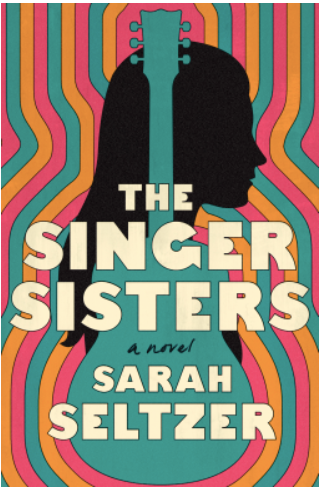
Review of Sarah Seltzer's The Singer Sisters: The Musical Mystique


There's a meta-genre of fiction epitomized in different but overlapping ways by Eddie and the Cruisers, Rob Reiner's This Is Spinal Tap, and Daisy Jones and the Six -- the first and the third adapted to the screen from novels -- that helps us understand what those who make music that lights up our nights are doing when they're off-stage and not in the studio.  Sarah Seltzer's The Singer Singers, a debut novel to be published this August, not only fits well in that narrative family, but in some ways exceeds it.  I'd expect to see it adapted on some kind of screen before too long.

The Singer Sisters actually tells us two stories, deftly interwoven.  One is a moving snapshot of the folk-rock music scene,  and therein the larger music venue in which folk-rock played, in the last third of the 20th century.  The other is a tableau of upper middle class Jewish culture, in New York City, Boston, and beyond, in the same period of time.

The Singers -- aka the Zingleman sisters -- strive to succeed across two tempestuous generations along with other fictional singers and writers, against a backdrop of real superstars that even non-devotees of folk-rock will instantly recognize.  The characters worry about "stealing from Dylan".  One of the singers concludes that "Joan Baez was right and Dylan wrong, that kindness mattered more than genius" (I would say that both are crucial).  There's a quote from Gordon Lightfoot's "Early Morning Rain" -- "see the silver bird on high" -- and a mention of Phil Ochs (not a superstar but shoulda been).  And there are fictitious characters that the cognoscenti will surely know, like the rock critic who uses his way with words to unfairly lambaste brilliant work (as the real rock critic did to Phil Ochs -- not to mention Paul McCartney). Meanwhile, the Singer songs are not only spoken of by the characters, but Seltzer actually delivers more than a dozen sets and snippets of original lyrics, demonstrating a considerable talent not only as a novelist but a lyricist, and leaving the reader yearning to hear them put to music and fulfilled in song.  In addition to a movie or a limited TV series, The Singer Sisters also has the makings of a Broadway musical.

The Zingleman sisters are Jewish, and their Yiddishkeit permeates the novel, not only in cream sodas, but their parents' wise view that they'd rather see their children fed with goishe food than go hungry without it. In this sense, The Singer Sisters has a kinship with Philip Roth's Goodbye Columbus, and I hope the novel is recognized as the compelling portrait of Jewish culture in America that it is.  It's especially important, given the rising wave of anti-Semitism that's afflicting our country and the world.

In case it's not obvious, The Singer Sisters is very much a woman's novel, explored in sisterhood, motherhood, and daughterhood, with love, heartbreak, pain, exultation, and a panoply of uniquely female emotion in every chapter.  But men might well get a necessary education from this novel too, and I heartily recommend it to any human being.

more about The Singer Sisters here.

============


my interview with Sarah Seltzer

============


"Paul Levinson's It's Real Life is a page-turning exploration into that multiverse known as rock and roll. But it is much more than a marvelous adventure narrated by a master storyteller ... it is also an exquisite meditation on the very nature of alternate history." 

-- Jack Dann, Fiction Writer's Guide to Alternate History


Friday, October 27, 2023

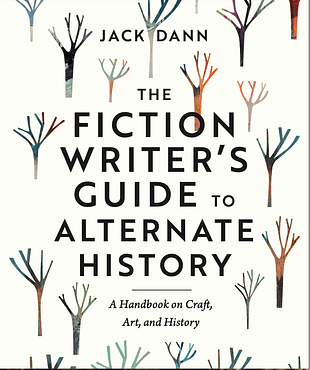
Review of Jack Dann's The Fiction Writer's Guide to Alternate History: A Tour-de-Force Treasure Trove

Fiction Writer's Guide to Alternate History


I've always had a keen love of alternate history science fiction.  Amazon Prime Video's The Man in the High Castle series (2015-2019), a mostly brilliant adaptation of Philip K. Dick's path-breaking 1962 novel, in which the Axis won the Second World War, was pretty much from the moment I started watching it easily the best drama I've ever seen on television, and still is.  (Here's an interview I did with Rufus Sewell in 2021 about the leading character he played in the series, one who wasn't in Dick's novel.)

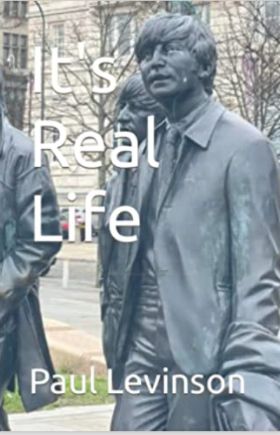
But as much as I love alternate history, I didn't really start writing it until "It's Real Life," a story in which John Lennon wasn't murdered and The Beatles were still together and making music in 1996.   That story was a finalist for the Sidewise Award, bestowed today for the best "short form" published in 2022.   An ideal time for me to read and review Jack Dann's Fiction Writer's Guide to Alternate History.

The heart of this remarkable book is a colloquium, conducted in the previous decade among the leading writers of alternate history.  I heard of all of them, met some of the them, and have read something between between all and some of their alternate history fiction.  They respond to Jack Dann's prompts, and I don't think they saw each other's responses.  They differ on what the "rules"of alternate history should be, including about whether there should be rules at all, consciously or unconsciously followed.  They of course draw upon their own works as examples, in seeming violation of I. A. Richard's warning against the "intentional fallacy," that is, relying upon what authors say they intended in their work, but this doesn't really matter, because the authors in Dann's book also talk about work by other authors in the book, as well as authors not in the book, and their arguments can be evaluated without reference to their work.  

One of their points that most struck me is Bruce Sterling's (p. 119) that “Commonly they’re [alternate histories] about troubled times in which the author has some kind of solution to offer.”  This is exactly why I wrote "It's Real Life": it always seemed to me that the world in which John Lennon was assassinated was a deformation of the way reality was supposed to be, and I wrote the story to give the world a taste of the way it was meant to be.  Pamela Sargent (p. 121), makes a similar point, writing that “Back in the early 1990s, I gave a talk at one convention in which I said that I had the persistent impression that all of us were living in a weird variant that had branched off from the main continuum," as does Paul Di Filippo (p. 97), who tells us that “I think the best such [alternate history] stories arise from creating a world the author would like to at least explore or even inhabit."

These and numerous other insights and explications in Dann's handbook are invaluable to authors at any stage in their careers.  If they're just starting out, it provides a blueprint -- which as Dann makes clear, they needn't follow if it goes against their grain -- and if you're an old hand, you'll find the comfort of better understanding just why you chose to do this or that in the narrative you just wrote, or maybe just finished, because you started it a long time ago, a crucial way of writing for many a writer, also discussed in Dann's book.

Another point of discussion of special interest to me, because I've written half a dozen books on media history, and that's a lot of what I teach as a professor at Fordham University, is what these authors of alternate histories think of our "real" history.  I put "real" in quotes because, as George Zebrowski (p. 120) notes, and I agree, “Tentative history is all we have, and in science fiction we can rehearse as many as we can imagine.”  Yet to make this issue even more provocative, while Kim Stanley Robinson (p. 90) agrees that "all history is a fiction, and as such, maybe it’s always an ‘alternative history,’” John Kessel (p. 83) insists that “I want the counterfactual to illuminate some element of real history,” and I agree with that, too.  Indeed, I think for a counterfactual or alternate history to work (some of the authors argue these have two different meanings, I do not), the story has to have some number of real signposts, to keep our appreciation of the alternate history on track.

Jack Dann of course also writes tellingly about his own alternate histories.  He talks about how Milton's Paradise Lost and John Martin's illustrations of them a century later were inspirations and building blocks for Dann's own Shadows in the Stone (2019).  All authors need inspirations, they're obviously essential, but you can't create them.  The best you can do is recognize them and then act upon them when you're ready.  In effect, the whole of The Fiction Writer's Guide to Alternate History is a treatise, in part multi-authored, of what inspires the imagining and writing of alternate histories.

I realized the moment I started writing "It's Real Life" that I was inspired by Peter Jackson and his The Beatles: Get Back documentary.  I saw its three parts the instant they were released on the Thanksgiving weekend in 2021, and wrote "It's Real Life" in January 2022.  In a way, that documentary is both an alternate history and it epitomizes the interplay of alternate and "real" history that is one of the central themes of Dann's book.  What were The Beatles really like as they stood on edge of disbanding in the history we all remember and most of us deeply regret. Jackson has hours of outtakes recorded when The Beatles were making the depressing Let It Be documentary that proves they were far happier than we've been told and we "remember".  Or were they?  After all, they did break up.

I was so energized by Jackson's documentary that I wrote an alternate history in which The Beatles didn't break up.  I've expanded it into a short novel that I haven't yet shown to anyone, except my wife, who read an earlier draft.  I'll no doubt go over it at least a few more times before I decide what to do with it.  Will I be influenced by the exhilarating experience I just had reading Jack Dann's Fiction Writer's Guide to Alternate History?  Will I follow or break some of the rules that Dann and many of the authors in that book say can and maybe should be broken?  I don't know.  But you can find out by reading The Writer's Guide to Alternate History now, and It's Real Life the novel whenever it's published.


Get "It's Real Life" in paperback, or on Kindle, or read for free here.


Tuesday, September 26, 2023

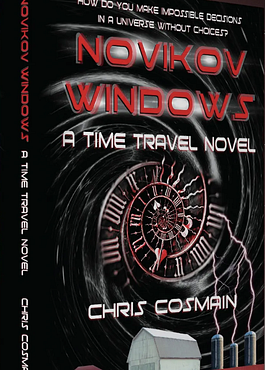
Review of Chris Cosmain's Novikov Windows

Novikov Windows


I'm going to here review a a very recently published, nearly 500-page time travel novel -- Chris Cosmain's Novikov Windows: A Time Travel Novel (that's the sub-title) -- I've just read, in two days.  That should give you an idea of how compelling I think this novel is.  

Because of that, I'm not going to give you any big spoilers in this review.  If you haven't yet read this novel, and doubt or would like further elaboration on any of the points I make below, my best advice is: read the novel.  (You can buy a copy over here.)

Now as to the narrative.  It has a 19th-century flavor.  In fact, important parts of the story take place back then.  But more than that, its style and pace feel as if it could have been written by H. G. Wells.  And it combines that ambience with all the mod-cons:  3-D printing, DNA and junk DNA, computers, and rockets all play a role.

I've said many times that I can't enjoy or take seriously any time-travel tale which ignores the paradoxes that time travel engenders, and gives the intellect (or at least mine) so much to deal with.  The one that comes up most often is the so-called grandfather paradox -- if I go back in time and accidentally kill my grandfather, before he sleeps with my grandmother, I wouldn't exist, so how have I gone back in time in the first place?  (By the way, that's not only so-called, but called in a way that's unnecessarily violent and sexist -- I can trigger the paradox by going back in time and obstructing either set of my grandparents from ever meeting.  The obstruction doesn't have to be death, and I don't need to divert one of my grandfathers, it could be one of my grandmothers.)  But Cosmain has a daring way of positing why this paradox would never arise.

Another favorite time-travel paradox is what I think of as the "where did it come from" paradox.  A man, somewhat older than me, who looks very familiar, knocks at my door with a package.  He advises me to open the package then walks away.  The package contains explicit instructions on how to build a time machine.  The instructions say it will take me ten years to build it, and after I build it, I need to travel ten years back in time and give myself the package.  So ... where did the package and its instructions come from in the first place?   That kind of paradox plays a crucial role in Novikov Windows.

Here are ten more specific elements I especially enjoyed in this novel (the enumeration reflects not where they appear in the story, but just the order I felt like putting them in):

1. Novikov Windows has one of the most ingenious time travel methods I've ever come across in a novel, story, movie, or TV series: the person or object is scanned down to the atomic level, the scan is sent back in time, in a device that recreates the person or object at the destination.

2. Vincent van Gogh makes an appearance. There's something about that Impressionistic Age and its love affair with light that just cries out time travel, isn’t there.

3. There's a refreshing, almost boyish, Tom Swiftian quality in the descriptions of the science and the tech necessary for time travel.  That's part of what I meant when I said H. G. Wells could have written this.

4.  The novel also has romantic passion ... deep kisses, deeper feelings, more.  That's why I didn't say the novel was Asimovian (my favorite science fiction author, but portraying love wasn't his strong suit).

5. Cosmain deals with the problem of not only traveling through time, but to the intended place.  You often don't find this in time travel stories.

6. The addition of new, important characters throughout the novel gives the characters we already know the need to explain to the new characters what's really going on, i.e., how the time travel works, its limits and specifications, which in turn provides us, the readers, another chance to understand this.  Yes, the science and effects of time travel in this novel are complex, but time travel that isn't is usually not worth reading.  And the time travel in this novel is something you likely haven't seen before, which also makes the story commendable, and worthy of Aristotle's advice to the teacher to teach the lesson three times: tell the students what you are going to teach them, teach them, then tell the students what you just taught them.  We all are students when it comes to time travel.

7. Speaking of education, we also learn some new words in this story, including the Australian larrikinism (rebelliousness) and the Japanese shouganai (a cross between the French c'est la vie and the Yiddish bashert).

8. Biology plays a major role in this novel (its author is a medical doctor), as indeed it should in a time travel story that transports living things across time. So does medical care.   If traveling in a plane can get you dehydrated, who can say what being scanned, sent back in time, and recreated would do to the body and mind.     

9. And time travel literally and figuratively becomes a bedfellow for these characters, often animating but also taking its toll, especially on the very composition of their families.

10. This story also has lots of nice little touches, including one involving Stephen Hawking and another the extinction of dinosaurs (well, that certainly doesn't seem nice, but you know what I mean, and it did leave our planet open for the success of mammals, including human beings).

I could go on, but I've already veered all too close to spoilers, and I don't want to spoil any of the fun for you.  Novikov Windows is a remarkable combination of hard science fiction, probing philosophy, ethical argument, and sheer adventure.  If you're not already a fan of time travel, chances are you'll become one after you read this novel.  If you are already a fan, this novel will go to the top of your list, and stay there as an accomplishment against which past and future time travel stories you may read will be judged.

====

My best-known time travel works:  The Plot to Save Socrates, Unburning Alexandria, Chronica (the Sierra Waters trilogy); The Chronology Protection CaseThe Loose Ends Saga; Ian's Ions and EonsMarilyn and Monet


And you can read my short story, "Slipping Time," free, any time!


Thursday, April 14, 2022

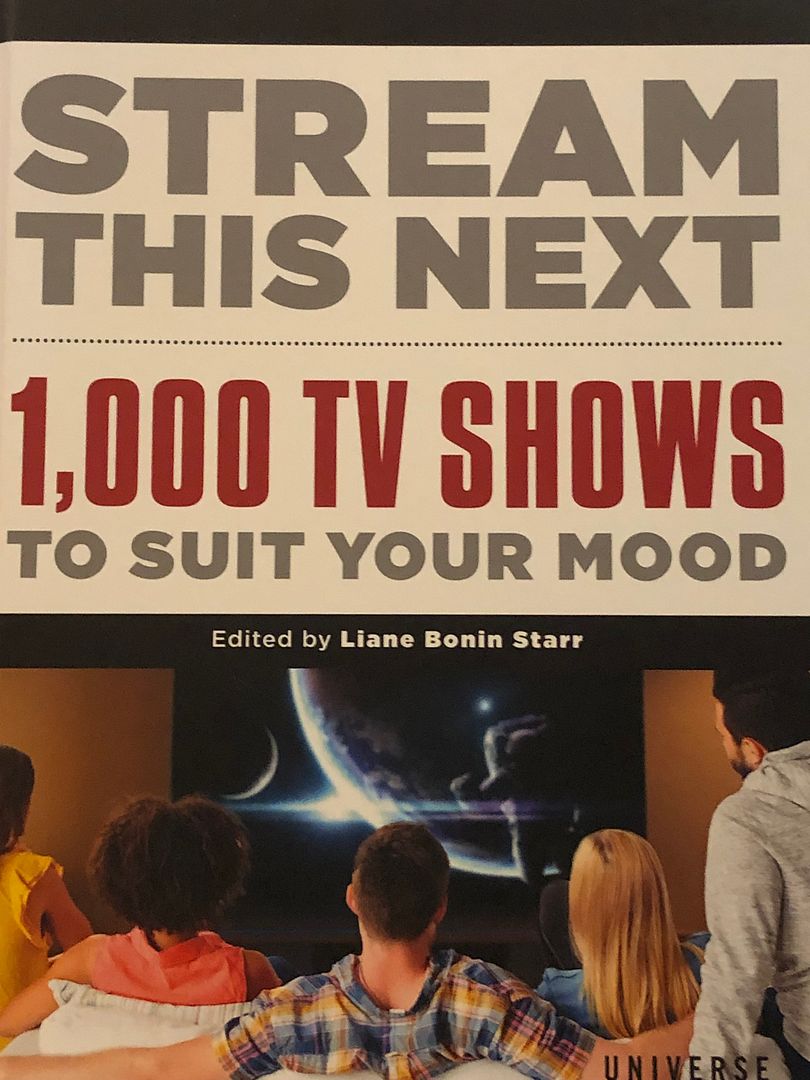
Review of Stream this Next: The Start of an Indispensable Guide


I've been saying at least since 2015 that streaming -- in particular the capacity it gives viewers to watch as much of a television series as they like, at one time, as if reading book -- constitutes a third golden age of television (the first being what TV broadcast networks began to bring us in the 1950s, the second being the cable revolution which I take as beginning with The Sopranos on HBO in 1999).  Indeed, I watch a huge amount of television -- I find it good for my brain -- and I'd estimate more than 80% of the dramas and comedies are streaming (all the live news I watch is on cable -- mostly MSNBC, with a little CNN, if you'd like to know).

And the streaming world has grown exponentially since 2015, with Apple TV+, Paramount+, HBO Max, Disney+, and (I'm probably leaving some out) joining Netflix, Amazon Prime Video, and Hulu as big-time streamers.  And  the nature of the streaming has evolved.  For example, several of the newer players -- especially Apple TV+ and Paramount+ -- have made binging possible only after a complete season of a series has been streamed, with each episode becoming available on a weekly basis, much as networks and cable still do, when they put up their new series.

The result is a still expanding avalanche of TV shows to possibly watch, on a growing number of venues with overlapping and different presentation modes.  A handbook or guide to at least some of these shows would be handy to have, and that's just what Liane Bonin Starr's Stream This Next: 1,000 TV Shows to Suit Your Mood is.  There of course are far more than 1000 TV shows now streaming or soon to stream, and this book does miss some of the best, in my view. For example, Star Trek: Discovery on Paramount+ is listed and well described, but there's no mention of Star Trek: Picard (the best of the new Star Treks, in my opinion) or Star Trek: Strange New Worlds, to debut next month, starring Anson Mount as Christopher Pike, in my view one of the best new captains.  It also would be useful to know whether the series streams all at once, i.e., is immediately available for binging, or doled out on a weekly basis for each new season.  Other meta-details, such as Paramount+ lacerating its shows with commercials, even though it requires paid subscriptions, would also be helpful to know.

But such perceived oversights, especially in terms of series that should have been listed, are inevitable -- different strokes for different folks -- and there's plenty of value in the categorization of the shows listed in Stream This Next -- ten categories ranging from comedies, thrillers ... to science fiction -- as well as is the show best watched with a group of family or friends, cuddling with someone as a couple, on your own, etc.  Liane Bonin Starr is listed as the book's editor, and she and her team have done a fine job in assembling this indispensable guide, published last month in hardcover by Universe, especially appealing if you like to put your eyes on the pages of a thick book, once in a while.

In fact, having just thumbed through this book, I realized I really wanted to see a streaming science fiction series I somehow must have missed in the past year. Want to know what it is? Keep reading my reviews ...


Monday, January 17, 2022

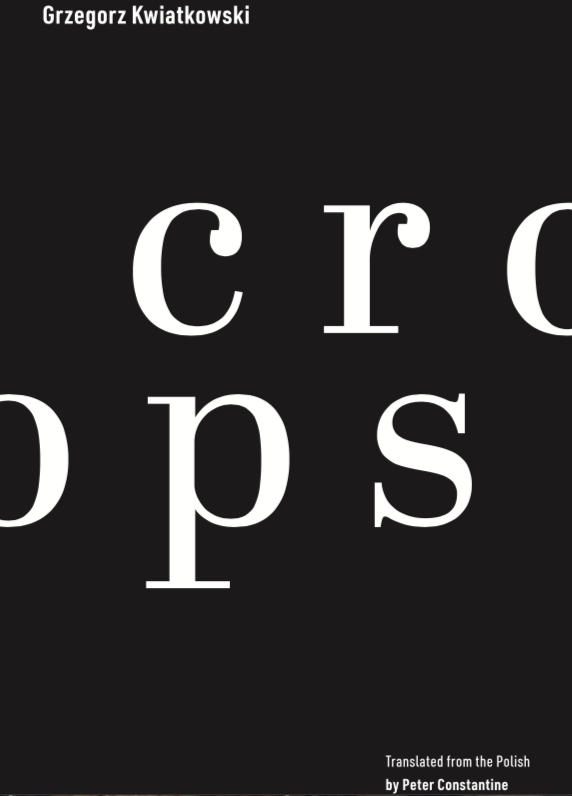
Review of Grzegorz Kwiatkowski's "Crops": Slaughter and Sunlight


I don't often review poetry on this blog.  The last -- and, in fact, the only -- time I did was Andrew McLuhan's Written Matter last February.  But, once again, words without music, or with music entirely in the head, call.

Grzegorz Kwiatkowski's Crops is a very short book with some very deep reflections about one of the tragedies of our modern world and longer than that.  Kwiatkowski is a Polish poet and musician, and this book of poetry traces his confrontation and struggle to understand the Holocaust that took so many innocent lives of Jews and others in his country.

The poems are not easy to read, and they should not be.  They're replete with bones and body parts, memories and excuses for what happened, a lot more than a moment of sheer depravity that gripped the world. And all the more relevant because of what's going on in our world today.

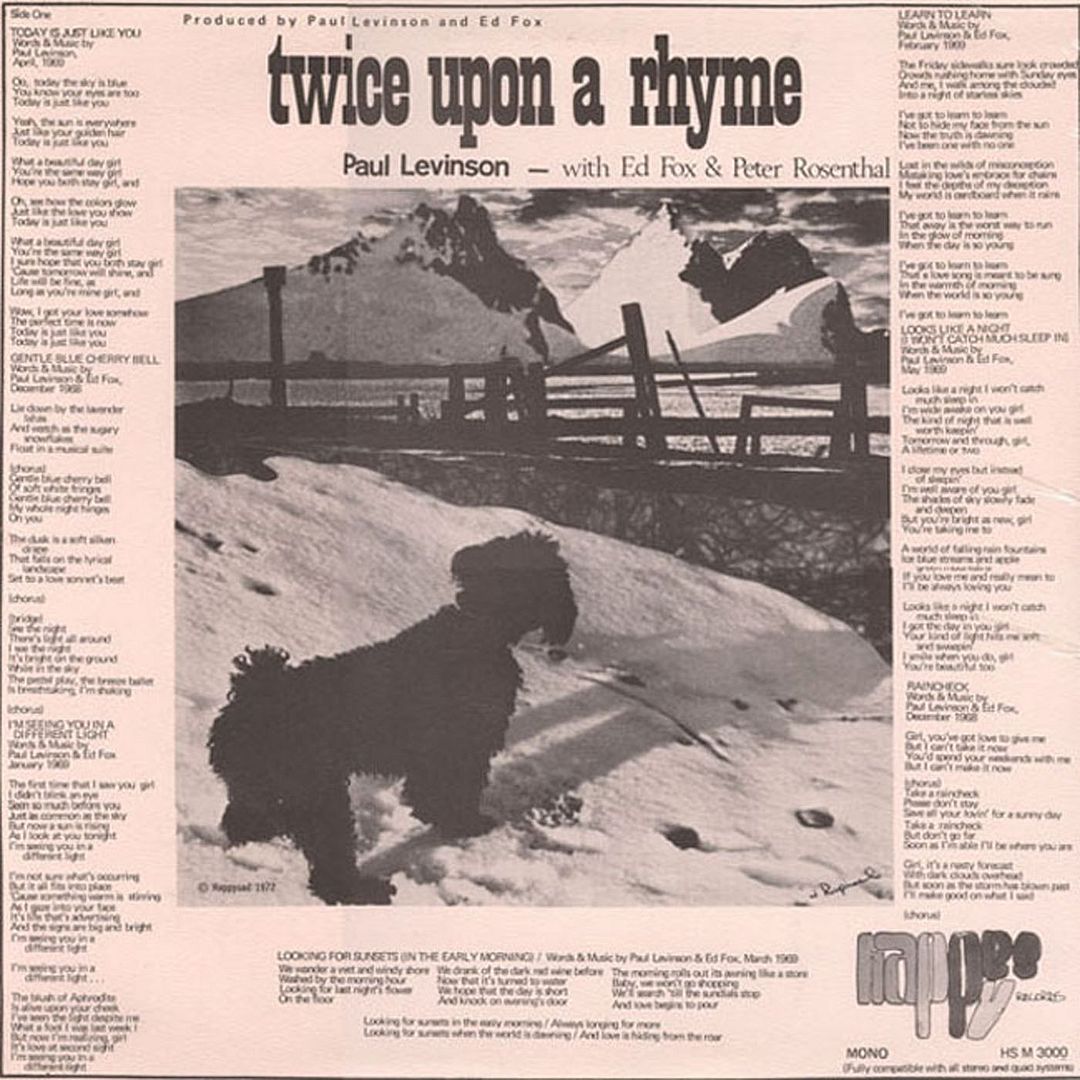
But I wouldn't be calling your attention to these poems if there was not also some hope in this grim accounting, leaking through and glimmering around the edges.  Kwiatkowski concludes one of his poems with "someone has written on the nearby wall: innocent sunsets".  In the context of the poem, the "innocent sunsets" are an evasion of history and responsibility.  But, for me, anything that has anything to do with sunsets is also a recognition of hope for the future.  I know that I always feel good when I see a sunset. And that's why, more than fifty years ago, I wrote the lyrics to Looking for Sunsets (In the Early Morning).

And, indeed, all the poetry of Crops is a plea for understanding and hence a statement of hope and an evidence of healing.  If someone in Poland today can write such poems, there's hope for our humanity.

===

Hear Grzegorz Kwiatkowski read some of his poetry via Zoom here.

Thursday, February 25, 2021

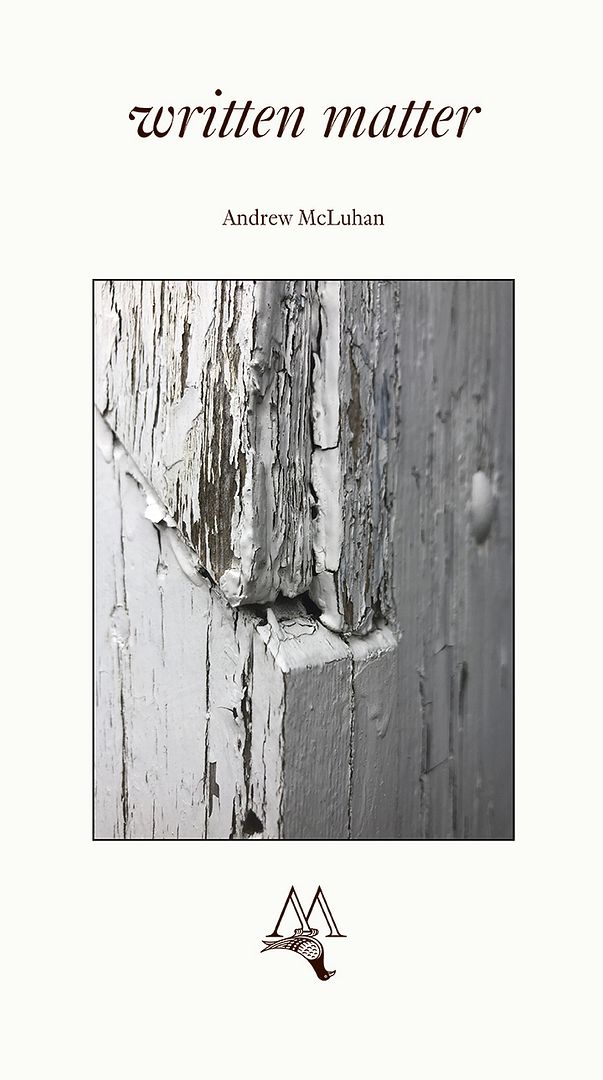
Review of Andrew McLuhan's Written Matter: Poems about Media and More

to be published 23 March 2021 by Revelore Press

Marshall McLuhan wrote about the media in a poetic style, preferring aphorism and metaphoric relations to the bleary-eyed recitation of more conventional media scholars.  His style frustrated far more than it delighted in academe, but the passage of time has increasingly confirmed his enormously pathbreaking contribution to understanding media.   His grandson Andrew writes poetry about media and other aspects of life on Earth in his new book, his first book, Written Matter.  My guess is it will delight lovers of the written word and seekers of truth about our complex existence.

The book begins with eight short poems (all the poems in this volume are short) that start with the media and "the flow of ink, the slow of think" and "when a pen fails, a pencil sails," and returns to media later in the book "where words lay waste ruin".  But my favorite poems in this little volume are about nature, as in "the fall softness becomes brittle" and about human life, as in "there I tread where tears tear time".

Half the book are photos taken by Andrew that in one way or another complement the poems on the left-hand side, so we're talking about a total of 28 poems in this volume.  I read them in about 20 minutes, but I expect to return to them often in the years ahead.


on Bandcamp, Spotify, Apple, Amazon


Wednesday, February 10, 2021

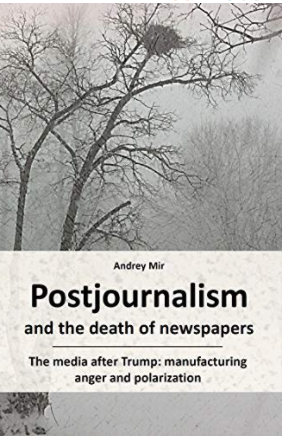
Review of Andrey Mir's Postjournalism and the Death of Newspapers

The full title of Postjournalism and the Death of Newspapers. The Media after Trump: Manufacturing Anger and Polarization by Andrey Mir says it all:  the delivery of news on Twitter and social media to an increasing majority of people has replaced the attempt to disseminate facts and truth on traditional news media, with the new goal of massive engagement via likes, retweets, and shares, with the result that an informed public, however imperfectly constructed, is being shoved aside by a polarized populace seething with anger.  I would add: this is also the best book on media theory and assessment written in forty years.

Mir brings to bear the media insight of Marshall McLuhan, the political savvy of Walter Lippmann, the radical economy of Edward Herman and Noam Chomsky, and much more in his detailed and probing analysis.  The 20th century began with newspapers selling news to readers and concluded with newspapers and radio and TV selling news to advertisers.  Both systems, though flawed, and for different reasons, were committed to making their utmost efforts to report the truth. Readers wouldn't tolerate too many falsities in their newspapers, and advertisers did not want to be associated with them, either.

All of that changed with the advent of social media, cheered at first, by many, including me, as uncorking the voice of the people, and pushing the haughty gatekeepers aka editors out of the way.   It was a case of Dylan's "Don't stand in the doorway, don't block up the hall." Occupy Wall Street and the Arab Spring were seen by me and many others as early triumphs of these unshacklings of information.  I still feel that way about social media and their potentials.  But Mir convincingly tags and explains the darkside of this same liberation of news.

On Twitter, readers pay nothing for the news other than their time.  Viewers pay nothing for broadcast news, either, but the advertisers do.  Ads appear on social media, too, but they're barely distinguishable from the myriad bits of news, which all too often are no longer news, but opinion.  And since the posters of these news opinions seek validation via likes, shares, and retweets, a kind of natural selection winnows out the more moderate opinions.  The more controversial and extreme the fact-opinion, the more likely it is to be retweeted.

This tide of polarization engulfs the traditional media, too.  Mir explains, “Centrist experts can appear in the media, but they are not those who generate buzz, virality, and spin-off in the polarized media environment aimed at frustrating and engaging" (p. 316).   When was the last time you saw a Trumpist or even a moderate on MSNBC or CNN?   Once in a blue moon, at most. As a viewer of these two cable news stations, no more immune than any other human to the polarization and anger of our age, I can attest to being annoyed and even angry when a Trumpist or even a moderate appears unchallenged by aggressive hosts on these stations.  I don't watch much of Fox News, but from what I've seen, the same and worse is true in reverse: progressives unchallenged or not by hosts are virtually nonexistent over there.  Moreover, some hosts on Fox have no problem spouting outright lies like Trump won the 2020 election as fact.

Keep in mind that Mir made all of these observations about the intensification of angers in this, our socially mediated age, prior to Trump's mob storming the U. S. Capitol on January 6 of this year.  I just saw, today, the second day of Trump's second impeachment trial in the U. S. Senate, a video that captured the sick fascistic depravity of that mob, and how close they came to killing the Vice President of the United States, the Speaker of the House, and who knows how many Senators and Representatives -- how close that Hitlerian, Trumpist mob, who pretend to be Americans, came to dealing out mass death, were it not for the bravery and savvy of the Capitol and District of Columbia police who were so vastly outnumbered.  They were outnumbered by the physical manifestation of the online mobs that Mir describes in Postjournalsm -- physical mobs that sought to cancel democracy by cancelling the lives of its elected representatives.

I remain an optimist, and, like John Milton, a believer in human rationality, and its capacity to stand up to illogical and inchoate emotion.  But it failed before, in Nazi Germany, and it almost failed here in the United States at the end of Trump's term in office.

If you'd like to learn more about how this state of the country and world came to be, read Mir's book.  You'll likely learn more from Postjournalism -- as chocked full of extensive research as it with prescient lines like "There were no revolutions before newspapers, and there will be none after; only riots (yet, maybe, coups)"(p. 451) -- than from the past dozen books you've read or will read on the subject.


Tuesday, November 10, 2020

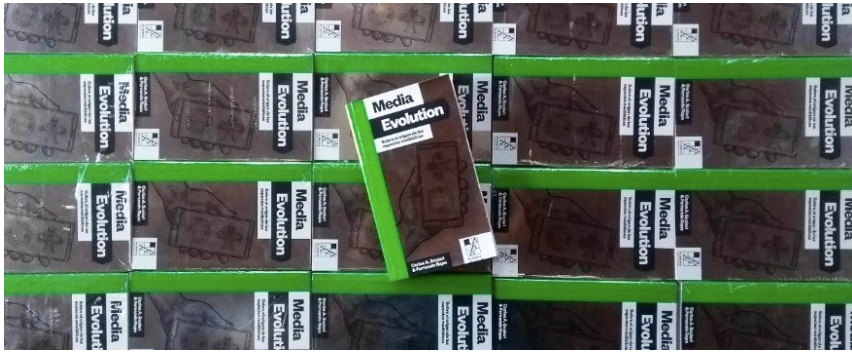
Carlos Scolari and Fernando Rapa's Media Evolution: A Review


Marshall McLuhan burst onto the scene and became the preeminent thinker about media and their effects upon us -- a position he still comfortably holds -- with the publication of his two masterful works, The Gutenberg Galaxy (1962) and Understanding Media (1964). These two were unconventional books -- Gutenberg Galaxy exploded the very notion of chapters and turned them into blog posts almost 40 years before there were blogs online -- but they were undeniably books.

Not so, or not quite, the pair of publications that followed.   These were a lot a closer to Mad Magazine than a book, or, if a book at all, more like a graphic novel than a proper or improper scholarly book.  They were also co-written -- which has nothing to do with their structure, but is worth noting -- with Quentin Fiore (The Medium is The Massage, 1967; War and Peace in the Global Village, 1968).  McLuhan followed these with more "conventional" Gutenberg Galaxy-type books, which also were co-written, leaving The Medium is the Massage and War and Peace in the Global Village as standalone high-water marks of how to conduct a scholarly probe ala Alfred E. Newman.

But those two serio-comic books are chocked full of insights, worthwhile to profound, about the media world back then and where it might be headed.  My own first book about McLuhan (Digital McLuhan: A Guide to the Information Millennium, 1999), a scholarly investigation in a form that your great-grandmother's professor would be comfortable reading (if not necessarily agreeing with) has quotes from and references to the two McLuhan-Fiore books in just about every chapter.  And I cherish the worn, cracking paperbacks of these sibling books on my bookshelf, right next to the other harder, hardcover works by McLuhan, or McLuhan and co-authors.

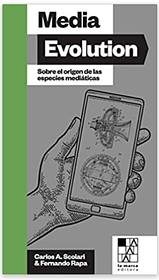
So I was truly pleased to get a copy of Carlos Scolari and Fernando Rapa's Media Evolution (Scolari's words, Rapa's graphic designs), which will fit right up there on my bookshelves next to Medium is the Massage and War and Peace in the Global Village.  Most of the words are in Spanish, which I can barely read, but the images are pretty much all you need to get what the book is talking about it, and they're images Quentin Fiore, and Marshall McLuhan, would surely have appreciated.   The references in the book are also in the McLuhanesque tradition -- deep and far reaching -- and range from close McLuhan associates such as Bob Logan to science fiction pathbreakers like Bruce Sterling.  Hey, Scolari even managed to get a photocopy of a relevant page from my 1979 doctoral dissertation (Human Replay: A Theory of the Evolution of Media) into his book.

So, pick up a copy of Media Evolution, and enjoy and learn, whatever language you most like to read.


Tuesday, September 8, 2020

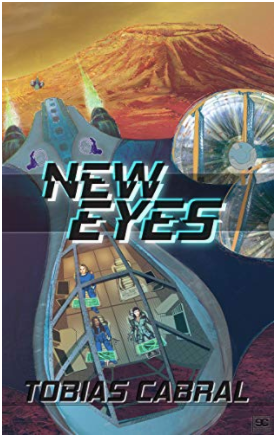
Review of Tobias Cabral's New Eyes: Newer Worlds

Tobias Cabral picked a good time to send me his 2018 novel New Eyes for review.   Mars is in the air.  Actually, it's always been in the air, or at least, at the top of the air, in the sky.  But NASA's Perseverance is on its way to Mars, with a landing date in February of next year.  Elon Musk wants to colonize the Red Planet (I'm 100% on board, here's a talk I gave at the 19th Annual International Mars Society Convention at The Catholic University in Washington, DC on 23 September 2016):

And I just saw, loved, and reviewed the first season of Away on Netflix.

Cabral's novel starts in February 2047.  Trips to Mars take just four days.  There's a space station named "Jeff Bezos," a ship named the "Elon Musk," and androids are "equipped with ‘minds’ that could not just pass but proctor the Turing Test" (italic and quotes around 'minds' in the novel).  And, at least one is capable of murder.  With the result that New Eyes is just as much in the tradition of Westworld and the new Raised by Wolves (see my reviews) as it is a descendant of The Martian Chronicles and The Martian.

But as the title suggests, the fulcrum of this narrative are eyes, in particular Gaspar's "Martian eyes".  The character's a "bio-cyberneticist," women desire his body, and his new eyes in effect make him a human on the way to becoming an android, in the time-honored Six Million Dollar Man way.

The novel also has resonance to the work of Orson Scott Card (sims play an important role, as in, you often can't tell what's really really real) and, to my eyes, at least, the novel reads a lot like Isaac Asimov (a big compliment in my book).   But as to the plot, well, Mars is "a mostly-unpopulated planet" at this point,  and this "young Martian society" is populated by humans and increasingly by androids.  Could this actually happen by 2047?  Probably not (more because of the androids than living on Mars).  But my late editor at Tor, David Hartwell, always told me that readers are willing to grant you at least one big part of a story they find unbelievable, and I'm happy to grant Cabral that.   I should also mention that Cabral throws in a bit more repartee humor than does Asimov -- someone comments that someone has a "nice assonance... that sounded naughty" -- and there's even some rapping in this story.

But that still doesn't tell you much about the nuts and bolts of the plot, does it?   You'll need to set your eyes on the novel to find that out.  Ok, I'm in a good mood.  Here's a quote from the novel: - think "alternate branches in a Many Worlds Hypothesis time travel story".  And enjoy.


first starship to Alpha Centauri leaves from Mars Vestibule ...


Saturday, May 23, 2020

Review of Brett Petersen’s The Parasite from Proto Space & Other Stories: The 2020 Anthology from Before the Golden Age


Kindle and paperback


Brett Petersen’s The Parasite from Proto Space & Other Stories has been compared to the work of Edgar Rice Burroughs, Ray Bradbury, Philip K. Dick, Ursula Le Guin, and Charles Bukowski, among others. Suppose I told you that I not only agreed, but added Frank Herbert, Sam Delany, and Olaf Stapledon to that lustrous list, and added them after reading just the first two stories in Petersen’s anthology. In the words of Ringo, would you stand up and walk out on me? If you did, that would be your loss.

Because Peterson’s stream-of-consciousness, metaphor-of-metaphor prose hits all of that at times, and sometimes more. The 2020 anthology feels like it was written sometime in the 1930s to the early 1950s, that is, before the height of the Golden Age of Asimov, Heinlein, and Clarke, even though its stories were written just a few years ago. The parasite in the title story is what used to be called, before and during the Golden Age, a bug-eyed-monster, except this BEM offers observations such as, “He turned the doorknob, which felt like one of Frosty the Snowman’s testicles.” Ok, there’s no way that could have been published in the 1930s. But that’s what makes The Parasite so strikingly original. It feels as if was written almost a hundred years ago, when Hugo Gernsback was riding high, but its attitudes and language smack your ... face with today.

Other stories feature worms from another dimension that eat our memories (not computer worms eating computer memories); a sentient goat, eppes (my word, Yiddish, tough to translate), that also gets hijacked to another dimension, apparently connected in some way to the one with the memory-eating worms; and— well, I’m not going capsule-summarize every story in this gonzo book.

Nor do I love every tale in this anthology. There’s a dark neo-pre-cyberpunk ambience coursing through the stories, sometimes too dark for my usually sunny taste. A father tells his son, “it won’t always be like this” (so good), and that proves true with an ugly vengeance. I prefer a little more hope. Another story features a murderous building, but its inherent black humor—the tenants “yank their window shades down like a skirt blown up by an undercurrent from a sewer grate”—is overwhelmed by the grim. The truth is that there is just one story with an unambiguously happy ending in this anthology, a space-faring tale in which an unlikely hero stops an extra-terrestrial construction from shattering “every preconceived notion we had about the universe” and then humanity. And perhaps one more with an uplifting ending, if an afterlife story can really be happy. I would have preferred more than one and a half of these happy-ish endings.

But be that as It may, Petersen’s way with words is superb, his dark imagination boundless, his eye for detail and logic in fleshing out these paranoid visions keen and impressive. If this sounds like your cup of dark tea, pick it up.


Friday, December 20, 2019

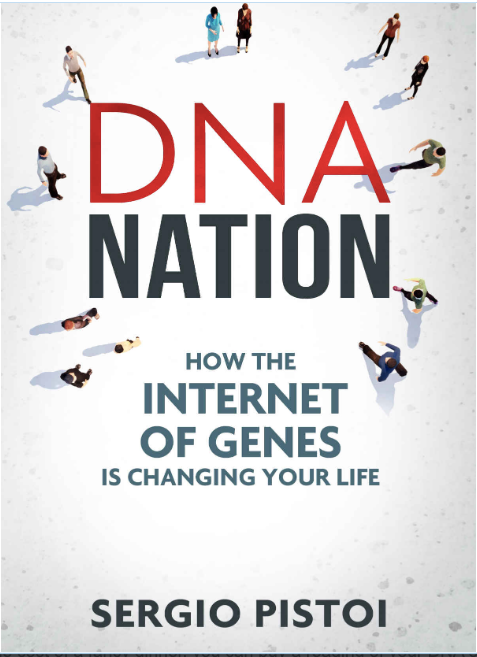
DNA Nation (Part 4, Chapters 18-24, Epilogue): Talkative Cookies


In the final chapters of his crucial and remarkable book, Sergio Pistoi observes that "Identical twins are the genetic equivalent of factory-made cookies: they have the same DNA ... They look very similar, and yet in many regards they are distinct" (p. 169).  He then adds, "With the advent of the familial search, your DNA talks for you and your family, regardless of what you would like do (p. 180). That pretty much captures the long and the short of  DNA Nation: How the Internet of Genes is Changing Your Lives:  DNA figures in a lot of our life experiences, but it by no means dictates everything.  And, as much as we might like to control who sees our genome and who does not, the revolution in consumer genomics has let that cat well out of the bag.

As we saw earlier in this book, some of the results of that DNA cat-at-large are beneficial.  DNA profiles of relatives have helped police nab serial killers who have committed their crimes decades earlier.  It's helpful to know we have a genetic propensity for an illness even if the likelihood of its finding expression in our lives is less than 20-percent.  It could be gratifying to find a relative we had no idea existed.  But the same garrulous DNA makes us vulnerable to a new kind of marketing based on knowledge of our genetic predispositions to this food or that, and anything we may buy.  And in the hands of a totalitarian government, well, when that combines with non-DNA data we may make public, the sky's the limit in terms what that government might do to anyone it deems an enemy of the state (a term, I would add, that Trump repeatedly uses to describe the free press in America).

Further, this situation will only get more perilous in the future, when, Pistoi notes, "All children will have their DNA sequenced at birth and will keep their genetic file during their entire lifetimes, as if it were a social security number" (p. 199).   The solution?  There is none, other than awareness that this revolution is already occurring.  Awareness is the necessary condition for taking whatever action we can to safeguard our privacy which, Pistoi aptly notes, "is a volume knob, not an on/off switch. Everyone has a level of privacy that suits their needs” (p. 196).

For example, I have a level of privacy that suits my need to acquaint more of the world with my science fiction, my scholarly writing, and my music.  You the reader of this review will likely have a level that's different.  The great virtue of DNA Nation is that it alerts us to be more careful and deliberate in deciding upon what level of privacy we need and want to pursue.

If some of this sounds like science fiction, that's because it currently is.  But Pistoi's book makes clear that the ratio of reality and science fiction regarding the potent mix of DNA and social media in our lives is daily moving further into the reality part of the dial.  Still, Pistoi observes that no science fiction author - "even the most daring writer - has envisaged a social network based on our genes" (p. 205).  He's right, and, given his zest for knowledge and talent as a writer, I urge him to write it.

See also: DNA Nation (Part 1, Chapters 1-5): Reconfiguring Your Human Family ... DNA Nation (Part 2, Chapters 6-13): The Extraordinary Revolution and Its Intrinsic Limitations ... DNA Nation (Part 3, Chapters 14-17): Two-Edged Swords


Saturday, December 14, 2019

DNA Nation (Part 3, Chapters 14-17): Two-Edged Swords


I've long held the obvious view that technology is a two-edged sword, ethically speaking: a knife can be used to cut food (good) or cut people (bad, unless the person wielding the knife is a surgeon) (see my "Guns, Knives, and Pillows" in On Behalf of Humanity: The Technological Edge for more).  In Part 3 of the excellent DNA Nation: How the Internet of Genes is Changing Your Lives, Sergio Pistoi looks at some of the dark sides of the revolution in genomics, while keeping his eyes on the astonishing benefits of opening the documents of our DNA that are beginning to come into play.

Pistoi explains that, in contrast to the relatively few deadly diseases (such as Huntington's) which are monogenic or caused by a single harmful mutation, most (including cancers) are multifactorial, "with thick and elaborate plots, where a criminal network of genetic and non-genetic factors conspire to develop the pathology. Think of Breaking Bad, Narcos and The Wire combined – but way more complicated" (p. 121).  Although I and no doubt Pistoi loved those series, the upshot for prevention and control of such illnesses is that identification of a complicit gene tells far less than the whole story.   Pistoi reports on a man who had what was mostly likely unnecessary extensive prostate surgery, after a suspect genetic mutation was flagged in his DNA.

But Pistoi goes on to detail some of the treasure-trove of benefits of DNA testing that are becoming available so fast that Pistoi may need to update his book on at least a yearly basis.  Via "a technique called Pre-implantation Genetic Diagnostic ... embryos are obtained in vitro from the egg and sperm of the couple, and DNA tested to select the ones without the mutation” (pp. 123-4).  I still have a book on our shelves called A Fortune in the Junk Pile - about finding valuable antiques in tag sales and flea markets - and Pistoi delves into the value of what was labeled "junk DNA" because it seemed to have no connection to somatic traits.   In fact, this DNA is now known to have the crucial "epigenetic" function of regulating the performance of genes, which allows the "reprogramming" of normal adult cells into stem cells (p. 147).  (As a science fiction author, I was especially glad to see this redemption of junk DNA - my April 1996 novelette in Analog, "The Copyright Notice Case," situated an ancient copyright in our DNA in the junk DNA we all carry; the story is in my 1999 Bestseller anthology).

And, just for good measure, Pistoi tells us that “Our bodies host ten times more microorganisms than our own cells" and "there is evidence that gut bacteria can protect or predispose us to pathologies ranging from inflammation to diabetes and obesity" (p. 149).   I was especially glad to see this, just as with the junk DNA, since my novel The Consciousness Plague hypothesizes that our very consciousness is made possible by communicative bacteria that live in our brains.  Outside of the realm of science fiction, Pistoi notes that bacteria and fungi in our biome add an important dimension to our DNA unveiling.

And I'll be back soon with my concluding review of this book which has updated my knowledge of DNA more than anything else I've read in the past twenty years.  Its overarching message: no food, no medication, can be deemed to be good or right for you, until it's matched to your DNA, a process which is still in its toddlership.

See also: DNA Nation (Part 1, Chapters 1-5): Reconfiguring Your Human Family ... DNA Nation (Part 2, Chapters 6-13): The Extraordinary Revolution and Its Intrinsic Limitations .... DNA Nation (Part 4, Chapters 18-24, Epilogue): Talkative Cookies


                                                    The Consciousness Plague

Thursday, December 12, 2019

DNA Nation (Part 2, Chapters 6-13): The Extraordinary Revolution and Its Intrinsic Limitations


In the April 1, 1993 issue of Wired, in my little article The Extinction of Extinction, I mused that, someday, "Heaven may well be a huge directory of DNA codes".  Although that date was April Fool's Day in many parts of the world, I wasn't kidding.  In Part 2 of the pathbreaking DNA Nation: How the Internet of Genes is Changing Your Life, Sergio Pistoi details exactly how that could come to be.

His tour, engagingly written and socially astute, just like Part 1 of this book, takes us from the mechanics of gene harvesting and analysis to the replacement of laboratories with crowdsourcing as the locus of DNA subjects.  As I pointed out in New New Media back in 2009, the same level of error in the expert-driven Encyclopedia Britannica and the crowd-sourced Wikipedia demonstrated as far back as 2005 that crowdsourcing was at least as effective as experts in the accumulation of knowledge.  Pistoi explains that, in the ongoing linking of genes to crucial and trivial aspects of our lives, the "democratization" of genetic research is already becoming far more effective than studies in labs. “I’m sitting on the couch, barefoot, holding a laptop and watching TV and someone tells me I am contributing to a genetic study," Pistoi notes. "Is that a joke?” (p. 104).  In his savvy, entertaining style, Pistoi shows us why it most certainly is not.

But Pistoi also repeatedly cautions and explains how so much our lives, at present, defy any genetic explication. He notes that "Predicting multigenic characteristics from DNA is like watching a party of people and guessing where they will choose to go for dinner" (p. 72), adding, as just one of many examples, that "sexual preferences are multifactorial traits involving many genetic and non-genetic factors, most of which are still unknown" (p. 99).  We, accordingly, need to beware of companies "selling digital snake oil" (p. 91).  The upshot, ranging from choice of sexual partners to food preferences, is that genetic causes, though now discoverable in ways totally unavailable for most of our history, are still poorly mapped, if known at all, for huge swaths of our daily lives. Including, for better or worse, frequency of "orgasms" in a typical sexual session.

And, speaking of sex, Pistoi brings a commendable moral gauge to his book.  He concludes his debunking of the "gay gene" - that homosexuality is a genetic predisposition - with an insistence that "people should not have to justify their sexual preferences for other consenting adults" (p. 102).  In addition to being a molecular biologist, science reporter, and chronicler of how genomic sites like 23andMe are "similar to social media like Facebook, Instagram and Google, which offer free services in exchange for the user’s data" (p. 107), Pistoi applies a keen moral sense, which enhances the pleasure of reading his book.

And I'll be back soon with one or two concluding reviews of the rest of this eye-opening new book.

See also DNA Nation (Part 1, Chapters 1-5): Reconfiguring the Human Family ... DNA Nation (Part 3, Chapters 14-17): Two-Edged Swords ... DNA Nation (Part 4, Chapters 18-24, Epilogue): Talkative Cookies


                      "DNA was the ultimate dossier"


Tuesday, December 10, 2019

DNA Nation (Part 1, Chapters 1-5): Reconfiguring Your Human Family


I enjoy binge-watching television series.  I think it's a real break-through in our popular culture.  I occasionally run into myopic critics of technology in academia, who see bingeing as somehow a debasement of our culture.  I always reply that binge-watching a television series brings to the audio-visual screen the same options we have with the venerable medium of the book, which we can read as fast or slowly as we like.  And every once in while, I come across a book which indeed demands to be savored, not binge-read. DNA Nation: How the Internet of Genes Is Changing Your Life by Sergio Pistoi is such a book.  Accordingly, having read the first part (chapters 1-5) today, I'm going to post this review.  And I'll be back, likely more than once, with one or more reviews when I've read the succeeding four parts, like in the next few days  (See my reviews of Dreaming the Beatles and The Perversity of Things for two other sequential, much longer, book reviews.)

Pistoi is a molecular biologist, with a philosopher's understanding of human nature and a media theorist's instinct for understanding the evolution and impact of social media.  He brings these talents to be bear in a package at turns both sagely and delightfully written, a handbook as much as a book, explaining how the scientific revolution of analyzing our DNA - which can be done for $100 or less, by sending a sample of your saliva - is pulling the rug out from under many of our preconceptions, ranging from where in the world our ancestors came from to who really are our closest and not-so-close relatives?  Along the way, DNA Nation eradicates whatever shred of scientific support the 21st racist may cling to, pointing out that DNA mapping shows more differences within racial groups than between them: "you may be more similar genetically to someone you identify as belonging to a different 'race' than your neighbor who looks very much like you" (p. 44).

And Pistoi leavens such weighty lessons with continuous wit and humor. “A genetic profile is not just a biological test," he advises, "it’s a selfie taken from inside our cells” (p. 50).  And, "I could couch-surf for decades around the world visiting all my cousins. And if only half of them invited me to family celebrations, I could spend an entire, terrifying life attending marriages, baptisms, first communions, Thanksgiving days and graduations" (p. 18).

Sex, always a good thing to write about, of course figures prominently in this book.   Indeed, it's the reason all of us humans are so genetically alike.  And it may even extend across species, or does extend across disparate groups of our own species.  Did our ancestors actually sleep with Neanderthals?  Our current DNA proves it, Pistoi notes, and helpfully adds, "If you have seen a diorama of a Neanderthal you may doubt it, but DNA doesn’t lie, and humans have never been too choosy with sex anyway” (p. 36).

But the thrust of the first part of this essential book is not the several percentages of Neanderthal DNA that some of us carry, but the way knowledge of our genetic profile, combined with the ubiquity of the Internet, has created a new world in which everything from family and friends to ethnic identities are starting to radically change.   I'll be back soon with more reviews of this book as I read further about this upheaval in preconceptions in daily progress.

See also DNA Nation (Part 2, Chapters 6-13) The Extraordinary Revolution and Its Intrinsic Limitations ...  DNA Nation (Part 3, Chapters 14-17): Two-Edged Swords ... DNA Nation (Part 4, Chapters 18-24, Epilogue): Talkative Cookies


                   "DNA was the ultimate dossier"


Sunday, August 18, 2019

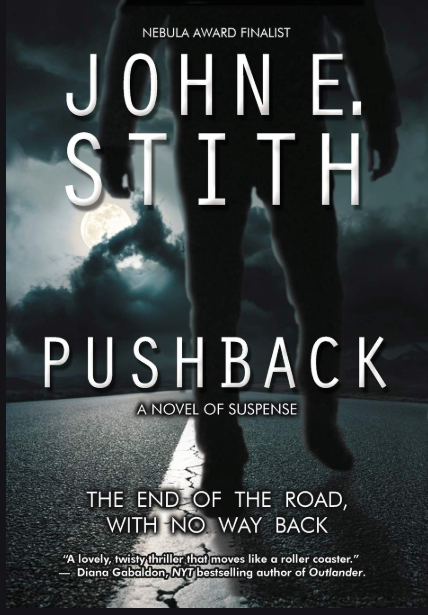
Review of John Stith's Pushback: Grab It


I usually review science fiction novels here.  But when I came across Pushback, an adrenalin pumping mystery novel by John Stith, who wrote Red Shift Rendezvous, one of my all-time favorite science fiction novels, hey, how could I resist?  Besides, the who dunnit of mystery and detective fiction is a close cousin of the what dunnit of science fiction.

The basic story of Pushback is an amiable investment counselor in Colorado Springs, Dave Barlow, finds himself the victim of an increasing series of pranks - increasing in both frequency and intensity - which soon became bizarre and sadistic attempts to murder him.   It starts when he shows up to a high school reunion and nobody remembers him because the people at the reunion are unknown to Dave and vice versa.  This escalates into his car filled with concrete, Dave almost killed in a hit-and run, his home leveled, Dave poisoned having dinner in a nice restaurant with a pretty actress trying to help him, and Dave nearly being blasted by a shotgun rigged to go off when he shows up at a client's home to talk finances.  Who is behind this and why?

Dave may be amiable but he's no slouch.  He fights back with intelligence and style, reported through the wry voice of John Stith, who serves up this surprising tale with his customary eye for detail, keen sense of humor, and immersion in decades of popular culture.  Dave is equally at home citing Z Z Top and learning how to explode eggs in a microwave on YouTube.  Middle-aged guys coming at Dave with golf clubs are "foursomes of the dead," and he notices a woman in tight jeans "closer to the paint family than the clothing family".

On that last point, there's plenty of romance in Pusback via Dave's new love, Cathy, and a winning tenderness throughout, making it no surprise that the novel was nominated for the Daphne du Maurier Award.   The location in Colorado Springs makes for a great pastel background for this narrative, which, come to think of it, would look great on any kind of screen. 

See also Book Review: Redshift Rendezvous by John Stith is Perfect Science Fiction Mystery Hybrid

Sunday, June 16, 2019

Review of Tobias Cabral's Night Music: A Dose of Hard SF, and Wash It Down with Rock 'n' Roll


Well, it's not quite rock 'n' roll, but there's definitely crucial music in Tobias Cabral's short 2009 novel (136 pages) Night Music, which is all about what happens at Zubrin Base on Mars.

And there's lots of science.  Although the genre is called science fiction, there's usually precious little hard science in the fiction we read under that moniker.  I've often said that Asimov's Foundation trilogy, for example, which I consider the greatest science fiction ever written, is really more philosophy-of-science fiction than science fiction.  Hal Clement's work, to stay with the golden age, is a rarity in that hard science actually plays a pivotal role in the stories he tells.

Cabral does this as well in Night Music.  It's not that hard science is a determining factor in this narrative.  It's that what happens on Zubrin Base, and the expedition to go out there to investigate, is told by science at every step, and accompanied by scientific details and explanations at every turn.

I don't want to say too much about the determinative role of the music, lest I give away the plot.  But I will say that, back here on Earth, I've been captivated by the hypothesis that we humans could sing before we could speak.  That's why, for example, I had my Neanderthals communicating via music in The Silk Code.   In Night Music, the acoustic is more akin to the music of the spheres.  But the novel is also about beginnings, the commencement of human interaction with another intelligent life-form.

It's praise, in my book, to say that Night Music could have been written, in terms of its style and structure, in the 1950s, even though its content is much more current.  If you have a taste for this kind of story-telling, pick up a little Night Music, an at-once profound and refreshing treat.


InfiniteRegress.tv