Chuck Todd interviews me about alternate histories
Showing posts with label Wernher von Braun. Show all posts

Sunday, March 15, 2020

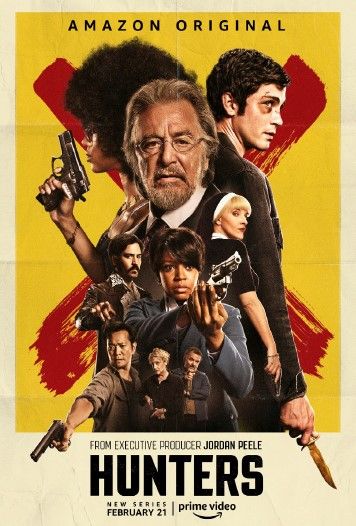
Hunters: Praise and Reservations


Hunters, due to its unusual mix of things I really liked and aspects I found annoying, is one of the strangest television series I've ever seen.   For that reason alone, it's unique,

What I really liked was of course Al Pacino's superb acting in the lead role in late 1970s America.  The rest of the acting was excellent, too, including Logan Lerman as Jonah.  The concentration camp scenes in 1940s Nazi Europe were of course not likeable, but as powerful as ever I've seen in a television series or a movie.  The depth of the Fourth Reich hatred of Jews in late 1970s America was well portrayed, which is to say, chilling and sobering to the core, even though it's not completely clear how much exaggeration, if any, is in that portrayal.

The series is billed as based on true events.  It is true that America welcomed Wernher von Braun and other Nazi scientists to the U. S. after the war, rather than see them fall into the hands of the Soviets.  It's also true that von Braun's genius in rocketry was at partly responsible for the U. S. beating the Soviets in the space race, and getting us to the Moon and back in 1969.  What's not clear at all in our history is whether von Braun had any connection to American neo-Nazis, and, indeed, to indicate that he did, as in Hunters, moves his true story into rank conspiracy theory.

And that gets to the parts I really didn't care for in Hunters.  In addition to playing fast and loose with life and death matters, Hunters deliberately almost frolics at times in a cartoonish ambience.  Faux commercials either promoting the Fourth Reich or telling the truth about some political matter are peppered into the episodes.  Although the action scenes are excellent, there's a bit of too much derring do and wise-cracking among the combatants.  The story works best when it tenderly presents the foibles of vulnerable human life, and worst when it verges into super heroism.

The plot is complex and, for the most part, very effective.  I'll leave it to you to decide if you liked the stunning revelation in last episode.  I didn't, particularly, and also think it didn't quite make sense.

Nonetheless, I'd rate Hunters as well worth your seeing.


just releasing:  Welcome Up: Songs of Space and Time  - digitalCDvinyl


Wednesday, May 16, 2018

Best Google Doodle since McLuhan


Today's Google Doodle is about art-deco artist Tamara de Lempicka, who worked primarily in the 1920s and 30s.   I've always loved art-deco - my wife and I still collect art-deco jewelry and silverware, when we can buy it on the cheap at an auction or flea market - and I gotta say this is the best Google Doodle since the July 21, 2017 Doodle (in motion, of course) honoring Marshall McLuhan.

Art-deco, though it extended into the 1930s and provided hope with its sleek shiny lines, was very much a product of the 1920s.   This was an age of fast cars, fast trains, big motion pictures soon with sound, and even the pulse of electricity in the first radio networks, CBS and NBC.   It was also the dawn of truly modern science fiction, with the advent of Gernsback's Amazing Stories, where I was proud to be published in 1993 and will soon be published again (this summer in its paper relaunch).

The science fiction that I've always most loved - which would be Asimov and Heinlein - was very much a reflection and extension of art-deco.   The clean sleek lines of the cars and trains and The Empire State Building and even more The Chrysler Building in New York City - which I've also always loved as architecture - were projected onto the rocket ships that lifted us off the Earth and brought us to other planets and solar systems.   And since that science fiction was the inspiration of space pioneers like Wernher von Braun, there's also a connection between art deco and the space program, and, indeed, the whole endeavor of getting us off this planet and out into the stars.

Our digital age is also a reflection of this same impulse - to move our information, and thus us, ever faster.  Why is fast good?  Because life is short.   Someday - I hope, in the not too-distant future - we'll indeed have space ships carrying lots of people out into the cosmos.   On the those ships, I like to image that there'll be some of Tamara de Lempicka's work.  Until then, we have today's Google Doodle to enjoy.


InfiniteRegress.tv