Chuck Todd interviews me about alternate histories
Showing posts with label Samuel Taylor Coleridge. Show all posts

Friday, February 17, 2023

The Ark 1.3: Asteroid and Comet


Well, as I've been expecting and been told, The Ark keeps getter better and better with every episode.

[Spoilers ahead ... ]

The main event in episode 1.3 is what to do about the next-to-no water left on the ship, usurped by an even more deadly danger, an asteroid hurtling towards the ship, which will reach and demolish the ship in hours.   The resolution of this dilemma upon dilemma is one sweet piece of science fiction at its best: Alicia sees the asteroid has a tail, which means it's a comet not an asteroid, which means it's made of water.  Which means that, if The Ark can fly a shuttle near the comet and match its speed -- increasing its speed is not so hard, given that the The Ark is in deep space with no atmospheric resistance -- The Ark can siphon off some of the comet's water, and refill The Ark's nearly empty tank.

Which it does, after some defiantly heroic maneuvers by Brice.  So, Coleridge's "water, water everywhere, and not a drop to drink," is surmounted and countermanded by the ingenuity of the crew, now working mostly together.

But, of course, this is not the end of this fine episode.  Before the credits roll, we learn that Garnet has a violent streak.  We already know that she's not averse to using physical force to get her orders obeyed.  But now we learn that she can slit someone's neck if she sees herself in any physical danger. 

The overall message: not everyone is what they seem to be on this crew.  The people who survived the catastrophe are not only survivors, but have histories that we don't know about.  A welcome element in a new series.

See also The Ark 1.1: Worth Watching ... 1.2: Why I'M Enjoying It

here's what happened to the first starship to Proxima Centauri


Sunday, February 20, 2022

Inventing Anna: Truth and Consequences


The wife and I binged Inventing Anna the past few nights, the nine-episode Shonda Rhimes series detailing the real-life rise and fall of Anna Delvey aka Anna Sorokin.  It's superb television, for a bunch a reasons.  Julia Garner in the title role was perfect, peerless, and Emmy-worthy.  Pretty much the same for Anna Chlumsky who plays Vivian Kent, the fictitious name for the real reporter Jessica Pressler whose New York magazine story "How Anna Delvey Tricked New York's Party People" is the basis of the Netflix series.   I haven't read the story, but the story in the movie is an incredible, powerful tale of a con artist, Anna, so charismatic that her lawyer and Vivian in their own ways practically fell in some kind of love with her.

But the question arises, as it always does with docu-dramas in any case, but especially those that tell us that what we see on the screen is true except when it isn't, about how much that we see on the screen is true? My wife did a little research, for example, and found that Jessica was pregnant while she was researching and reporting Anna's story, but didn't actually give birth at the crucial time that Vivien did in the series.  Does that matter?  

Well, no and yes.  No, because, if the story on the screen is as riveting as Inventing Anna, what does it matter how much truth it conveys?  But, yes, because part of the very reason that we find this narrative so riveting is our assumption that most of it is indeed truth, or closely based upon it.

Samuel Taylor Coleridge wrote in his Biographia Literaria back in 1817 about the "willing suspension of disbelief" that is the essential foundation for the enjoyment of poetry.  We may know that the words are in whatever degree fictitious, i.e., not completely truthful.  But our mind puts that aside and we laugh, cry, and everything in between about what we see on the page and now screen as if they were indeed 100% real.

So, by that standard, Inventing Anna gets the highest grade.  Still, one cannot suspend one's disbelief forever.  Fortunately in this case, the real world is still very much with us, and it will be fun and instructive, more than fun, to see what happens with Anna in the years ahead.

In the meantime, in addition to Garner and Chlumsky, I thought Katie Lowes as Rachel, Arian Moayed as Todd, and Anthony Edwards as Alan put in especially memorable performances in this unique memorable series.


Monday, January 14, 2019

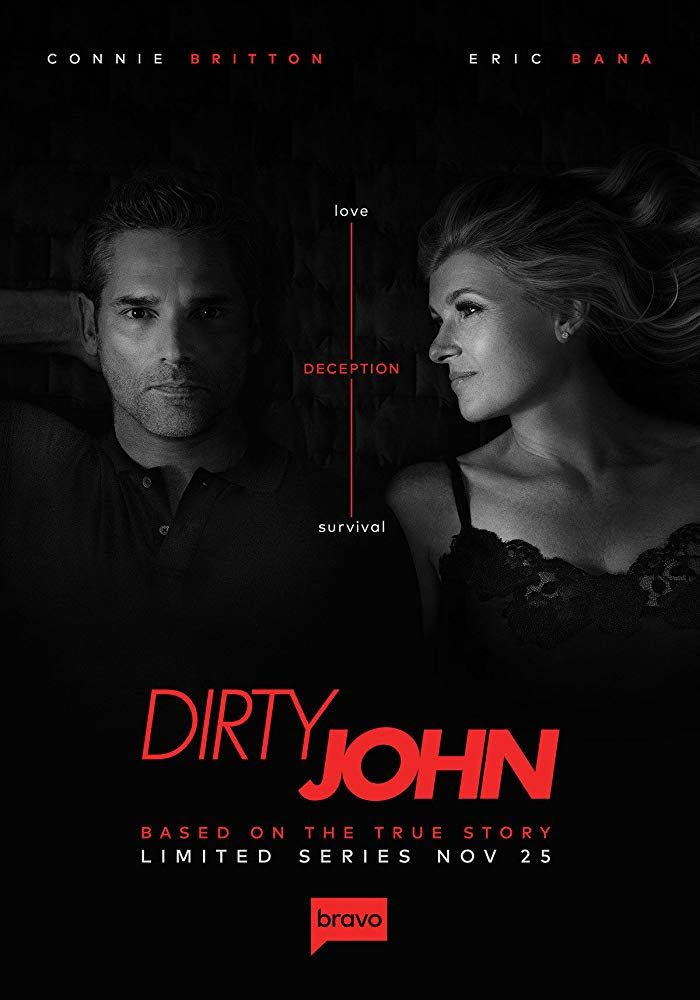
Dirty John Season 1 Finale: Truth Stranger than Fiction


Dirty John wrapped up its first season last night - there's supposed to be a second season, I assume with a completely different story - with an episode that seals this first season as a sterling example of truth stranger than fiction.  (I didn't review last week's episode 1.7 because it was mostly rehash.)

John comes close to killing Debra's daughter, Terra.  Her instincts with a knife save her, and she fatally stabs John.  As he's laying there in the hospital, waiting only for permission of his family to take him off life support, Debra says she can't do it.  Fortunately, John's sister is there, and she has no problem at all sending this monster to whatever hell awaits him.

But Debra ... she's good to the last drop.  After all of this, including the near-killing of her daughter, she can't bring herself to give the ok for John to be taken off life support?   She obviously inherited that insane forgiveness gene from her mother, to a grievous fault.

If this were purely a piece of fiction, I would find it too unbelievable to enjoy.  I would be utterly unable, in Coleridge's apt terms, to suspend my disbelief.  But since this is based on a true story, what are we to make of it?   For me, the lesson is that Debra in her own way is as crazy as John.  She doesn't hurt people, but she enables someone who does.

The acting in this series was excellent.  But since the storyline defies belief, even though it is true, and that is even more disturbing, I can't say I was enhanced by watching the series.  Nonetheless, glutton for punishment that I am, I'll no doubt watch season 2.

See also: Dirty John 1.1: Hunter and Hunted ... Dirty John 1.2: Motives and Plans ... Dirty John 1.4: The Forgiveness Gene ... Dirty John 1.5: John's Family ... Dirty John 1.6: Getting Wise


Wednesday, May 9, 2018

The Americans 6.7: Suspension of Disbelief and the Sketches


Throughout previous seasons of The Americans, I've wondered why Stan, looking at the sketches of Philip and Elizabeth in disguise, didn't recognize them as his next-door neighbors.  I mean, the disguises are good, but not that good.  The sketches of the Soviet-agent suspects sure looked to me like Philip and Elizabeth, and, if anything, Stan knows them much better than I do.  I see them just once a week, for an hour or so, for ten or a few more weeks once a year. Stan sees them all the time.

I always assumed this was just the willing suspension of disbelief - see Coleridge - that I and all viewers of this great series had to make.  It was the price we had to pay to enjoy this excellent, and important, series.   But in tonight's episode 6.7, that willing suspension of disbelief was really put to the test.

Stan is suspicious of Philip and Elizabeth - suspicious that they're up to something no good, or at very least something they don't want to tell him.  Of course, there's no reason to assume that they're Soviet spies.  Yet he's moved in this episode to break into and look through their home - while both are in Chicago (Philip told him they'll be in Houston), on a mission that will result in the death of two FBI agents.

He finds nothing.  Presumably the sketches of the suspects from Chicago have not yet arrived - that will be left to the next episode, according to the coming attractions.   But why isn't Stan looking at the previous sketches right now - he's already been told that a white man and a white woman were in that bus in Chicago.   Given that he's already suspicious about his neighbors - if not for being Soviet spies, for something untoward - it's hard to believe that he's not already putting two and two together - his two neighbors are this couple that keep showing up at all of these murderous occasions.

Well, they'll be plenty of time for that next week and in the remaining episodes of this extraordinary series, and I'll be back here with reviews of them all.


Sunday, September 15, 2013

Hell on Wheels 3.7: Water, Water

"Water, water every where, and all the boards did shrink; water, water, every where, nor any drop to drink," the poet Samuel Taylor Coleridge wrote in the "Ryme of the Ancient Mariner" in 1798. And that's an apt description of tonight's Hell on Wheels 3.7 taking place less than a hundred years later - including the shrinking of the board that was attempting to railroad Bohannan out of the railroad last week.

The water is undrinkable because it's carrying cholera.  And the pursuit of potable water (for some reason, I like that word) by Bohanan is the main spring of the story tonight.   He finally reaches it, thanks to the son of the Mormon couple murdered by the Swede last week.

I was glad to see this, not only because it saved Bohannan and the railroad, but because it connected Bohannan, at long last, to the Swede.  I'll be disappointed if Bohannan doesn't put the Swede out of his misery by the end of this season.

Back to the shrinking board:  it shrunk by one in tonight's episode, because Durant shot the Senator who not only failed to deliver Bohannan on a platter last week but was now extricating himself from being Durant's lacky.  Durant is getting more reckless by the episode, now shooting a U.S. Senator point blank dead.

But the most powerful storyline in tonight's episode had little to do with water - except insofar as Eva didn't want her daughter subjected to the daily deadly perils of life on the frontier, such as cholera. So she gives her and Elam's baby to the baby's biological uncle.  Elam - as we see in the coming attractions, and as makes total sense - will go ballistic when he finds out.   Indeed, it's hard to see how his relationship with Eva can survive - unless, perhaps, she is pregnant, this time with his child.

But the irony regarding the bad water and cholera theme of tonight's episode is they had plenty of that back here in New York, back then, too.

See also Hell on Wheels 3.1-2: Bohannan in Command ... Hell on Wheels 3.3: Talking and Walking ... Hell on Wheels 3.4: Extreme Lacrosse ... Hell on Wheels 3.5: The Glove ... Hell on Wheels 3.6: The Man in Charge

And see also  Hell on Wheels: Blood, Sweat, and Tears on the Track, and the Telegraph ... Hell on Wheels 1.6: Horse vs. Rail ... Hell on Wheels 1.8: Multiple Tracks ... Hell on Wheels 1.9: Historical Inevitable and Unknown ... Hell on Wheels Season One Finale: Greek Tragedy, Western Style


#SFWApro


download Hell on Wheels season 3 on

Monday, April 22, 2013

The Borgias 3.2: Going Both Ways

In terms of sheer licentiousness, The Borgias 3.2 intriguingly went both ways.

Lucrezia and Cesare, who have been partaking of an increasing sexual tension since almost the very first episode in the series, all but got into bed last night.  Or, to be more precise, there were in bed, and would have likely have made passionate, incestuous, mutually consensual love had they been interrupted by a voice at the door.  Not quite as culturally significant as the Person from Porlock whose unexpected knock on the door shattered Coleridge's writing of his Xanadu poem and left it forever a beautiful fragment, but important enough in the Borgias saga on Showtime, and giving us at least one more week of dramatic anticipation.   Same for the brief glimpses of Lucretia unclothed.

Equally compelling, but going in completely the opposite direction, is Rodrigo's lack of passion in bed with Giulia Farnese. The obvious reason is he's still getting over his near assassination by poison - still physically not fully recovered - but the problem turns out to be much more interesting.  Rodrigo, nearly murdered, no longer feels physically enough at ease with his mistress to make love to her.  In a nice twist, it turns out that he does feel at ease with his wife, with whom he has long had a mostly Platonic relationship.  So, as his children move towards sibling incest, Rodrigo goes back into the moral fold with a sexual relationship with his wife.

And he has ample reason to feel not at ease about his safety.  Not only were his family almost murdered last week, but he's almost murdered again this week by a Cardinal he's trying to divest of his robes and power.   This is part of an attempt to root out all of his opponents in the College of Cardinals, whether they actively worked for his death or just wanted it.

The method that Rodrigo used - getting Cardinal Sforza to pinpoint a likely Cardinal and get him to confess about himself and the others, whether this Cardinal really knew of a plot or not, seems strikingly familiar to what we saw in totalitarian regimes in the 20th century.  Sobering thought that these techniques were practiced as a high, evil art in the Vactican half a millenium earlier.

See also The Borgias Season 3 Premiere: "Blade's Breath"

And see also The Borgias Season 2 Sneak Preview

And see also The Borgias Sneak Preview Review ... The Borgias 1.5: Machiavellian Politics and Marriage ... The Borgias 1.6: Beds, Leg, Cannon ... Borgias  Season One Concludes


Thursday, September 30, 2010

Criminal Minds 6.2: The Meaning of J. J. Leaving

A sad, beautiful Criminal Minds 6.2 tonight, with J. J. forced to leave the BAU to accept a promotion - forced to leave by superiors way over Hotch and even Strauss' heads.  At least she left alive, which leaves open the possibility of her return to the team at some point in the future.

As Samuel Taylor Coleridge noted in his Biographia Literaria almost two centuries ago, a "willing suspension of disbelief" is essential to the enjoyment of poetry.  The same applies to the enjoyment of television today - an acceptance in some part of your brain that the characters whose lives and adventures you are following on the screen are in some sense real.  And few things disrupt that pact made with your fiction as does a major character leaving a narrative because the actor or actress can no longer perform the part.   It's as if the really real world behind the television has reached out and punctured the pretended real world of the narrative you've been following so closely.

Sometimes it can't be helped, as when Jock Ewing left Dallas because actor Jim Davis died in 1981.   Other times this happens because the actor or actress decides to leave, as when Adam Cartright left Bonanza in 1965 because Pernell Roberts rode away in search of greener pastures.

In the case of J. J. leaving Criminal Minds, the fault seems to be with the powers that be somewhere in control of the series.   Actress A.J. Cook certainly didn't seem to want to leave, based on her public statements.   In a case of the storyline of tonight's show echoing what happened in really real television life,  A. J. was apparently obliged to leave for the same unsatisfying executive reasons as was J. J. on the show.

It was clear in tonight's episode that the rest of cast will certainly miss her.   The worst criminal part of the story at least had a happy ending - a Natalee Holloway kind of story in which the victim was found alive, due in the case of Criminal Minds to the sharp observations of J. J.

So the writers gave J. J. a fine send-off in these last two episodes - the first two episodes of a new season.  As I said in my review last week,  J. J. added a tender humanity, a lightness of being, to this often crushingly intense show, and, for that reason, she'll be difficult to replace, if she is at all.


5-min podcast review of Criminal Minds

See also Criminal Minds in Sixth Season Premiere and Criminal Minds 5.22 and the Dark Side of New New Media


                 Special Discount Coupons for Angie's List, Avis, Budget Car, eHarmony, eMusic, Mozy, Zazzle


The Plot to Save Socrates


"challenging fun" - Entertainment Weekly

"a Da Vinci-esque thriller" - New York Daily News

"Sierra Waters is sexy as hell" - curled up with a good book


Thursday, May 20, 2010

Bones Season 5 Finale: Eye Contact and Evolution

"I taught you about eye contact, you taught me about evolution," Booth says to Bones in the best line of this fine, sad, Season 5 finale, written by exec producers Hart Hanson and Stephen Nathan.   The second best phrases were "anthropological microcosm" and "crap," spoken respectively by Bones and Booth about a hoarder, murder-victim's cluttered apartment.

So, yes, this show was about letting go of the past - at least for a year, for our major characters - and trying something new.  This includes Sweets and Daisy splitting up because she's going to Maluku for what could be the dig of the century on the origins of humanity.   Jack and Angela off to Paris for a year, because, as Jack aptly notes, he does not want to break in a new FBI - forensic anthropologist team.  And that would be because Bones is also going to the former Spice Islands (Maluku) as head of the expedition, and Booth is back in the military and off to Afghanistan for this same year.  That leaves just poor Cam holding the bag of bones at the Jeffersonian.

In sum:  a couple split (Sweets and Daisy),  a couple together but splitting from Washington (Jack and Angela), and a couple not a couple splitting from each other as well as Washington (Bones and Booth).

A pretty grim tally, if you ask me, but there is this one important mitigating factor.   Bones the show will be back in the Fall, which is obviously far less than a year.   Were television time real time, we would be without Bones as we know it for a year.   But in reality, Bones and Booth and everyone else will only not be together over the summer, when we the viewers would not have been seeing them anyway, except via DVR or whatever, which we can still do anyway.

So what's the big deal?   Well, first of all, we can't be sure what will be going on this Fall.   Though Bones and Booth will both be in the story, no doubt, they may be in different parts of the world, and, for all we know, Jack and Angela might not ever come back at all, which would be even worse.  But even if the Fall begins with everyone back at the Jeffersonian, our willing suspension of disbelief will still be vexed - because, ordinarily, that Coleridgean state (after Samuel Taylor Coleridge - see his Biographia Literaria) would lead us to believe that Bones and Booth and team would be happily solving cases all summer long.  Roll out those lazy, hazy, crazy days of summer.

But, part of the power and charm of Bones has always been that the relationships have not been all fun and games - far from it - so why should this be any different?   The truth is that this season finale is deeply consistent with all that is Bones, and makes me more eager than ever to see the Fall.


5-min podcast review of Bones Season 5 finale

See also Bones: Hilarity and Crime and Bones is Back For Season 5: What Is Love? and 5.2: Anonymous Donors and Pipes and 5.3: Bones in Amish Country and 5.4: Bones Meets Peyton Place and Desperate Housewives and Ancient Bones 5.5 and Bones 5.6: A Chicken in Every Viewer's Pot and Psychological Bones 5.7 and Bones 5.8: Booth's "Pops" and Bones 5.9 Meets Avatar and Videogamers ... Bad Santa, Heart-Warming Bones 5.10 ... Bones 5.11: Of UFOs, Bloggers, and Triangles ... Bones 5.12: A Famous Skeleton and Angela's Baby ... Love with Teeth on Bones 5.13 ... Faith vs. Science vs. Psychology in Bones 5.14 ... Page 187 in Bones 5.15 ... Bones 100: Two Deep Kisses and One Wild Relationship ... Bones 5.17: The Deadly Stars ... Bones Under Water in 5.18 ... Bones 5.19: Ergo Together ...  Bones 5.20: Ergo Together ...  Bones 5.21: The Rarity of Happy Endings


Special Discount Coupons for Angie's List, Avis, Budget Rent-a-Car, eBags, eHarmony, eMusic


The Plot to Save Socrates


"challenging fun" - Entertainment Weekly

"a Da Vinci-esque thriller" - New York Daily News

"Sierra Waters is sexy as hell" - curled up with a good book

Thursday, April 15, 2010

Reasons for Glee's Success

Several reporters interviewed me today about the reasons for Glee's success - it returned after a several month hiatus with double the ratings - and what I think of its future.

Here is a little of what I told them (I'll put the links to the stories here when they're posted in the next few days) -

1. Glee is one of best examples of a television show that draws on older media (songs we all know) and new media (songs on the show are available for download on iTunes).   I explore this powerful hybridization of old and new media in my New New Media book.

2. A TV show about a high school in middle American is a welcome relief from the high-tension punch-in-the-stomach drama of 24, Criminal Minds, etc., much as I love those shows.   A high school story about real people is also welcome alternative to the mind-tangling, paradoxical stories of Lost, much as I love that show, too.  But people appreciate an alternative to that kind of demanding television.  Like the critically acclaimed Friday Night Lights, Glee appeals to the need we all have to see stories about people living like us.

3. Coleridge talked about "that willing suspension of disbelief" which allows us to enjoy fiction.  Although breaking out into song is in one sense absurd, once we break through that sense, it is as natural as songs we hear in our heads.

4.  The mixing of musical styles and traditions is one of the strengths of the show, and helps it appeal to a wider audience.

5.  I think Glee is an important television show, which will be around for a while, because of all the reasons above - especially its "just plain folks" appeal, or telling us a story about people not much different from us.


Special Discount Coupons for Angie's List, Avis, Budget Rent-a-Car, eBags, eHarmony, eMusic


The Plot to Save Socrates


"challenging fun" - Entertainment Weekly

"a Da Vinci-esque thriller" - New York Daily News

"Sierra Waters is sexy as hell" - curled up with a good book

Sunday, December 30, 2007

Further Thoughts on the WGA Strike: Avoiding Being Tuned to a Dead Channel

I was interviewed by Lawrence O'Donnell on KCRW National Public Radio's "To The Point" this past Friday about the continuing WGA strike and its impact. This was a return engagement for me - I was interviewed on KCRW's "Which Way L.A." about the strike by Warren Olney at its outset in the beginning of November.

The most significant part of Friday's interview, from my perspective, was an exchange of sorts between me and Shawn Ryan - a member of the WGA negotiating team, and creator, among many other important accomplishments in television, of the critically acclaimed "The Shield".

I said, at the conclusion of my interview, that I thought the television viewers were being hurt the most by this strike, and then the writers themselves.

Shawn Ryan responded, with more than a bit of derision, that, well, of course it's unfortunate that television viewers are being inconvenienced by not being able to see their favorite shows, but obviously writers who are not getting paid during the strike, and need the money to live, are being hurt far more.

Radio - even NPR - being what it is, I never got the chance to respond. But that's what they make blogs for, so here's what I would have said:

First, of course writers are suffering more due to the loss of income during the strike, and the damage that creates. Indeed, one of my main points before and during the strike has been that the writers are hurting themselves more than those they are striking against.

But dollars and cents and the essential things they buy are not the only things of great value being damaged by the strike.

There is also a psychic, cultural damage, that is very different from the sheer economics, but can affect far more people, and have a much longer impact.

Television viewing of scripted shows, like all forms of narrative appreciation, is based on what Samuel Taylor Coleridge called a "willing suspension of disbelief" - we know that what we're seeing is not real, but a part of our mind pretends that it is. This allows us to make the story our own - to care, sometimes deeply, about the story and its characters. We take time out of our busy lives to read the book, go to the movies, watch television.

In the case of television, this process can be especially profound. We become engaged in continuing series, on screens that cost us little or nothing to watch, in our living rooms and bedrooms. When this process clicks, the characters and the stories can become almost essential parts of our lives. This is what the television industry hopes will happen - and, contrary to what many critics of television in the academic world say, I think that's by and large a very good thing. (See my book, The Soft Edge, for more of my championship of television and its benefits.)

This is what is being jeopardized by the strike, and it's more than a mere inconvenience. Although series are not yet being stopped in mid-stream, their relationships with viewers are being seriously disrupted. Lost, which had such a fabulous finale in May, will debut its new season at the end of January - but with only eight episodes. 24, which was supposed to start in January, won't go on at all. Mad Men, which had a superb and pathbreaking first season on AMC, was supposed to start production on season 2 in November - and that's now on hold. And this is just the beginning.

Comparing these jeopardized viewer relationships to writers not receiving income during the strike is obviously comparing apples and oranges.

But a shattering of the bond between television viewer and television may be irreversible - and lead to something which cannot be healed by money - viewers going elsewhere, to non-television screens, for their entertainment.

This in no way lets the television networks and producers off the hook for being so stingy and unfair to writers.

But it means the WGA should think again about how long it will keep the strike going. Writers can convey their arguments to the producers - and the public - without being on strike. Reason can prevail without risking the destruction of the medium that the writers toil so hard to make alive.

"The sky above the port was the color of television, tuned to a dead channel," William Gibson began his 1984 Neuromancer. Let's hope that doesn't describe the future of television...

Thursday, August 23, 2007

Coleridge in the Digital Age: Cell Phone as Porlock

Who's Porlock?

Well, just about every literate person will recognize "In Xanadu did Kubla Khan, A stately pleasure-dome decree..." and most will have heard the story behind it. Samuel Taylor Coleridge was in an opium trance. He started writing that beautiful poem. Fifty-two equally splendid lines came forth- but Coleridge was interrupted by a knock on the door, from a "person on business from Porlock," according to Coleridge's notes...

And by the time he got back to his poem, he had lost it - leaving us just the fragment.

Some cynics claim that Coleridge made up the whole incident to explain his unfinished fragment - that there was no person from Porlock who interrupted him. Others, seeing some high moral ground in the story, accept it, and point to the pitfalls of drugs as its primary lesson.

I don’t know whether the story is true or false. But it has always struck me as having a completely different lesson: the vulnerability of the creative impulse, indeed our thoughts at any time, to interruption from the outside world.

And I’ve long held that this capacity to interrupt - to shatter our inner world when a call comes in at an inopportune time - is the one real drawback of the cellphone. The very power that the cellphone gives to make a call, to express ourselves at the instant we wish, is turned against us when we receive a call we would rather not have - or, even if we receive a call that would otherwise be welcome, at a different time.

Of course, we can turn off our phone - but that incurs social penalties, such as having to explain to callers why our phone was off.

But, optimist that I am, I can see a route to hope: had the iPhone or any cell phones with Internet connections existed back in the late 1790s, the person on business from Porlock might not have needed to pay a call on Coleridge in the first place. He might have received what he needed on the Internet, the access to which is entering a whole new realm of ease via cell phones. And maybe Coleridge, had he been writing "In Xanadu" on his iPhone or Blackberry, might have been able to retrieve more of his memory with the visceral stimulus of the device in hand. And here's the really crucial point- hold it, there’s someone knocking at my door-Cellphone by Paul Levinson


Digg!

Wednesday, January 17, 2007

Olbermann's suspension of rationality about 24

I said I would post a review of 24 here once a week, within 24 minutes of the conclusion of each episode. But I just had to come by and respond to the bizarre diatribe Keith Olbermann directed at 24 on his MSNBC Countdown show last night. I had heard about it, but just got a chance to see it.

I have to say that I have rarely seen as ignorant and misleading an analysis of television and propaganda - and I say this as someone who teaches and has published books on this subject. Olbermann claims that the nuclear explosion at the end of Episode 4 of 24, the suicide bombings at the beginning and throughout, and indeed all of 24, is an attempt of Fox to push the Bush administration's agenda of scaring the American people about terrorism.

I'm no friend of the Bush administration, but the absurdity of Olbermann's charge has nothing to do with what the Bush administration wants or does not want of the American people, so I won't even bother to address that issue. Nor do I need to discuss the relationship of Fox News or Fox Entertainment with the Bush administration, because that, too, is irrelevant to the vacuity of Olbermann's claim.

What is relevant is something Samuel Taylor Coleridge talked about in his Biographia Literaria nearly 200 years ago. Exploring how and why people enjoy poetry, Coleridge said it operates on a "willing suspension of disbelief" - that is, people pretend that what they are reading in a poem is real, even though they know full well it is fiction. The genius of Coleridge's insight is that, of course, all media of fiction operate this way.

Does Olbermann really think that, even if Fox were doing the Bush administration's bidding, and this went down to the creators of 24, that the American people would be unable to distinguish this fiction from our reality? Does Olbermann think that any Americans would have derived any enjoyment whatsoever from a nuke going off near Los Angeles, if they thought for a moment that this was likely, or anything other than a remotely possible danger?

Like so many others who speak to us from their media soap boxes, Olbermann is so eager to make provocative points that he leaves common sense and a basic respect for human rationality behind him.

Surely, fiction can be influential - just as a media commentator can. But by and large, as Jefferson and most of our founding fathers saw very clearly, people can separate truth from fiction. We can tell when we're watching a work of fiction, and when a media commentator is stretching to make a ridiculous point - which, if taken at its word, is in effect calling for a de facto censorship of a television program.

This puts Olbermann in the same class of media commentators as those on the fanatical, far right. Congratulations, Keith.

I'm off to teach an evening class - I'll have a podcast up about this later tonight.

Useful links:

Memo to Olbermann: Are You Going after Rome?

Memo II to Olbermann: Did You See Jack Bauer's Concern About Militant VP?

Keith Olbermann, Jack Bauer, and Samuel Taylor Coleridge 30-minute podcast

Levinson news clips 3-minute podcast

Biographia Literaria: Biographical Sketches of my Literary Life & Opinions Coleridge's masterpiece

Olbermann's diatribe can't guarantee how long it will be up at this MSNBC site

24 - Season 6 Premiere (First 4 Episodes)
InfiniteRegress.tv