I've had an abiding interest in Herman Mankiewicz and Orson Welles since I first saw Citizen Kane and devoured Pauline Kael's Raising Kane in an MA in Media Studies class I was taking at The New School in 1975. Welles became such a passion that I devoted one of my Ian's Ions and Eons stories ("Ian, George, and George") to Welles (George actually was his first name, and Orson his middle name) and I even talked about his work in this History Channel interview in 2010:
I've had less opportunity to talk about Mankiewicz, but pleased to discover that his son Frank was Robert F. Kennedy's 1968 Presidential campaign press secretary, and his grandson Josh (son of Frank), a local New York City television and now a national NBC reporter. I was therefore glad to see Mank on Netflix last night.
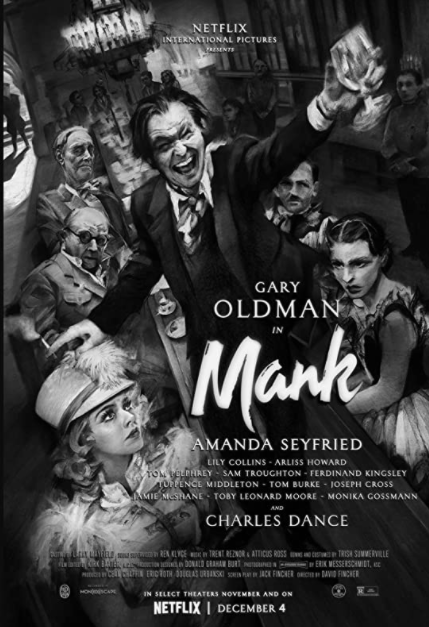
I thought it was good but not great. The black-and-white, flashback format was a nice, if somewhat obvious, homage to Citizen Kane. Herman's writing of the script, with no credit but ample payment from Orson, at first, and then Herman insisting on getting credit, because he realized the impact the movie would have, was also well presented. But the probing, enduring questions around the creation of this masterpiece were barely touched upon and not extensively explored. What was Herman's ultimate motivation in writing such a devastating take-down of his friend and patron William Randolph Hearst aka Charles Foster Kane? Did Herman love Hearst's young wife Marion Davies, platonically but nonetheless deeply enough to motivate the script?
And speaking of Davies, when Herman's brother Joe asks Herman about the "rumor" that "Rosebud" was Hearst's name for Davies' "genitalia," Herman scoffingly denies it. Was that denial truthful (which it appeared to be in the movie) or just Herman not wanting to admit the truth to his brother?
The problem is that, since presumably almost no one in the audience for Mank knows what really happened, and why, we have no way of judging the accuracy of this docu-drama. That's ok. I often tell my students that you can't expect complete truth even in documentaries, let alone docu-dramas. But because that elusive truth of such keen interest, I found Mank enjoyable -- and certainly lifted by Gary Oldman's brilliant performance in the title role -- but somewhat unsatisfying.