Chuck Todd interviews me about alternate histories
Showing posts with label Dune:Prophecy. Show all posts

Sunday, December 22, 2024

Dune: Prophecy Season One Finale: Truths Coming Out


Dune: Prophecy put up a powerfully long finale tonight on Max -- an hour and twenty-one minutes -- for its short six-episode debut season.  And it made every minute and sound of the Voice count, as it dealt out a series of blows and retributions and affirmations of what we already knew and suspected.

[I'm not going to give you a detailed recap, but I suppose I should warn about spoilers anyway ... ]

First, we learned more of the brutal truth about what Valya was willing to do, and did, to insure that the Sisterhood went her way.  That way was to keep AI as an essential weapon in the Sisterhood's arsenal. I agree with Valtya's view of AI,  But as to her methods ... well, we see that she killed not only Dorotea but a vast majority of the Sisterhood in that room, because they opposed her view, and thought AI was a blasphemous threat to humanity.

Later, we're also treated to a battle royale between Valya and Desmond Hart.  It's pretty much a draw.  As readers of my reviews here of Dune: Prophecy know, I've been a bigger fan of Hart than Valya.  They might both have well died, had not Tulya arrived and rallied her sister Valya -- and then, after convincing Valya to let her son Hart be, because she as his mother not only loved him but was sure she could control him, Tula goes and tends to her wounded son.  I said a few episodes ago that I thought Tulia would ultimately be a more potent character than Valya, and I think she proved it in that scene and in this episode.  

One thing I didn't like, though, was the Emperor's self-inflicted death.  He wasn't a bad Emperor, as far as Emperors go.  But leaving a Bene Gesserit in the palace, who now through face- and body-shifting looks just like Princess Ynez, I thought that was a pretty cool move.

All in all, I think these six episodes have offered a memorable and captivating prologue to the Dune saga. Kudos, again, to Kevin J. Anderson and Brian Herbert who wrote the novel Sisterhood of Dune, which I haven't yet read and on which Dune: Prophecy is based, Frank Herbert who got the Dune saga going with a series of masterpiece novels, and everyone who starred in this TV series.  

I'll see you back here when the second season comes along.

See also Dune: Prophecy 1.1: Compelling Prequel ... 1.2: The Hart of The Matter ... 1.3: The Power of Voice ... 1.4: The Ambience ... 1.5: Revelation and Seduction

and Dune, Part One: Half the Movie, Twice the Power of Most Other Complete Films ... Dune, Part Two: Not As Good as Part One


Wednesday, December 18, 2024

Dune: Prophecy 1.5: Revelation and Seduction


There's more than one revelation in the riveting Dune:Prophecy 1.5, but I'll focus here on only one, clearly the most important in this series:

[And of course, there will be spoilers ahead ... ]

We learn about Hart's parentage.  First, let me say again how much I enjoy the ambience of this prequel series, which feels so much like I felt in the 1960s, when I first read Dune and Dune: Messiah, the original Dune novels.  My eyes on the streaming screen give me the same feeling as my eyes on those paperback books.   They feel the same and smell the same, though of course, anything my brain perceives in watching Dune: Prophecy is entirely a product of my brain processing what I'm seeing on my laptop.  I'm not touching any paper or perceiving what subtle stimuli it delivers to my nose.

But what is Hart's heritage?  Anirul -- the aptly named AI system that the Bene Gesserit illicitly utilize (also a sensory pleasure to see in action) -- delivers its conclusion: Hart comes from both Atreides and Harkonnen lines!  Now we saw the two lines mate, as it were, just a few episodes ago.  Young Tula Harkonnen and her Atreides lover, whom she kills the morning after.  It makes sense, doesn't it, that someone with the powers of Desmond has to be the product of the two most powerful lines that stretch across the Dune saga, of course making their appearance in the very first novel by Frank Herbert.

Meanwhile, apropos love making, it was good to see Empress Natalya seduce Desmond -- God knows what that will produce if she becomes pregnant -- and Sister Francesca doing the same to the Emperor himself.  I tell ya, they got the royal couple coming and going in this episode, fortunately or unfortunately not together.

My only regret about this series is that it's a mini-series with a vengeance, the first season ending next week with only its sixth episode.  But it's shot to the top of my list, and I'll be back here not only next week with a review, but whenever its story continues on HBO: Max.

See also Dune: Prophecy 1.1: Compelling Prequel ... 1.2: The Hart of The Matter ... 1.3: The Power of Voice ... 1.4: The Ambience

and Dune, Part One: Half the Movie, Twice the Power of Most Other Complete Films ... Dune, Part Two: Not As Good as Part One


Monday, December 9, 2024

Dune: Prophecy 1.4: The Ambience


We learn a lot in every episode of Dune: Prophecy.   Before I tell what specifically I learned in episode 1.4, let me begin with an overall ambience I realized I was experiencing when I was watching this episode last night:  there's something about the pacing, the cinematography, the dialogue, the acting, I don't know, about Dune: Prophecy that makes me feel I'm in the original Frank Herbert Dune novel and its Dune Messiah sequel.  More so, much more so, than the original David Lynch movie, and the more recent efforts by Denis Villeneuve.  I haven't read the Sisterhood of Dune prequel by Kevin J. Anderson and Brian Herbert that is the basis of Dune: Prophecy and of this authenticity feeling I have about it -- whether it's in the Sisterhood of Dune, or just in Dune: Prophecy, or in both -- so I don't know who deserves credit and thanks for this.  I guess like the Dune saga itself, it's real and powerful, but its specific contours are blurry (cool, in Marshall McLuhan's sense), and it maybe, likely, adds to the charm of this narrative on HBO Max, or even is responsible for it.

Now on to some more specific things I learned last night, and here of course there will be a few spoilers in what follows:

  • It's confirmed that Desmond's fearsome ability to burn people from the inside out can indeed extend across the galaxy -- it's the case that Kasha's burning at the same time as Pruet was not somehow a reflection of Pruwet's burning.  He and Kasha were both burned by Desmond at the same time.
  • Desmond's power to burn people extends to more than two at a time.
  • A single Bene Gesserit is so far no match (for want of a better word) for a one-on-one with Desmond.  It will likely take some sort of group of Bene Gesserit to do him in.
What other powers does Desmond possess?  Is he responsible for Lila's awakening?  Also, I said last week that I'm liking Tula more than Valya.  I'm also beginning to think that Tula not Valya may be the one to bring Desmond down (if anyone can do that).  There is something about Valya that is too ... obvious. She and her wiles are easier to spot than Tula's.  We'll see.

And I'll be back here next week with my review of the next episode.

See also Dune: Prophecy 1.1: Compelling Prequel ... 1.2: The Hart of The Matter ... 1.3: The Power of Voice

and Dune, Part One: Half the Movie, Twice the Power of Most Other Complete Films ... Dune, Part Two: Not As Good as Part One


in Kindle and paperback

More books about McLuhan and the media at Connected Editions

Wednesday, December 4, 2024

Dune: Prophecy 1.3: The Power of Voice


Lots of dramas on TV give us flashbacks to the earlier lives of current characters, to give us a sense of who they are and their motives, but Dune: Prophecy is doing it better than most, and in episode 1.3 devotes most of an entire episode to the younger Valya and Tula sisters, at the time Reverend Mother Raquella, the first Reverend Mother and founder of the Bene Gesserit, was still alive and very much in charge.

[Spoilers ahead ... ]

And this makes what Valya was able to do with her Voice -- stop Reverend Mother Raquella in her tracks -- and not do to Desmond Hart last week -- get Desmond to follow her order, given in Voice, to slit his own throat -- all the more impressive.  If the Bene Gesserit are the heroes in this story, and Desmond Hart the villain -- both vying for control of humanity -- it makes the outcome of their confrontation all the more difficult to predict. Valya's Voice stops Raquella and kills Dorotea, but has little effect on Hart.  (Of course, since this is a prequel to the Dune saga we already know, we already know the general outcome of this struggle.  But it will still be fun to see exactly how it all plays out, and what seeds it sows for all future stories in Dune.)

The other big part of this excellent episode is young Tula, who makes a habit of doing more than expected.  She kills Orry Atreides -- after they make love and he proposes to her -- to avenge the death of her beloved brother by the Atreides, because she loves her family more than the man she just made love to.  And in the future -- the present in our overall narrative -- she defies the Bene Gesserit policy and keeps Sister Lila alive by some forbidden means.   Although both Harkonnen sisters are very complex and therefore interesting characters, I think I find Tula a little more so.  I guess I'm a sucker for defiance and going your own way.   In a way, that difference between the two sisters reflects differences in the overall Sisterhood, and that's probably part of its strength.

I'm really enjoying this prequel series, and next week's episode promises even more, with a title -- "Twice Born" -- that suggests we may find out more about the origin of Hart's powers.

See also Dune: Prophecy 1.1: Compelling Prequel ... 1.2: The Hart of The Matter

and Dune, Part One: Half the Movie, Twice the Power of Most Other Complete Films ... Dune, Part Two: Not As Good as Part One

Wednesday, November 27, 2024

Dune: Prophecy 1.2: The Hart of the Matter


Well, there will be spoilers in this review of Dune Prophecy 1.2, because there's nothing I have an interest in talking about that takes place in this remarkable episode that doesn't contain spoilers.

I said in my review last week of episode 1.1 that Desmond Hart, played by Travis Fimmel, was my favorite character, in part because Fimmel is a uniquely memorable actor, in part because the character he is playing was starting to do some remarkable things.  Not just the horrible thing of killing the boy by making him burn from the inside out -- which I would just as soon not have seen -- but the far more extraordinary thing of burning Kasha, a Bene Gesserit member at the same time, "halfway across the universe," as was remarkable upon in 1.2

That's a power that far exceeds what the Bene Gesserit can do, and in episode 1.2 we see Hart has another extraordinary power: he is able to defy Valya's order, delivered via Voice, to slit his own throat -- the same command via which Valya permanently silenced Dorotea in episode 1.1.  (Well, not quite permanently -- we see Dorotea talking to/at Sister Lila, when Lila is in that never never land that the poison she has ingested, which she is supposed to break into non-poisonous "molecules," is coursing through her body and brain.  But you know what I mean.)

Episode 1.2 also gives us at least a partial answer of how Hart got to have such power.  He says he was ingested via a sandworm and came out alive and in possession of his powers.  That of course leaves open the question of who is Hart that he survived such a power-bestowing ordeal.  But it's a good start.

Meanwhile, in other highlights of this episode, there was a legitimately good sex scene between Constantine Corrino (an illegitimate son of the Emperor) and Lady Shannon Richese (older sister of the slain boy -- much older, she's not a child).  This happens in contrast to a subsequent scene in which Kieran Atreides (who of course is bound to have an important role in this series) and Princess Ynez (a legitimate princess) elect not to have sex, which almost certainly means they eventually will.

So Dune: Prophecy is off to a very good start, indeed, and I'll see you back here with reviews of subsequent episodes in the weeks ahead.

Tuesday, November 19, 2024

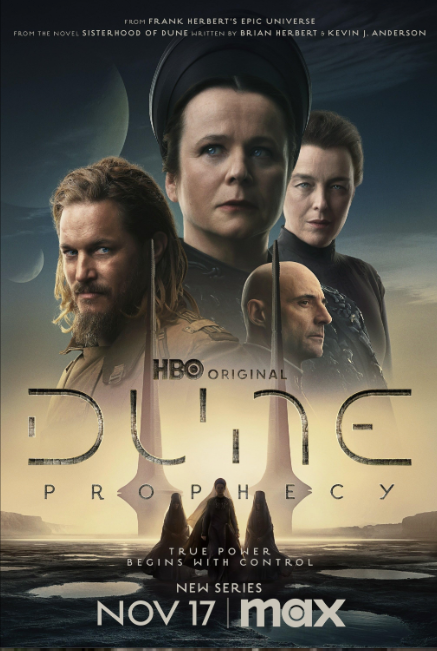
Dune: Prophecy 1.1: Compelling Prequel


I just watched the first episode of Dune: Prophecy on HBO Max.  Here's a non-spoiler review:

This prequel to the Dune series takes place 10,148 years (you can look up whether that's Earth years) before the birth of Paul Atreides, we're told near the beginning of this first episode.  Now the Dune series of novels is second only to the Foundation series of novels, I've thought ever since I started reading science fiction many years ago.  And the first episode of Dune: Prophecy has a lot in common with the first Dune novel.  Both have some scenes I'd rather not have read or seen.  And both start off way too slowly.   But Dune proceeded to be monumental in its story and impact, and Dune: Prophecy looks like it could be headed in that direction, too.

The essence of Dune: Prophecy is the establishment and growth into power of the Bene Gesserit, one of the most compelling components of the future Dune saga.  The characters in this powerful order that seeks to guide and control the universe by breeding the most appropriate humans for the job are well introduced in this first episode, but my favorite character is Desmond Hart, played by Travis Fimmel, whom I first noticed in his incandescent role of Ragnar Lothbrok in Vikings.  He has a way of speaking and acting that dominates every scene he's in, and leaves an indelible impression.

Someone on some social media site remarked that Dune: Prophecy was just Game of Thrones in outer space.  I did hear someone comment in Dune: Prophecy about "bending" someone's will, and, as I said, there was a scene or two I would rather not have seen, but the Dune story first came out in two serials published in Analog Magazine in 1964 and 1965, followed by the novel in 1965, so if Game of Thrones and Dune: Prophecy have any connection, it's that Thrones was influenced by the narrative qualities of Prophecy rather than vice versa.

And Dune: Prophecy has a freshness and some unexpected turns -- which I won't tell you about -- all its own.   I will tell you that Mark Strong as Emperor Javicco Corrino is memorable -- the Emperors have always been among my favorite Dune characters -- as are Emily Watson and Olivia Williams as the Harkonnen Sisters, who play such important roles.

So if you've been a devotee of the Dune saga, well, you can't go wrong with Prophecy. And if you haven't read or watched yourself into the Dune universe, well, you don't know what you're missing.

See also Dune, Part One: Half the Movie, Twice the Power of Most Other Complete Films ... Dune, Part Two: Not As Good as Part One


InfiniteRegress.tv