Chuck Todd interviews me about alternate histories
Showing posts with label Joel Iskowitz. Show all posts

Tuesday, December 2, 2025

Paul Anka: His Way: The Right Way (Except for One Missing Song)


My wife and I saw Paul Anka: His Way, a 2024 documentary, last night on HBO.  Why did we wait so long to see it?  I don't know. Probably because we weren't paying enough attention.

I've been a fan of Anka since 1957, when I was in 5th grade in PS 96 in The Bronx, and Anka had a great hit, "Diana".  Joel Iskowitz, Jordan Axelrod, Steven Auerbach, and Paul Gorman were in my class.  I started an acapella group, Little Levi and the Emeralds.  I don't think we sang much of "Diana" -- we were more into The Five Satins, The Harptones, and The Del Vikings -- but we sure loved it.

Anka explains and demonstrates at the beginning of the documentary that the ease of playing those 4-chord songs -- C, Am, F, G -- when he sat down at the piano was what drew him into singing and then writing.   And he progressed in extraordinary ways, writing "My Way" for Sinatra, the Johnny Carson theme song, and even some songs with Michael Jackson.  He also wrote "It Doesn't Matter Anymore" for Buddy Holly and "She's a Lady" for Tom Jones, and those are just a fraction of the more than 900 songs Anka has written!

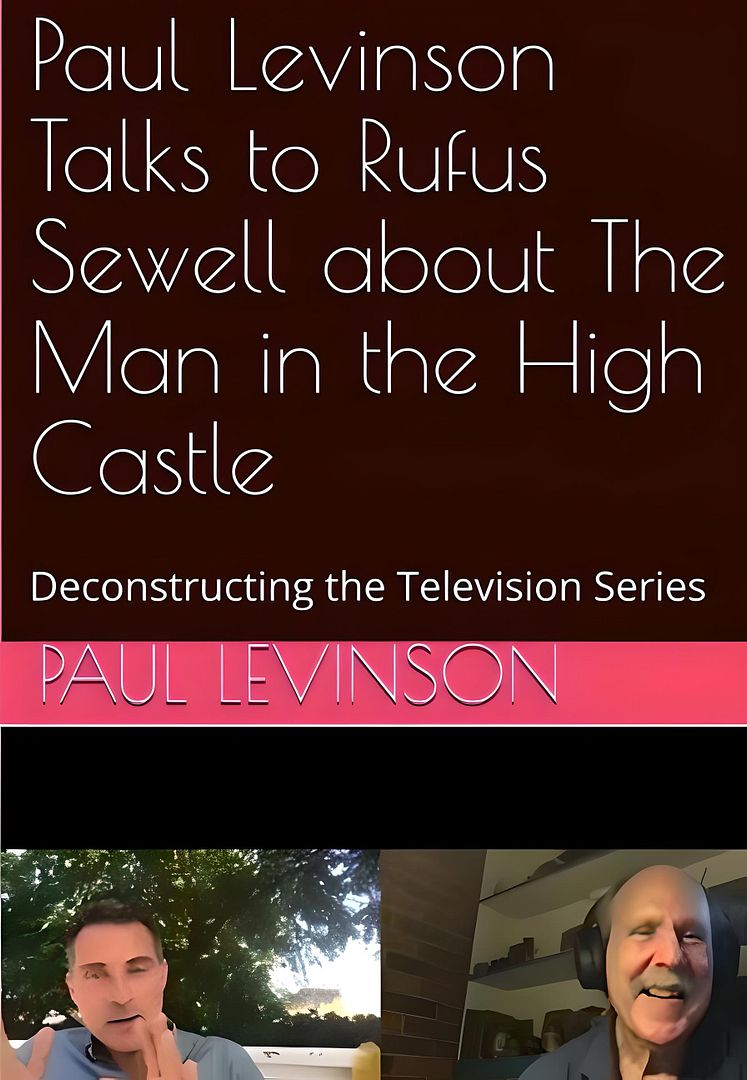
Of course, no documentary can play even small parts of most of that number of songs, but the question always arises (for me, at least) of what songs would I have liked to hear and see Paul Anka perform in His Way?  And, yes, there is one, in particular.  It's a song that played a crucial role in Amazon's adaptation  (by Frank Spotnitz) of Philip K. Dick's The Man in the High Castle, which ran for four seasons (2015-2019) and helped establish streaming as the titan it is today,  The first episode of the second season in 2016 opens with an extended mise-en-scène of protagonist John Smith's (Rufus Sewell brilliantly portrays Smith) young teenage son Thomas getting off the school bus and walking into class.  Everything seems so normally, happily, suburban American, as Thomas Smith (good job Quinn Lord) looks at the girls and walks into school.  We begin to get a disquieting taste of this alternate history in which the Nazis beat America in the Second World War when we see the Nazi insignia on Thomas's arm and then a kid in the class asks Thomas how many slaves George Washington and Thomas Jefferson had.  Thomas Smith then looks at a girl in the class in that certain way, she looks back at him when he isn't looking, but the joy of that budding teenage romance is shattered to pieces for the TV viewer when Thomas is called up to the front of the class to give a Nazi pledge of allegiance that he does with pride.  

Now, this is one of Spotnitz's best conceived and realized scenes, and he hammers it home playing Paul Anka's 1960 hit song, "My Home Town," loudly and softly in the background until Thomas begins the pledge.  This is an upbeat, zestful song, brimming with the enthusiasm and pleasures of living that is a hallmark of Anka's music, especially his early recordings -- the perfect background for the unnerving perversion of American life that the Nazi conquest has wrought.


So, yeah, I missed "My Home Town" in Paul Anka: His Way -- especially given the steps to fascism our country is currently taking -- but the documentary is titled "His Way", that is,  Paul's way, and/or the movie's director and writer John Maggio's way, not my way, and as I've been known to say to someone who tells me that they would have had a character in one of my novels do or say something different than what I had them do or say: hey, go write your own novel. :)   And all in all, there's not much I would change in this rendition of Anka's incredible inspiring life and journey.  At 84 years old, he's still going strong, hasn't reached the top of the mountain yet (as he says), and I'm looking forward to hearing and hearing about the rest of the climb.


more about this book here

Tuesday, November 17, 2020

Joel Iskowitz at the Atlantic Gallery

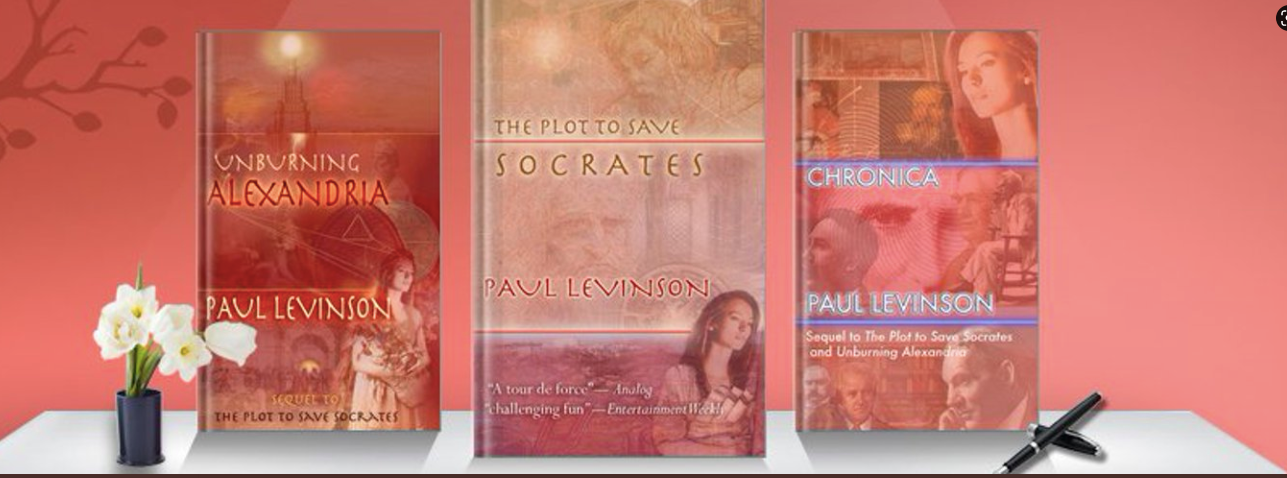
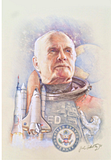
As many of you know, I've had the great fortune of having Joel Iskowitz design the covers for many of my books, ranging from the Sierra Waters time travel trilogy (pictured above -- and note that the third novel, Chronica, written in 2015, makes reference to Joe Biden as President!) to Marilyn and Monet (pictured at the end of this post).  Isky, as I call him, has been my friend since the 5th grade in the Bronx, where we conspired about how to impress girls, and I first became aware of his talent for illustration.   More recently, he has guest lectured in some of my classes at Fordham University, I interviewed him on my Light On Light Through podcast, and he introduced me to John Glenn (subject of several Iskowitz portraits), whom I interviewed just a year before his passing for Touching the Face of the Cosmos: On the Intersection of Space Travel and Religion (for which Isky also did the cover) (here's an audio of the interview).

So, I was truly delighted to learn about Joel Iskowitz's first solo show, Icons of Inspiration, at the Atlantic Gallery in New York City.  Our continuing caution about COVID kept Tina and me from attending in person, but, happily, you can see all of Isky's works online at the virtual show, right over here.  

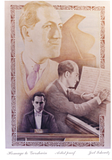
My favorites are just about all of them, but here are some that really hit the spot for me: Bob Dylan, Edgar Allan Poe, Louis Armstrong (with Bogey and Bacall), George Gershwin, and of course John Glenn.

Prints are available of many of these -- they'd light up any wall, just as they light up the soul.


Friday, September 27, 2019

What a Day for a Daydreamed Story

originally published in The Dreams Journal, 23 January 2016

I write all the time – except when I'm sleeping. It's not that the dreams I occasionally recall serve as raw material or inspiration for my writing. As far as I can tell, what happens when I sleep has no connection to my writing at all, other than getting me well rested when I get enough sleep. Don't get me wrong – it's not that I don't like sleep. I love to sleep. But it's as far away as bright sunlight is to the dead of night when it comes to my writing – all parts of which, including its deepest origins, take place for me when I'm awake.

It's a good thing, too. If I get eight hours or less of sleep a night, that gives me sixteen or more hours of time to write and daydream, which is the source, in one way or another, of everything I write.

Here's an example: A few years ago, I walked up to my car in the parking lot of the Chauncey Square shopping center, having just finished a great swim in the New York Sports Club pool upstairs, and I did a classic double take. Parked right next to my car, then a 2006 silver Prius with almost 100,000 miles on it, was another Prius, same year and color. I couldn't tell, of course, if this other car also had traveled 100,000 miles, but it certainly had enough wear on it, and, if you looked closely enough, I could almost imagine I saw the same scuffs and dents, in the very same places as on my car.

This was the trigger for my story. And, in the ten-minute drive back home, I daydreamed "The Other Car," a magical realism little tale about a man who was encountering the very birth of an alternate reality in which he was the major player. One of the many great things about daydreaming is that it is inherently multi-tasking, and allows you to do other things as you tell yourself your story. So I got home perfectly safe and sound, something I'd have been unlikely to do if I had actually fallen asleep at the wheel and dreamed the plot of "The Other Car".

It is true that when you're asleep and dreaming, you sometimes are aware that you're dreaming, but there's very little more you – or, at least, I – can do with that, regarding my writing. I get good ideas as I'm falling asleep, and rush to write them down, but that's still really daydreaming not dreaming, because I'm still awake. The same is true about waking up in the morning with a way in my head of moving past a plot impasse in my story – it might seem like I had just dreamed that, but, actually, that part of the story came to me after I had woken up.

The problem with dreaming a story when you're fast asleep is you have no way of recording it. The best you can hope for is memory, notoriously unreliable when it comes to dreams, and writing down your recollection of what you dreamt, after you've awoken. In contrast, recording is always available to the daydreamer. I prefer writing to voice-recording my stories, and have been known to pull over to the side of the road and feverishly write down some lines, sometimes even paragraphs. Smart phones are a fabulous help with this – you can jot down a note, email it to yourself, and it's right there for you when you get home to your slightly bigger screen.

Daydreaming, like writing, is best done alone – at least, again, for me – which is why driving, with no passengers, has worked so well with me. So are long walks. Swimming, which is what I had been doing before encountering the other car, is good, too. I hate to interrupt my laps, but, on occasion, I've gotten out of the pool, walked to my locker, taken out my phone, and written down a crucial scene. (I'd save a little time leaving my phone by the side of the pool, but don't want to risk its accidentally being kicked in or deliberately stolen.)

By the way, I love spending time with my family, but, just as with sleeping, it's important to recognize that neither is conducive to writing at the same time. That's why I always say to anyone who asks that the single best thing you can do to clear your path as a writer is be willing to be anti-social on occasion. There are a million worthwhile and enjoyable things to do in life. But if they require your interaction with other people, you won't be writing at those times.

Of course, a conversation could spark an idea for a story or a way to move forward in whatever it is you're already writing. Any experience, like my seeing the other Prius, can do that.

The key is leaving yourself space and time between the conversations to let your daydreams take over. I wrote "The Other Car" in less than a day, and, I was so happy with it, I asked my artist friend Joel Iskowitz to do a cover, which he did, and I published the story on Amazon Kindle the next day. The ease and speed of publishing on Amazon has made the synapse between finished story and publication almost as short as between the brain and fingers that wrote the story.

You can do it all in a day now, as befits writing from daydreams, from which you can dip in and out of reality at the speed of thought. Or, to paraphrase John Sebastian, any day is a good day for a daydream if you're a writer.


  • "Flat-out fantastic ... I'd highly recommend all science fiction fans take a look at it." - Scifi and Scary
  • "the end was stunning" - Ignite

Monday, December 31, 2018

Escape at Dannemora Finale: Why "At"?


Herewith some thoughts on tonight's powerful Escape at Dannemora finale:

1. Michael Imperioli did a great Andrew Cuomo.  Doesn't look all the much like him, but he got the Governor's voice and manner down perfectly.

2.  Matt was indeed a pretty good artist.  The portraits of George W. Bush and Hillary Clinton  that we saw at the end were a lot better than most.  (I like Joel Iskowitz's work better - he's done a lot of my book covers, and is doing the cover for my new album, Welcome Up.  But if JI wasn't available, I might have asked Matt, if he was still alive and not a murderer.)

3. Matt really slowed Sweat down after the escape.  He was at his best, in control and usually comfortably in charge, in prison.  He was at his worst outside of prison, in the real world.

4.  But even on his own, had Sweat made it to Canada, would he have been home free?  The Canadians won't extradite people for whom there might be a death penalty, but there wasn't one awaiting Sweat, so it seems possible, even likely, that they would have extradited him.  Of course, they first would have needed to find him.  (Especially strong work by Paul Dano as Sweat tonight.)

5. Tilly seems to have an almost unbelievable power over men.   Her husband is staying with her, and if that scene near the end, with the new prison guard (or cop) propositioning her is true ... plus the prisoners at Dannemora ... well ...

6. All in all, an unusual and excellent series.  I still don't get though, why it's "Escape at" rather than "Escape from"?   Is that because they didn't succeed in their escape?  Do the results of an escape govern our grammar?

But I enjoyed the mini-series.

this cover by Joel Iskowitz ... really

Thursday, December 17, 2015

Touching the Face of the Cosmos just published


Click here, and then on Look Inside, to see Table of Contents


#SFWApro 


right after my interview John Glenn, appearing in the anthology


#7 on Amazon Kindle Top 100 Science and Religion a day after publication

Tuesday, September 29, 2015

Fordham University Press to Distribute Print Edition of Touching the Face of Cosmos; 1st Glimpse of Cover

Two very good pieces of news regarding Touching the Face of the Cosmos, the forthcoming anthology edited by Paul Levinson (me) and Michael Waltemathe:

1. Fordham University Press will be distributing the print editions of the book, which will appear in its Spring 2016 catalog, with a likely publication date in March.  Connected Editions will still be publishing all digital editions, with a likely publication date in November.   (A list of essays and stories can be found here.)   Paperback and hardcover editions now available for pre-order.

2.  Here's the cover - created by world-renown illustrator Joel Iskowitz.


And here's the catalog copy for the anthology -

Military advantage, scientific knowledge, and commerce have thus far been the main motives to human exploration of outer space. Touching the Face of the Cosmos explores what may be the best motive of all, largely untapped: the desire of every human being, essentially spiritual, to understand more about our place in the universe, how our lives on Earth are inextricably part of that bigger picture. Drawing on leading scientists, religious thinkers, and science fiction writers – including a new interview with John Glenn, and an essay by Director of the Vatican Observatory Guy Consolmagno, SJ – Paul Levinson and Michael Waltemathe have assembled a volume that puts space travel and religion on the map for anyone interested in outer space, theology, and philosophy. 
Paul Levinson, PhD, is Professor of Communication and Media Studies at Fordham University, and author of 16 scholarly books and novels, including Realspace: The Fate of Physical Presence in the Digital Age, On and Off Planet. 
Michael Waltemathe, PhD, is Senior Lecturer in Religious Education, Department of Protestant Theology, Ruhr-University Bochum, Germany, and author of Computer Worlds and Religion, and articles about science, religion, and outer space.

Tuesday, March 31, 2015

Beau Willimon at Fordham

I saw Beau Willimon at Fordham University earlier this evening - thanks to my colleague Beth Knobel (erstwhile CBS Moscow bureau chief) for arranging this.   The hour was the best of this kind I've ever attended.   By which I mean, a creator of a landmark work talking incisively, truthfully, vividly about the creative and business processes employed in bringing the work to life.

Among the highlights of Willimon's disclosures and lessons imparted -

  • He started his creative life as an illustrator and painter, but found the static image insufficient to tell the stories he wanted to tell.   (See illustrator Joel Iskowitz for an opposite point of view.)
  • Willimon says the revolution in television-making founded and exemplified by his House of Cards is that a writer, producer, creator can sell not just a pilot but an entire season of a series to a distributor like Netflix.   I'd say that this, in effect, is the creator's side of what we viewers experience and enjoy as binge all-at-once watching of a television series, and  this increase of creative control in the producer's hands may be the beginning for television of what Kindle publishing has done for authors on Amazon.
  • Willimon thinks that there's here's no such thing as writer's block - I've long thought much the same, that cries of writer's block are evasions.   Willimon put an even finer point on this, explaining that writer's block is really not inability to write but unwillingness to confront a possible failure. 
  • Indeed, Willimon emphasized that we should embrace not run from failure - a view very much in tune with Kark Popper's (one of my favorite 20th century philosophers) that we learn more from our mistakes than our successes.
  • Willimon says the auteur theory of film (and, by extension, television) is overrated and untrue - these creative forms are inherently collaborative efforts.   (I was thinking that one of the reasons I like writing novels and short stories is that I don't have to collaborate too much with anyone.)
  • Willimon's favorite scene in the third season of House of Cards was Frank Underwood and Tom Yates first getting down to brass takes about Tom's life.   Just about every scene with Tom was among my favorites in the third season.
One of the great perks of the academic life is getting an hour like this - reflections from someone whose work initiated what I think of as the third golden age of television (title of a book in progress) - the first being in the 1950s, the second in the first decade of the 21st century with shows like The Sopranos (no commercials, no FCC restrictions on content), and the third being right now with House of Cards - already joined by Peaky Blinders, Bosch, Bloodline, and more.

See also House of Cards 3: Frank, Claire, "Putin," and Superb ... House of Cards Season 2: Even Better than the First, and Why ...  House of Cards Season 1: A Review

And also Thomas Maier: Masters of Sex and Biography Come to Life

The Experiment with "The Other Car"

Hey, I don't usually talk much inside baseball here about my science fiction writing  - how and why I make decisions to get my stories published in this place or that, or try to get them published - but I thought you might enjoy a little of the story behind the story of my recently published The Other Car, which I put up as an ebook on Amazon about two weeks ago.

First, as some of you may know, this is the not way I've ever published my short stories.  All of the 40 short science fiction and fantasy stories I've published since 1991 - you can see a list of most of them here, at the Internet Speculative Fiction Data Base  - were published the good old-fashioned traditional way.  I sold the story to a magazine - whether print, or more recently, online, or both - for a payment per word, usually 5 to 10 cents per word.   For example, my most recent sale of this sort was for my 5500-word story, "The Wallet," to Sci Phi Journal #4, which was just published last month.   The Sci Phi Journal paid me 5-cents per word for this story.

"The Other Car," which I just wrote a little over two weeks ago, is coincidentally almost the same length, and is in the same slipstream, new weird, science fantasy corner of the science fiction genre.  I describe it as follows:
James Oleson is beginning to see everything in perfect duplicate - two identical models of cars which are the same down to scuff marks and license plate, two old philosophy books with the same torn pages and inscription in old ink, and twin mail men. Is he losing his mind, or experiencing the birth of a new alternate reality via binary fission?
I decided, as an experiment, to publish this right away as a short story ebook on Amazon Kindle.  I got my friend, world renown illustrator Joel Iskowitz, to do a cover - see below.   The satisfaction to an author in getting a work immediately out to the public is enormous.   But would I make anything close to the money I would have made had I sold "The Other Car" to a magazine?    I priced the short story at $0.99, and as an author I by no means see all of that money, but so far "The Other Car" is off to a pretty good start.  Here's where it was about a week after its publication on Amazon, on its Top 100 science fiction short story list:


But the story still has a long way to go to reach what I would have earned had I sold the story for 5-cents a word, let alone 10-cents or more a word, to a magazine.   I'm going to give this experiment a year, and see where I stand then on the story's earnings.  I'll be sure to report the results right here.

In the meantime, I'll list reviews and any other good news about "The Other Car" that may come along, right here as well:

  • 28 March 2015: 1st review of "The Other Car" on Ignite Books - "the end was stunning"
  • 28 March 2015: 2nd review of "The Other Car" on Amazon - "my draw dropped"
  • 28 March 2015: "The Other Car" on SFSignal's "140+ Excellent Science Fiction, Fantasy and Horror eBook Deals – All Priced Under $4 Each"
  • 31 March 2015: "The Other Car" on Speculative Fiction Showcase's "Indie Speculative Fiction of the Month for March 2015"
  • 3 April 2015: 3rd review of "The Other Car" on timetowritenow  "an inspiring break from working on my taxes"
  • 4 April 2015: 4th review of "The Other Car" on Amazon - "brain tease extraordinaire"
  • 2 May 2015: I raised the price of "The Other Car" to $2.99 - I'll keep it there for a few months, and see if I make more money (70% of $2.99) than at the original price (30% of $0.99) at what will likely be fewer sales at the higher price.

Friday, February 28, 2014

"Author's Cut" Updated Kindle Edition of The Pixel Eye published by JoSara MeDia

I'm pleased to announce that JoSara MeDia has just published a Kindle edition of my novel, The Pixel Eye.

The Pixel Eye was originally published by Tor Books in 2003, and was praised by The New York Times ("the nuttiness of the premise and the grittiness of the near-future New York ambiance are equally appealing"), Library Journal ("Levinson's latest novel featuring the resourceful and wise-cracking D'Amato delivers another satisfying mix of hard-sf intrigue and detective story set in New York City"), and reviews in numerous other places.

Squirrels are spying on us in the park. Mice may have organic bombs set to go off in their brains. Holograms are taking the place of real people, some of whom are deceased. Phil D'Amato investigates a case that pits civil liberties against national security as he seeks to ward off a major terrorist attack on near-future New York City.

Like the JoSara author’s cuts of The Silk Code, The Consciousness Plague, and The Plot to Save Socrates, this new edition of The Pixel Eye restores bits of my original wording lost to copy-editing.  But it also contains significant updates in the world inhabited by forensic detective Dr. Phil D'Amato. The NSA existed in 2003 but was not often in the headlines.  It plays a significant role in this 2014 edition of The Pixel Eye.   

Also note that although The Pixel Eye is my third novel detailing the cases of Dr. D'Amato (after The Silk Code and The Consciousness Plague), it is an entirely standalone story, not a sequel, and can be read before the first two novels.

The new ebook edition of the novel has a specially commissioned cover by Joel Iskowitz, who designed the covers for The Silk Code, The Consciousness Plague, The Plot to Save Socrates, and Unburning Alexandria ebooks, and  whose designs have appeared on stamps around the world, US coins, and murals.

I again chose JoSara MeDia because this small, savvy publisher did such a good job with The Silk Code, The Consciousness Plague, The Plot to Save Socrates, and Unburning Alexandria ebooks, as well as the Unburning Alexandria paperback published last summer. JoSara MeDia has published award-winning authors in multiple formats, including print, eBook, and enhanced eBooks as iPad and Android applications. JoSara MeDia also works with non-profit organizations, such as the Texas State Historical Association, assisting them with strategies and solutions to get their content available in these multiple formats.


reviews
  • "The nuttiness of the premise and the grittiness of the near-future New York ambiance are equally appealing" - The New York Times
  • "a breezily chilling story ... enough to send a shiver down most readers' spines" - Publisher's Weekly
  • "a thoroughly enjoyable book, extremely readable, and brave" - SF Weekly
  • "D'Amato is a charming narrator and an intriguing character" - Cinescape
  • "Levinson's latest novel featuring the resourceful and wise-cracking D'Amato delivers another satisfying mix of hard-sf intrigue and detective story set in New York City" - Library Journal
  • "Levinson's descriptions of the unique hustle and bustle of New York City are right up there with Jeffery Deaver's." - MyShelf.com
  • "The Pixel Eye, much like Orwell's 1984 and Bradbury's Fahrenheit 451, presents a chilling vision of the future that hits way too close to home for comfort . . . a thought-provoking book that should be on anyone's reading list." - Royal Library
#SFWApro

Wednesday, September 25, 2013

"Author's Cut" Kindle Edition of The Consciousness Plague Published by JoSara MeDia

I'm pleased to announce that JoSara MeDia has just published a Kindle edition of my novel, The Consciousness Plague.

The Consciousness Plague was originally published by Tor Books in 2002, and was praised by Booklist ("more nearly reaches the heights of Isaac Asimov's classic SF mysteries than those of most other genre hands"), Library Journal ("intelligent blend of police procedural and speculative fiction"), and reviews in numerous other places.

Like the JoSara author’s cuts of The Silk Code and The Plot to Save Socrates, this new edition of The Consciousness Plague restores bits of my original wording lost to copy-editing.  But it also contains significant updates in the world inhabited by Dr. Phil D'Amato, the protagonist whose first appearance in a novel was in The Silk Code. Google Drive and smartphones didn't yet exist in 2002, but they play a role in this 2013 edition of The Consciousness Plague.   

Also of note: a major section of the novel takes place on The Lake Shore Ltd - Amtrak's train between New York City and Chicago - and was written when I took that train to the World Science Fiction Convention in Chicago in 2000.

The new ebook edition of the novel has a specially commissioned cover by Joel Iskowitz, who designed the covers for The Silk Code, The Plot to Save Socrates, and Unburning Alexandria ebooks, and  whose designs have appeared on stamps around the world, US coins, and NASA murals.

I again chose JoSara MeDia because this small, savvy publisher did such a good job with The Silk Code, The Plot to Save Socrates, and Unburning Alexandria ebooks, as well as the Unburning Alexandria paperback published last month. JoSara MeDia has published award-winning authors in multiple formats, including print, eBook, and enhanced eBooks as iPad and Android applications. JoSara MeDia also works with non-profit organizations, such as the Texas State Historical Association, assisting them with strategies and solutions to get their content available in these multiple formats.

 photo THECONSCIOUSNESSPLAGUE5_zps8e1b18e3.jpg

free sample of The Consciousness Plague

reviews
  • "more nearly reaches the heights of Isaac Asimov's classic SF mysteries than those of most other genre hands who attempt them manage to do these days" - Roland Green, Booklist 
  • "Levinson's intelligent blend of police procedural and speculative fiction should appeal to fans of mystery and science fiction" - Library Journal
  • "Intriguing speculation, solid sleuthing, and agreeably baffling suspects" - Kirkus
  • "A satisfying blend of murder mystery, police procedure, and science fiction" - Orlando Sentinel
  • "D'Amato [is] ... an earnest Everyman, operating on a shoeshine and a hunch" - Paul Di Filippo, SFWeekly
  • "Quincy would be proud!" - SciFiDimensions
  • "satisfying and properly links up the plots" - Scott's Corner
  • "a quick, enjoyable read" - Rambles
  • "A little bit mystery, a little bit sci-fi and a whole lot of inquisitive character development kept me glued to The Consciousness Plague from beginning to end. For those interested in medicine, serial killers and mysteries you’ll find this book a quick read and you’ll wish it didn’t have to end so soon." - scrink.com


Enjoy listening to audio books? Get a free audio book copy of The Consciousness Plague - or any one of 85,000 other titles - with a 14-day trial membership at Audible.com ...

#SFWApro

Friday, May 3, 2013

Unburning Alexandria - the novel - published!

I'm pleased to announce that my novel, Unburning Alexandria, was published yesterday by JoSara MeDia.  The long-awaited sequel to The Plot to Save Socrates is now available on Kindle, iTunes, Nook, and Kobo.  A paperback was published by JoSara MeDia in at the end of July 2013.

I started writing Unburning Alexandria when I was finishing up The Plot to Save Socrates in late 2005 - indeed, the opening chapter of Unburning Alexandria was originally the next-to-last chapter in The Plot to Save Socrates.  But on the urging of my editor at Tor, David Hartwell, I took that chapter out of The Plot to Save Socrates and saved it for Unburning Alexandria.  The chapter, along with the next chapter in the novel, were published as a novelette called "Unburning Alexandria" in Analog Magazine in November 2008.

When JoSara published my author's cut of The Plot to Save Socrates last December, I re-inserted that chapter in The Plot to Save Socrates.  For the reader's convenience - and for those who read the original printed versions of The Plot to Save Socrates rather than the ebooks - I included that chapter as Chapter 0 in Unburning Alexandria.

In either case, I hope you enjoy Unburning Alexandria, which tells the following story -

Mid-twenty-first century time traveler Sierra Waters, fresh from her mission to save Socrates from the hemlock, is determined to alter history yet again, by saving the ancient Library of Alexandria - where as many as 750,000 one-of-a-kind texts were lost, an event described by many as “one of the greatest intellectual catastrophes in history.”

Along the way she will encounter old friends such as William Henry Appleton the great 19th century American publisher and enemies like the enigmatic time travelling inventor Heron of Alexandria. And her quest will involve such other real historic personages as Hypatia, Cleopatra’s sister Arsinoe, Ptolemy the astronomer, and St. Augustine - again placing her friends, her loved-ones, and herself in deadly jeopardy.

In this sequel to THE PLOT TO SAVE SOCRATES, award winning author Paul Levinson offers another time-traveling adventure spanning millennia, full of surprising twists and turns, all the while attempting the seemingly impossible: UNBURNING ALEXANDRIA.


Thanks to Joel Iskowitz, the world-renown illustrator whose works appear on US coins and stamps around the world, for the cover.

Here's a video of a reading I did from the beginning of Unburning Alexandria, at the late great Robin's Bookstore in Philadelphia in 2008.


  • Read a sample from Unburning Alexandria - a whole chapter, FREE - at SF Signal.
  • Read why JoSara MeDia published Unburning Alexandria
from Sam Tomaino's review of "Unburning Alexandria" (the novelette in Analog Magazine) in SFRevu in 2008:

Paul Levinson's "Unburning Alexandria" was a nicely told story of time travel set in 413 AD Alexandria and other cities. Sierra is trying to rescue works from the famous library but she has another goal, too. A number of characters, historical and not, pop in to the story filled with intrigue and mystery. I liked this but I was left waiting for more. I hope Mr. Levinson has more to tell.

I did indeed have more - and it's now out in the novel, Unburning Alexandria ...


reviews of the novel

"Levinson's stories are intricately plotted and avoid the tricky Gordian knots of paradoxes with skill and fun." - John DeNardo, Kirkus

"You get used to reading verbal bombshells when you read Paul Levinson’s science fiction works.... characters say things like, 'I was here, in Carthage, three months from now'.” - Jim Curtis, The Morton Report

"little quirkinesses ... and a lot of clever ideas" - GF Willmetts, SFCrowsnest

"Not since Ilium had a novel kept me reading into the wee hours of dusk (I finished this sucker at 3:30 am, unable to resist immediately tweeting my triumph from the mountain tops). Just before tossing all aces like a godforsaken magician, Levinson shuffled his paradoxes like a deck of cards, and I have to admit, stoked the flames of my imagination. It was a great ride." - Shane Lindemoen 


words by Paul Levinson, music by John Anealio, demo by John Anealio

Wednesday, December 12, 2012

"Author's Cut" Kindle edition of The Plot to Save Socrates with Extended Ending Published by JoSara MeDia

I'm delighted to announce that JoSara MeDia has just published a Kindle edition of my novel, The Plot to Save Socrates.

The Plot to Save Socrates was originally published by Tor Books in 2006, and was praised by The New York Daily News (" Da Vinci-esque thriller"), Entertainment Weekly ("challenging fun"), and reviews in dozens of other places.

This author’s cut of The Plot to Save Socrates not only restores a lot of my original wording, but an entire chapter near the end of the novel that features Hypatia of Alexandria.  The novel has a new, specially commissioned cover by Joel Iskowitz, who designed the cover for The Silk Code ebook, and whose designs have appeared on stamps around the world, US coins, and NASA murals.

I chose JoSara MeDia because this small, savvy publisher did such a good job with The Silk Code author's cut ebook brought out this past August. JoSara MeDia has published award-winning authors in multiple formats, including print, eBook, and enhanced eBooks in the form of iPad and Android applications. JoSara MeDia also works with non-profit organizations, such as the Texas State Historical Association, assisting them with strategies and solutions to get their content available in these multiple formats.


Praise for the novel...

"...challenging fun" - Entertainment Weekly

"Da Vinci-esque thriller" - New York Daily News

"...a fun book to read" - Dallas Morning News

"resonates with the current political climate . . . . heroine Sierra Waters is sexy as hell . . . . there's a bite to Levinson's wit" - Brian Charles Clark, Curled Up With A Good Book at curledup.com 

"a journey through time that'll make you think as it thrills ... so accessible, even those generally put off by sci-fi should enjoy the trip." - Rod Lott, bookgasm.com

"Levinson spins a fascinating tale ... An intriguing premise with believable characters and attention to period detail make this an outstanding choice... Highly recommended." - Library Journal,*starred review

"Light, engaging time-travel yarn . . . neatly satisfies the circularity inherent in time travel, whose paradoxes Levinson links to Greek philosophy." - Publishers Weekly

"A thinking person's time travel story... I felt like I was there." - SF Signal

 "This is a dazzling performance. . . .History as science fiction; science fiction as history." - Barry N. Malzberg 

"... quick-to-read, entertaining treatment of the problems inherent in time travel with style and flair" - Booklist

"There's a delightfully old-fashioned feel to The Plot to Save Socrates. . . . Levinson's cool, spare style reminded me of the writing of Isaac Asimov. . ." - Colin Harvey, Strange Horizons

"Paul Levinson's new novel is both very different from anything he has done before and very satisfying. . . . This, I think, is the first of Levinson's novels to deserve to be called a tour de force. Watch for it on award ballots." - Tom Easton, Analog: Science Fiction and Fact

"it's exciting to see a book as daring with both its ideas and its approach to narrative structure as this one hit the shelves . . . It's an absolute treat to sit back and be wrapped up in a story that gives a retro SF premise like time travel such a brilliant new kick, and it's doubly delightful to find the story as fun and entertaining as it is thought-provoking." - SF Reviews.net 

"proves that excellent entertainment can and ought to be intellectually respectable -- a glorious example to us all." - Brian Stableford

"...readers are sure to enjoy his take on the paradoxes of time travel" - BookPage 

"Intricately and intriguingly woven, lots of fun, and extremely thought provoking." - Stanley Schmidt 

"Paul Levinson has outdone himself: The Plot to Save Socrates is a philosophically rich gem full of big ideas and wonderful time-travel tricks." - Robert J. Sawyer

"as happens with Kurt Vonnegut's Billy Pilgrim . . . . the reader soon becomes unstuck in time . . . . Levinson presents one of the most unique books I've ever encountered. A highly recommended read." - Matt St. Amand 

"Paul Levinson brings both intellectual heft and affection for his delightfully depicted characters to this highly original story of time travel . . . bringing all of its threads together in an ending that is emotionally satisfying and extremely moving. The Plot to Save Socrates will provoke thought long after readers have finished the book, at which point many may want to pick it up and read it again, to savor its twists and turns." - Pamela Sargent, SFWeekly

"Fast-paced and full of plot twists." - Davis Enterprise (California)

"an elaborately-reasoned temporal tale - a novelized thought experiment whose logic and ideas Socrates would have approved of" - John Joseph Adams, intergalacticmedicineshow.com

"a philosophically rich, engaging time travel story . . . a charming portrayal of Socrates" - Fantasybookspot.com 

"a fun romp through 2500 years of Western history" - freshfiction.com

"I've never read anything like this before . . . The Plot to Save Socrates is highly, original, creative, and engaging. I enjoyed it from the first page." - Book.of.the.moment. at myspace.com/book_of_the_moment.com

"revels in the possibilities for paradoxes . . . . fresh and welcome" - Steven Silver's Reviews at sfsite

"frankly, he [Levinson] is one of my 'read on sight' authors . . . The Plot to Save Socrates is a tapestry of times and characters and philosophies, with an excellent look at history. . . ." - Jerry Wright, Bewildering Stories at bewilderingstories.com

"a very intelligently written novel . . . ." - GF Willmetts, at SFcrowsnest.com

"Paul Levinson handles a complicated plot and a multitude of characters in a manner that can only be described as masterful. . . . I highly recommend this book, and I won't be surprised if it wins several awards." - Scott M. Sandridge, specmusicmuse

"This book was a lot of fun, and surprisingly poignant at the end. (Yes, I'll admit I cried a little.) . . . I was worried this would be a fairly cold sci-fi book, where I never got to like any of the characters, but somehow by halfway through I found I really cared about them. I'm not sure how Levinson managed that . . . but somehow they all just got inside me." - Lady Amalthea, eharlequin.com

". . . a new metaphor for the literary tradition of time travel." - Robert Blechman, blogcritics.org

"Socrates has always seemed a rather dour and dull figure to me but Paul Levinson breathes new life into this time." - Debbie, ck2skwipsandkritiques.com

"an extremely engaging, entertaining story. . ." - Laurie Thayer, Rambles.net

"truly a thought-provoking, breathtaking, and highly entertaining novel." - Lysette Brodey, PerpetualProse.com

"The Plot to Save Socrates turns on its head Plato's report of Socrates' poisoning ..." - Gerry Elman, Esq., Stanford Alumni Blog

"Doppelgangers, deception, and the sheer amount of historical reference alone make this novel magnificant, but that is not all!... Paul Levinson has created a historical text for all ages, making the plot flow like wine and pleasing to even the most hesitant of readers." - Jenna A, luxuryreading.com 

"I was hooked by the second page." - Kanti Burns, Book Reviews and more

"A lively cast of historical figures populates this epoch-bending adventure, highly recommended especially for fans of alternate history novels!" - Midwest Bookreview


Enjoy listening to audio books? Get a free audio book copy of The Plot to Save Socrates - or any one of 85,000 other titles - with a 14-day trial membership at Audible.com ...


words by Paul Levinson, music by John Anealio, demo by John Anealio

Sunday, November 11, 2012

Brain Power: From Nathaniel Hawthorne to Tiffany Shlain

Tiffany Shlain has done it again.  The director of the acclaimed Connected and The Tribe movies has given us another slice of her vision that probes and provokes our understanding as it delights our senses and coaxes our smiles.  As is the case with all of Shlain's movies, you feel after seeing it that you saw something you already once knew, but needed to be reminded about, and now that you've seen it again the ideas and the rhythm are even more important than you realized.

The idea of Brain Power: From Neurons to Networks is the chestnut that the Internet is like our brain.  The metaphor actually goes at least as far back as Nathaniel Hawthorne and his character Clifford in The House of the Seven Gables (1851), who muses, "Is it a fact - or have I dreamed it - that, by means of electricity, the world has become a great nerve, vibrating thousands of miles in a breathless point of time"?

It was short arc from the telegraph in Hawthorne's time to the web in ours - with McLuhan's global village in 1962 along the way - and, come to think of it, Shlain's Brain Power does have the memorable quality of a dream.  But it also has the focus of an important scholarly pursuit, and Shlain's thesis is that the Internet is not just like a human brain, but the brain of a human child.  This is because the human brain for the first years of its existence is hard-wired to learn - or, in neuronal terms, make connections.   Like links online, connections in the brain literally build, enrich, and expand it, with an initial strategy of the more links the better.

Part of growing up - for the web as a whole and the brain of every person - is pruning the links and connections that don't work, or don't work out well.  Shlain also raises concern about stress and overload suppressing the growth of good connections.   I've always thought that what we suffer from is not overload but underload, or not enough good connections and apps to make sense of what the world has for us.   That's why, when we walk into a library or bookstore, we may feel a fleeting tinge of overload with all the books before us, but it quickly passes because we have the navigational app to make sense of what we see, to know where to find the biographies, the fiction, and so forth.   Human beings, as William James, another Victorian, noted, are in the business of multi-tasking, or wringing order from the confusion of the world.   Overload can be exhilarating.

One thing's sure.   There's no overload or confusion in Shlain's marvelous 10-minute movie.   You'll feel exhilarated and pleased after you see the children and parents on the screen, the cool animation (a Shlain trademark) and world-class art (including quick takes of what famous illustrators such as Joel Iskowitz think the brain is),  the ideas that flow like a sparkling fountain on a summer day.   Take a sip - it will expand some of your good connections.


You can see Brain Power, for free, right here.
InfiniteRegress.tv