Chuck Todd interviews me about alternate histories
Showing posts with label Joan Baez. Show all posts

Wednesday, December 25, 2024

A Complete Unknown: A Nearly Completely Superb Bob Dylan Biopic, Slightly Alternate History


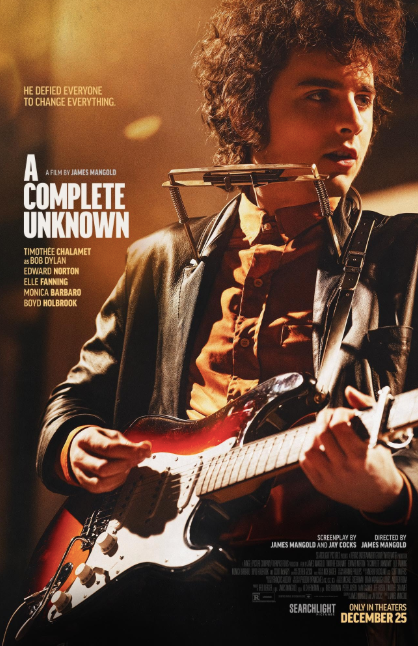
My wife and I just got back from seeing A Complete Unknown, the Bob Dylan biopic.  We both loved it.  The following is my take on the movie.

Dylan recently famously tweeted (on X) that Timothée Chalamet is "a brilliant actor so I’m sure he’s going to be completely believable as me. Or a younger me. Or some other me."  Unsurprisingly, Dylan got it entirely right.  Every biopic ever made is about someone inevitably a little or lot different from the subject of the movie.  Not only can the actor not possibly look 100% like the subject -- unless they are the subject's identical twin, and the producer somehow managed to go back in time and talk the twin into playing the subject's part in the biopic -- but there's inevitably dialogue left out or changed, streets and buildings that don't look the same as the originals, etc, etc.  Look, frankly, even a documentary is never entirely truthful.  It may be more truthful than the biopic, but the director inevitably has to make easy and painful decisions to leave certain things out, etc, etc.   In a phrase, all biopics and docu-dramas are alternate histories (and documentaries, too, just a little less so).

But A Complete Unknown is so good because it managed to get so many things right.  Chalamet as Dylan and Edward Norton as Pete Seeger were letter and note perfect in the words they spoke, the songs they sang, and even what they looked like and how they moved.  Monica Barbaro was not quite there singing as Joan Baez, whose rich mellifluous voice back then is unmatchable, but Barbaro hit all the notes well, and certainly captured Baez's attitude, energy, and intelligence with style.  I don't know what Suze Rotolo at that age was like, even in video. She was inspiration for the part of Sylvie Russo in the movie, because Dylan (to his credit) in our current time didn't feel right about having her character by name in the movie, because she left the world in 2011 and couldn't give her consent to be portrayed in the movie -- but Elle Fanning did a fine job in the part.  (The obvious explanation is Dylan wanted the name changed because some of the interactions with Dylan and Russo in the movie are at variance in some significant way with what really happened between Dylan and Rotolo.)

In addition to Dylan's songs, which were immensely enjoyable to see written, and see and hear performed, there was a symmetry, a kind of rhyme, in the movie, which I expect will stay with me for a long time.  One of my favorite examples is Woody Guthrie's "So Long, It's Been Good to Know You".  It starts off the movie, which begins in 1961, as Dylan comes to New York, and goes to see Woody Guthrie, who was already seriously ill (in reality, he'll live until 1967), and meets Pete Seeger (who had a wonderful cover of the song, solo, and earlier with The Weavers).  At that point, it seems like the song is about Dylan and Seeger saying goodbye to Guthrie.  But when the movie ends, with Dylan going the apostate electric way, the song is played again, and the goodbye is to the Dylan who has forsaken acoustic folk for an electric band with Al Cooper et al. 

The title itself of this cinematic triumph underwent a transformative rhyme.  Dylan is "a complete unknown" when he first crosses the Hudson and arrives in New York City and the movie begins.  And of course the song that plays out the movie as Dylan commits to high voltage is "Like a Rolling Stone," in which "a complete unknown" is one of the many signature phrases.

The implication in the movie -- actually a little more than an implication -- is that Dylan did this because he wanted to be as famous as the Beatles.  I don't know Dylan personally, and have no idea if that's true, but I do know that both kinds of Dylan -- "Blowing in the Wind," "The Times They Are A-Changin'," and "Masters of War" evolving into "Like a Rolling Stone," "Just Like A Woman," and "Positively Fourth Street" (I don't think the last two were in the movie) -- were equally works of genius in their own ways.  And I also know, for whatever it's worth, that the lyrics Dylan wrote are in a class of their own, at the top of the best lyrics ever written, surpassing the timeless word-craft of Cole Porter, John Lennon and Paul McCartney.

There was one scene I found annoying in the movie.  One of the highlights of the momentous Newport Folk Festival scene has Joan Baez singing "There But for Fortune," a huge hit for her, written by Phil Ochs.  Dylan is shown offstage, not looking very happy.  Maybe he's understandably nervous.  Or maybe he's jealous.  But the song isn't identified by Baez.  And in fact there's no mention of Ochs anywhere in the movie.  Whether an accidental oversight or a deliberate cut of something that was filmed ... who knows.  It certainly doesn't make sense given the prominence of the song in that scene, not to tell the movie audience who wrote it.

I'm also sorry we didn't hear any of "God On Our Side" -- especially relevant on this day -- the most irrefutable anti-war song, pinpointing the hypocrisy and insanity of war, ever written.

But I guess that's just personal opinion, and I also think that, just like Dylan's songs, this movie will never grow old.  It will be watched long into the future, after which people might watch Peter Jackson's documentary about The Beatles, and then Martin Scorsese's.  But there's no need to wait for the future.  My recommendation is see A Complete Unknown as soon as you can.

=============

One of the real people left out of the movie is Terri Thal, Dylan's first manager.  Here's an interview Frank LoBuono did with her on his Being Frank podcast on May 30, 2024.

For more on the movie, see David Browne's piece in Rolling Stone.

=============


I haven't written an alternate history as yet about Dylan, but here's one I wrote about The Beatles, in Kindlepaperback, and hardcover


I've always been partial to rhymes.  They're the velcro of the mind.
You can listen to my 1972 album on Bandcamp and Spotify.


The Weavers singing "So Long, It's Been Good to Know You"

Saturday, September 22, 2018

Joan Baez at the Beacon Theater


There are so many ways I could begin my review of Joan Baez's superb concert at the Beacon Theater tonight -
  • This is the second time in less than a week that Tina and I attended a farewell concert - Paul Simon's at the Prudential Center in Newark last week and Joan Baez's tonight.  In both cases, the concerts were so good that it's hard to believe these masters of music, voice, and lyrics are retiring from touring.  
  • Joan Baez, always current and trenchant, sang a powerful Woody Guthrie song about immigrants.   We couldn't help thinking about Joy Reed's interview of Jose Antonio Vargas at the Powerhouse Arena in Brooklyn Wednesday night.
  • One of Joan's last songs was Paul Simon's "The Boxer" - also one of the last encores that Paul Simon sang last week.  "I am leaving but the fighter still remains" was never more apt.
And all of those openers are valid.   And there is much more to be said about Joan Baez's concert tonight.  She said, after one song - a song her sister Mimi sang all the time - that it's hard to sing and cry at the same time.  At several times in the concert, I felt the same way about applauding and crying.  Especially after she sang Zoe Mulford's "The President Sang Amazing Grace".  (Yes, that's exactly what the song's about.)

Baez sang one of her masterpieces early on - "Diamonds and Rust," her parting reflection about Bob Dylan.  This was after opening the concert with a Dylan song.  She followed with a wonderful rendition of Phil Ochs' "There But For Fortune" - a lyricist who never received the recognition he deserved as someone right up there with Dylan.  And she sang several more Dylan songs, including the incomparable "A Hard Rain's A-Gonna Fall," which Baez linked to the state of the nation and world today.   After all these years, Joan Baez remains the best voice Dylan ever had.

And we do live in a world "where souls are forgotten," certainly by the White House and its minions.  Which means we need Joan Baez's voice more than ever.  I remain ever hopeful we can hear it again.

Thursday, January 6, 2011

There But for Fortune: Gift of Phil Ochs to the Future

Tina, Simon, and I saw There But for Fortune last night at the IFC Center - formerly the Waverly Theater - in the heart of Greenwich Village in NYC.  It was the second time for Tina and Simon - they were at a a preview screening in December (Simon reviewed it for Entertainment Weekly; Tina has been one of the lead editors of Phil Ochs' Wikipedia page since 2006).   This documentary about the life and times of Phil Ochs merits repeated viewing.

If you don't know who Phil Ochs was, here's what you missed: a folk singer who wrote and sang topical songs - one of his albums was entitled "All the News that's Fit to Sing" - with a warmly evocative voice, a trenchant logic and commentary, and a zest and precision in lyrics that rivals Bob Dylan and Cole Porter.   Ochs' songs critiquing the Vietnam War ("White Boots Marching in a Yellow Land"), war in general ("I Ain't a Marchin' Anymore"), the wishy-washy "liberal" political philosophy of the 1960s (that is, Hubert Humphrey rather than Eugene McCarthy, in his song "Love Me, I'm a Liberal") and many more are still among the best "protest" - political commentary - ever written in any medium.   And when you add to this "The Crucification" (the public's thirst for the fall of heroes they create, ranging from Christ to John F. Kennedy), "The Floods of Florence" (artists struggling to communicate through own their media), "Flower Lady" (the eternal witness to cultural decline), and more like that, you get some of the best songs and cultural commentary ever written, period.

Ochs was loved and admired, but he got nothing like the recognition he deserved in his own time.  Robert Christgau, long the dyspeptic music critic of The Village Voice, complained about Ochs' guitar strumming in a concert in which Ochs' words, melodies, and voice were heart-rending and extraordinary (Tina and I were likely in that audience -  we heard Ochs at concerts and rallies at least a dozen times).  Dylan dissed Ochs, didn't include him in his Rolling Thunder tour, though the two had often performed together, including just the two of them for Broadside Magazine with Pete Seeger listening at the beginning of their careers (Pete talks about this in the movie).    In 1976, Ochs took his own life - succumbing to the pits of a manic depression that had also helped propel him to greatness.

So There But for Fortume - written and directed by Kenneth Bowser, produced by Michael Cole, Bowser, and Ochs' brother Michael - had a lot to take care of, a steep road to climb, and it did this just masterfully, with clips and photos of Ochs and friends seldom if ever seen before,  and sage and instructive interviews with people in a position to know, from Joan Baez to Abby Hoffman to Sean Penn and Christopher Hitchens.  Some of these interviews were clearly done years ago (as Kenneth Bowser and Michael Ochs discussed in their q&a after the movie - a perfect cap for a splendid night - There But for Fortune was 19 years in the making).

Among my favorite parts (in no particular order, because it was all great) was Ochs explaining why he went to orchestration rather than folk rock with his Pleasures of the Harbor album,  the revelation that Ochs saw himself as a John Wayne patriot (the Vietnam War that Ochs so implacably and aptly opposed was, after all, unconstitutional, as has been every war since World War II, the last time Congress adhered to the Constitutional requirement of a declaration of war by both houses of Congress), photos of "Bobby" Dylan at Ochs' place in the Village in the early days,  Dylan and Ochs performing at the concert on behalf of Chilean refugees in the 1970s, and much, much more.

I think everyone whose souls were captured, ratified, and lifted by Phil Ochs wanted to do something to keep his words and music alive when we learned of his death back in 1976.  I was teaching at Fairleigh Dickinson University in Teaneck, NJ, then, and did a radio show for the campus station - broadcast and heard all over the New York area - called "Seminar on the Air".  I asked the program director if I could do a special on Ochs.  He said ok, but keep it to an hour.  I invited my friend and fellow-Ochs lover Josh Meywrowitz to join me, but by the time we were finished talking about Ochs and playing his records, the clock said our taping had gone three hours.   I called the program director - he said, hey, I know it will be hard, but kindly cut the tape down to the one hour.  I had a decision to make ...  I was sending a press release about our show to the New York Times, and my hand must have "slipped" when I put in the length of the show, because it said three hours ...  On the Saturday the show was to air, I got a call from the program director early in the morning, telling me the Times had listed our show - great news - but by mistake or misprint [smile] indicated its length as three hours.  He asked me if there was any chance I still had the three-hour version of the show on hand.  Of course I did.  I went out to Teaneck, put the three hour tape in the queue, and it was indeed played in its entirety that night.  Hey, even three hours of radio doesn't do Ochs justice.  You gotta do what you can ...

But Ken Bowser, Michael Ochs, and Michael Cole have done with There But for Fortune more than any who loved Ochs could have asked for.   The documentary is a gift to the future, and I'm guessing it will finally put the works of Phil Ochs in the eternal hall of great works, right along with Dylan's, that will be listened to for centuries or longer to come.

Further listeningDennis Elsas recently interviewed Ken Bowser on WFUV-FM Radio, with fine Ochs songs as accompaniment ... One of the songs Elsas and Bowser discuss is Ochs' "Small Circle of Friends," which, as Elsas notes, "almost became a hit record".

I've long been vexed by perhaps the main reason this song did not become a hit.  Shortly after it was released in 1967, the FCC issued a warning to radio stations, that their licenses could be in jeopardy when they came up for renewal if they played songs that endorsed drug use.   "Small Circle of Friends," which is about public apathy, has a verse about "smoking marijuana" and getting high detaching people from their responsibilities as citizens and human beings.  It is obviously an attack on drug use, not an endorsement, but that distinction was lost on radio stations afraid of the FCC.   Many of them promptly dropped "Small Circle of Friends" from their play lists.  Just one of many reasons I'd like to see the FCC declared unconstitutional - put out of its miserable, censorious business - as a blatant violation of the First Amendment.

Tuesday, October 28, 2008

Joan Baez Sings Dylan, Lennon, Earle, and Speaks Obama at NY Town Hall Concert

My wife and I just returned from Joan Baez's splendid concert at Town Hall in New York City, where she celebrated half a century of singing and campaigning for peace, justice, sanity, and the better angels of our life.

Her voice is as angelic as ever. She sang Dylan's "Love is a Four Letter Word," Lennon's "Imagine," a song by Steve Earle - "God is God" - from her new Day After Tomorrow album, as well as Earle's classic "Christmas in Washington," and some of her own great songs, too, including "Diamonds and Rust" (about Dylan). Her back-up people were superb - John Doyle on guitar, Dirk Powell on violin, banjo, mandolin, accordion, and who knows what else, and Todd Phillips on acoustic bass (not stand-up bass fiddle). And they all sang.

Powell has done a video for Obama. Joan Baez asked the audience to "give it up for Obama" and the crowd erupted in joyous applause.

Joan Baez has endured a lot. Disdained by Dylan after she helped light up his career at Newport, called "Joanie Phonie" by the Neanderthals in both Republican and Democratic Parties because she spoke and sang out against our unconstitutional, immoral war in Vietnam - with apologies to the prehistoric Neanderthals, I have no reason to think they were that bad - but Joan Baez has soldiered on, with grace and dignity and hope.

Dylan has seen the error of his ways - he apologized, in a manner of sorts, in Scorcese's No Direction Home. But the war mongers, those who want to step on other people, both here and abroad, and label anyone who doesn't "anti-American," or worse - well, they're obviously still with us.

But, maybe, at last, after lo these many years, not for much longer. No one would have predicted, or did predict, back in the rubble of the 1960s, that in 2008 we might elect someone who would galvanize the nation, call upon our better spirits, replenish the democratic spirit, as has Barack Obama.

There's less than a week left until the election. Joan Baez has held a public vigil on the right thing to do for so many years. I'm looking forward to toasting her through the virtual firmament next Tuesday night ... Make sure you vote!

And in the meantime, I don't have a video of tonight's concert, but here she is singing one of the very best of Dylan's songs - "With God On Our Side" - in 1966... Followed by Dirk Powell's "Oui, On Peut - Yes We Can!" for Obama...


Saturday, September 15, 2007

Joan Baez Sings "With God On Our Side" in 1966: Suggested Campaign Song for 2007-8


Joan Baez's 1966 performance of Bob Dylan's "With God On Our Side"...

I don't know how you can not be moved to tears by this song and Baez's performance. She has the voice of angel. And Dylan's words are the most powerful refutation of war as a moral instrument ever written.

Dylan first performed the song at Town Hall in New York City, April 12, 1963. Joan Baez took him by the hand and out on the stage of the Newport Folk Festival for an extraordinary performance of the song on July 25, 1963. You can see a clip from it in Martin Scorsese's 2005 No Direction Home bio-documentary of Dylan.

Here in 2007, the hope expressed at the end of the song that, "If God is on our side, He'll stop the next war," remains unfulfilled.

Ron Paul, the only one of the Republicans, and Dennis Kucinich, Mike Gravel, John Edwards, Bill Richardson, Barack Obama, Hillary Clinton, and to a degree any of the other Democrats, could make that happen if elected President. They could stop this unconstitutional war, started in lies.

Ron Paul could use this song as a campaign song. So could Dennis Kucinich. I hope one of them does.

The lyrics are here.

See also Joan Baez Sings Dylan, Lennon, Earle, and Speaks Obama at New York Town Hall Concert

Monday, September 10, 2007

Bob Dylan and Ron Paul

I was watching Martin Scorsese's 2005 No Direction Home last night - the story of Bob Dylan's complex rise through the folk, anti-war, and rock eras. My favorite scene in this extraordinary chronicle is Dylan and Joan Baez singing Dylan's "With God On Our Side" at the 1963 Newport Folk Festival. The words and emotion of that anti-war song ring as true today, unhappily, as in 1963. They're not being sung, but they're being said, by Ron Paul and his supporters.

"God On Our Side" - how countries going to war always claim or think God is on their side - is probably the best anti-war song ever written. Dylan also wrote "Masters of War," a close second. And I put Phil Ochs' "I Ain't A Marchin' Anymore" and Edwin Starr's "War" (written by Norman Whitfield and Barrett Strong) up there, too.

But what made the Newport Folk Festival scene so powerful was not just the song but the Dylan and Baez performance, two thin wisps with wonderful voices, and the way the crowd responded. This was July, 1963. JFK was still alive, and our undeclared in war in southeast Asia still low profile. But Dylan's song brought the crowd just a little into a terrible future...

We're still in that future of illegal wars right now. Critics of these wars are not on stage at Newport anymore. They're communicating on YouTube and the Internet. They're Ron Paul and Dennis Kucinich and Mike Gravel.

What was the exchange last week between Mike Huckabee and Ron Paul, if not a short debate between someone (Huckabee) who believes that America has God on its side, and someone (Ron Paul) who sees the danger and hypocrisy in that...

After the Newport Folk Festival, in December 1963, Dylan received an award from the Emergency Civil Liberties Committee, celebrating the Bill of Rights. That strikes a chord in 2007, too. Which candidate speaks most often about the Bill of Rights? Ron Paul, and, actually, he is often the only candidate for President speaking about the First Amendment.

The second part of Scorsese's movie shows the torrent of criticism Dylan ran into when he began writing and singing different kinds of songs, with electric back-up. I always loved Dylan's electric as much as his folk phase. But there's a lesson here for the current campaign as well: people need to get beyond supporting the expected candidates, or doing what is politically expected of them. They need to support candidates who truly feel right to them - who are saying and doing the right things - regardless of preconceptions.

It's been a long time since 1963. It's long since due that we heed Dylan's message, and break free of the double-talking political past.


Digg!
InfiniteRegress.tv