reviewing Black Doves; Dark Matter; Dept. Q; Detective Hole; Dexter: Resurrection; Fauda; For All Mankind; Foundation; Hijack; Memory of a Killer; MobLand; Outlander; Paradise; Presumed Innocent; Severance; Silo; Slow Horses; Smoke; Star City; Star Trek: Strange New Worlds; Tehran;The: Day of the Jackal, Diplomat, Night Agent; Your Friends & Neighbors +books, films, music, podcasts, politics
George Santayana had irrational faith in reason - I have irrational faith in TV.
Chuck Todd interviews me about alternate histories
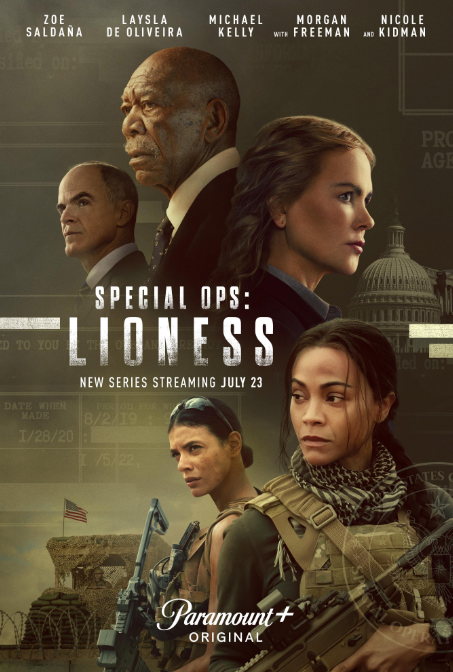
I just finished watching the 8th and final episode of the first season of Special Ops: Lioness on Paramount Plus, and here's my shot at a mostly non-spoiler review.
To begin with, this is a story about a recruit to a CIA hit team. The recruit is a woman, the target is an Arab oil magnate who funds terrorists, and the way the recruit is supposed to get to the target is she becomes friends with the target's daughter, so much so that she'll be invited to the daughter's wedding.
So, the first two parts -- the recruit being a woman, the target being a terrorist-funding oil dealer -- is obviously nothing new. But the way the recruit is supposed to get to the oil man is somewhat new, and the nitty gritties of the eight episodes are bristling not only with excitement but lots of originality.
Perhaps the most original is the impact this hit job has on three women: Cruz (the recruit), Joe (her superior and primary trainer), and Kaitlyn (head of the operation). I don't recall any CIA series in which women had so much power, and that in itself makes this series well worth watching. Men play important roles, for sure, but in many ways their most important roles are those that they play in the three women's lives.
And there is a fourth woman who also plays a central, crucial role -- Aaliyah, the target's daughter. Suffice to say that Cruz's mission to get to know Aaliyah has all kinds of unexpected consequences. Aaliyah is well played by Stephanie Nur, as is Cruz by Laysla De Oliveira. I don't recall seeing Nur on the screen before. De Oliveira was in Needle in a Time Stack, but I don't particularly remember her from that. It's a safe bet that I won't forget either of them after seeing Lioness. And Zoe Saldana as Cruz and Nicole Kidman as Kaitlin are of course very well known to me and everyone, but I've never seen them play characters quite like Cruz and Kaitlin. All of this adds up to characters who are fresh and powerful and convincing.
There were some cliched elements in the overall story, but I can't tell you what they are without giving too much away. But even if ten or twenty percent of the story is something we've seen in one way or another before, those kinds of tropes are unavoidable, and they really don't detract too much if at all from this blockbuster, painfully and redeemingly human, of a narrative.
Star Trek, since its birth in our popular culture in 1966 on NBC television, has led a remarkable life. Canceled after three seasons due to an insufficiently large audience - of which my wife (then my girlfriend) and I were devotedly among - Star Trek went on to break the hold of network television, with a series of series beginning with Star Trek: The Next Generation that went directly into successful syndication. As I pointed out in How Star Trek Liberated Television, this in retrospect was the beginning of television entertainment on cable and the Internet which is still burgeoning today. Along the way, Star Trek had some of best time travel stories (City on the Edge of Forever in the original series, Yesterday's Enterprise in The Next Generation) - keep that in mind - as well as some of the best humans meet alien stories ever told. I truly believe that when we eventually get beyond our solar system with faster-than-light travel in centuries to come - who knows, maybe decades - we will still be inspired by Star Trek as we navigate our way through the cosmos.
Star Trek also inspired other works in popular culture, including a whole bunch of movies, most of which were not as good, not even close, to best of Star Trek television. This is the challenge that J. J. Abrams and his colleagues took up when they set out to make a new Star Trek movie.
They decided to make a movie about the original crew and characters - Kirk, Spock, McCoy, Scotty, Uhura, Sulu, Chekov - before and during their first meeting up on the Enterprise. A movie about Star Trek Academy, detailing some of these budding relationships, had been talked about for decades. Abrams could have made such a movie, and it would no doubt have been excellent, a real delight for the fans, and everyone.
Instead, J. J. Abrams decided to something better. The reason, I'm sure, is that he didn't want to be locked into telling the same stories we already saw on television all those years ago, once again, now, on the big screen, if this movie succeeded. Nor did he want to be confined to filling in the gaps of what we already know about Kirk, Spock, et al....
So .... Abrams did something very different indeed. And here the story of the new Star Trek begins....
[[[SPOILERS BELOW HERE]]]
Kirk's father dies at the hands of Romulans, as Kirk's mother, pregnant with James T., escapes in a shuttle. The father has been Captain for all of 12 minutes. Some 25 years later, James Tiberius Kirk and Dr. Leonard "Bones" McCoy do meet up at Starfleet Academy. Uhura, whom Kirk has unsuccessfully flirted with, is there, too. And, of course, so is Spock, who is ahead of Kirk, and puts him to a famous test-
But the Romulans attack again - this time, Planet Vulcan. Star Fleet sends out a whole bunch of ships - including the Enterprise with Captain Pike in command, and Spock the science officer. By the time they get to Vulcan, Pike is in Romulan hands, and despite the best heroic efforts of Kirk and Sulu, and Spock, now in command, Planet Vulcan is destroyed, and along with it, Spock's mother-
Wait a minute! Vulcan destroyed? But didn't we see the planet, numerous times, in various episodes of various series of Star Trek? And Spock's mother, too?
Yes, of course we did! So, what's going on?
J. J. Abrams, in the sharp script written by Roberto Orci and Alex Kurtzman (all three of current Fringe fame), are giving us a splendid time travel story (shades of Lost). We get this spelled out to us in detail when young Kirk meets old Spock - played by Leonard Nimoy - who explains that Romulans killed Kirk's father after being whipped back in time from a future in which old Spock failed to save the Romulan home world.... And old Spock has been pulled back through time, too.
Now, if I were a sufficiently versed fan, I would have noticed at the beginning that this was another Star Trek universe - not quite the one we have seen on television and in theaters all of these years. Because no one ever said in a word in those about Kirk's father dying a few seconds after he was born. But Vulcan destroyed was more than enough to wake even me up that we were seeing something very different and daring here in which ...
Everything is new, to some lesser or greater extent, except old Spock, who has seen everything that we have on the screens over the years. Young Spock, smartly played by Heroes' Zachary Quinto, is also a new Spock - who has lost his mother and his planet, just as the new Kirk, perfectly played by Chris Pine, has lost his father. And young Spock (call him Spock 2) now lives in the same version of reality (call it Universe 2) as does old Spock (call him Spock 1). Old Spock's story along side of young Spock's story makes this Star Trek a sequel as well as a prequel.
There are other nice differences in this new reality. Spock 2 has a romantic relation with - Uhura, who's given a winning, sassy, refreshing performance by Zoe Saldana. But McCoy, wonderfully played by Karl Urban, is just and sarcastically funny as he should. And Simon Pegg's Scotty, John Cho's Sulu, and Anton Yelchin's Chekov are also fine and satisfyingly in character and ambiance - though poor Chekov, only 17 in the movie, and on the Enterprise earlier than he was in the original television series, is still stuck with that laughable Russian accent.
But Abrams has done the seemingly impossible, and done it with style and savvy - he has given us a genuinely new Star Trek, from the very beginning, with a genuinely new story - and even given us a witness to the original that we all grew up with, in the person of the original, older Spock. The story will live long and prosper indeed.