Chuck Todd interviews me about alternate histories
Showing posts with label Jerry Brown. Show all posts

Sunday, January 12, 2025

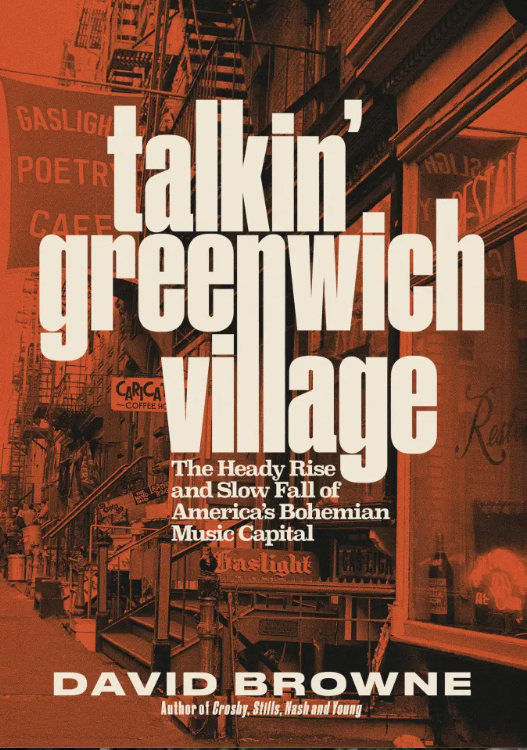
Review of David Browne's Talkin' Greenwich Village: Cornucopic Rainbow Biography


                                    more about the book here

If ever there was a time-travel ticket to a past and a place that you knew so well you could still see the sun glinting through the tree leaves, hear the din of the eateries as you walked by, and, most important, still hear the music that actually defied any given time or place, it would be David Browne's book, Talkin' Greenwich Village: The Heady Rise and Slow Fall of America's Bohemian Music Capital.  That's because Browne has a way of writing, an eye for detail, a penchant for commentary, that draws you in to fill the background you in one way or another actually experienced, or, what Marshall McLuhan called "cool".

Yeah, I sang doo-wop in Washington Square Park with my acapela group The Transits in the early 1960s, and then my folk-rock group The New Outlook a few years later (Ellie Greenwich and Mike Rashkow heard us uptown one Sunday afternoon in Central Park, and signed us to Atlantic Records, after changing our name to The Other Voices), but the way I really got to know the village was finishing up my BA in Journalism at NYU, then going a few blocks up to the New School for an M.A., then back to NYU for my PhD in the 1970s.  (I even managed to write three pieces for The Village Voice just before all that, my sum-total career as a music journalist.)

Turns out David Browne and I could have passed each other in the street -- David arrived to pursue his BA in Journalism at NYU in 1978, and I left, thankfully finished with school, in 1979 -- or bumped into each other going in and out of the diner southeast of the park.  But David stayed focused on the Village and its clubs and their music, to the present day, while I pursued music on the radio, MTV, iTunes, and anyplace I could hear it, and only came to the Village with my wife to eat in a great Italian restaurant near Houston Street, or go shopping at Balducci's.

And Talkin' Greenwich Village is one of the results of Browne's passion -- he's written more than half a dozen other books about popular music, and writes for Rolling Stone -- and delivers a cornucopia of vignettes, insights, and are what in effect mini reviews of dozens of artists.  You know, I always judge a book by how well it treats a subject I know something about.  My wife and I were/are devoted fans of Phil Ochs -- I consider his "The Crucification" right up there with the very best songs that Dylan wrote -- and Browne not only got everything right in his discussion of Ochs and his life in the Village (with an intermission in California) over the 1960s and 70s, until he took his own life the year my wife and I got married (we went to the Memorial Concert for Ochs that Browne also aptly describes), but I also learned something from his description of Ochs.  It's become hard-wired into Ochs's story that he was broken when Dylan did not include him in his Rolling Thunder tour.  But Browne provides a missing piece of the story, telling us how Ochs badgered Dylan, when Dylan was first beginning to put together the group that would tour.   Which means, it's not quite true that a callous or jealous Dylan simply didn't include Ochs on the tour.

But in addition to, I don't know, at least vignettes of 50 artists spread across 8 chapters and an Epilogue teeming with information -- Browne lists every interview he did for the book in its Bibliography -- he focuses on two artists, Dave Van Ronk, and the Roche Sisters (and, also of course, Bob Dylan), and makes them, in effect, centerpieces and guides to what Browne is telling us happened in these magical decades.  I only saw Van Ronk once (at the Phil Ochs 1976 Memorial  Concert at the Felt Forum) and the Roche Sisters only on YouTube.  But Browne's accounts of Van Ronk and of the Roches across the decades amount to mini but in-depth biographies of the two, and make Talkin' Greenwich Village irresistible reading just on their own.

But lest you think everything in this book is as serious as Ochs, or even Dylan, Browne also has a knack for the kind of detail that will make you chuckle, or even laugh out loud.  Seeking the name of a song on one of The Blues Project's just-recorded albums, the response to the person who's writing down the titles is "'What song? You mean Steve’s song?' To [Steve] Katz’s chagrin, 'Steves Song,' complete with a missing apostrophe, became the title."  Or, "when Orbison and Ronstadt huddled in his dressing room, [Jerry] Brown [then Ronstadt's boyfriend], waiting patiently outside, finally began pounding on the door: 'Let me in! I’m the governor of California!'''  Or, "the worst [performers in this Village venue] were booed or heckled. When asked if one contestant should be booted off the stage, [owner] Porco grumbled, 'No, I think we should shoot him.'”

Of course, no volume is perfect, and I'll tell you the one thing I missed in this New York Public Library of a book. I was a big fan of The Blues Project, and to this day I find myself humming or singing to myself "Cheryl's Going Home".  The song was written by Bob Lind (who wrote "Bright Elusive Butterfly of Love"), who does a pretty good job singing it.  But the Blues Project rendition, with those piercing guitar notes, and their interplay with organ, is something else.  Browne tells us almost as much about The Blues Project, Danny Kalb in particular, as he does about Van Ronk, the Roches, and Dylan.  But not a word about that elusive heart-breaker Cheryl.  I guess she was already home and out of sight.

But every page of this pulsating encyclopedia of whirling words is worth reading.  The fall of Greenwich Village and its clubs and taverns and whatever you want to call them brought tears to my eyes, because David Browne had made it seem like a beloved living organism, a mini gaia of music just several blocks long.  My only really lasting regret about this book is that it wasn't ten times longer.  As it was, it's 400 pages went by too quickly, because I just couldn't put the book down.

=========

Check back here at the end of the month for my upcoming interview with David Browne.

=========


                        in Kindlepaperback, and hardcover


Tuesday, May 31, 2016

Glad that Jerry Brown Endorsed Hillary Clinton

Good for Jerry Brown, Governor of California, to endorse Hillary Clinton today.  I met him about a decade ago when he was speaker at a conference about Marshall McLuhan at Fordham University, and our lengthy conversation before his talk confirmed what I already knew:  Jerry Brown is one of the brightest people, profoundest of thinkers, not only in politics but across the board in all professions.

He first caught my attention when he was serving as the 34th Governor of California in the mid-1970s through the early 1980s.   I was impressed by his championship of the space program, and his idea that California should get its own space effort going, with a space academy and its own satellite. This of course was not to get military advantage over an adversary, as the US space program had sought to do vis-a-vis the Soviet Union in the 1960s. Brown's idea showed a real understanding of the cosmic import of getting humans off this planet.

Brown's endorsement of Hillary also shows admirable integrity and clear thinking about what's best for the country today.  Given his nasty exchange in a 1992 Democratic debate with Bill Clinton about Hillary, Brown had every reason to go with Bernie now or sit this out.  But he correctly sees that Hillary will get the nomination, and a win in California can strengthen her hand in the battle ahead with Trump.

I look forward to Jerry Brown getting an important position that befits the depth of his intellect in the Clinton administration.


Saturday, December 3, 2011

A Progressive Libertarian in the Occupy Wall Street Age

It's been 3 and 1/2 years since I posted I Am a Progressive Libertarian, which received some 60+ comments, most in 2009 and 2010, most by people who argued that I wasn't really a libertarian, which I maintained I really was.  The gist of my position is we need (a) less or no government in regulation of communication, technology, etc., and strict enforcement of Constitutional provisions of government's capacity to wage war, collect data on citizens, etc., (b) more government involvement in providing health care (I see protection from microbial parasites or disease as akin to protection from human invaders), and (c) payment for necessary government by taxing the super-rich (as a goal, no taxes from any person or business earning less than $1,000,000 per year, greatly increased taxes for all people and corporations earning more than that per year). 

How does that position play in our Occupy Wall Street age?

1. The resurgence of direct democracy that is the mainspring of Occupy Wall Street is a straight-up staple of any libertarian philosophy.   Direct democracy intrinsically reduces government by replacing representatives of the people (in Congress, in state houses, and in city halls) with the people themselves as decision-makers.   See Occupy Wall Street, Direct Democracy, Social Media for more.  The failure of Congress to reach an agreement on budgetary issues this year is further evidence of the decline of representative democracy.  Referenda to recall or remove elected government officials, calls for a Constitutional Convention, and General Assemblies at Occupy sites are expressions of this new direct democracy.  Note that The Tea Party, which often presents itself as a conservative libertarian movement, is explicitly focused on electing representatives, meaning that, unlike Occupy Wall Street, The Tea Party is not pursuing direct democracy (though both movements arise from a common refusal to accept business-as-usual from current officials and representatives in government).

2.  Police brutality against protesters in Occupy Wall Street sites across America is precisely the kind of government trampling of communication - and abrogation of First Amendment rights to peaceably assembly - that the progressive libertarian seeks to prevent, restrain, punish, and stop.   Similarly, the obstruction of the press from covering the Occupy Wall Street eviction in New York by Mayor Michael "I Have an Army" Bloomberg is an outright violation of the freedom of press provision of the First Amendment.   The failure of President Obama to condemn all of these violations in the U.S., and of Governor Jerry Brown to do the same in California, is yet another example of the exhaustion of representative democracy in our digital/street age.

3.  The 99% vs. 1% focus of Occupy Wall Street is exactly what I have in mind with the goal of no taxes for any person or business earning under a million dollars per year, and sharp increases in taxes for all earnings above one million dollars per year.   Bank of America's decision to rescind its plan to charge $5 a month for use of debit cards is a small but first explicit victory of the 99% over the 1%.

In sum, the progressive libertarian approach is not a call for yet another political party.  It is, rather, a philosophy, a perspective, which I see as consonant with Occupy Wall Street and hope will ring a bell with those seeking less government in our political  lives and more government responsiveness to our human needs, financed by the super-wealthy.   As a citizen, I intend to continue to shine an uncompromising light on the government's escalating violation of our First Amendment rights.

See also I Am a Progressive Libertarian and The Occupy Wall Street Chronicles, Part 1

-Paul Levinson, PhD
Professor of Communication and Media Studies
Fordham University

Wednesday, November 30, 2011

Occupy Wall Street Chronicles, Part 1

I offer ongoing commentary about Occupy Wall Street, September 27 through November 23, 2011.  The commentary first appeared in 15 blog posts - dates, titles, and links to the text of the blog posts are listed below.  Main themes include Occupy Wall Street as a resurgence of direct democracy, police violation of the First Amendment in their violence against protesters and the press, failure of the Obama administration to protect the rights of Occupy citizens attacked by munipalities, and much more.  The audio podcast is about 55 minutes in length.  It is intended as both analysis and eyewitness to one of the most important revolutions in human history.  Further chronicles will appear here in subsequent months.


audio podcast: Occupy Wall Street Chronicles, Part 1


  1. Sept 27, 2011 NYC Police Disgrace Themselves in Brutal Treatment of Wall Street Protesters
  2. Oct 6, 2011 Advice to President Obama: Join Occupy Wall Street
  3. Oct 16, 2011 Occupy Wall Street, Direct Democracy, Social Media: A Thumbnail History of Media and Politics Since Ancient Athens
  4. Oct 21, 2011 Obama Should Call in National Guard to Restrain NYPD in Occupy Wall Street
  5. Oct 26, 2011 No Expiration Date on First Amendment
  6. Oct 29, 2011 Into the Mind of a Conservative Bully
  7. Nov 2, 2011 Bank of America Bends to Will of the People
  8. Nov 10, 2011 Open Letter to Governor Jerry Brown
  9. Nov 13, 2011 Lame CBS Broadcasts Only First Hour of Republican Foreign Policy Debate
  10. Nov 15, 2011 Mayor Bloomberg's Poor Understanding of the First Amendment
  11. Nov 16, 2011 Violation of First Amendment to Cover Up Violation of First Amendment
  12. Nov 20, 2011 What OWS Has Shown Us about Bloomberg, Jerry Brown, Obama
  13. Nov 20, 2011 Jay Carney (and Obama) Have It All Wrong about Police and OWS
  14. Nov 20, 2011 Failure of Budget Super-Committee Shows Further Decay of Representative Democracy
  15. Nov 23, 2011 First Amendment Trampling Bloomberg Caves: NYPD Ordered to Let Press Do Its Job
My television interviews about OWS ... with Chuck Scarborough on NY Nightly News ... on FOX 5 NY ...

Relevant movie ... Tiffany Shlain's Connected moive

Blog posts since the audio podcast  (to appear in Occupy Wall Street Chronicles, Part 2) -

  16.  Nov 25, 2011: Cairo and New York: A Tale of Two Related Cities
  17.  Nov 26, 2011: LA Woman Could Be Charged with 'Battery" for Pepper Spray - How About 
         UC-Davis Cops?
  18.  Nov 27, 2011: The Pike Pepper Spray Meme:  Pros and Cons
  19.  Dec 3, 2011:  A Progressive Libertarian in the Occupy Wall Street Age
  20.  Dec 9, 2011: More Lies from Mayor "I Have an Army" Bloomberg about OWS and the Press


transcript vidcast of OWS Chron 1 - thanks to Claude Almansi

Saturday, November 26, 2011

LA Woman Could Be Charged with 'Battery" for Pepper Spray - How About UC-Davis Cops?

I just heard that the woman who pepper sprayed shoppers in Los Angeles to get an edge on bargains could be charged with "battery".  Seems right.

And what about the UC-Davis police who pepper sprayed non-violent students week before last?

No such justice.

At least, not so far.   The two cops who pepper sprayed the students, and the head of their UC-Davis police unit, have suspended with pay, pending investigation.

Are students in California worth less as human beings than shoppers, or are cops out there somewhere above the law?

If anything, the cops should be charged with a crime worse than what was brought  against the pepper sprayer of shoppers.  Police are (a) paid by taxpayers to (b) protect not attack law-abiding citizens.

If anyone should be suspended - without, not with,  pay - it should be the officers who stood around, watched the two pepper-spraying cops, and did nothing.

I'd like to think that most police in America wouldn't stand by when their colleagues were breaking the law, and certainly wouldn't break the law by assaulting peaceful protesters themselves.   We do every good police officer a disservice by going easy on the rotten apples in uniform.

Governor Jerry Brown of California, is there any reason you're not saying this?   How about you, President Obama?


Occupy Wall Street Chronicles, Part 1


Sunday, November 20, 2011

What OWS Has Shown Us about Bloomberg, Jerry Brown, Obama

Mayor Michael Bloomberg of NYC:  Trampled on the First Amendment freedom of peaceable assembly rights of Occupy Wall Street protesters  in Zuccotti Park; trampled on First Amendment freedom of press rights of all New Yorkers and Americans by banning media from his forced eviction of Zuccotti Park protesters; has supported police beating of protesters, roughing up of journalists, arrest of protesters and journalists; conspired with 17 other mayors to launch nation-wide clearing of OWS sites in cities across America.   I would not vote for him if I lived in NYC (where I work);  I will never vote for him for any other offices; I would like to see a Federal investigation into his OWS conduct.

Governor Jerry Brown of California:  Has remained silent as police in cities and campuses in California have shot rubber bullets at protesters (one point blank at the head on an Iraq War veteran that put him in the hospital in critical condition) and people with camera phones, used pepper spray on students at UC-Davis, and beat students at Berkeley.  I once admired his vision and had an impressive, hour-long conversation with him at  Fordham University when I was Chair of the Department of Communication and Media Studies several years ago.   I no longer admire him, to say the least, and unless he moves very quickly now to protect the people in his state from police brutality I will speak out against him if he runs for any office again.

President Barack Obama of the United States:  Has also been silent about all of the above.  I voted for him in 2008, and wrote and spoke out in his favor many times (see the many posts in this blog).  His silence about the above attacks on Americans exercising their First Amendment rights are making me begin to wonder if I will able to vote for him again.


my interview on NY Night News about Bloomberg


Occupy Wall Street Chronicles, Part 1

Thursday, November 10, 2011

Open Letter to Governor Jerry Brown

Dear Jerry -

We met several years ago, when the Department of Communication and Media Studies at Fordham University - of which I was then Chair - invited you to give one of our annual lectures about Marshall McLuhan.   You and I had the opportunity to have an excellent, wide-ranging talk about media and society, prior to your lecture.   I was already an admirer of your perceptive vision and understanding of our society.  I consider of our conversation one of the best I've had with anyone.   I was, therefore, delighted with your re-entry into politics, and cheered when you were again elected Governor of California, even though I'm a New Yorker, through and through.

But with this in mind, I've been stunned to see what your police have doing in your state.  And I find your lack of public response incomprehensible.

What on Earth is going on with you and the state of California?

A former Marine - an Iraq War veteran - was shot point blank in the head by a rubber bullet, landing him in the hospital in critical condition.   A person who dared to point a video camera at police in another protest was shot at point blank range in the body with a rubber bullet.  Just last night, I saw a video on YouTube of your police beating students who dared to stand up for their First Amendment rights at Berkeley.

What on Earth is going on in California, and why are you doing nothing about it?

As you must know, none of the Occupy protesters in these incidents were the least bit violent.  In some cases, a few raised their voices a little.  All of this is their right under the First Amendment, to "peaceably assemble".

I am surprised and deeply disturbed and saddened that you seem unwilling or unable to use the power of your office to curb your police.  Do you think rubber bullets which send citizens to the hospital in critical condition are a proper response to people who are assembling and raising their voices in protest of the economic and other inequalities in this country?  Whether the police are local, or even security forces at a private institution, this brutality is happening in your state, and, as Governor, it is your responsibility to stop it.

I know you were once in a seminary, and thought of joining the priesthood.   I was always glad that you brought that sensitivity, that awareness of the human condition, to your important work in government.

The nation, and your state, stand at a crossroads now.  You can make s decisive difference in the outcome, and help our nation continue on it path to a better democracy.   You can become a national leader on the side of the angels and the Constitution in this.

Please stop your out of control police, before lives are lost, and you miss your chance.

-Paul Levinson, PhD
Professor of Communication and Media Studies
[Chair of Department, 2002-2008]
Fordham University


Occupy Wall Street Chronicles, Part 1
InfiniteRegress.tv