
Chuck Todd interviews me about alternate histories
Showing posts with label Buddy Holly. Show all posts

Tuesday, December 2, 2025

Paul Anka: His Way: The Right Way (Except for One Missing Song)


My wife and I saw Paul Anka: His Way, a 2024 documentary, last night on HBO.  Why did we wait so long to see it?  I don't know. Probably because we weren't paying enough attention.

I've been a fan of Anka since 1957, when I was in 5th grade in PS 96 in The Bronx, and Anka had a great hit, "Diana".  Joel Iskowitz, Jordan Axelrod, Steven Auerbach, and Paul Gorman were in my class.  I started an acapella group, Little Levi and the Emeralds.  I don't think we sang much of "Diana" -- we were more into The Five Satins, The Harptones, and The Del Vikings -- but we sure loved it.

Anka explains and demonstrates at the beginning of the documentary that the ease of playing those 4-chord songs -- C, Am, F, G -- when he sat down at the piano was what drew him into singing and then writing.   And he progressed in extraordinary ways, writing "My Way" for Sinatra, the Johnny Carson theme song, and even some songs with Michael Jackson.  He also wrote "It Doesn't Matter Anymore" for Buddy Holly and "She's a Lady" for Tom Jones, and those are just a fraction of the more than 900 songs Anka has written!

Of course, no documentary can play even small parts of most of that number of songs, but the question always arises (for me, at least) of what songs would I have liked to hear and see Paul Anka perform in His Way?  And, yes, there is one, in particular.  It's a song that played a crucial role in Amazon's adaptation  (by Frank Spotnitz) of Philip K. Dick's The Man in the High Castle, which ran for four seasons (2015-2019) and helped establish streaming as the titan it is today,  The first episode of the second season in 2016 opens with an extended mise-en-scène of protagonist John Smith's (Rufus Sewell brilliantly portrays Smith) young teenage son Thomas getting off the school bus and walking into class.  Everything seems so normally, happily, suburban American, as Thomas Smith (good job Quinn Lord) looks at the girls and walks into school.  We begin to get a disquieting taste of this alternate history in which the Nazis beat America in the Second World War when we see the Nazi insignia on Thomas's arm and then a kid in the class asks Thomas how many slaves George Washington and Thomas Jefferson had.  Thomas Smith then looks at a girl in the class in that certain way, she looks back at him when he isn't looking, but the joy of that budding teenage romance is shattered to pieces for the TV viewer when Thomas is called up to the front of the class to give a Nazi pledge of allegiance that he does with pride.  

Now, this is one of Spotnitz's best conceived and realized scenes, and he hammers it home playing Paul Anka's 1960 hit song, "My Home Town," loudly and softly in the background until Thomas begins the pledge.  This is an upbeat, zestful song, brimming with the enthusiasm and pleasures of living that is a hallmark of Anka's music, especially his early recordings -- the perfect background for the unnerving perversion of American life that the Nazi conquest has wrought.


So, yeah, I missed "My Home Town" in Paul Anka: His Way -- especially given the steps to fascism our country is currently taking -- but the documentary is titled "His Way", that is,  Paul's way, and/or the movie's director and writer John Maggio's way, not my way, and as I've been known to say to someone who tells me that they would have had a character in one of my novels do or say something different than what I had them do or say: hey, go write your own novel. :)   And all in all, there's not much I would change in this rendition of Anka's incredible inspiring life and journey.  At 84 years old, he's still going strong, hasn't reached the top of the mountain yet (as he says), and I'm looking forward to hearing and hearing about the rest of the climb.
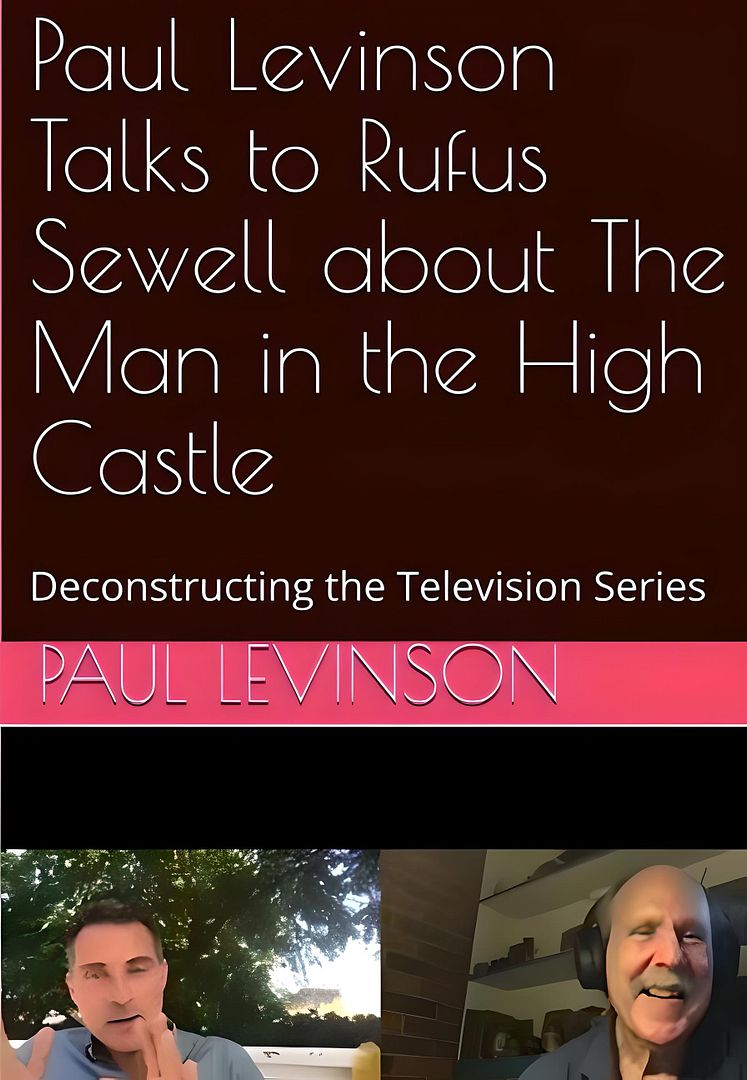


more about this book here

Wednesday, January 23, 2019

Project Bluebook 1.3: Peggy Sue Gets Space Ship


I'm continuing to enjoy Project Blue Book - as a science fiction story based on some actual events.  Along those lines, it would be a great twist if Hynek himself was an extraterrestrial, wouldn't it.  Such a move would have about the same relationship to reality as most of the other high points in this series.

Take our government organizing a massive coverup, and urging Hynek and Quinn to help them sell this to the public.  The truth is that our government was engaged in all kinds of coverups in the Red-scare 50s.   The government is no doubt involved in all kinds of coverups today.  But that's still a long ways off from a coverup specifically being about sundry alien sightings.

Episode 1.3 takes us to Lubbock, Texas in 1951, where strange lights were seen for many nights in the sky, and, according to some reports, a guy's truck was demolished but he escaped physically unscathed.  Hynek and Quinn investigate, and encounter a professor who concluded the lights were made by a formation of plovers - flying terrestrial birds, not extra-terrestrial spaceships (in reality, Hynek actually learned this from the professor years later, in 1959, but ok).  Unsurprisingly, Hynek and Quinn don't put much credence in the professor's assessment, though Quinn is always happy to acquiesce to his superiors' commands.   (I predict, though, that as this series progresses, he'll come to reject them.)

So Lubbock goes down as a major example of another government-suppressed incident of visitation from outer space.  One facet not explored in this episode is the connection of all of this to Buddy Holly, Lubbock's best known citizen.   He appeared on television for the first time in 1952, just a year after the Lights.  He had a fabulous, original voice, and wrote irresistibly catchy songs, loved by the Beatles and everyone else.  Could Buddy have been influenced by those lights in the sky, inspired by them to change the world with his music?

Now that would be a story.

See also:  Project Blue Book 1.1: Science Fiction, Or? ... Project Blue 1.2: Calling Roy Thinnes


here I am talking Ancient Aliens a few years ago on the History Channel


Wednesday, May 24, 2017

Review of Rob Sheffield's Dreaming the Beatles 2 of X: The Heroine with a Thousand Faces

Among Rob Sheffield's many talents as a Beatles journalist - not historian, because, as Sheffield convincingly demonstrates, the Beatles are far more important today then when they were writing and recording as a band, which back then was extraordinarily important indeed - but among the delightful ways Sheffield makes his case is by fashioning his arguments from the Beatles' lyrics, so deftly that you don't even want a quote.  Talking about John Lennon's unquenchable need to make a girl care, to make her "feel something," Sheffield concludes "Because if he doesn't reach her, the song is worthless and so is he.  It's a love that lasts forever, it's a love that has no past".

And what that does, of course, is bring in the music and Lennon's voice in "Don't Let Me Down" as irresistible and utterly convincing accompaniment to Sheffield's point.

And that's just one example of many.  And I've only just finished the first chapter (or perhaps the second, if you count a Prelude as a proper chapter).

But what Sheffield's literally lyrical mode of discourse also does is support the very thesis he's making in this remarkable book as a whole: that the Beatles, like the love Lennon is singing about, will indeed last forever.   Evidence of this ticket to eternity is that the words of the Beatles are now so fully in our psyches that they don't require quotes.

But they do have a past.   As Sheffield explains, the Beatles invented all kinds of things - the totally self-contained band,  or one that not only plays its own instruments and sings, but writes its own songs, and the band that constantly re-invented itself, using its success as a platform to create new kinds of music which all but replaced rather than built upon their earlier successes.

We (I was born in 1947) knew this at the time - we were well aware of what rock music was like before the Beatles, when groups stayed with the genre that propelled them to fame, and most singers did not write their own songs.  (Roy Orbison did, but his music, though sublime, barely evolved. Buddy Holly sometimes did, but tragically didn't live long enough to evolve.)

The other theme in this first chapter is the preeminence of girls in the Beatles' story - not just as the essence of whom the Beatles most wanted to impress (or, Paul and John, anyway), but in the sheer variety of girls/women who appear in Beatles' songs.  "Does the 'Martha My Dear' girl fall in love with the boy?  Or does she leave him like the 'For No One' girl does?  Does the 'Ticket to Ride' boy ever get her back?" (Or maybe they're all the same girl, a heroine with a thousand faces - it amounts to the same.)  (To matters even more interesting, Paul at some point famously said Martha was a canine, but when people first heard the song, no one knew that.)

Well, you get the picture - and not only that.  Sheffield also sees part of the very persona of The Beatles as feminine - after all, look at their long hair.

Hey, I gotta end this now.  We'll be off to the Cape tomorrow.  But I'll be driving with The Beatles channel on.   And the next part of this review will be written just a few feet from the shoreline. Which should work out well, seeing as I heard the Beachboy-Chuck Berry-inspired "Back in the USSR" for the first time in years today.

See also Review of Rob Sheffield's Dreaming the Beatles 1 of X: The Love Affair ... 3 of X: Dear Beatles ... 4 of X: Paradox George ...  5 of X: The Power of Yeah   ... 6 of X: The Case for Ringo ... 7 of X: Anatomy of a Ride ... 8 of X: Rubber Soul on July 4 ... 9 of X: Covers ... 10 of X: I. A. Richards ... 11 of X: Underrated Revolver ... 12 of X: Sgt. Pepper ... 13 of X: Beatles vs. Stones ... 14 of X: Unending 60s ... 15 of X: Voting for McCartney, Again ... 16 of X: "I'm A Loser" ... 17 of X: The Split ... 18 of X: "Absolute Elsewhere" ... 19 of X: (Unnecessary but Brilliant) Defense of McCartney ... 20 of X: "All Things Must Pass" ... 21 of X: Resistance ... 22: The 70s Till the End ... 23: Near the Science Fiction Shop ... 24 of 24: The Last Two

And here's "It's Real Life" -- free alternate history short story about The Beatles, made into a radio play and audiobook and winner of The Mary Shelley Award 2023


Saturday, April 28, 2012

The Third Returns with Exits

Emon Hassan's The Third returns with its second episode - "Exits" - this Tuesday, May 1.  If ever there was a medium is the message movie, ala Marshall McLuhan, "The Third" would be it (even though McLuhan liked tetrads better than triads).   This is because the story, quiveringly, quietly terrifying, is told with not much content.

But I'll tell you a bit about the content, anyway.  An old woman is stretched out, eyes closed, in bed.  I thought she was dead, until she smiled.   Her son kneels by her bed, and cries.  Maybe she was dead, after all.

There's not much of the emotive actor Philip Willingham in this episode, except that haunting face, at the beginning.  But there's a guy who looks like an elderly Buddy Holly, or maybe Elvis Costello, if he'd continued with his Buddy Holly look.  And the woman and son.


The music by Kevin Mahonchak is superbly eerie and unsettling, as is the cinematography by Hassan.  The second episode of The Third premiering on the first (you knew that was coming) is just five minutes or so, with four more episodes to follow.  In case it's not apparent, there's a kind of music of the spheres, mathematical synchronicity to The Third, not only in its name but its presentation.


Reviewing last week's episode of Mad Men, I said it felt like it had been directed by some David - Cronenberg or Lynch.  The same could be said of the shot of other-worldliness to the cortex that is The Third.  You can catch the start of Exits (a rearrangement of exist) only on the Web, on Tuesday, over here - where you can also see all six episodes of last year's pilot, right now.  Click on the label "The Third" below to read my reviews of three of those.


Wednesday, March 4, 2009

Lost 5.8: True Love Ways

A fabulous, very satisfying all-island episode 5.8 of Lost tonight - one of the best Sawyer episodes, and, for that matter, one of the best Lost episodes of all time, also.

Speaking of which - time - Sawyer, Juliet, Miles, Faraday, and Jin are back in the 1970s, and the island has stopped skipping, due to Locke's turning of the wheel. We get a great immersion in prime Dharma time - before Ben and his father have arrived. Horace (who met Ben's father and mother on the road in Oregon) is head of the Dharma island crew. He's married to Amy (played by Reiko Aylesworth - Michelle Dressler on 24, and a pleasure to see again), who is having his baby boy.

But the real love story, and it's a wonderful one, is between Sawyer and Juliet. She's got Sawyer's back, as he says, and he enables her to recover her confidence, culminating in her successful delivery of Horace and Amy's baby.

Has Sawyer really gotten over Kate? We'll find out soon, because tonight's episode ends with Sawyer going out to meet Jin, who has picked up Hurley, Jack, and Kate (having traveled back from LA and through time on that plane that fell from the sky last week). I've got to say that ...I'm rooting for Sawyer and Juliet, they were so good together tonight. But it won't be easy - and, Juliet may well have some feelings for Jack. But Sawyer and Juliet never looked happier. (And Sawyer was back in primo wise-cracking form - aptly calling Faraday "Plato").

Faraday may be due for some happiness, too. Charlotte disappeared before the island stopped skipping - she wasn't dead, Faraday told Sawyer and Juliet - she just disappeared. This seems to mean that she was never on the island. And the fact that Faraday sees Charlotte as a little girl in Dharma town means that maybe he will warn her a little more strongly this time not to come back to the island as an adult, which means that Faraday could go find Charlotte off-island at some point, and they could live happily ever after, as I suggested a few weeks ago.

But that's getting a little ahead of the game. For now, it's good to see true love ways on that time-jangled island. I could almost hear Buddy Holly's voice over the credits.

5-min podcast review of Lost 5 Hr 8


More Lost - see
: The Richard-Locke Compass Time Travel Loop ...

and Lost Returns in 5 Dimensions and 5.3: The Loops, The Bomb ... 5.4: A Saving Skip Back in Time ... 5.5 Two Time Loops and Mind Benders ... 5.6 A Lot of Questions ... 5.7 Bentham and Ben


Special Discount Coupons for Angie's List, Avis, Budget Rent-a-Car, eBags, eHarmony, eMusic, Nutrisystem


The Plot to Save Socrates


"challenging fun" - Entertainment Weekly

"a Da Vinci-esque thriller" - New York Daily News

"Sierra Waters is sexy as hell" - curled up with a good book


more about The Plot to Save Socrates...

Get your own at Profile Pitstop.com


Read the first chapter of The Plot to Save Socrates
.... FREE!
InfiniteRegress.tv