Chuck Todd interviews me about alternate histories
Showing posts with label Ridley Scott. Show all posts

Friday, August 1, 2025

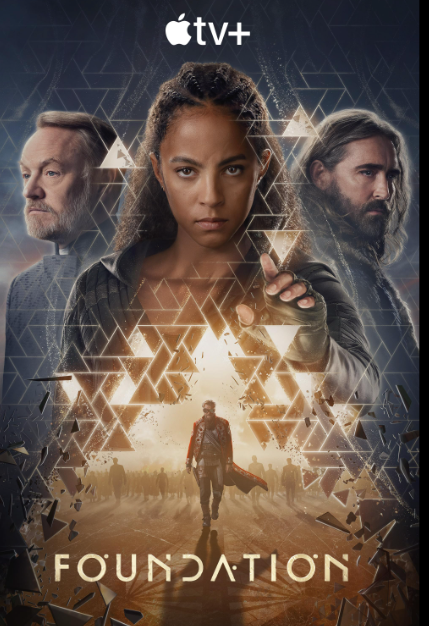
Foundation 3.4: Cleon Knows His PKD

Another superb episode in the third season of Foundation -- 3.4 -- in which the series continues to integrate the Cleon triumvirate story with Asimov's original Foundation trilogy, alternated in many ways but still ringing true enough to Asimov's vision to be expansive rather than smothering of what Asimov put on his pages.

My favorite sliver of a scene has Day chiding Demerzel with a question borrowed and transmuted from Philip K. Dick's 1968 novel, Do Androids Dream of Electric Sheep, brought to the movie screen in 1982 by Ridley Scott as Blade Runner.  Day concludes his testy conversation with Demerzel -- he's understandable uncomfortable with her -- with a question, "Do robots dream of wiping their own asses?" Not as elegant as Philip K. Dick, but, hey, a lot of years have passed since he came up with that title.

And it was good to hear Demerzel talk about Asimov's three laws of robotics, and then the zeroth law, as she struggles to understand how she has evolved, who and what she's become and must do.  She's an advanced piece of work, indeed.  Not only can she think and talk with her head physically detached from her body, she can navigate the complexities of the universe with the best of 'em -- e.g., Hari and Gaal -- and knows that the Second Foundation is the best way of stopping The Mule.

[Spoilers ahead ... ]

Speaking of which -- the Second Foundation and The Mule -- I actually like that Pricher wasn't converted by The Mule (who did manage to read his mind), and is literally in league with Gaal.  This is a significant departure from Asimov's story, and I think it's a good one.  I've always been at least slightly unhappy about Pricher's conversion to The Mule all those years before their story was streaming on Apple TV+, and it will be fun to see where this twist goes.

Gaal continues to play a vastly more important role in this rendition of the Foundation saga than her male counterpart in the trilogy.  Not only is she in bed with Pricher, she has intellectually seduced Dawn, and drawn him into the cause of the Second Foundation.  As I said in a previous review, this realignment of the major players in the story of The Mule, in which powerful elements of the Empire are joining the Foundations in their desperate looming war with that demon manipulator of minds, is refreshing and promises some major unexpected developments.  As became clear back in the days back when television was just being born as a mass medium, Seldon's psychohistory can only go so far.

See also Foundation 3.1: Now We're Talkin'! ... 3.2: "The Fault, Dear Brutus, Is Not in Our Stars" ... 3.3: Dawn and The Mule

And see also Foundation 2.1: Once Again, A Tale of Two Stories ... 2.2: Major Players ... 2.3: Bel Riose and Hari ... 2.5: The Original Cleon and the Robot ... 2.6: Hari and Evita ... 2.7: Is Demerzel Telling the Truth? ... 2.8: Major Revelations ... 2.9: Exceptional Alterations ... Season 2 Finale: Pros and Cons

And see also Foundation 1.1-2: Mathematician, Man of the People, and Cleon's Clones ... Foundation 1.3: Clonal Science Fiction, Hari Seldon as V. I. Lenin ... Foundation 1.4: Slow Hand, Long Half-Life, Flipped Coin ... Foundation 1.5: What We Learned in that Final Scene ... Foundation 1.6: Folded Variations ... Foundation 1.7: Alternate History/Future ... Foundation 1.8: Divergences and Convergences ... Foundation 1.9: Vindication and Questions ... Foundation Season 1 Finale: Right Up There


Tuesday, September 1, 2020

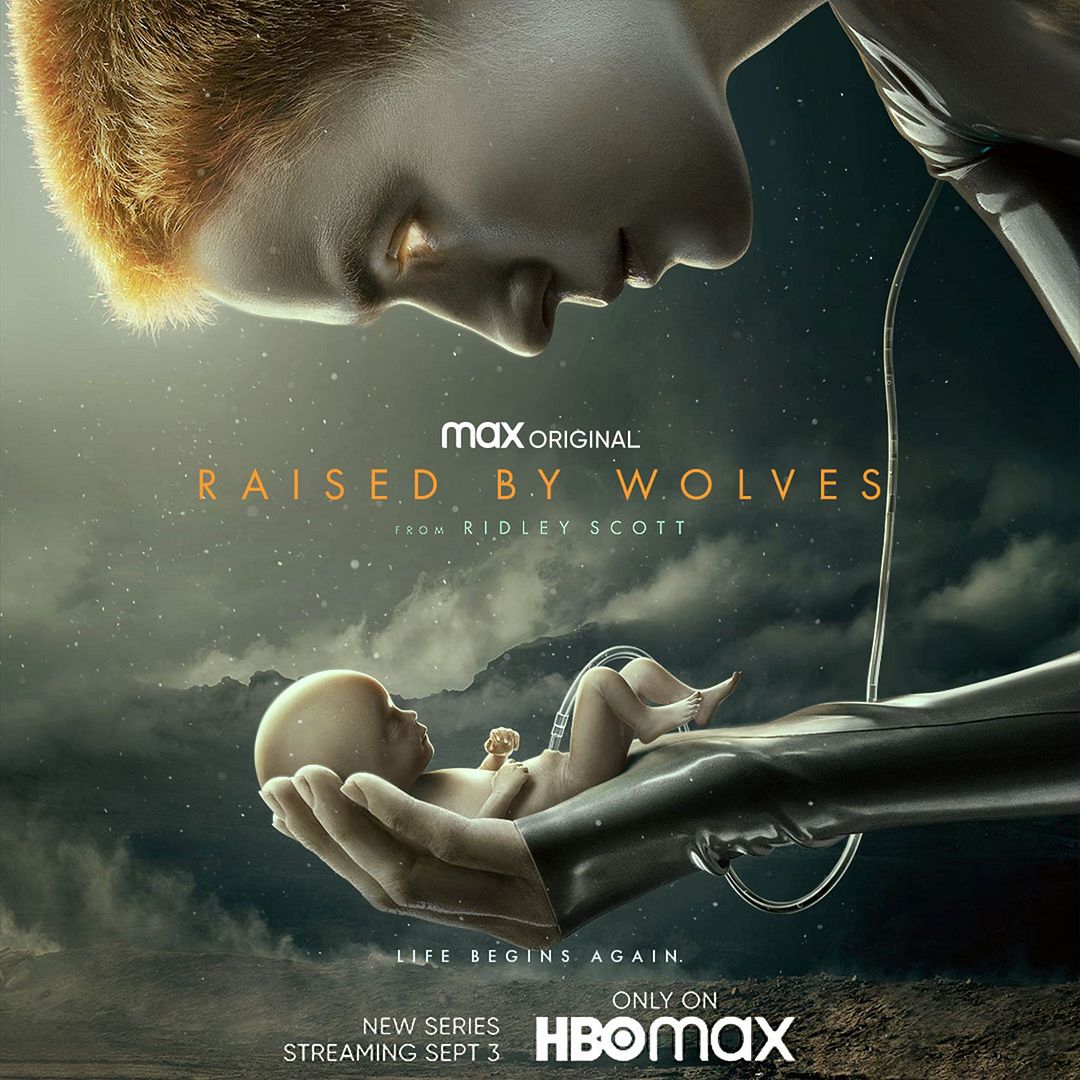
Raised by Wolves 1.1: Fast Action and Deep Philosophy


I just saw Raised by Wolves 1.1, courtesy of HBO Max, where the series is set to debut this Thursday, September 3.  In a sentence, it's a big concept, altogether excellent combination of fast action and deep philosophy, as befits Executive Producer Ridley Scott, and especially well-suited to our pandemic ridden time, when the very fate of humanity could well be at stake if things get much worse.

The narrative features androids and space travel (the action) and a conflict between true believers and atheists (the philosophy) who have left a dying Earth.  As such, the series is one big step more promising than the excellent Westworld, at least to my science fictional tastes, because it tells a story not only of humans and androids, but sets it way out in space, on a planet around another star.   The flavor is therefore closest to 2001 than anything else, even though Raised by Wolves has not much else in common with Clarke's story and Kubrick's movie.

The special effects and overall cinematography are top-notch to the point of breathtaking at times.  The acting is also fine, and it was good to see Travis Fimmel from Vikings back on the screen.   Amanda Collin is fine as Mother the android, and her character comes with the awesome power of killing everything around her with a scream (reminds me, in an odd way, of the episode "Sound that Kills" in the ancient Science Fiction Theater television show).  Munro Lennon-Ritchie and Jadon Holdsworth as Campion put in good performances, and it will be fun to see how this crucial character - a young boy whose allegiances to belief have not been settled as yet - develops.

I'd add that if ever there was a series I wanted to binge-watch to the end - at least, of this first season - Raised by Wolves appears to be that.   But I'll take it the way it's being presented, and will be back here with subsequent reviews.


Saturday, October 28, 2017

Bladerunner 2049: The Only Better Movie of this Kind is Bladerunner, and Hey


I loved it.  So did my son Simon, who's now a father of his own.  We loved it almost as much as the original Bladerunner, which we saw more than once on videotape, before there even were DVDs for rent, back in the early 1990s.   That's high praise.  The only reason Bladerunner 2049 wasn't as good as Bladerunner circa 1982 was that the 1982 movie broke so much new ground.  Back in the mid-80s, when I was teaching in the MA in Media Studies Program at the New School, I asked Stephen Jacobs (who then was my student, and has long since become a professor himself, at the Rochester Institute of Technology) to give me an example of cyberpunk.  "Bladerunner" he replied.  It defined the field, at least in the movies.  It was and still is that good.  Not only that, it began Philip K Dick's run of stories made into great movies and TV series, with the current example of The Man in the High Castle on Amazon.  And it inspired me to write The Civil Right of Robots.

But Bladerunner 2049 did as outstanding a job as could be done in a sequel for that kind of movie - moreover, a sequel on the screen some 35 years later.  Rather than reviewing the plot, or even the acting - other than mentioning that both were excellent, and Ryan Gosling as "K" and Harrison Ford reprising his Deckard role were especially excellent - I'll go over certain points and questions which capture this visually and intellectually stunning film (and there will be spoilers):

  • Did you catch that "CCCP Soviet" sign on the building in LA?  How could the Soviets still have a sign on a building in 2049?  Maybe Putin managed to restore the Soviet Union?  Possibly.  But I think a better explanation is that Bladerunner 2049 and in turn Bladerunner are and were alternate realities from the outset.  Or, at least they are now.  The Bladerunner of 1982 took place in 2019, in a world that doesn't look much like our world does now, in 2017 (except insofar as Times Square has seemed increasingly Bladerunner-inspired in the past decade). So the makers of Bladerunner 2049 had to make a sequel in a world that looked 30 years later than the world of 2019 and how it was depicted in 1982.  That world has Japan much on its mind - Japan looked like it could become the dominant computer power back then - and, of course, the Soviet Union and Russian were in everyone's head, too.  Bladerunner 2049 has both Russian and Japanese all over the scenes. It could have not flashed Soviet at all,  and benefitted from the unexpected prominence of Russia in our popular culture in the past year.  But instead the sign says CCCP and Soviet - as a shorthand for saying this is the future of Bladerunner 1982/2019, not our future.  Very nice touch.
  • Did "K" die at the end?  The convention in movie-making is that if (a) you're very badly wounded, and (b) you're lying motionless with your eyes open, then (c) you're dead.  On the other hand, we've learned that the replicants can only be killed when their brains are destroyed, by a bullet, or, in the case of Niander's evil, powerful, beautiful replicant apprentice, by deprivation of oxygen because K drowned her.  But nothing like that happened to K.  He's been badly wounded - but I'd put my money on his not dying.
  • So, is Deckard a replicant or not?  On the yes side, he has a pretty high survival quotient, too.  And he did father a replicant with Rachel, who definitely was a replicant.  But, wait, that's also evidence that he isn't a replicant, right?  I mean, isn't it more likely that human sperm and replicant ovum created a living being, than replicant sperm and replicant ovum?  I think so.  I am a little less sure that Deckard is human than K is alive, but I'd go with Deckard as human if push came to shove.
  • I enjoyed the Elvis in what's left of Las Vegas hologram, with a quick shot of Marilyn Monroe thrown in.   (I just published Marilyn and Monet, so I'm always glad to see her given screen time, or for that matter, stage time, as in Anthony Marinelli's Max & Domino which I reviewed here just last week.)  But Elvis belting it out on a stage is a fine homage to David Lynch, and there was a touch of Twin Peaks, somehow, in Bladerunner 2049.
Highly recommend, for the senses and brain.  Bladerunner 2049 is 2017 movie-making at top of its game.  Kudos to Ridley Scott and everyone involved in this movie.


It all started in the hot summer of 1960, when Marilyn Monroe walked off the set of The Misfits and began to hear a haunting song in her head, "Goodbye Norma Jean" ...

Sunday, November 22, 2015

The Man in the High Castle 2-10: Timely Alternate History Par Excellence

There couldn't be a better time to see The Man in the High Castle - actually, any time would be great - but recent events make this weekend an especially chilling and resonant time to see the 10-part television series on Amazon, based on the Philip K. Dick justifiably lionized novel of the same name. The United States and the civilized world are involved in a 21st century version of a world war, this time against DAESH aka ISIS, with the latest atrocity committed in France last week; Donald Trump is calling for registration of Muslims in the United States, a move that recalls how Nazis began their persecution of Jews; and DAESH regularly releases videos which show what they expect to be doing to the world in the near future.

The Man in the High Castle debuted its pilot in January of this year, and I thought it was superb.  My review is here.   I found the rest of the season in some ways better than the pilot, in a few ways not as good, but altogether also superb and deserving of being called a masterpiece.

Since this isn't a comparative media paper, I won't get into the differences and similarities between the novel and the television series,* other than to say there indeed significant differences and similarities, I liked most but not all of the changes, and you can 100% enjoy the television series without having read the novel, if that's what you'd like to do.

Germany and Japan winning World War II and splitting up the United States remains a brilliant alternate history tableau, as is the peek into the alternate reality of that alternate reality in which we won after all - i.e., the reality which you and I inhabit.   The attention to alternate reality detail is riveting, ranging from 1962 American hit records sung in Japanese in San Francisco, to the Nazi celebration of "VA Day" as in a nightmarishly twisted 4th of July, firecrackers and all, at the Long Island home of Obergruppenführer John Smith, well played by Rufus Sewell (Alexa Davalos was also especially good as Juliana, as was Cary-Hiroyuki Tagawa as Tagomi - and Rupert Evans was strong as Frank, so was Luke Kleintank as Joe - there wasn't an off-key note in any performance, even the minor characters were memorable).   The palpable impact of these details is more than enough to make you suspend your disbelief and contemplate how profoundly horrendous it would have been had we lost the war, and those words don't even scratch the surface.  Any American who isn't shaken to the core by these details has ice water in his veins.

There are lots of unexpected but motivated twists in the plot, which works well on both the macro and micro levels.  The tension between Germany and Japan - worried about the Nazis now dropping the a-bomb on them - provides a plausible backdrop to the narrative.   Germany is more advanced than Japan - with not only atomic weapons but rocket passenger planes - and this flows logically out of the technological sophistication in our own reality.

But the ultimate backdrop and mystery is the source and content of the newsreels that everyone - including an aged Hitler (played by Wolf Muser, who looks an aged Peter Graves) - is intent on getting in their hands.   The source is not revealed, and the content ...

Well, it starts off showing the Allies winning the war (what the book does in the novel - I'm making just this one comparison), with the implication that ours is the more prime reality, a very cool Philip K. Dick ingredient. But the newsreels morph into a selection of alternate realities - also interesting in its own way (and disturbingly reminiscent of what Donald Trump has been saying about seeing videos of Muslims in Jersey City cheering as the Twin Towers fell on 9/11, which didn't happen in our reality).

And, in the end of The Man in the High Castle-- well, that's the part - the very end - which I thought was not too good, and not really explained, and even could be interpreted as everything we've seen in the narrative being a given character's bad dream.  But see it yourself.  Whatever you think of the ending, you'll be treated to what has set a standard for alternate reality brought to television, in the same way the novel did that for alternate reality in writing.

Hats off not only to Philip K. Dick, but Frank Spotnitz, who created the series - and presented a visual tableau in many ways evocative of Hitchcock - and Ridley Scott, one of the executive producers, who even put in an origami-making character, a nice shout-out to his other masterwork, Bladerunner.

*Ok, here's a very significant difference between the novel and the television series - which is actually the second comparison I'm making, if you've read this far in the review and are keeping track.  In the book, the alternate history which is our reality is told in a book - a secret book, like Goldstein's in 1984 (and this device in the Philip K. Dick novel was likely inspired by Orwell's).  In the television series, however, the alternate histories which start as ours are in movie reels - news reels - and this gives them a chilling verisimilitude, especially when the characters themselves begin appearing in them near the end.   Seeing yourself in a newsreel, doing things you didn't do, or didn't do yet, is the ultimately effective way of telling an alternate history narrative.   (Read here for further analysis, with spoilers.)


What if the Soviet Union had survived into the 21st century 
and Eddie and Cruisers were a real band?


more time travel and alternate history


InfiniteRegress.tv