Chuck Todd interviews me about alternate histories
Showing posts with label Ray Bradbury. Show all posts

Friday, August 22, 2025

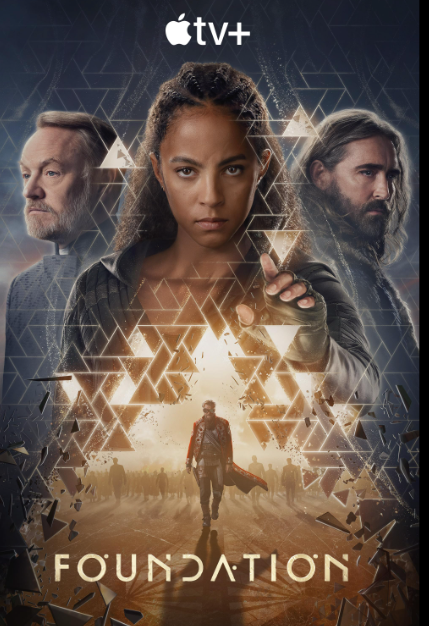
Foundation 3.7: The Origin of The Mule


Well, until the ending of Foundation 3.7 -- up on Apple TV+ today -- I was going to say it was a horrible episode, or maybe an episode about horrible things.   And it was.  Until it revealed to us the origin of a maniacal character, the arch enemy in Asimov's Foundation trilogy, and in this the third season of its adaptation on streaming television,

As I've been saying in all of my reviews of this season so far, it adheres to enough essential elements of Asimov's trilogy, and its sequels and prequels, to be immensely enjoyable, at least to me.  And it's been doing this while deepening and broadening the original story, as it's been doing and did again in 3.7 to our understanding of Demerzel.

[Spoilers ahead ... ]

But 3.7 did something that Asimov never did.  In his narrative, The Mule was a power-hungry mutant, who had the power to literally change people's minds.  We readers were supposed to assume, I guess, that the Mule was just born that way.  But episode 3.7 has finally given us a much narratively better explanation, by telling us The Mule's backstory.

The Foundation preyed upon The Mule's parents, by allowing them just one child.  The Mule's parents had two, and the Foundation representative gave them until its next soon-to-come visit to divest themselves of one of their children.  The father decided to save their baby and kill their son, I guess about 11 or 12 years old.  As the father was attempting to drown him, the boy discovered that he had the power to mentally direct his parents to drown themselves.

The whole scene was revolting to see. (Seeing or reading a  science fiction story in which children are hurt, or worse, is something I never want to do.*)  But the whole scene did raise the profound ethical quandary: if you could travel back in time, and eliminate Hitler as a baby, would you do it?

And now, after all these years, we have an answer as to how The Mule arose.  Had he not been nearly a victim of the worst kind of violence as a boy, perhaps his mental power would not have arisen.  Or, if it had, perhaps he would have used it for good, not evil.

And one last spoiler: the brief conversation The Mule has with Hari in the last moments of the episode -- that's with live Hari not his hologram, since we saw last week that the hologram has no knowledge of The Mule.  In a way, that's a happy ending.  It's good to see Hari Seldon alive.

*I guess a partial exception is the movie adaptation of Ray Bradbury's "The Last Night of the World" in The Illustrated Man.

Note added August 26, 2025:  I discussed this episode in depth the other evening on the Stars End Podcast:


See also
 Foundation 3.1: Now We're Talkin'! ... 3.2: "The Fault, Dear Brutus, Is Not in Our Stars" ... 3.3: Dawn and The Mule ... 3.4: Cleon Knows His PKD ... 3.5: Cleaving Closer to Asimov's Trilogy ... 3.6: Finally! But ... 

And see also Foundation 2.1: Once Again, A Tale of Two Stories ... 2.2: Major Players ... 2.3: Bel Riose and Hari ... 2.5: The Original Cleon and the Robot ... 2.6: Hari and Evita ... 2.7: Is Demerzel Telling the Truth? ... 2.8: Major Revelations ... 2.9: Exceptional Alterations ... Season 2 Finale: Pros and Cons

And see also Foundation 1.1-2: Mathematician, Man of the People, and Cleon's Clones ... Foundation 1.3: Clonal Science Fiction, Hari Seldon as V. I. Lenin ... Foundation 1.4: Slow Hand, Long Half-Life, Flipped Coin ... Foundation 1.5: What We Learned in that Final Scene ... Foundation 1.6: Folded Variations ... Foundation 1.7: Alternate History/Future ... Foundation 1.8: Divergences and Convergences ... Foundation 1.9: Vindication and Questions ... Foundation Season 1 Finale: Right Up There


Sunday, May 20, 2018

Fahrenheit 451: Updated for Fake News, Hate Speech, and DNA


I just saw the new Fahrenheit 451 - the HBO movie, based on Ray Bradbury's justly lionized 1953 novel of the same name, made into an excellent 1966 movie of the same name by François Truffaut.  The new HBO movie by Ramin Bahrani obviously had a lot to live up to with that kind of pedigree.  I'm here to tell you that it did - which puts me at odds with the numerous dyspeptic reviews it's already received on IMDb (at this point, 5.1/10), Rotten Tomatoes (32%), and Roger Ebert (2/4).  That's no surprise - I often find the established wisdom of professional and nonprofessional critics myopic.

But to the HBO movie - what I look for in a remake is something different, important, and if possible, more meaningfully current than in the original or earlier versions, while maintaining the best parts, including memorable details of the original.  Again, not an easy task.  But the new Fahrenheit 451 does it potently and beautifully.

The lie that Benjamin Franklin started fire brigades in America to burn rather than extinguish fires, with the truth that Franklin wanted fire fighters to put out fires being denounced as a lie, was one of the starkest parts of the original story.  It's in the new movie, too, but the truth is denounced as not just a lie but "fake" - a clear reference to our current crisis of fake news.

Another chillingly effective detail in the original is Captain Beatty extolling the "equality" of all books being burned, and holding up a copy of Mein Kampf as an example.  The scene is chilling because it tempts us to think that it's good if some books are burned - in this case, a book preaching hate, written by a monster who implemented that hate in the worst way. And the scene has special relevance to our struggle in 2018 with "hate speech" and what to do about it.  (See my The First Amendment in the Age of Post-Truth for my brief argument as to why we must not burn or censor it.)

But the new Fahreinheit also introduces something brand new to the story - which has gotten some critics crazy.  In the new ending ... wait, I won't tell you the ending, because I don't want to spoil it for you if haven't yet seen the movie.   But I can tell you the radically new element upon which the ending is predicated: our heroes do more than memorize books, so each person becomes a book, which is the inspiring, ennobling upshot of the original.   In the new movie, our heroes are also working on a plan to encode the text of every book, the digital code of every film, every piece of music, into DNA, where it can be stored and spread via biology. In other words, a good greater than any number of brave individuals.

Now I think that's a really cool departure from the original - and not just because I explored the biological potency and uses of information in my first novel, The Silk Code (reviewed here in The New York Times - one review I really liked).   But in the movie, this plan is brilliant and makes every sense.   After all, the villains are touting digital information (because it can be easily manipulated - another bow to fake news) over books, where the information is stable and reliable.  (The information in books has what I call "reliable locatability" - what's on page 77 of any book will be there on page 77 next week or next year or next century, as long as the book isn't burned.  See my New New Media, 2nd edition, p. 77 - not a novel - for more.)

Anyway - you needn't take my word for it.  See Fahrenheit 451 on HBO and see if you agree.


Monday, April 18, 2016

Fear the Walking Dead 2.2: Almost the Last Night of the World

Fear the Walking Dead is back on AMC for its second season, and up to its second episode, just on the air tonight.  As I said last year when I first began watching the first season, I like this series in some ways a lot more than The Walking Dead, as heretical as that might sound.  But the proximity of Fear to our normalcy, such as it is, makes it more compelling in some ways than the parent show, in which the world, or at least the East Coast of the US part of it, often seems like another planet.

Tonight's episode of FTHW continued the theme of this second season - to wit, the sea is no escape from either the infected, as they're called in this series, or humans already on the road to the pathology of the mind caused by the apocalyptic epidemic.  Indeed, in 2.2, we and our heroes learn there's no likely safe haven on shore, either, however far that might be from fallen LA.

The father of the family in the house on the shore is planning on doing a Jonestown on his wife, his kids, himself, as Nick sadly but aptly puts it.   What the father is planning is also reminiscent of Ray Bradbury's "The Last Night of the World" (in the 1969 movie, The Illustrated Man, screenplay by Howard B. Kreitsek, not in the original anthology), in which a scientist murders his children to spare them an horrific end of the world, only to wake the next morning with his wife to find the scientific predictions were wrong.

Of course, in Fear the Walking Dead, as in The Walking Dead, the end of the world is all too real. Still, it's a little early in both shows to murder your children to keep them from the infected, so the father in question in tonight's episode still deserved to be opposed.

As is also the case with both Walking Dead series, few rescue plans turn to be completely successful, and often are not at all.   The main takeaway of tonight's episode is Madison learning not only that you can't save everyone but you may well not be able to save anyone in this apocalypse aborning.

Strong stuff, and I'm looking forward to more.

And see also Fear the Walking Dead 1.1: Great Beginnings ... Fear TWD 1.2: Tobias Leads the Way ... Fear TWD Season 1 Finale: Water Water

#SFWApro

Tuesday, September 22, 2015

Blindspot 1.1: Good to See - Or, Coronet Blue meets The Illustrated Man

Good to see Blindspot begin on NBC last night - in fact, it was excellent.  Coronet Blue, the 1960s CBS summer replacement series fragment starring Frank Converse about a guy who washes up in New York with no memory and saying the words "coronet blue" was always one of my favorites, as is Ray Bradbury's 1951 anthology The Illustrated Man, about a vagrant whose tattoos each tell a magical, science fictional story.

Blindspot has elements of both, as well as Sullivan Stapleton (from Strike Back), an Australian with a great American accent, who plays Kurt, the lead FBI guy, whose name is tattooed on Jane Doe's the amnesiac's back.  She's played by Jaimie Alexander, who does well in her role, too.   The debut was fast-moving, and revealed enough important information to give hope for a compelling series.

Not enough information, being kept too much in the dark, is a pitfall with these kinds of shows, which Blindspot avoided.   We now know that Jane was/is some kind of Navy Seal - even though the Seals don't officially - yet - take women, though as FBI leader Bethany aptly remarks, maybe that's just their public stance.  And there's an evil guy with a beard afoot - who's apparently behind Jane's condition - though who knows for sure if he's entirely evil (and here Blindspot connects a little with NBC's other strange crime hit that begins with a B, Blacklist).

Back to The Illustrated Man, it looks as if given episodes of Blindspot might well be devoted to clues contained in the tattoos, which will be deciphered in series as the series progresses.  That's a good way of keep the stories fresh, as the underlying plot unfolds.

So I'm up for watching Blindspot.  I gotta say, though, that I liked Blacklist much better at the beginning than as the series went on, and I'm hoping Blindspot can avoid this kind of running out of tension and steam.

 
no tattoos, but pretty strange


Wednesday, May 21, 2014

Revolution: Farewell

Revolution aired the last of its episodes in its two-year run tonight.   Lots of it was excellent, and made me sorry the series was ending.  But one thing - the very ending - was just the opposite in every way.

Among the good things:  Charlie's talk to Miles about getting together with Rachel - made sense and would have been fun to see in a third season.   Bass keeping his word to Miles was a high point in both seasons.   And the Texas Rangers getting the jump on the President, preventing a war with California, was a fine piece of futuristic television, too.

But the ending ... well, I've been saying all season that the nanites were bringing the series down - whether in the sky or in people.  The only good nanite episode was Aaron believing he had gone back in time.  Otherwise, the nanites were as trite and obvious as you can get, not to mention that they had no intrinsic connection to the good post-apocalyptic black-out story.

Tonight's ending, I hate to say, made me glad this was the final season - because only nanites taking over my brain would have gotten me to watch more of what we saw on the screen at the end.   A walking dead zombie cadre which, as a nanite voice tells us, will make the Patriots look like bumbling children.  The only inviting thing about that storyline was the location of the zombie central - Bradbury, evoking the great Ray.

And so Revolution ends.  It had lots of potential, beginning with Charlie and her resonance to Hunger Games, and lots of other strong and memorable characters.  And a fine, sarcastic near-future repartee, like the mention of "Hillary" a few weeks back.   It's too bad it never found its footing - the nanites were to blame - but everyone associated with the show can be proud for the two good seasons it gave us.   Science fiction is a tough sell on television, and Revolution gave it a good shot.

See also Revolution 2.1: "The Last Surviving Friend" ... Revolution 2.2: Reanimation ... Revolution 2.4: Nanites and ... Maybe Aliens? ... Revolution 2.7: Firestarter Aaron vs. the Creepster ... Revolution 2.9: The Boy and the Attitude ... Revolution 2.10: Mexico and More ... Revolution 2.11: Captives and Nanites ... Revolution 2.12: Eugenics and Lubbock ... Revolution 2.13: Steve Tyler, Mummy ... Revolution 2.14: Time Travel! ... Revolution 2.15: Not Time Travel ... Revolution 2.16: The Manchurian Post-Blackout Candidate ... Revolution 2.17: Arabic Writing on the Wall ... Revolution 2.19: No to Nanites, Yes to Post-Apocalypse ... Revolution 2.20: Hillary

And see also Revolution: Preview Review  ... Revolution 1.2: Fast Changes ... Revolution 1.14: Nanites and Jack Bauer ... Revolution 1.15: Major Tom and More 24 ... Revolution 1.16: Feeling a Little Like the Hatch in Lost ... Revolution 1.17: Even Better Nanites ... Revolution 1.18: Whodunnit? ... Revolution 1.19: Cheney's Bunker ... Revolution Season 1 Finale: Good Pivot

#SFWApro


Like stories about near-future espionage?  Check out The Pixel Eye


Wednesday, October 27, 2010

NCIS 8.6: The Written Woman

Ray Bradbury's 1951 The Illustrated Man told the stories in tattoos all over a vagrant's body - it was a Canterbury Tales for the science fiction age.  Last night's NCIS 8.6 tells the story of a naval officer with all kinds of self-inscribed writing all over her body.   She's drugged and runs into the street and is killed by a car.  The team has to understand what she was trying to convey in her writing if they are to understand why she died.   The result is a cerebral, compelling episode of NCIS which resonates with Memento and Fringe.

My first thought that was that the ink in the self-inscriptions contained some kind of poison, quietly infused by the killer, which is what got Clea Thorson drugged (like Umberto Eco's The Name of the Rose, I suppose).  I wasn't that far off.  The poison came cumulatively from Clea's showers.   Meanwhile, Abby does a great job of cracking the code and Clea.  It was good to see her snap at Gibbs in the heat of the investigation - realistic.

My favorite line came from McGee this week.  When DiNozzo reveals the name of his new flame - Ethel - and waxes on about what the name means to him, McGee offers: "I've fallen, and I can't get up."  Point McGee!  The only name with an "E" that I can think of that's even more great-grandmotherly than Ethel would be Edna.

But DiNozzo polishes off the episode with a banging impersonation of John Travolta, in Saturday Night Fever garb.   Michael Weatherly could have a good career doing impersonations, if this NCIS gig ever gives him some time.

See also NCIS Back in Season 8 Action ... NCIS 8.2: Interns! ... NCIS 8.3: Tiff! ... NCIS 8.4: Gary Cooper not John Wayne ... NCIS 8.5: Dead DJ, DiNozzo Hoarse, and Baseball

And see ee also NCIS  ... NCIS 7.16: Gibbs' Mother-in-Law Dilemma ... NCIS 7.17: Ducky's Ties ... NCIS 7.18: Bogus Treasure and Real Locker ... NCIS 7.21: NCIS Meets Laura ... NCIS Season 7 Finale: Retribution


                 Special Discount Coupons for Angie's List, Avis, Budget Car, eHarmony, eMusic, Mozy, Zazzle


The Plot to Save Socrates


"challenging fun" - Entertainment Weekly

"a Da Vinci-esque thriller" - New York Daily News

"Sierra Waters is sexy as hell" - curled up with a good book


Sunday, October 5, 2008

Between Ray Bradbury and Telstar on Mad Men 2.10

Mad Men 2.10 began tonight with a mention of Ray Bradbury as an attraction for Paul in Pasadena and ended with the Tornados' 1962 instrumental hit "Telstar" playing on the plane as Don and Pete fly to Pasadena...

And in between, let's see ...

1. Betty's father suffers a stroke and is starting to go senile, which prompts a visit from Betty and Don. They have to stay in the same bedroom for appearances, and Betty, after consigning Don to the floor, joins him there in the dead of night to make love, once again. But not to worry, those in the audience who want Betty to be tough, this is just "pretend," as Betty tells Don as she sends him away, again, the next day when they get home. Will they be together at the end of this season? Choices being yes; no, Betty asks for a divorce; no, Betty starts up with someone else; no, Betty leaves town with the kids ... A lot more no's in there than yes's - but I think the yes still has a shot.

2. Glenn the neighbor's boy with a mad crush on Betty is briefly back in the picture - I don't know, not one of my favorite story lines...

3. Paul was supposed to go to Pasadena. That means he can't accompany his African-American girlfriend on a freedom ride down south. But Paul is able to recover, and go with her, when Don decides he wants to go to Pasadena himself. Paul's angry, but at least that cloud has a silver lining. I sometimes think there's not a single nice person on the show - which, come to think of it, is part of its attraction.

4. Trudy's in perfect baby doll pajamas asking Pete why can't they adopt ... and the office is celebrating Harry's impending fatherhood. Harry, played by Rich Somner who still looks to me like Isaac Asimov (speaking of science fiction writers and Ray Bradbury) is probably the happiest guy in the office ... But you get the feeling he's hanging on to that by a thread...

Lots of good situations to be resolved as the season moves well into its last quarter...


See also: Mad Men Returns with a Xerox and a Call Girl ... 2.2: The Advertising Devil and the Deep Blue Sea ... 2.3 Double-Barreled Power ... 2.4: Betty and Don's Son ... 2.5: Best Montage Since Hitchcock ... 2.6: Jackie, Marilyn, and Liberty Valance ... 2.7: Double Dons ... 2.8: Did Don Get What He Deserved? ... 2.9: Don and Roger ... 2.11: Welcome to the Hotel California ... 2.12: The Day the Earth Stood Still on Mad Man


And listen to my fabulous 20-minute interview last Fall with Rich Sommer (Harry Crane) at Light On Light Through


The Plot to Save Socrates


"challenging fun" - Entertainment Weekly

"a Da Vinci-esque thriller" - New York Daily News

"Sierra Waters is sexy as hell" - curled up with a good book


more about The Plot to Save Socrates...

Get your own at Profile Pitstop.com


Read the first chapter of The Plot to Save Socrates
.... FREE!

Thursday, September 25, 2008

Fringe 2 and 3: The Anthology Tightrope

What I most like about Fringe so far is the sheer diversity of its classic science fiction themes - slowing and accelerating aging last week, mental telepathy this week. Both had a good, plausibly scientific backdrop, putting Fringe clearly in the province of science fiction rather than fantasy or horror, a plus in my book. Fringe is thus coming out of the gate as modern day Science Fiction Theater with a touch of Twilight Zone, with even a little Ray Bradbury Illustrated Man dropped in.

But Fringe is also trying to do something more - go beyond unconnected anthologies, and underpin its multiplex science fiction with a story line that ties it all together. Dr. Walter Bishop - played by the always compelling John Noble - is at the center of this. He's a scientist whose diverse work decades ago is suddenly bearing harrowing but fascinating fruit right now.

There's also his partner - who may be at the core of the evil doing, and our government agents and officials, who presumably are trying to combat this, unless they're also trying to use it for their own ends.

It's a promising story. But it needs more clarification and development. Walking the tight rope between fine standalone episodes and a cool, unfolding, underlying plot is never easy - especially when the rope is woven of the complex, glittering strands of science fiction.

See also Fringe Begins ... Fringe 4: The Eternal Bald Observer


The Plot to Save Socrates


"challenging fun" - Entertainment Weekly

"a Da Vinci-esque thriller" - New York Daily News

"Sierra Waters is sexy as hell" - curled up with a good book


more about The Plot to Save Socrates...

Get your own at Profile Pitstop.com


Read the first chapter of The Plot to Save Socrates
.... FREE!

Tuesday, November 20, 2007

Journeyman Continues: 9: Dan Unravels His Present//Announcing Contest!

Two intense, important stories are going on in NBC's Journeyman right now. One, as reported in BuddyTV yesterday, is about how much longer NBC will continue the series. The future is stormy - the series could be pulled after next week's Episode 10.

To help keep the series alive, in whatever small way I can, I'm announcing a contest about next week's episode (look for it in this text after I conclude my review of Episode 9). But, first, my review...

Last night's episode was by far the best yet, and I've been pretty much saying that about every episode of Journeyman. It's one of my two-three favorite series now on television, and the best time travel series, ever.

It keeps pushing the envelope - which, in time travel stories, means playing ever more dangerously with the paradoxes time travel inevitably engenders.

Dan strays from his mission last night. Against Livia's advice, he does things he was not "meant" to do (we still do not know who is calling the ultimate shots and thereby the meaning). But, in the process, Dan undermines the crucial progress he has made with his brother Jack - who, on the basis of an event that first took place, was beginning to believe that Dan might really be time traveling, or at least not psycho. Dan's going beyond the plan in the past results in that crucial event not occurring, which leaves Jack in the present back to his doubting ways - which are now so much in the driver's seat that Jack is on his way to trying to get Dan committed ... (I'm reminded of Marshall McLuhan's great quip that the only people who have proof of their sanity are those who have been discharged from mental institutions)...

But this is just the tip of things "not going well" because of Dan's divergence from the plan - as Livia so aptly put it. Once you change just one thing in the past - as Ray Bradbury mapped out so well, so many ways ago, in his "Sound of Thunder" - your whole present and future can crumble around and on top of you...

Which raises an interesting point about Journeyman. Apparently, if Dan follows the plan - whoever is devising it - he's relatively free of paradox. Only if he diverges does he court disaster....

I look forward to finding out more next week, when this two-part episode concludes.

Which brings me to our CONTEST: Here it is: I will send a free, autographed copy of my own time travel novel, The Plot to Save Socrates, to the first person who e-mails me at

Levinson.paul@gmail.com

with the last word that Dan says on next week's episode.

I just want that last word, and I'll send the novel to the first person who e-mails me on gmail - "first" determined by the gmail time stamp.

You can see what the novel looks like, and read some of the blurbs about it, below.

But, more importantly, watch the show! Television will be at lot less compelling if it's taken off the air.

My reviews of other Journeyman episodes ... 1: NBC Quantum Leaps Into Journeyman ...2 ... 3 ... 4 ... 5 ... 6... 7 ... 8. Livia's Story ... 9. Dan Unravels His Present ... 10. Jack's In!... 11. Livia's Beau//Save the Newspaper, Save the World ... 12. The Perfect Time Travel Story ... Lucky 13


The Plot to Save Socrates


"challenging fun" - Entertainment Weekly

"a Da Vinci-esque thriller" - New York Daily News

"Sierra Waters is sexy as hell" - curled up with a good book


more about The Plot to Save Socrates...

Get your own at Profile Pitstop.com


Read the first chapter of The Plot to Save Socrates
.... FREE!

Thursday, October 11, 2007

Evolution of Science Fiction ... my 6-minute tour...


My infamous 6-minute tour on the history and evolution of science ... from The History Channel's 2002 Time Machine series...

From Mary Shelley through H. G. Wells, George Melies, Hugo Gernsback, Ray Bradbury, William Gibson ... I comment on all of them and more ... scientific romances, bug-eyed monsters, cyberpunk, and bio-tech science fiction ... with some really cool pictures as accompaniment...
InfiniteRegress.tv