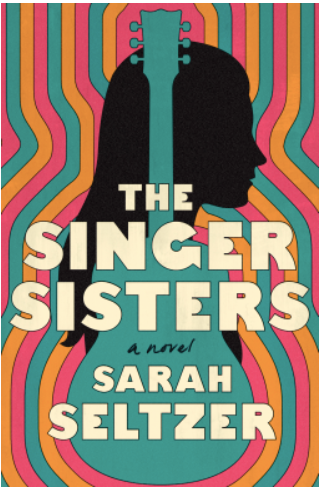
There's a meta-genre of fiction epitomized in different but overlapping ways by Eddie and the Cruisers, Rob Reiner's This Is Spinal Tap, and Daisy Jones and the Six -- the first and the third adapted to the screen from novels -- that helps us understand what those who make music that lights up our nights are doing when they're off-stage and not in the studio. Sarah Seltzer's The Singer Singers, a debut novel to be published this August, not only fits well in that narrative family, but in some ways exceeds it. I'd expect to see it adapted on some kind of screen before too long.
The Singer Sisters actually tells us two stories, deftly interwoven. One is a moving snapshot of the folk-rock music scene, and therein the larger music venue in which folk-rock played, in the last third of the 20th century. The other is a tableau of upper middle class Jewish culture, in New York City, Boston, and beyond, in the same period of time.
The Singers -- aka the Zingleman sisters -- strive to succeed across two tempestuous generations along with other fictional singers and writers, against a backdrop of real superstars that even non-devotees of folk-rock will instantly recognize. The characters worry about "stealing from Dylan". One of the singers concludes that "Joan Baez was right and Dylan wrong, that kindness mattered more than genius" (I would say that both are crucial). There's a quote from Gordon Lightfoot's "Early Morning Rain" -- "see the silver bird on high" -- and a mention of Phil Ochs (not a superstar but shoulda been). And there are fictitious characters that the cognoscenti will surely know, like the rock critic who uses his way with words to unfairly lambaste brilliant work (as the real rock critic did to Phil Ochs -- not to mention Paul McCartney). Meanwhile, the Singer songs are not only spoken of by the characters, but Seltzer actually delivers more than a dozen sets and snippets of original lyrics, demonstrating a considerable talent not only as a novelist but a lyricist, and leaving the reader yearning to hear them put to music and fulfilled in song. In addition to a movie or a limited TV series, The Singer Sisters also has the makings of a Broadway musical.
The Zingleman sisters are Jewish, and their Yiddishkeit permeates the novel, not only in cream sodas, but their parents' wise view that they'd rather see their children fed with goishe food than go hungry without it. In this sense, The Singer Sisters has a kinship with Philip Roth's Goodbye Columbus, and I hope the novel is recognized as the compelling portrait of Jewish culture in America that it is. It's especially important, given the rising wave of anti-Semitism that's afflicting our country and the world.
In case it's not obvious, The Singer Sisters is very much a woman's novel, explored in sisterhood, motherhood, and daughterhood, with love, heartbreak, pain, exultation, and a panoply of uniquely female emotion in every chapter. But men might well get a necessary education from this novel too, and I heartily recommend it to any human being.
============
my interview with Sarah Seltzer

"Paul Levinson's It's Real Life is a page-turning exploration into that multiverse known as rock and roll. But it is much more than a marvelous adventure narrated by a master storyteller ... it is also an exquisite meditation on the very nature of alternate history."
-- Jack Dann, Fiction Writer's Guide to Alternate History